

Scale AI in 2025–2026:
The $29B Bet That Just Got Complicated
Meta paid $14.3 billion for half the company. Google and OpenAI walked out the door. The founder left for the competition. This is the most honest, complete breakdown of what Scale AI actually is — and what its story means for anyone building or buying AI today.
What You Need to Know Right Now
- What Scale AI actually does (and why it matters)
- Valuation history: from $1B to $29B in 6 years
- The Meta deal — and the mess it created
- How Scale AI’s products actually work
- Real-world deployments and outcomes
- The risks nobody is talking about
- Who’s competing — and gaining ground
- What comes next: 2026 predictions
- Should your organization use Scale AI?
- FAQ
What Scale AI Actually Does
Here’s the version nobody usually tells you: Scale AI is essentially a quality control factory for AI. Not glamorous. But absolutely essential.
Every AI model you’ve ever used — GPT-4, Gemini, Claude, Llama — was shaped by vast amounts of human-labeled training data. Someone had to look at a photo and say “this is a pedestrian.” Someone had to read two AI responses and judge which was more helpful. Someone had to test whether a model could be tricked into generating harmful content. Scale AI built the infrastructure to do all of that — at a scale that one company, or even ten companies, could never manage alone.
The company launched in 2016 as a simple API for image annotation. Autonomous vehicle companies were the early customers — they needed millions of labeled road images, fast. Scale delivered. By 2020, it had crossed $100M in annual revenue almost entirely on the backs of GM’s Cruise, Lyft, and Voyage.
Then the large language model wave hit. And everything changed.
“Quality training data is the secret ingredient in AI. Meta wanted the best.”
— AI Funding Tracker analysis of the Scale AI–Meta deal, 2025
OpenAI, Anthropic, Google, and eventually every serious AI lab discovered they needed something Scale had perfected: Reinforcement Learning from Human Feedback (RLHF). The technique that makes raw language models feel like actual assistants rather than autocomplete tools on steroids. Scale became the go-to provider for that human feedback loop — employing not just anyone, but specialists. PhD scientists. Senior engineers. Domain experts in medicine, law, finance.
From $1B to $29B: A Valuation History
The growth curve is worth seeing, because it tells you more about the AI data industry than any market report.
The Meta Deal — And the Mess It Created
On June 12, 2025, Scale AI made its biggest announcement ever. Meta had invested $14.3 billion for a 49% non-voting stake, more than doubling the company’s valuation to $29 billion overnight. Alexandr Wang called it a “deeply unique moment.” The press called it transformational.
Then the clients started leaving.
Within weeks of the Meta deal closing, Google, OpenAI, xAI, and Microsoft reduced or paused their Scale AI engagements. Google alone had planned to spend $200M with Scale in 2025 to train Gemini. That deal is gone. The reason is obvious: these companies don’t want their proprietary training data anywhere near a company 49% owned by their main competitor.
Think about it from Google’s perspective. You’re sharing your most sensitive AI training strategies — your data, your fine-tuning approaches, your evaluation frameworks — with a vendor that now has Meta sitting in its boardroom. Even with legal firewalls and contractual guarantees, would you feel comfortable? Google’s answer was no. So was OpenAI’s.
The irony runs deep. The Meta deal was supposed to be Scale AI’s coronation moment. Instead, it exposed what may be the company’s most fundamental vulnerability: its entire business depends on being trusted by competitors who are also each other’s enemies. Data neutrality isn’t just a nice-to-have. It’s the whole product.
What the Numbers Show
| Client | Estimated 2024 Spend | 2025 Status | Reason |
|---|---|---|---|
| ~$150M | Terminated | Data confidentiality / Meta conflict | |
| OpenAI | Significant | Cut ties | Competitive conflict with Meta |
| xAI (Elon Musk) | Growing | Reduced / paused | Exploring alternative providers |
| Microsoft | Significant | Stepping back | Competitive concerns |
| Meta | Core client | Expanded | Now the dominant investor |
| U.S. DoD | $100M+ contract | Active / growing | Defense AI programs ongoing |
Scale’s interim CEO Jason Droege acknowledged the challenge directly, pointing to “over-rapid gen-AI capacity expansion” as one driver of a July 2025 layoff that cut 200 full-time employees — roughly 14% of the workforce — and ended contracts with approximately 500 additional workers.
This is the classic platform trap. The moment your infrastructure provider gets acquired by a competitor, you have to assume your data isn’t safe — regardless of legal protections. Scale AI is now learning what happens when the trust underlying a B2B infrastructure business evaporates. Sacra’s analysis put it sharply: a single structural transaction rapidly hollowed out the customer base.
That said — Scale described 2025 as its strongest financial year ever. Revenue is estimated at $2B (up from $870M), new business signed exceeded $1B, and its applications division more than doubled revenue in the second half of the year. The defense sector and international public-sector business both grew sharply. So the picture is complicated: customer flight at the top end, but strong growth in areas that don’t care about the Meta conflict. Government agencies, defense contractors, and non-competing enterprises are still buying.
How Scale AI’s Products Actually Work
Beyond the headlines, Scale AI runs on four core product lines. Understanding the distinction between them matters if you’re evaluating the platform for your own use.
1. Data Labeling — The Original Engine
This is where Scale started and it’s still the foundation. Independent contractors on Scale’s “Taskers” platform annotate text, images, audio, and video at scale. Two variants exist: managed labeling projects (where Scale owns the quality process end-to-end) and API-based labeling (where engineering teams plug directly into the pipeline).
The critical differentiator — and this is what separated Scale from cheaper alternatives early on — is the quality verification layer. Raw crowd-sourced annotation is notoriously inconsistent. Scale built systematic audit processes, disagreement resolution, and accuracy benchmarking on top of the human labor. That’s what AI labs were actually paying for.
2. RLHF — The Product That Made Scale Famous
Reinforcement Learning from Human Feedback is the technique that turns a raw language model into something usable. You show human evaluators pairs of model outputs and ask them to pick the better one. Repeat millions of times. The model learns what “better” means to humans.
Scale’s RLHF platform handles the entire pipeline: recruiting qualified evaluators (often domain experts, not general crowd workers), designing evaluation criteria, managing the feedback collection, and processing it into training signals. OpenAI used Scale extensively for this. So did Anthropic. So did Google.
One dirty secret of RLHF: a thousand preferences from well-briefed expert evaluators outperforms ten thousand preferences from general crowd workers. Scale figured this out early. The shift toward PhD annotators and senior engineers that the industry noticed in 2024? Scale had been moving in that direction for two years already.
3. Generative AI Platform (Scale GenAI)
The enterprise-facing product for building custom AI applications. This is where Scale shifted in 2023–2024 as the market matured. Rather than just selling data services, Scale wanted to own the full deployment stack: build your model, evaluate it against custom benchmarks, red-team it for safety, and monitor it in production.
Features include: custom LLM fine-tuning on proprietary data, automated evaluation frameworks, adversarial testing (red teaming), and model performance monitoring. Enterprise clients get dedicated support and security controls, including support for classified environments.
4. Defense & Government — Donovan and Thunderforge
Scale’s fastest-growing vertical and, notably, the one least affected by the Meta fallout. The Donovan platform processes unstructured intelligence data for operational decisions. The Thunderforge project — a March 2025 Pentagon contract — uses AI to assist military planners with ship and aircraft movement planning.
Government clients are less sensitive to the Meta relationship (a foreign-policy adversary situation, not a commercial competitor one). And once you’re credentialed and cleared for classified work, switching costs are enormous. This is why Scale’s international public-sector revenue doubled in 2025 and is projected to double again in 2026.
| Product | Primary Buyers | Status After Meta Deal | Growth Trajectory |
|---|---|---|---|
| Data Labeling | AI labs, tech companies | At risk (client flight) | Flat to declining |
| RLHF / Model Training | Foundation model labs | Significantly impacted | Declining with big labs |
| GenAI Platform | Enterprise, non-AI companies | Largely intact | Growing |
| Defense / Government | DoD, NATO, allied govts | Accelerating | Strong growth (2×+ YoY) |
Real-World Deployments: What Scale AI Looks Like in Practice
Self-Driving Perception Models
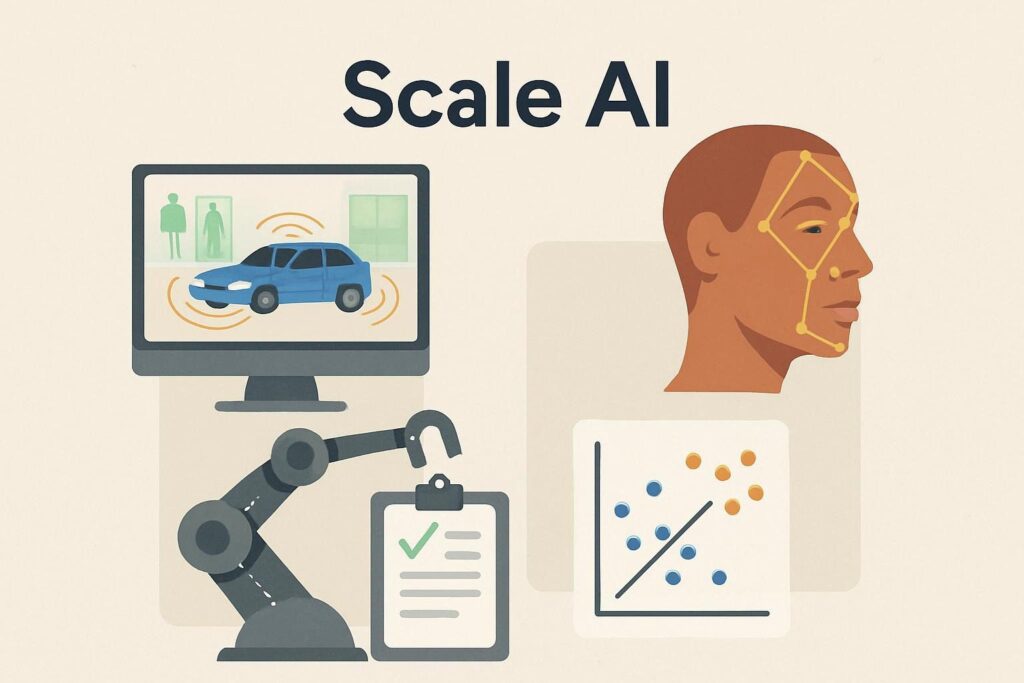
A major autonomous vehicle manufacturer came to Scale with a brutal problem: millions of hours of raw dashcam footage that needed to be labeled for pedestrian detection, traffic sign recognition, and edge-case scenario classification. Purely automated labeling tools were missing the 2% of edge cases that actually matter for safety.
Scale’s solution paired their computer vision annotation pipeline with a systematic edge-case curation process — human annotators specifically trained to flag unusual scenarios that the automated system would skip.
The 2% of edge cases that automated tools miss are exactly the 2% that cause accidents. No amount of cheap annotation volume compensates for missing those.
Domain-Specific LLM for Financial Analysis
A Fortune 500 financial services firm wanted a large language model that could reliably analyze complex financial documents — earnings reports, regulatory filings, credit agreements — without the hallucination problems that plagued general-purpose models.
Scale implemented a custom RLHF pipeline with financial expert evaluators: CFAs, CPAs, and former analysts who could actually judge whether a model’s interpretation of a 10-K was accurate. General crowd workers, however well-briefed, simply can’t do this job.
Domain expertise in the feedback loop isn’t a nice-to-have. For regulated industries, it’s the difference between a model that’s useful and one that’s a liability.
Donovan: AI-Assisted Military Decision-Making
The Pentagon’s $100M+ Donovan contract required Scale to deploy AI in classified environments — secret and top-secret networks — to process unstructured intelligence data at what the DoD calls “mission speed.” This isn’t about chatbots or document summarization. It’s about helping analysts synthesize vast information streams and surface the most operationally relevant signals.
Intelligence processing at mission speed across classified networks
Government work is unglamorous to win but almost impossible to lose. Security clearances, compliance infrastructure, and institutional trust don’t transfer to a competitor easily.
The Risks Nobody Is Talking About Enough
Beyond the customer flight problem — which everyone is covering — there are two structural risks that deserve more attention.
Risk 1: Synthetic Data Could Make Human Annotation Obsolete
Here’s the uncomfortable truth that Scale’s investors are quietly thinking about: the better AI models get, the less you need humans to label data. If a frontier model can generate synthetic training data that’s as good as human-labeled data — and evaluate other models without human input — then Scale’s core business model starts to look shaky.
OpenAI and Anthropic are investing heavily in techniques that reduce dependence on human annotation: Reinforcement Learning from AI Feedback (RLAIF), constitutional AI, and increasingly capable self-evaluation. The trend toward smaller, domain-specific expert annotators (rather than large generalist crowds) is already underway. xAI laid off roughly 500 generalist annotators in 2025 — about a third of its labeling team.
Scale’s bet is that the shift toward specialized expert annotation creates more value, not less. High-quality expert feedback doesn’t get automated out quickly. But this is a real strategic risk, not a hypothetical one.
Risk 2: Data Security — A Real Incident, Not a Hypothetical
Reports revealed that Scale AI inadvertently left thousands of sensitive project documents accessible via public Google Docs links — exposing confidential client data and contractor information to unauthorized access. For a company whose value proposition is data trust, this is about as bad as it gets.
This incident didn’t get as much attention as the Meta deal. But for enterprise buyers evaluating Scale AI, it should weigh heavily. The moment you’re handing over proprietary training data and fine-tuning strategies, your vendor’s security posture becomes your risk surface.
Risk 3: The Surge AI Threat
Surge AI raised $1 billion in July 2025 at a $25 billion valuation. Reports indicated that Surge had quietly surpassed Scale in revenue — pulling in $1B in 2024. That’s a direct competitor, well-capitalized, without a $29B Meta millstone creating trust issues. Labelbox reported “hundreds of millions” in new revenue from clients leaving Scale. Handshake reported tripled demand.
Competition in the data labeling space is intensifying precisely at the moment Scale needs it least.
Who’s Competing — And Gaining Ground
The post-Meta landscape created an opening. Multiple players are moving fast to fill it.
Reportedly surpassed Scale in revenue. No Meta conflict. Well-positioned to absorb departing Scale clients.
Google is already engaging Labelbox as a Scale replacement. CEO expects hundreds of millions in new revenue.
Smaller but growing rapidly among AI labs that want a truly neutral provider.
Google is reportedly evaluating Turing alongside Labelbox as a Scale replacement.
The real competitive advantage Scale AI still holds: government clearances and defense relationships. No startup competitor has Donovan. No startup competitor has the security infrastructure for classified environments. That moat is genuinely hard to replicate, and it’s increasingly where Scale’s growth story lives.
What Comes Next: 2026 Predictions
Scale AI Will Increasingly Be a Defense Company
This isn’t speculation. The numbers point clearly in this direction. International public-sector revenue doubled in 2025 and is projected to double again in 2026. Commercial AI labs are leaving. Government agencies are not. Scale has every incentive to lean into clearances, compliance infrastructure, and classified deployment capabilities — the three things that commercial competitors can’t easily copy.
The CEO Situation Needs Resolution
Jason Droege is “interim” CEO. That’s an unstable situation for a $29B company navigating a strategic crisis. Watch for either a permanent CEO appointment or, potentially, an announcement about Wang’s future relationship with the company once the Meta Superintelligence Labs work matures.
Synthetic Data Is the Sword of Damocles
The transition from human-labeled to synthetic training data will be gradual — not sudden. But 2026 is probably the year the industry will start to understand the timeline more clearly. Scale’s move toward specialist annotators (rather than generalist crowds) is the right hedge. The question is whether they can retool fast enough.
Here’s what the bearish narrative misses: Scale described 2025 as its strongest year ever, with $2B in revenue, well over $1B in new business signed, and its data business turning profitable. The company lost its most prestigious commercial clients — but may have been too dependent on them anyway. A more diversified revenue base, anchored by defense and non-AI-lab enterprise clients, could actually be healthier long-term.
Should Your Organization Use Scale AI? A Practical Guide
The Meta situation has changed the calculus. Here’s an honest framework for evaluating whether Scale AI makes sense for your specific situation.
Scale AI Is Likely the Right Choice If:
- You’re a government agency or defense contractor — Scale’s classified capabilities are genuinely hard to replicate
- You need specialized domain expert annotation (medicine, law, finance) at scale — this is still Scale’s strength
- You’re a non-tech enterprise building AI on top of existing models, not training foundation models from scratch
- You need RLHF for non-competitive applications where Meta conflict isn’t a concern
- Your use case involves computer vision, robotics, or sensor data rather than LLM training
You Should Think Twice If:
- You’re an AI lab competing directly with Meta — the trust issue is real, not theoretical
- Your data is highly proprietary or competitively sensitive and you can’t risk even perceived leakage
- You’re building frontier foundation models that compete in Meta’s market areas
- Your organization has strict vendor neutrality requirements for AI infrastructure
Implementation Checklist
- Define specific AI use cases and success metrics before vendor discussions
- Conduct a data residency audit — understand exactly what data you’ll be sharing
- Evaluate the Meta conflict specifically: does your organization compete with Meta?
- Assess your security requirements: do you need classified environment support?
- Start with a pilot project ($50K–$100K range) before enterprise commitment
- Build in evaluation metrics from day one — accuracy, cost per sample, turnaround time
- Plan your integration with existing MLOps pipelines (Scale integrates with TensorFlow, PyTorch, major clouds)
- Review Scale’s data governance policies — confirm data ownership remains yours
Frequently Asked Questions
Is Scale AI publicly traded?
Who is running Scale AI after Alexandr Wang left?
What happened to Scale AI’s relationship with Google and OpenAI?
How much does Scale AI cost for enterprises?
What is RLHF and why does it matter for Scale AI?
Is Scale AI safe for handling sensitive data?
What is Scale AI’s biggest long-term threat?
Sources & References
Scale AI — Official announcement: Meta investment & leadership transition
TechCrunch — Scale AI confirms Meta investment, Wang departure (June 2025)
CNBC — Alexandr Wang confirms departure for Meta
Sacra — Scale AI revenue, valuation & funding analysis
Deep Research Global — Scale AI SWOT Analysis (2026)
TechBeams — Google terminates Scale AI partnership
TSG Invest — Scale AI valuation deep dive
Brookings — When AI companies compete with their customers (March 2026)
AI Business Success Stories 2026
7 Generative AI Use Cases Actually Delivering ROI in 2026 (Not Just Pilot Projects)
AI Tools That Might Change the Internet More Than ChatGPT
The Fastest-Growing AI Companies: Revenue, Valuations & What’s Really Driving the Boom
AI INFRASTRUCTURE: INVESTMENT THESIS 2.0
AI in Business 2026: 7 Rigorously Verified Case Studies
The Top AI Companies in India: Advice That Sounds Right—But Is Quietly Holding You Back
Top 10 Trending AI Startups in the USA for 2026
AI Video Generation: Enterprise Deployment Trade-offs in Late 2025
OpenAI Prompt Engineering Guide 2026 – Master AI Prompts
601 Google Cloud AI Use Cases 2026: Industry Guide with Real ROI Data
88% of Companies Say They Use AI—Only 7% Actually Produce Anything With It: The $47B Governance Arbitrage of 2026
McKinsey AI Use Cases: The Game-Changing Applications Transforming Business Operations