AI Writing Tools Can Double Your Traffic. Most Sites Get the Order Wrong.
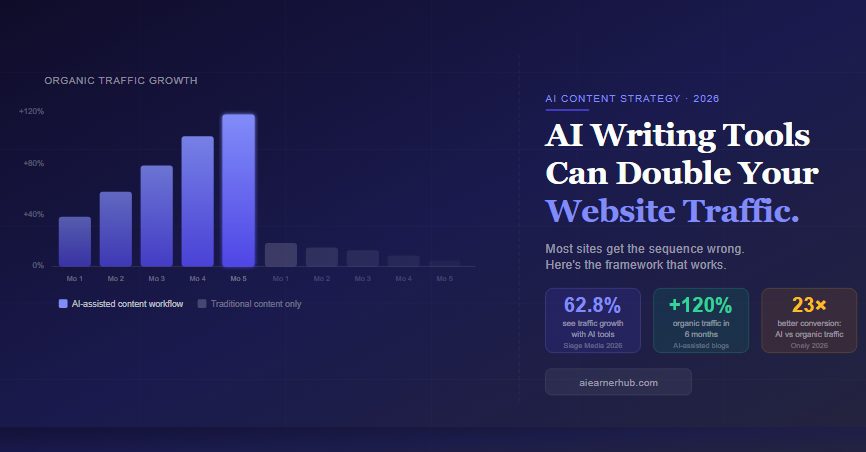
62.8% of sites that deploy AI writing tools see traffic growth. 36.4% see a decline. The difference isn’t which tool they use. It’s the sequence.
Here’s the number nobody in the “AI content” space wants to talk about: in the most recent Siege Media dataset covering real content teams, 36.4% of sites using AI writing tools saw a traffic decline. Not flat. Decline. The same tools, roughly the same content categories, almost opposite outcomes.
The divergence isn’t random. It maps almost perfectly to one thing: whether teams used AI to think faster or to publish faster. The first group doubled their traffic. The second torched whatever domain authority they’d spent years building.
This is not a guide about which AI tool to buy. It’s about the operational sequence that separates the 62% from the 36%, using the specific mechanics that Google’s algorithm has evolved to reward in 2026 — and the ones it’s specifically hunting for to penalize.
What the 2026 data actually shows — not what vendors want you to see
The AI writing industry’s marketing works like a magician’s hand: watch the 120% organic traffic figure, don’t watch the 36% who lost ground. Both are real numbers from the same Siege Media dataset. The difference is context, and context is what vendors omit.
The uncomfortable truth embedded in this data: AI content adoption is now near-universal. If 97% of marketers are using these tools, “using AI” is no longer a competitive advantage. It’s a floor. The sites gaining traffic have moved past tool adoption into process design — specifically, into workflows that force editorial judgment into the production chain at the right moments.
The sites that lost traffic didn’t fail because they used AI. They failed because they removed the one thing Google’s algorithm has gotten dramatically better at detecting: original human judgment. Not human-sounding prose. Judgment. The kind that surfaces a counterintuitive angle, cites something that didn’t appear in the top-10 results, or admits what the article doesn’t know. More on how Google detects this below — because the mechanism matters for how you build your workflow.
How Google’s ranking system scores AI content in 2026 — the actual mechanism
The March 2024 core update folded the Helpful Content system into Google’s core ranking algorithm. It’s no longer a separate “update” you survive and move on from. As of 2026, content quality signals run continuously, not in periodic waves. This matters operationally: there’s no safe window to publish weak content between updates.
Third-party analysis of Google’s algorithm in 2026 points to what practitioners are calling an “Information Gain” score: a mathematical measure of how much unique value a page adds beyond what already exists in the index. This is not keyword coverage. It’s the delta between your page and the competition. Raw AI output trained on the existing web can not, by definition, score well here — it is the existing web, redistributed.
The specific failure mode Google now catches
Sites that deployed unedited AI content at scale in 2024 saw dramatic drops, including gaming sites, review aggregators, and programmatic blog networks. The signal Google was following wasn’t AI detection — it was engagement collapse. When bounce rates spiked and dwell time crashed on AI-slop pages, Google adjusted rankings within the same crawl cycle. The detection was behavioral, not textual. This is why the advice to “make AI content sound more human” misses the point entirely — if the content doesn’t actually serve the reader, engagement will expose it regardless of how natural the prose sounds.
What Google’s Quality Rater Guidelines say is worth stating plainly: AI content is acceptable, but only if it adds real value. Keyword-stuffed, derivative content won’t rank. The algorithm now has enough signal from user behavior, page quality assessments, and link graph analysis to find derivative content even when it’s syntactically polished.
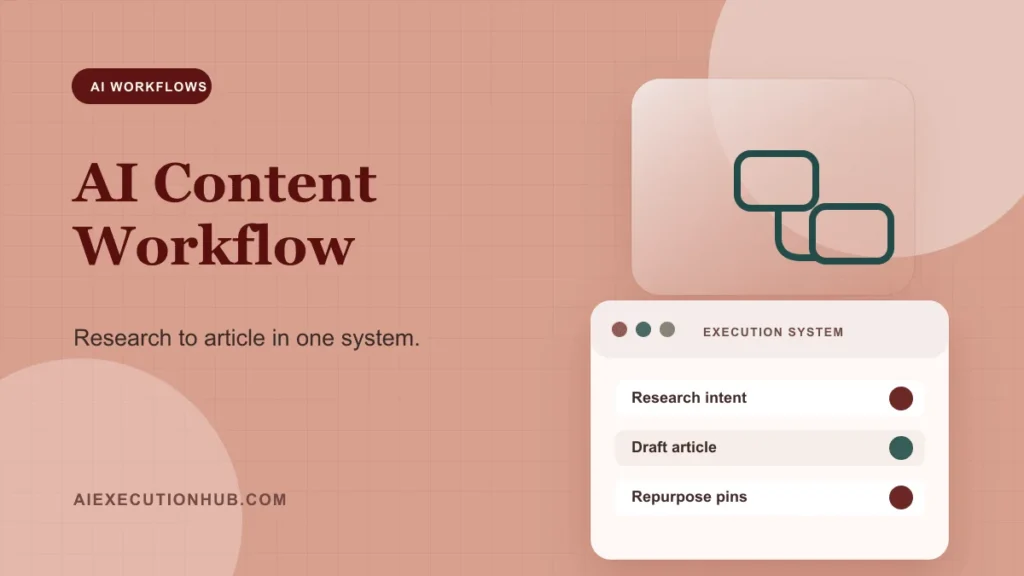
The four-phase workflow that actually works
What follows isn’t a vendor workflow or an agency sales pitch. It’s reconstructed from the overlap between what the Ahrefs analysis of 900,000 newly created pages found about high-performing AI-assisted content, and the operational patterns of the sites that showed up consistently in the 62.8% traffic-growth cohort.
The core insight: AI tools are best at compressing the parts of content creation that don’t require judgment. Human editors are scarce and expensive. The workflow below engineers the handoffs so AI handles volume, humans handle insight, and the final product has the fingerprints of both — which is exactly what Google’s algorithm rewards.
Research phase: use AI to exhaust the obvious, find the gap
Before writing a single word, use an AI tool (Claude works particularly well for this; its long context window lets you feed it 10+ competitor articles simultaneously) to generate a comprehensive map of what existing content covers. The goal is inversion: you’re not looking for what to write, you’re looking for the question nobody has answered yet, the data nobody cited, the counterexample nobody included.
This takes about 20 minutes and produces something most content teams never generate: a genuine information gap. Fill that gap in your piece and you’ve satisfied the Information Gain criterion almost automatically. Skip this step and you’re writing a more expensive version of the content that already exists.
Drafting phase: AI writes the scaffold, not the piece
The most effective use of AI drafting in 2026 is structural, not creative. Use it to produce a complete first draft of the parts that require synthesis without judgment: definitions, background context, procedural steps, data summaries. These sections exist in nearly every article on a given topic. AI can produce a competent version in seconds. You shouldn’t spend editorial time on them.
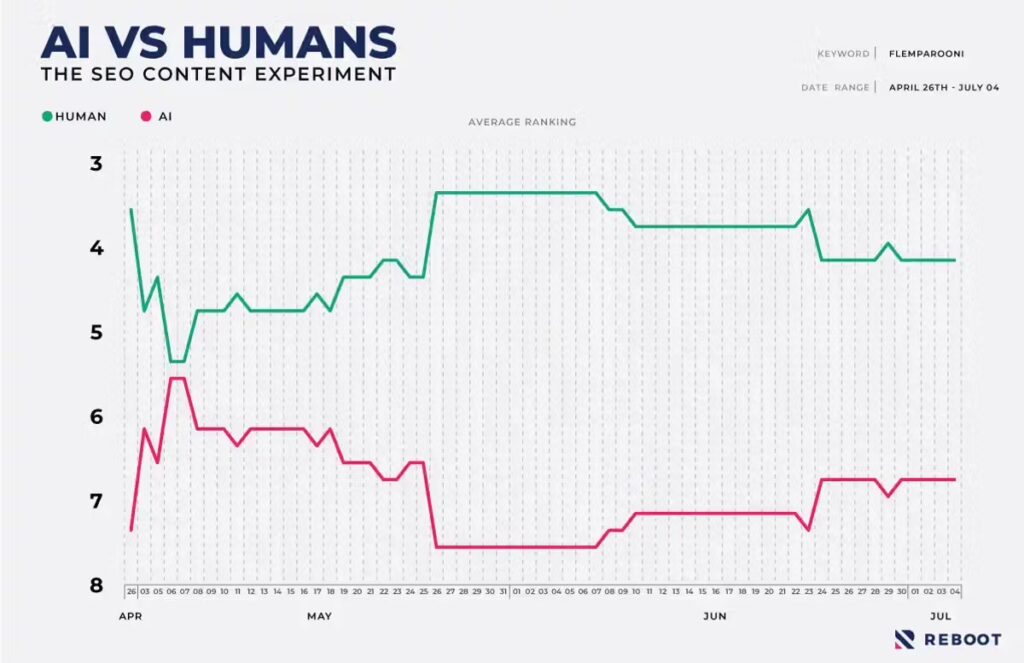
What AI should not write in your workflow: the opening paragraph, any section that depends on your own experience or testing, contrarian claims, and the closing. These are where your Information Gain lives. Hand-write them. The hybrid approach — documented by an Ahrefs/AllAboutAI case study — showed 2.4x better SEO performance than pure AI output while using 68% less time than human-only production. That ratio is the target.
Editing phase: the anti-pattern scan
Before publishing anything AI-assisted, run a deliberate check for what Google’s Quality Raters are specifically looking for. This is not about AI detection tools — those are largely theater. It’s about the reader experience signals that will determine whether your engagement metrics support or undermine your ranking.
The specific phrases that tank dwell time because readers recognize them as AI output: “dives into,” “comprehensive guide to,” “in today’s rapidly evolving,” “it’s important to note,” “game-changer,” “revolutionize.” These aren’t wrong because they’re AI-generated. They’re wrong because they signal that nobody who actually knows the topic edited this piece. A reader who knows the field bounces. Google sees the bounce. You lose the ranking.
Maintenance phase: the part everyone skips
Google’s Helpful Content system evaluates content continuously, not at publication time. A page that ranked well in January 2026 because the information was accurate can start losing ground by April if the field has moved. AI tools make it cheap to refresh content. Build a quarterly review into your workflow using the same AI-assisted research process from phase one — compare what your page says against current top results and flag the delta. This is dramatically cheaper than letting rankings decay and attempting recovery SEO later.
Which tools actually move the needle — and for which tasks
The AI writing tool market in 2026 is crowded enough that tool choice matters less than workflow design, but it’s not irrelevant. The three dominant platforms — ChatGPT (GPT-5.4), Claude (Opus 4.6 / Sonnet 4.6), and Gemini (3.1 Pro) — have meaningfully different strengths that map to different phases of the workflow above.
| Tool | Best for | Traffic workflow fit | Notable limitation | 2026 pricing |
|---|---|---|---|---|
| Claude Opus 4.6 / Sonnet 4.6 | Long-form research, editing manuscripts, competitive gap analysis | ✓ Research + Editing phases | Less capable at image generation; best at text | Pro from ~$20/mo |
| ChatGPT (GPT-5.4) | Versatile drafting, custom GPTs for content workflows, broad task range | ✓ Drafting phase, especially structured content | Can produce plausible-sounding but unverified facts at speed | Plus from $20/mo |
| Gemini 3.1 Pro | Research-heavy writing, Google Docs integration, real-time data | ✓ Research phase; best with current events | Less natural long-form prose than Claude or ChatGPT | Advanced from $19.99/mo |
| Surfer / Clearscope / MarketMuse | SEO optimization overlay, keyword density, competitor benchmarking | Post-draft optimization only | Over-reliance creates “optimized” content that reads like a spreadsheet | From $49–$179/mo |
| Perplexity / You.com | Real-time cited research, fact verification | ✓ Research phase source verification | Not a writing tool; use as a research layer only | Free tier available |
The second traffic source nobody is optimizing for yet
Here’s the development that fundamentally changes the content strategy calculus in 2026: AI referral traffic is converting at rates that make traditional organic traffic look inefficient.
These numbers are worth sitting with for a moment. A source that generates 0.5% of your traffic accounts for 12.1% of your signups. That’s not a rounding error in a dataset — that’s a structural insight about intent. People arriving from ChatGPT, Perplexity, or Google’s AI Overviews have already done research. They’re not browsing. They arrived because an AI system decided your content was authoritative enough to cite.
This creates a second optimization target beyond Google’s blue links: AI citation visibility. The content that gets cited by large language models shares specific characteristics — it tends to be factually dense, clearly structured, cites primary sources, and includes the kind of specific details (exact figures, named methodologies, attributed quotes) that AI systems use as evidence of reliability. This is, not coincidentally, also the content that ranks well in Google’s organic results under the Information Gain framework.
The operational implication: the workflow that doubles your Google traffic is essentially the same workflow that earns you AI referral citations. The two goals don’t compete. They reinforce each other. Sites optimizing for one are getting the other as a side effect.
The specific mechanics — not “use AI more,” but where and how
Traffic doubling is a real outcome. The Siege Media data showing 120% organic traffic growth in six months comes from teams using AI-assisted blog writing — which is specific enough to be useful. Here’s what the operationally precise version of that looks like.
Publish cadence: the arithmetic of compounding
The most straightforward path to doubled traffic is doubled publish cadence at equivalent quality. If AI tools let you produce 3 articles per week instead of 1.5, and you maintain editorial quality across that volume, you will approximately double your crawled pages, your indexed content surface, and eventually your keyword coverage — which compounds into traffic growth over a 3–6 month period as pages mature in the index.
This only works if the quality holds. Every piece of thin content you publish actively cannibalizes authority from your strong pages. The calculation isn’t “more content = more traffic.” It’s “more quality content = more traffic.” The failure mode is publishing 3× the volume at half the quality and ending up with worse aggregate rankings than your original pace.
Topic clustering: the structure AI helps you build faster
AI tools compress the research phase of topic clustering from a multi-day exercise to an afternoon. A topic cluster — a pillar page supported by 8–12 satellite articles — is the content architecture that Google’s algorithm most reliably rewards with authority signals. Build one cluster per quarter, linked coherently, and you’re compounding domain authority rather than distributing it across disconnected one-off articles.
For a site like AIEarnerHub operating in the AI tools and monetization space, a coherent cluster might be: one pillar on AI content workflows, surrounded by satellite pages covering specific tools, specific use cases, measurement approaches, and common failure modes. Each satellite links to the pillar. The pillar links to each satellite contextually. Google reads the cluster as a signal of topical authority. The individual pages rank better because the cluster ranks better.
The editing multiplier: where AI pays back its cost most reliably
The most underrated use of AI in a content workflow is editing, not writing. The Siege Media data shows that content marketers using AI for editing doubled from 19% to 38% between 2025 and 2026 — faster growth than any other application. Editing use cases where AI outperforms human speed without sacrificing quality: structural consistency checks, passive voice elimination, reading level analysis, factual claim flagging for verification, and detecting the specific phrases that signal AI origin to engaged readers. Use AI for this and you free human editorial time for the one thing AI reliably can’t replicate: inserting the observation that only you have.
Three approaches that are actively destroying traffic right now
These are not theoretical risks. They’re the specific behaviors that explain the 36.4% decline cohort.
1. Programmatic content at scale with no editorial layer
Publishing hundreds or thousands of pages generated from AI with only minimal template variation is what Google explicitly calls “scaled content abuse.” The March 2024 core update targeted this specifically and the enforcement has intensified with each subsequent update. Sites that built traffic this way before 2024 lost it. Sites doing it in 2026 will lose it faster, because Google’s detection for this pattern has improved materially. This includes “AI-assisted” content where the only human involvement is pressing publish.
2. Chasing topics outside your domain expertise
Google’s algorithm now penalizes sites that publish off-topic content to capture search traffic. This was always a signal, but it’s become a harder constraint in 2026. A site that has established authority in one area and then pivots to trending topics in adjacent spaces sees a dilution of topical authority signals. The AI tools make it easy to generate plausible content on any topic — but “plausible” and “authoritative” are different things, and Google’s algorithm is increasingly capable of telling them apart based on the surrounding domain context.
3. Treating SEO optimization as a substitute for content quality
The sites that over-indexed on keyword optimization tools at the expense of actual content substance are consistently underperforming. As one practitioner put it bluntly: the pages that rank in 2026 are not the ones that hit a keyword density target. They’re the ones readers stay on. Keyword optimization tools should be a final-pass audit on content that’s already good, not a production guide for content that’s thin.
Measuring it: the metrics that actually tell you if it’s working
Content teams deploying AI tools often measure the wrong things — specifically, output metrics (articles published, words generated, turnaround time) instead of outcome metrics. If you’re doubling output volume but your organic traffic is flat or declining, you’ve optimized the wrong variable.
| Metric | What it tells you | Target signal | Red flag |
|---|---|---|---|
| Organic impressions (GSC) | Whether Google is indexing and surfacing your content | Steady weekly growth across keyword portfolio | Flat or declining while publish cadence increases |
| Average position (GSC) | Ranking quality of indexed pages | Gradual improvement as pages mature (3–6 months) | High impression volume, poor average position — AI slop signal |
| Dwell time (GA4) | Whether readers are actually reading your content | >2 min for long-form; >90 sec for 1,000-word pieces | Sub-60 second average — content isn’t holding attention |
| AI referral traffic (GA4 source/medium) | Whether you’re earning LLM citations | Slow, steady growth month-over-month | Zero — your content lacks the citation signals AI models look for |
| Branded search volume (GSC) | Whether content is building brand authority, not just page views | Rising branded queries as traffic grows | High traffic, flat branded searches — traffic without authority |
The one number worth watching most closely, particularly in the first 90 days after deploying an AI-assisted workflow: dwell time per article relative to your pre-AI baseline. If it’s holding steady or improving while volume increases, you’ve successfully maintained editorial quality. If it’s dropping, the AI is showing — and the ranking signal will follow within 30–60 days.
The implication most people will ignore
If everything in this article is accurate, it means that the sites currently winning with AI writing tools are not the ones who adopted first. They’re the ones who built the right constraints around adoption — workflows that forced quality control to remain human while letting volume scale with machines.
The uncomfortable implication: if you’re publishing AI content without a genuine information gap, a named human editor with domain expertise, and a measurement system tracking dwell time and ranking quality — you are in the 36.4%, even if your traffic looks stable. Stable traffic in 2026 during a period of AI content proliferation means you’re already falling behind the sites that have the workflow right. The gap shows in rankings 60–90 days after the content quality diverges, not immediately.
The real question isn’t whether to use AI writing tools. That debate ended in 2024. The question is whether your workflow makes the output better than what you’d publish without AI — or just faster. Only one of those answers doubles your traffic.
Build the workflow that actually compounds
AIEarnerHub covers AI-assisted content strategy, monetization, and the specific tool configurations that produce measurable traffic results — not generic advice.
Explore AIEarnerHub →- Ahrefs Blog — SEO performance analysis of 900,000+ new pages
- Onely Technical SEO — AI referral traffic and conversion research
- Semrush Blog — E-E-A-T implementation guides
- Wynter — B2B messaging and content research methodology