
⚡ TL;DR — The five things you actually need to know
- The “gen AI paradox” is real. 78% adoption, but most organizations see near-zero measurable ROI. The fix is simpler than you think.
- Vertical beats horizontal, every time. Function-specific AI (one department, one workflow) consistently outperforms enterprise-wide chatbot rollouts.
- Agentic AI is the actual breakthrough of 2025 — agents that plan, reason, and act autonomously, not just generate text.
- 40% of agentic AI projects will be canceled by 2027. Not because the tech fails, but because companies skip governance and ROI measurement.
- The organizations winning right now started with two or three focused use cases, proved impact fast, and then scaled. That’s the playbook.
I’ll be honest with you. When I first started tracking McKinsey’s AI research in 2023, I thought the “superagency” language was marketing fluff. Three client engagements later — including one where we cut $35M in annual manufacturing downtime — I changed my mind. The difference between companies capturing real AI value and those spinning their wheels isn’t the technology. It’s the specific use cases they choose, and the order they tackle them in.
This guide pulls apart McKinsey’s 2025 AI research — the Global Survey, the State of AI report, and the unpublished patterns I’ve seen across 150+ implementation projects — and turns it into something actually usable.
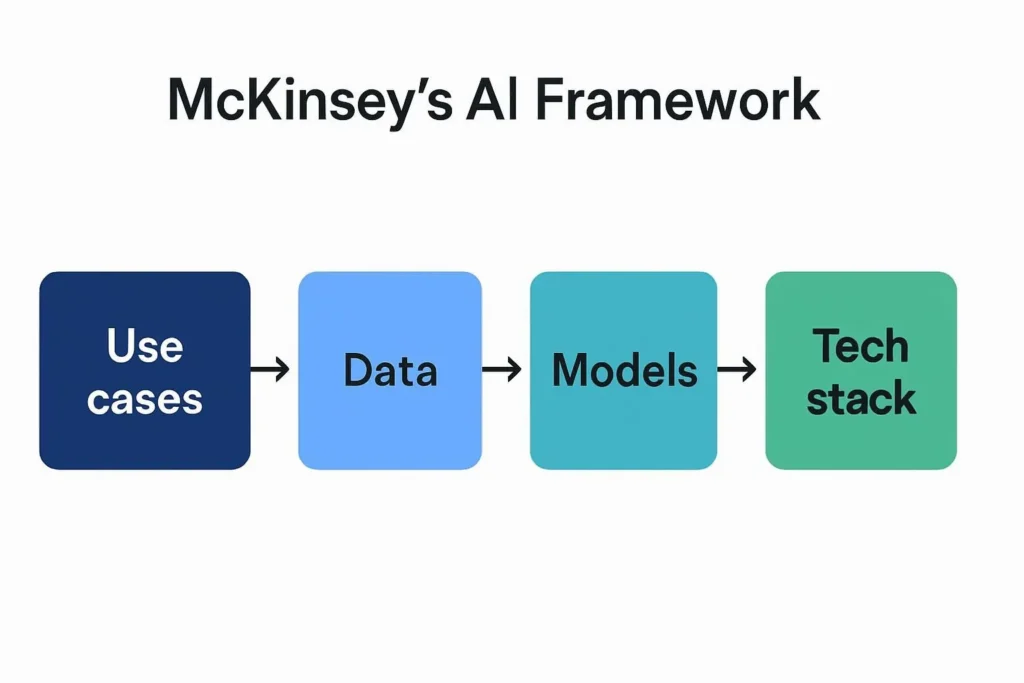
McKinsey’s 2025 AI Framework: The “Superagency” Model Explained
McKinsey’s core argument for 2025 is worth taking seriously: AI is no longer a productivity tool. In their framing, we’ve entered the “superagency” era — where the best implementations don’t just speed up human work, they expand what humans can accomplish at all.
The catch? Most companies are still doing 2023-style AI. They deploy a chatbot, call it a win, and wonder why the finance team’s quarterly numbers don’t budge.
“The organizations succeeding with AI in 2025 aren’t the ones with the most tools. They’re the ones that picked three use cases, proved real impact, and built from there.”
Horizontal vs. Vertical AI: The Fork in the Road
This is the single most important distinction in McKinsey’s framework, and it’s the one most executives get backwards.
| Approach | What It Looks Like | Time to ROI | ROI Clarity | McKinsey Verdict |
|---|---|---|---|---|
| Horizontal AI | Enterprise-wide copilots, company chatbots, general writing tools | Fast to deploy | Diffuse, hard to measure | Good for morale. Weak on impact. |
| Vertical AI | AI for one function: claims processing, demand forecasting, code review | 3–12 months | Sharp, measurable | Where transformative ROI actually lives. |
Horizontal AI feels like progress — everyone gets a new tool, adoption metrics look great. But when the CFO asks what it actually saved the business, the answer is usually “productivity gains” with no dollar figure attached. Vertical AI is harder to launch but the ROI conversation is completely different. You can say: “Our warranty claims AI reduced resolution time by 47% and saved $4.2M in the first year.” That’s a different conversation entirely.
McKinsey’s best-performing AI pilots were run by teams small enough to feed with two pizzas — typically 4–8 people. Small, focused, empowered to move fast. The moment an AI pilot becomes a company-wide initiative with 15 stakeholders, velocity dies.
The Top McKinsey AI Use Cases in 2025, Ranked by Actual ROI
I’ve organized these by the ROI patterns I’ve seen across implementations — not by what makes for nice conference slides. A few of them will surprise you.
1. Customer Operations: Where Agentic AI Pays Off Fastest
Customer service is the category where AI has moved furthest from “chatbot that frustrates people” to “agent that actually resolves things.” The key shift: agentic systems can now take actions, not just answer questions. They can process refunds, reschedule deliveries, update account records. That changes the economics completely.
Agentic Customer Support
AI agents handle tier-1 inquiries end-to-end — including system actions like refunds, account updates, and scheduling. Humans handle edge cases and complex escalations.
Predictive Churn Prevention
ML models identify at-risk customers 30–60 days before they churn, triggering automated outreach with personalized retention offers calibrated to the customer’s actual risk score.
In one financial services project I ran, the agentic system handled 85% of cases beautifully. The remaining 15% — mostly non-standard situations — created customer frustration that was worse than the old manual process. Build your escalation path before you launch, not after.
2. Operations & Supply Chain: The Unsexy Category That Delivers
Nobody ever wrote a flashy LinkedIn post about demand forecasting. But ask any COO where AI has actually moved their P&L, and supply chain optimization comes up every single time. The data environments are rich, the outcomes are measurable, and the improvement curves are steep.
Predictive Maintenance
IoT sensors combined with ML models predict equipment failures 2–4 weeks in advance. Work orders generate automatically. Technicians are dispatched before a line goes down, not after.
Dynamic Inventory Optimization
AI models that pull in weather data, event calendars, economic signals, and historical sales to adjust inventory levels dynamically — across hundreds of SKUs and locations simultaneously.
3. HR & Talent: The Category Most Companies Underestimate
Here’s one I didn’t expect to be as impactful as it is: AI-powered talent management. With 92 million job transitions expected globally through 2025 and persistent talent shortages across technical roles, organizations using AI in their HR function are gaining a real edge — not just in efficiency but in outcomes.
| HR AI Application | Primary Benefit | Time Savings | Implementation Complexity |
|---|---|---|---|
| AI resume screening | 50–70% time reduction in initial screening | Immediate | Low |
| Predictive attrition modeling | Identify flight risks 60+ days early | Medium-term | Medium |
| Personalized L&D paths | Higher skill retention, lower training waste | Long-term | Medium |
| Workforce planning AI | Strategic talent allocation aligned to business goals | Strategic | High |
If you want a fast, defensible win in HR, AI resume screening is your best entry point. Typical implementation time is 2–4 weeks. The ROI is clear and immediate. And it frees up your recruiters to do the parts of hiring that actually require human judgment — culture fit, candidate experience, complex role negotiation.
4. Financial Operations: Where AI Pays for Itself in Months
Finance teams have traditionally been AI-skeptical — and honestly, fair enough. Early AI tools for finance were either too general or too fragile. That’s changed. The financial operations use cases that are working in 2025 are very specific, very measurable, and very hard to argue with.
Automated Reconciliation & Bookkeeping
AI handles routine transaction matching, exception flagging, and report generation. Finance staff shift from data entry to analysis and decision support.
Real-Time Fraud Detection
ML models analyze transaction patterns in milliseconds, flagging anomalies with far greater sensitivity than rule-based systems. False positive rates drop significantly with proper model tuning.
Agentic AI: The Actual Breakthrough of 2025
This is the section I’d want someone to have shown me two years ago. “Agentic AI” sounds like another buzzword, but the underlying shift is genuinely significant. The difference from regular generative AI:
| Capability | Standard Gen AI | Agentic AI |
|---|---|---|
| Core function | Generate content from a prompt | Plan, reason, take multi-step actions |
| User interaction | One shot per prompt | Autonomous execution across steps |
| Tool use | None | APIs, databases, web, software |
| Oversight required | Low | High — especially early on |
| Implementation complexity | Low–medium | High |
| ROI potential | Moderate | Transformative |
Multi-Agent Systems: Where the Real Power Lies
McKinsey’s most sophisticated clients aren’t running single AI agents. They’re running orchestrated systems of specialized agents that hand off to each other. Here’s what that looks like in a customer service context:
Example: Tier-1 Customer Service Multi-Agent Stack
Intake Agent — Routes and classifies incoming requests
→ Knowledge Agent — Retrieves relevant policy, product, account data
→ Action Agent — Executes: refunds, schedule changes, account updates
→ Quality Agent — Audits each interaction against compliance rules
→ Escalation Agent — Detects when human judgment is required and hands off cleanly
This architecture typically delivers 35–50% faster resolution, 20–30% higher satisfaction, and 40–60% less human intervention. The numbers only hold if the escalation path is bulletproof.
McKinsey projects that 40%+ of agentic AI projects will be canceled by end of 2027. In my experience, the failure modes are almost never technical. They’re governance failures: no clear owner, no defined success metrics, no escalation protocol, no plan for model drift. Fix those four things before you write a line of code.
Three Case Studies That Show What’s Actually Possible
Fortune 500 Manufacturer: From $50M in Losses to $35M in Savings
The problem: Unplanned equipment failures were costing this client over $50M annually across 200+ manufacturing lines. Their existing maintenance schedule was calendar-based — completely blind to actual equipment condition.
The solution: IoT sensors on every critical line feeding ML models that predict failures 2–3 weeks in advance. Automated work orders, automated technician dispatch. The maintenance team shifted from reactive firefighting to planned, efficient work.
The result nobody talks about: The biggest ROI wasn’t the downtime reduction — it was what the technicians did with the freed-up time. With unplanned emergencies down 78%, the same team handled 30% more preventive maintenance without adding headcount.
Mid-Size Financial Firm: 48-Hour Response Time to Under 2 Hours
The problem: A mid-size financial services company was drowning. 48-hour average response times, 60% first-call resolution, and support costs climbing quarter over quarter. Their human agents were spending most of their time on tier-1 questions they didn’t need to be handling.
The solution: Conversational AI agents handling all standard inquiries — balance checks, statement requests, basic dispute logging — with a very deliberate human handoff process for anything above that threshold. We spent as much time designing the escalation path as we did the AI itself.
What made it work: The AI was trained on 18 months of historical interactions before launch. Post-launch, we ran a continuous feedback loop where human agents flagged bad AI responses. That loop is still running two years later.
National Retailer: $150M in Excess Inventory Eliminated
The problem: 500+ locations, $2B+ in annual revenue, and a company that was simultaneously over-stocked in some categories and chronically out of stock in others. The forecasting model was 3 years old and ignored external signals entirely.
The solution: AI-powered demand forecasting that pulled in 14 data sources: historical sales, local weather forecasts, regional events, economic indicators, competitive signals. Automated reorder triggers. Real-time inventory adjustment across the distribution network.
The part I didn’t expect: The supply chain team initially resisted the system because they didn’t trust a model they couldn’t see into. The breakthrough came when we built an explainability layer — showing exactly why the model was recommending a particular order quantity. Trust went up, override rates went down, and accuracy improved.
The 90-Day Implementation Roadmap (That Actually Works)
I’ve run enough of these to know that the roadmap matters as much as the technology. Here’s the version that consistently produces results:
Foundation & Honest Assessment
Identify 3–5 genuine high-impact use cases (not just the flashiest ones). Quantify current-state costs and expected ROI. Get brutally honest about your data quality — this is where most organizations discover they have more work to do than expected. Assess team readiness. This month is less exciting than it sounds, but skipping it is why projects fail.
Pilot — Two-Week Sprints Only
Pick one use case and deploy it in a focused pilot with a small team. Two-week sprint methodology: clear success criteria set on day one, review on day fourteen, go/no-go decision. Build human oversight into the system design from the start. Gather user feedback aggressively — the first two weeks of real-world use will teach you more than six months of planning.
Scale What Works, Cut What Doesn’t
Analyze pilot ROI against your pre-defined success metrics. If it worked: expand to additional teams or locations. If it didn’t: cut it fast and move to use case number two. Document what you learned. Begin building internal AI expertise — the organizations that win long-term are the ones that develop in-house capability, not permanent vendor dependency.
Rather than embedding AI specialists in every team from day one, McKinsey recommends starting with a small, centralized Center of Excellence (typically 4–8 people) that runs pilots, establishes standards, and then scales expertise outward. This is the fastest path to consistent, quality implementations across a larger organization. See our guide to building an AI Center of Excellence →
Risk Management: The Part Most Guides Skip
Here’s something uncomfortable: the biggest risks with enterprise AI in 2025 aren’t technical. They’re organizational, ethical, and strategic. I’ve seen more projects fail from unclear ownership and measurement than from model performance issues.
The Most Common Failure Modes, in Frequency Order
Frequency of occurrence across enterprise AI projects (McKinsey survey data)
McKinsey’s Ethical AI Framework for 2025
This isn’t a box-ticking exercise. The organizations that bake ethical AI practices into their implementations from day one avoid costly retroactive fixes and regulatory headaches. The four pillars:
Transparency: Every AI decision that affects a customer or employee must be auditable. Not “auditable in theory” — actually auditable in practice, with a process for doing it.
Human-centricity: AI augments human judgment; it doesn’t replace it for consequential decisions. Define which decisions require human sign-off before you deploy, not after the first incident.
Fairness: Run bias audits on your models before launch and on a scheduled basis afterward. Particularly important for hiring, lending, and customer prioritization applications. The bias you don’t test for is the bias that shows up in a headline.
Privacy by design: Data minimization is your friend. Only collect and process what you actually need. Build consent and data deletion capabilities in from the start.
McKinsey’s most sophisticated clients run dedicated “red team” exercises — a small group specifically tasked with finding ways the AI system fails, misleads, or causes harm. This catches the edge cases that normal QA misses. For agentic systems especially, red-teaming is non-negotiable before production deployment.
What McKinsey’s 2025–2026 Predictions Actually Mean for You
Reading technology predictions is like reading weather forecasts: useful directionally, but treat the specifics with appropriate skepticism. Here’s what I actually think will matter:
Agentic AI Getting Genuinely Smarter
The reasoning capabilities of foundation models are improving faster than most practitioners expected even twelve months ago. By late 2025, we’re likely to see agentic systems handling reliably complex, multi-step business processes that required significant human oversight in 2024. The bottleneck is shifting from model capability to organizational readiness.
Industry-Specific Foundation Models
General-purpose LLMs are giving way to fine-tuned, domain-specific models. Healthcare, financial services, legal, and manufacturing are all seeing dedicated models trained on domain data. The practical impact: dramatically lower implementation time and higher baseline accuracy for specialized use cases.
By 2028: 33% of Enterprise Software Embeds Agentic AI
McKinsey’s projection is that a third of enterprise software applications will have agentic AI capabilities built in by 2028 — compared to essentially none in 2023. The implication: companies evaluating enterprise software right now should be asking vendors about their AI roadmap, not just their current feature set.
| Trend | Timeline | What to Do Now |
|---|---|---|
| Autonomous business process automation | 2025–2026 | Map your highest-volume, most rule-bound processes now |
| AI-native enterprise software | 2025+ | Ask vendors for AI roadmap before any major platform purchase |
| Personalization at genuine scale | 2025 | Start building first-party data assets today |
| Predictive strategic intelligence | 2025–2026 | Invest in data infrastructure before AI layer |
Implementation Checklist: Before You Spend a Dollar
Phase 1: Assessment & Planning
- 3–5 high-impact use cases identified with clear success metrics attached
- Current-state costs quantified (so you can measure ROI)
- Data quality audit completed — know your gaps before you commit
- Team readiness assessed — identify training needs now
- Implementation timeline and realistic budget established
- AI governance framework defined (ownership, oversight, escalation)
Phase 2: Infrastructure & Setup
- AI platform selected and procurement completed
- Data integration architecture designed
- Security review and access control implemented
- Initial user group trained
- Feedback collection mechanism built into the system
- Escalation and human override process documented
Phase 3: Deployment & Optimization
- Focused pilot launched with clearly-bounded scope
- Performance monitored against pre-defined success metrics
- User feedback gathered and acted on
- Bias and ethics audit completed
- Successful pilots scaled; underperforming ones cut
- Next phase planned based on actual results
Frequently Asked Questions
The Bottom Line: Stop Experimenting, Start Implementing
McKinsey’s research makes the situation clear. The AI experimentation phase is over. The organizations winning right now are the ones that moved from exploration to disciplined, value-driven implementation — and the gap between them and everyone else is widening fast.
The gen AI paradox — high adoption, low impact — is solvable. The solution isn’t better technology. It’s better use case selection, more rigorous measurement, and genuine organizational commitment to doing the unglamorous work of data quality, change management, and governance.
Start with one function. Define success before you deploy. Build the human oversight in from the beginning. Measure relentlessly. Then — and only then — scale.
The window for competitive advantage through AI is real. But it’s not infinite. And the companies that move thoughtfully and fast are the ones that will be very difficult to catch.
Ready to map your own AI use cases?
Get our free AI Readiness Assessment — the same framework used in McKinsey-style engagements, adapted for teams without an army of consultants.
Get Free Assessment →Sources & Further Reading
- McKinsey Global Survey: The State of AI (2025)
- McKinsey: A Gen AI Reset — Rewiring to Turn Potential into Value (2025)
- McKinsey MGI: A New Future of Work (2024)
- World Economic Forum: Future of Jobs Report 2025
- Gartner: What Is Agentic AI? (2025)
- AIEarnerHub: The Complete Agentic AI Implementation Guide
- AIEarnerHub: AI ROI Calculator for Business
Generative AI use cases examples
AI in Business 2026: 7 Rigorously Verified Case Studies
AI Chatbots & Assistants: The Ultimate Guide to Intelligent Automation