
Trending AI Startups in the USA:
Who’s Actually Building Something Real
Funding rounds make headlines. Valuations get shared on LinkedIn. But most articles covering “top AI startups” don’t tell you what these companies actually do day-to-day, who their real customers are, or which ones are building durable businesses versus burning VC money on GPU clusters.
Here’s a straight read on the ones worth watching — with real numbers, honest assessments of what they’re good for, and no invented case studies.
- The US AI startup scene in 2025 is split between model labs (OpenAI, Anthropic, xAI) and infrastructure/data companies (Scale AI, Databricks, Cohere). Different businesses, very different relevance to you.
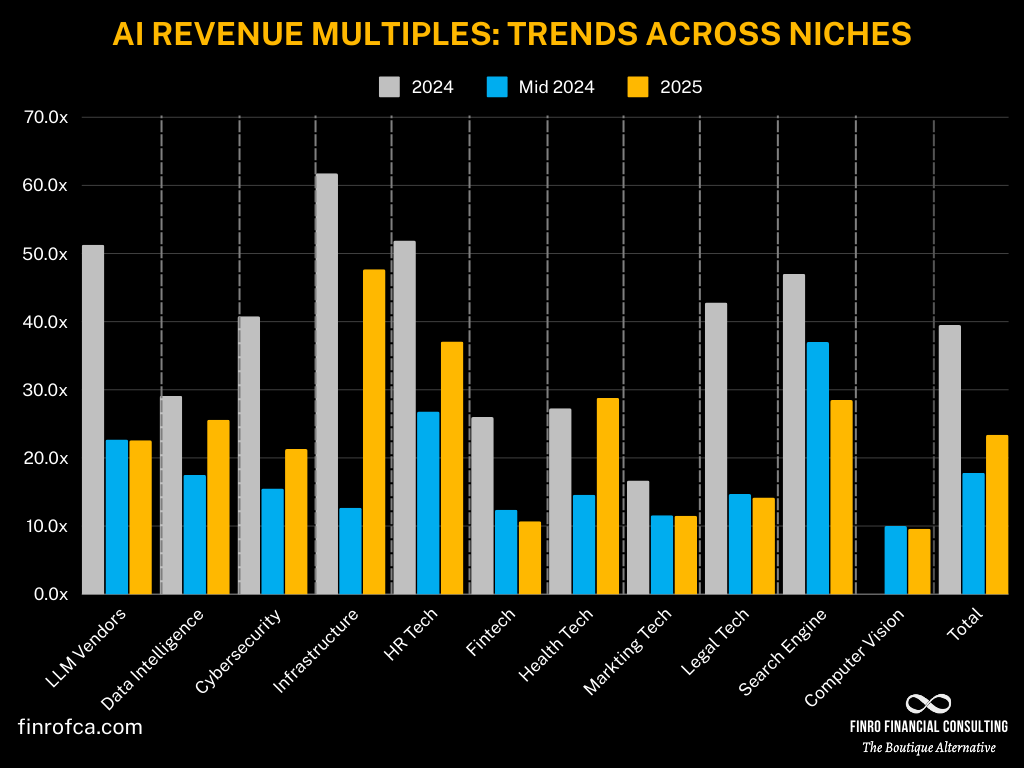
- Valuations are dramatic and mostly unverified by revenue. OpenAI is at ~$157B; xAI at ~$50B. These numbers reflect expectations, not cash flows.
- Perplexity AI is the most underestimated name on this list for people who do research-heavy work. It’s not just “search with AI” — the enterprise tier is a different product.
- For most small businesses: Perplexity, Cohere’s API, or Claude are more practical entry points than OpenAI, which is priced for scale.
- Scope note: I track these companies for client advisory work in B2B SaaS and fintech. Consumer and hardware AI are underrepresented here.
Why 2025 Is Different From Every Previous AI Hype Cycle
The thing that separates what’s happening now from the 2016–2019 “machine learning is going to change everything” wave: real revenue. Companies are paying real money for AI capabilities, not just running pilots that disappear after a quarter.
Stanford’s 2025 AI Index puts US AI private investment at over $67B in 2024 — roughly five times what it was in 2020. That’s not hype money; that’s enterprise contracts, API consumption, and data infrastructure deals. The companies I cover below are winning real enterprise customers, not just raising rounds. Established
The catch — and it’s a real one — is that revenue concentration is extreme. OpenAI likely accounts for a disproportionate share of AI API spending. The rest of the market is real but smaller than the combined funding announcements suggest.
Best AI Tools for Freelancers → ML Freelance Work in 2025 →
The Funding Picture (In Real Numbers)
Before the profiles: here’s the actual valuation context as of Q1 2025, sourced from public funding announcements. These are last-known valuations, not current trading prices, and private company valuations are inherently fuzzy.
Last-known private valuations, Q1 2025. Sources: public funding announcements, TechCrunch, PitchBook coverage. Private valuations are set at time of funding round and do not reflect current market conditions. OpenAI’s $157B reflects its February 2025 secondary market raise.
The Companies Worth Understanding
The one everyone knows, but not everyone understands. OpenAI runs two separate businesses: a consumer product (ChatGPT, ~200M weekly users as of early 2025) and an API business that powers thousands of developer applications. These have different economics and different competitive dynamics.
The GPT-4o and o3 models dominate enterprise API adoption. The newer o-series “reasoning” models (o1, o3) are genuinely interesting — they perform significantly better on complex multi-step problems by spending more compute at inference time. For developers building agentic workflows or code analysis tools, the o-series is worth evaluating separately from GPT-4o. Established
Sora (video generation) and the Operator agent product launched in 2025. Operator is early and limited, but it’s the direction the company is clearly moving: AI that acts, not just responds.
Founded by former OpenAI researchers, Anthropic has built a genuine technical reputation around safety research — Constitutional AI and interpretability work that actually gets published and peer-reviewed. That’s not marketing. It’s real research infrastructure. Established
Claude 3.5 Sonnet benchmarks consistently near or at the top for coding tasks and long-context reasoning. The 200K token context window matters in practice: if you need to process entire codebases, legal documents, or long research papers, Claude handles it better than most alternatives. Amazon has invested heavily ($4B as of late 2024), which means AWS integration is tight — relevant if your infrastructure is already there.
The enterprise product is genuinely competitive with OpenAI for B2B use cases. Pricing is comparable. Claude Haiku (the small model) is fast, cheap, and underused by people who defaulted to GPT-3.5 out of habit.
Elon Musk’s model lab, launched in 2023. xAI raised $6B in 2024 and operates the Colossus supercluster in Memphis — reportedly over 100,000 H100 GPUs, making it one of the largest training clusters outside of Microsoft/OpenAI. That compute matters; it’s what allowed Grok 3 to be competitive on reasoning benchmarks. Established
The X (Twitter) integration is the genuine differentiator — Grok has access to real-time X data that no other major model has. For tracking breaking news, public sentiment, or live events, that’s a real advantage. For everything else, it’s in the same competitive tier as Claude and GPT-4o.
The business model is still figuring itself out. Grok is available through X Premium ($8/month) and through a separate xAI API. Enterprise adoption is lower than OpenAI and Anthropic so far — the association with Musk and X is an asset to some buyers and a dealbreaker for others. Probable
Not a model company — Scale AI builds the data infrastructure that trains models. Data labeling, RLHF (reinforcement learning from human feedback), and evaluation pipelines. Every major model lab uses some form of what Scale provides. Established
The US government is a major customer. Scale has significant DoD contracts for AI-enabled defense applications — which is either exciting or concerning depending on your perspective, but is unquestionably real revenue. The company also runs “Donovan,” an enterprise AI platform for government agencies.
For most developers and small businesses, Scale AI isn’t a direct tool — it’s the company that makes the tools you use better. The relevance is indirect but significant: the quality of model training data is what separates useful models from unreliable ones, and Scale is deep in that infrastructure layer.
Databricks is the oldest company on this list and arguably the most mature business. Founded on Apache Spark, it’s evolved into the dominant “lakehouse” platform — a unified architecture for data storage, processing, and ML. $62B valuation, reportedly $2.4B in ARR as of late 2024. That’s an actual business, not just a funding multiple. Established
DBRX is their open-source model (released early 2024), competitive with Mixtral at the time of release. More importantly, Databricks built the infrastructure to let enterprises deploy and fine-tune models on their own data — which is what large regulated businesses actually need. Banks and healthcare systems can’t send patient data to OpenAI’s servers.
MLflow, their experiment tracking tool, is used across the ML industry regardless of whether you’re a Databricks customer. That mindshare matters.
Perplexity calls itself an “answer engine” — the pitch is that it combines web search with LLM synthesis and cites its sources. Raised $500M at a $9B valuation in early 2025. That’s a big number for a company that competes directly with Google in consumer search. Established
The consumer product is good but not dramatically better than Google’s AI Overviews for most queries. The enterprise product (Perplexity Enterprise Pro) is a different story — it integrates with private data sources and internal documents, giving companies a search layer over their own knowledge base without the hallucination risk of pure LLM retrieval. That’s a genuinely useful product for research-heavy teams: analysts, lawyers, journalists, strategy consultants.
They’ve had some controversies around content attribution — publishers have complained that Perplexity’s summaries reduce traffic without proper licensing. That legal exposure is real and worth watching. Probable
The least-covered company on this list, and the most underrated for B2B use cases. Cohere builds enterprise LLMs with a focus on security, deployment flexibility, and retrieval-augmented generation (RAG). Command R+ is their flagship model — competitive with GPT-4 class models on enterprise reasoning tasks. Established
The key differentiator: Cohere lets you deploy models on your own cloud infrastructure, on-premises, or in a VPC. For enterprises with strict data residency requirements — European companies under GDPR, financial institutions, healthcare — that’s not a nice-to-have, it’s a compliance requirement that rules out API-only providers. The Embed and Rerank models are also genuinely strong for semantic search and RAG pipelines. Established
Cohere doesn’t have consumer products. It doesn’t compete in the chatbot or creative writing space. It’s building AI infrastructure for companies that need reliable, private, enterprise-grade models — and doing it quietly while OpenAI gets the headlines.
The Right Way to Think About These Companies
Most “top AI startups” articles treat all of these as interchangeable. They’re not. They operate in different parts of the stack, serve different customers, and have different business risks. Here’s a cleaner taxonomy.
| Company | Layer | Best for | Dev friendly? | SMB practical? |
|---|---|---|---|---|
| OpenAI | Model Lab | General-purpose AI, coding, agents | ● Yes | ● Costs add up |
| Anthropic | Model Lab | Long context, compliance-sensitive | ● Yes | ● Haiku is cheap |
| xAI | Model Lab | Real-time X/Twitter data | ● Limited API | ● X Premium required |
| Scale AI | Data Infrastructure | Training data, eval pipelines | ● Not self-serve | ● Enterprise pricing |
| Databricks | Data Platform | Enterprise ML on proprietary data | ● MLflow is free | ● Too complex |
| Perplexity | AI Search | Research, cited answers, RAG for docs | ● API available | ● Free tier is real |
| Cohere | Enterprise LLMs | Private deployment, EU data residency | ● Good docs | ● Depends on use case |
The One Thing Most Coverage Gets Wrong
Most “top AI startups” lists treat this as a ranking of which company is “best.” That framing is useless. OpenAI is not better than Cohere — they solve different problems for different buyers. A $200M enterprise that needs on-premises GDPR-compliant AI deployment doesn’t have the same needs as a solo developer building a Chrome extension.
The question isn’t “which AI startup is winning” — it’s “which layer of the stack matters to your specific problem.” Get that right and the rest of the decision is mostly obvious. — Something I find myself repeating in client calls more often than I’d like.
The companies that will matter most in 2027 probably aren’t the ones with the biggest current valuations. They’re the ones building in the infrastructure and data layers — the companies whose names don’t appear on TechCrunch covers but whose APIs are called billions of times a day inside products you already use.
AI Tools for Freelancers 2025 → Remote AI Jobs: What Actually Pays → ML Engineer Freelance Guide →The Fastest-Growing AI Companies: Revenue, Valuations & What’s Really Driving the Boom
15 Proven AI Startups to Invest In: Techniques Most Experts Won’t Tell You
ChatGPT vs Claude vs Gemini —Which AI Actually Wins?
Scale AI: The Complete Guide to Enterprise AI Data Transformation
AI INFRASTRUCTURE: INVESTMENT THESIS 2.0
ChatGPT Competitors You’ve Never Heard Of: Best Guide
Gallery