

AI Chatbots Are Competing
Harder Than Ever — Here’s Why
ChatGPT’s market share dropped 19 percentage points in 12 months. That’s not normal market erosion — that’s a structural break. Here’s a clear-eyed look at what’s actually driving it.
AI Chatbot Market Share — Jan 2025 vs May 2026 (Web + Mobile Traffic)
Source: Similarweb / Azumo, Jan 2026. Enterprise share for Claude sourced separately. ChatGPT figures include Bing Copilot (same underlying model). Note: Grok daily active user share in US reported separately at 15.2% of DAU, not reflected in this web traffic snapshot.
TL;DR — What You Need to Know in 2 Minutes
- ChatGPT’s share fell from 87% to ~68% in just 12 months — the single largest market-share drop in generative AI history.
- Google Gemini grew 370% year-over-year, reaching 18.2% of web traffic — and that’s before factoring in its Android/Workspace integration.
- The global generative AI chatbot market hit $12.98B in 2026 and is projected to reach $113B by 2034 (31% CAGR). The prize is enormous — hence the war.
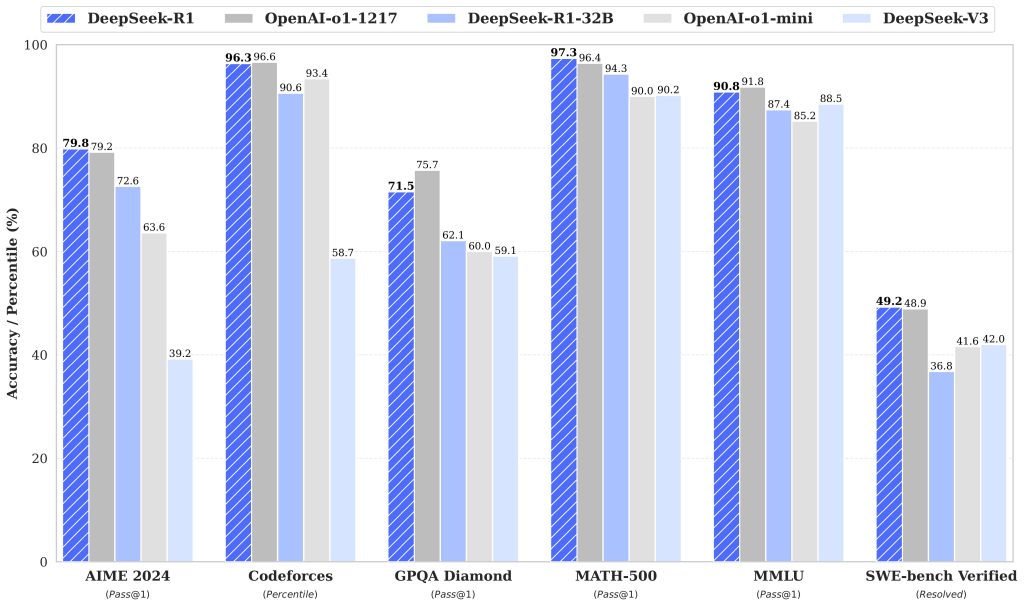
- No single model dominates every benchmark. Claude Opus 4.6 leads SWE-bench (80.8%). GPT-5.4 leads on math reasoning. Gemini leads on multimodal and abstract reasoning. Benchmarks diverge by task type.
- Funding is extraordinary: Anthropic raised $30B in a single Series G. xAI closed a $20B Series E. Q1 2026 AI funding already doubled all of 2025.
- The real competition is no longer for chat market share — it’s for enterprise contracts, agentic workflows, and OS/cloud integration. That’s what’s making labs push so hard.
- For most users: the practical difference between top models is narrower than ever. The smarter move is matching the model to the task rather than picking one and sticking with it.
The Structural Break Nobody Predicted
Twelve months ago, the conventional take was that OpenAI had won. ChatGPT had over 87% of the generative AI chatbot market. Its nearest competitors were barely visible in the data. Analysts wrote things like “OpenAI’s moat is distribution,” and nobody could really argue with that.
Then something shifted — not gradually, but in a concentrated burst. Between January 2025 and May 2026, ChatGPT lost roughly 19 percentage points of market share. Google Gemini picked up most of it, jumping from 5.4% to over 18%. DeepSeek arrived from essentially nowhere and staked a credible 4%. Perplexity, Grok, and Claude carved out the rest.
A 19-point drop for a dominant platform in 12 months is not ordinary competitive attrition. It’s a structural break — the kind you see when a market reaches a tipping point where enough alternatives become genuinely good enough that switching stops feeling risky. That’s where we are now.
The global generative AI chatbot segment reached $12.98 billion in 2026, growing at a 31.11% CAGR. It is projected to reach $113.35 billion by 2034. With stakes this high, no major player can afford to let a competitor pull ahead without a fight. That’s the structural reason the competition has intensified — not better models per se, but the sheer scale of what’s being competed for.
What makes this moment analytically interesting isn’t the market-share shift itself. It’s the mechanisms behind it. The competition is being driven by at least six distinct forces operating simultaneously — and understanding them separately matters if you want to predict what happens next.
Why Is This Happening Now, Specifically?
The honest answer involves timing more than technology. The underlying models have been improving steadily for years. But three things converged in the 14 months since early 2025 that created the current situation.
The capability gap closed faster than anyone planned for
In early 2024, there was a meaningful, perceivable quality gap between ChatGPT and most competitors. Non-technical users could feel it. Developers could measure it. By late 2025, that gap collapsed to statistical noise on most everyday tasks. When competing products are genuinely comparable, switching cost becomes the only differentiator — and switching cost in AI chat is close to zero.
Distribution advantages got neutralized
OpenAI’s early moat wasn’t the model — it was that everyone had heard of ChatGPT. But Google has 4+ billion Android users, a trillion searches per month, and an office suite used by 3 billion people. When Google started shipping Gemini directly into Search, into Gmail, into Docs and Sheets, it didn’t need users to choose it — they were already there.
DeepSeek broke the cost narrative
When DeepSeek R1 was published in January 2025, it did something no previous competitor had managed: it provided verifiable, near-frontier reasoning at roughly 15–50% of OpenAI’s inference cost, as an open-weight model. The implication wasn’t just “here’s a cheaper option.” It was that the claimed cost of frontier AI had been massively overstated. That forced every lab to rethink pricing, which in turn accelerated the race to ship more capable models faster.
The Six Forces Driving Competition Right Now
1. Ecosystem Integration (The Invisible Moat War)
The most important competition in AI right now isn’t happening in benchmark leaderboards — it’s happening in enterprise software stacks. Google has integrated Gemini across Docs, Sheets, Slides, Drive, and Gmail. Microsoft embedded Copilot (GPT-4/5 family) into Office 365, Teams, and Azure. Anthropic’s Claude is available through both Amazon Bedrock and Google Cloud Vertex AI. xAI’s Grok lives inside X/Twitter, where it has privileged access to real-time social data.
Each of these integrations creates a sticky usage pattern that’s much harder to compete with than a standalone chat interface. Enterprise users who start running workflows through Gemini in Google Workspace aren’t going to switch mid-project because a competitor scored 2 points better on a math benchmark.
2. Agentic Capability (The Next Battleground)
The shift from chatbots to agents — systems that can autonomously take multi-step actions, write and run code, browse the web, manage files, and interact with external services — is where all the major labs are competing most aggressively right now. This is partly because agents are substantially more valuable than chat windows (enterprises will pay much more for an AI that executes tasks autonomously than one that answers questions), and partly because agents require deep integration with infrastructure, which creates lock-in.
Claude Code (Anthropic’s agentic coding CLI) is reportedly a primary driver of Anthropic’s revenue surge — from $1B annualized revenue in January 2025 to $30B by April 2026. OpenAI’s Operator and Codex serve the same function. Gemini Spark and Google’s agent products are chasing the same enterprise contracts. The chatbot era is functionally over; the agent era is what’s being fought over.
3. Pricing as a Competitive Weapon
The price compression in the API market over the past 18 months has been extraordinary. DeepSeek V3.2 — a frontier-class model — costs $0.27 per million input tokens. GPT-5.4 Thinking costs $15 per million input tokens. That’s a 55× price differential for models that aren’t 55× apart in quality. Gemini 2.5 Pro Batch costs $0.75/M input — positioned to undercut both for high-volume workloads.
This pricing pressure is forcing every lab to ship more capable smaller models faster, create tiered product lines (the Opus/Sonnet/Haiku structure from Anthropic, the GPT-5/4-mini split from OpenAI), and justify premium pricing with genuinely differentiating capabilities rather than brand alone.
4. Open Source Disruption
Meta’s Llama 4 Maverick — released in early 2026 as fully open-weight — is competitive with most commercial models on standard benchmarks while being free to self-host. This creates a genuine credible alternative for any organization that doesn’t want vendor dependency, has data sovereignty requirements, or is operating in a regulated industry where sending data to a third-party API is non-trivial. The existence of open-weight frontier models sets a hard floor on how much commercial providers can charge.
5. Specialization (Perplexity’s Lesson)
Perplexity grew 370% year-over-year by doing one thing better than anyone else: real-time, cited, web-grounded answers. It didn’t try to be a general chatbot — it built a specific use case (research and information discovery) and executed it extremely well. Grok’s real-time integration with X gives it a differentiated angle on social media analysis. This specialization trend is forcing general-purpose platforms to either match specialized competitors in their niches or accept that users will have multiple AI tools for different jobs.
6. Capital Concentration
The funding environment for frontier AI labs has become surreal. Venture funding to foundational AI startups in Q1 2026 alone doubled everything raised in all of 2025. The three dominant recipients are OpenAI ($852B valuation, preparing for a Q4 2026 IPO), Anthropic ($380B valuation after a $30B Series G), and xAI ($42.7B raised total after a $20B Series E). The capital arms race means each lab can sustain years of operating losses while investing in compute infrastructure. Competition doesn’t slow down when money isn’t a binding constraint.
The Competitive Timeline: 14 Months That Rewrote Everything
Benchmark Reality Check: Who Actually Leads Where
The single most misleading framing in AI coverage is “Model X is the best.” Every major lab publishes benchmarks that favor their own model. The honest read of the current landscape is that top models trade leads across different task types — sometimes within a few points of each other.
| Benchmark / Use Case | Leader (May 2026) | Score | Runner-Up | Notes |
|---|---|---|---|---|
| SWE-bench Verified (real GitHub issues) | Claude Opus 4.6 | 80.8% | GPT-5.4 | Autonomous repo-level engineering |
| GPQA Diamond (graduate science) | GPT-5.2 | 92.4% | Claude Opus 4.6 | Physics, chemistry, biology reasoning |
| AIME 2025 (competition math) | GPT-5.2 | 100% | Kimi K2 Thinking (99.1%) | Multi-step problem solving |
| ARC-AGI-2 (abstract reasoning) | Gemini 3.1 Pro | 77.1% | Claude (68.8%) | GPT-5.2 scores 52.9% |
| Terminal-Bench 2.0 (agentic execution) | GPT-5.4 | 75.1% | Claude Opus 4.6 | Autonomous terminal tasks |
| Multimodal / Visual reasoning | Gemini 3.1 Pro | — | GPT-5.4 | Native multimodal architecture advantage |
| Long-context coherence (1M tokens) | Claude Opus 4.6 | — | Gemini 2.5 Pro | First production 1M context window |
| Cost efficiency (API, frontier class) | Kimi K2 Thinking | $0.60/M | DeepSeek R2 ($0.55/M) | Best quality-per-dollar by significant margin |
| Real-time information | Grok 4 / Perplexity | — | Gemini (Search grounding) | Live X data; Perplexity citation model |
| Educational use cases (Arena for Learning) | Gemini 2.5 Pro | 73.2% | GPT-5 family | Head-to-head structured education |
Sources: Vellum LLM Leaderboard (May 2026), byteiota coding benchmarks (Mar 2026), AI Magicx comparison (Mar 2026), teamai.com model analysis. All benchmark scores reflect publicly reported figures; independent replication recommended before production decisions.
Determining which model is strongest at coding has become harder now that we’re in 2026, as results vary not just by model but also by agentic implementation. Benchmarks fragment by task type, causing rank reversals.
— LogRocket, March 2026 analysis
The practical implication of this fragmentation is clear: the most sophisticated teams aren’t picking a single model — they’re running model routing setups where the task dictates the tool. GPT-5.1 for copy and conversational tone; Claude 4.x for technical documentation and long-context work; Kimi K2 or Gemini Flash for high-volume cost-sensitive tasks; Grok for anything requiring real-time social context.
The Money Behind It: Capital at a Scale That Changes Behavior
These are not numbers that lead to rational, measured competition. When Anthropic’s ARR grew 30× in 14 months — from $1B to $30B — the response from every other lab is obvious: raise more capital, hire more researchers, ship more models faster. The same dynamic applies in reverse. OpenAI’s IPO preparation creates pressure to demonstrate continued dominance. xAI’s $20B raise creates an obligation to show results from that capital.
The capital concentration is also creating unusual strategic dynamics. Google has invested in Anthropic while simultaneously building Gemini as a direct competitor. Amazon has invested heavily in Anthropic while also running its own Bedrock platform. These overlapping relationships mean the competitive pressure isn’t pure — it’s complicated by strategic equity stakes that create partial alignment between rivals.
Case Studies: What Competition Looks Like on the Ground
Case 1: The Enterprise Developer Switching Problem
A recurring pattern reported by developers in 2025–2026: teams that started on GPT-4 or ChatGPT Plus began systematically evaluating alternatives when their API bills scaled up. The typical switching trigger wasn’t a “better model” in the abstract — it was hitting a specific bottleneck (context length, cost per token, or a specific benchmark task) where a competitor offered a measurable advantage.
For long-context work — processing large codebases, analyzing lengthy legal documents, running multi-file code refactors — Claude’s 1M token production context window became a genuine competitive differentiator when it shipped with Opus 4.6 in February 2026. Teams doing multi-file code migrations reported switching specifically for this feature, not because Claude was “better” overall.
Case 2: The DeepSeek Cost Shock
Organizations running high-volume API workloads — document classification, content moderation, data extraction pipelines — found that DeepSeek V3.2 at $0.27/M input tokens made previously uneconomical use cases viable. The 55× cost differential versus GPT-5.4 Thinking isn’t relevant for low-volume premium use cases, but for processing millions of documents a day, it’s the difference between a product that works economically and one that doesn’t.
DeepSeek’s hosted API presents a data sovereignty risk for organizations handling EU or US citizen personal data. Chinese national security law can require companies to provide data to authorities. Multiple Western governments have blocked or restricted DeepSeek on organizational devices. The open-weight version (self-hosted) is a different calculation entirely — it addresses the data risk while preserving the cost advantage. This distinction matters and is often missing from cost-comparison articles.
Case 3: Perplexity’s Differentiation Playbook
Perplexity’s trajectory is the clearest case study in why specialization beats generalism in a crowded market. By committing fully to real-time, cited, web-grounded answers and refusing to be a general chatbot, it grew to 435M+ monthly search queries and achieved an 85% user retention rate — the highest reported in the category. It didn’t need to win the benchmark wars; it needed to be the best tool for a specific job that tens of millions of people do every day.
The lesson isn’t that everyone should specialize. It’s that in a market where general capabilities are converging, clear positioning around a differentiated use case can build a more defensible position than chasing the same benchmark leaderboard as six well-funded competitors.
Case 4: Anthropic’s Enterprise Focus vs. OpenAI’s Consumer Scale
OpenAI has 900 million weekly active ChatGPT users, but over 80% of its revenue comes from consumer subscriptions — which are less sticky and lower-margin than enterprise contracts. Anthropic deliberately targeted enterprise: emphasizing data security, predictability, and coding performance. The result is that Claude serves only 16–30M monthly active users overall, but holds roughly 29% of enterprise AI application share — a massive overrepresentation relative to raw user counts. Enterprise contracts are larger, stickier, and more defensible. Anthropic’s 30× revenue growth in 14 months reflects this strategy working.
Winners, Losers, and Dark Horses
| Player | Trajectory | Strongest Position | Real Vulnerability |
|---|---|---|---|
| Google Gemini | ↑ Strong | Distribution (Android + Workspace), multimodal, cost via Flash models | Consumer brand perception still lags ChatGPT; Gemini Ultra adoption uneven |
| OpenAI / ChatGPT | → Holding | Consumer brand, developer ecosystem, math/reasoning benchmarks, Codex for agentic coding | Share erosion is real; consumer-heavy revenue mix is lower-margin than enterprise |
| Anthropic / Claude | ↑ Surging | Enterprise trust, coding agents (Claude Code), long-context, safety positioning | Low consumer brand awareness (2% overall market share despite 29% enterprise share) |
| xAI / Grok | ↑ Surprise | Real-time social data, X platform integration, mobile DAU growth (1.6% → 15.2%) | SOC 2 / HIPAA certification gaps block enterprise adoption; X’s audience is niche |
| Perplexity | ↑ Differentiating | Real-time search, citation model, 85% retention — highest in category | Small absolute share; search giants (Google) can replicate the core feature with distribution advantage |
| DeepSeek | → Constrained | Cost efficiency, open weights, mathematical reasoning, Asian market adoption | Regulatory/data sovereignty blocks Western enterprise adoption of hosted version; depends on self-hosting story |
| Meta / Llama 4 | → Growing | Fully open-source frontier model; sets cost floor for commercial providers | No commercial AI product strategy; relies on ecosystem adoption rather than direct revenue |
| Mistral (Le Chat) | → Niche | European data sovereignty, enterprise corporate use, smaller-model efficiency | Outgunned on raw capability; funding gap vs US giants |
What This Actually Means For You
If you’re an individual user
The honest advice: stop treating model selection as an identity. The practical capability gap between top models for everyday writing, research, coding help, and analysis is smaller than the difference between a good prompt and a bad one. Use ChatGPT or Claude or Gemini — whichever interface you find most comfortable. The competition means all of them will improve faster than before.
If you’re doing something specific — deep research with citations, use Perplexity. Long-context document analysis, lean on Claude. Math-heavy work or coding automation, try GPT-5.x or Claude Opus 4.6. Real-time social context, Grok. Match the tool to the job rather than picking one tool for everything.
If you’re building a product or running a team
The multi-model routing approach used by sophisticated teams is becoming a real production pattern, not a novelty. The question to ask yourself isn’t “which model should we use?” — it’s “which models should we route to for which task categories?” This requires more upfront evaluation work but produces meaningfully better results and substantially lower costs.
For regulated industries: DeepSeek’s open-weight version, Meta’s Llama 4, or Mistral offer self-hosting options that address data sovereignty concerns. Don’t dismiss them because the hosted API presents risks — the on-premises story is different.
If you’re evaluating AI investment or market trends
The era of single-platform dominance in AI chat is over. What’s being competed for now is infrastructure-level lock-in: cloud provider relationships (AWS/GCP/Azure), enterprise software integration (Office, Workspace, Salesforce), and agentic workflow ownership. The chatbot market share numbers are increasingly a lagging indicator — watch the enterprise contract announcements and the agent product adoption metrics instead.
The most durable observation from watching this market evolve: the labs that win are the ones that move from “chatbot” to “infrastructure layer.” Anthropic’s 30× ARR growth didn’t come from people switching chat windows — it came from enterprises embedding Claude Code and Claude into production workflows. Google’s Gemini surge didn’t come from head-to-head chatbot comparisons — it came from Workspace integration. The competition for your attention is interesting; the competition for your workflow is the real war.
Frequently Asked Questions
Is ChatGPT still the best AI chatbot in 2026?
“Best” is the wrong frame. ChatGPT (GPT-5.x family) leads on mathematical reasoning benchmarks and has the largest consumer user base at 900 million weekly active users. But Claude Opus 4.6 leads on software engineering tasks, Gemini 3.1 Pro leads on multimodal and abstract reasoning, and DeepSeek/Kimi leads on cost efficiency. The honest answer is that each model has a legitimate claim to being the best at something specific.
Why did ChatGPT lose so much market share so fast?
Three converging factors: the capability gap between ChatGPT and competitors closed to near-zero on everyday tasks, making switching essentially costless; Google deployed Gemini to hundreds of millions of users via existing products (Search, Gmail, Workspace) without requiring any active switch; and DeepSeek’s emergence disrupted the cost narrative in ways that forced pricing changes across the industry. It wasn’t a single failure — it was structural market maturation.
Is DeepSeek safe to use?
The hosted API version presents a real data sovereignty risk for organizations handling EU or US personal data, since Chinese national security law can require companies to hand over data to authorities. Multiple Western governments have restricted it on organizational devices. The open-weight version, self-hosted on your own infrastructure, is a categorically different risk profile — the capability and cost advantages are retained without the data transfer concern.
What’s the actual practical difference between the top models in 2026?
On most everyday tasks (writing, summarizing, basic coding, Q&A), the practical difference is small enough that user preference and interface familiarity matter more than model selection. Meaningful differences emerge at the edges: context length (Claude’s 1M window vs. others’ 200K), coding autonomy on real repositories (Claude Code), multimodal natively designed tasks (Gemini), real-time data (Grok, Perplexity), and cost at scale (DeepSeek, Gemini Flash, Kimi).
What is an AI agent and how is it different from a chatbot?
A chatbot responds to prompts — you ask, it answers. An AI agent can autonomously plan and execute multi-step tasks: write code and run it, browse the web, modify files, call APIs, and chain actions across tools without asking you at each step. Claude Code, OpenAI’s Codex/Operator, and Gemini Spark are all agent products. Agents are substantially more commercially valuable than chat windows, which is why all major labs are investing heavily in them now.
Which AI chatbot is best for coding in 2026?
It depends on the specific coding task. Claude Opus 4.6 leads SWE-bench Verified (real GitHub issue resolution) at 80.8%. GPT-5.4 and its Codex variant lead on Terminal-Bench 2.0 (agentic terminal execution). For long-context work like large codebase refactors, Claude’s 1M context window is unmatched. For cost-sensitive high-volume code generation, DeepSeek R2 or Kimi K2 are the best quality-per-dollar options. Most serious development teams use 2–3 models depending on the task.
Why is Anthropic’s revenue growing so fast?
Primarily because of enterprise adoption of Claude Code (its agentic coding CLI) and Claude’s positioning for data-sensitive enterprise workloads. Anthropic’s ARR grew from $1B to $30B in 14 months — roughly 30×. This isn’t coming from consumer chat subscriptions; it’s coming from enterprises embedding Claude into production workflows, often on long-term contracts. The enterprise-first strategy (emphasizing security, predictability, compliance) produced higher-value, stickier revenue than consumer subscriptions.
Should I be worried about AI chatbot quality plateauing?
Not in the near term. The volume of capital flowing into AI infrastructure — Q1 2026 alone doubled all of 2025’s AI startup funding — means the pace of model improvement isn’t slowing. The more honest concern is benchmark saturation: as models approach 100% on existing benchmarks (GPT-5.2 hit 100% on AIME 2025), the industry is creating harder tests. Progress continues but becomes harder to measure clearly.
Is Perplexity a real competitor to Google Search?
For research-intensive queries with a tolerance for paying for accuracy, yes. Perplexity’s 85% retention rate — the highest in the AI chatbot category — suggests it’s genuinely solving a problem better than the alternatives for a specific user population. However, Google’s search integration of Gemini and its 4 billion Android users means it can replicate Perplexity’s core value proposition with native distribution advantages. Perplexity’s long-term defensibility depends on staying ahead on user experience and citation quality.
What does the multi-model routing approach look like in practice?
The pattern used by sophisticated teams in 2026: GPT-5.1 for consumer-facing copy and tone-sensitive content; Claude 4.x Sonnet for technical documentation, integration logic, and extended coding tasks; Kimi K2 or Gemini Flash for high-volume, cost-sensitive processing (Slack summaries, routine analysis); Grok for anything requiring real-time X/social context; Perplexity for research workflows requiring citations. This isn’t about having 5 subscriptions — it’s about API routing where the model selection is a configuration variable tied to the task type.
When will this competition stabilize?
It won’t stabilize in the traditional sense — new entrants (Kimi, Qwen, domestic models from non-US labs) keep arriving with competitive capabilities. What will change is the locus of competition: it will move further from consumer chat and deeper into enterprise infrastructure, agentic workflow ownership, and AI-powered operating system integration. The “chatbot war” is already giving way to a “platform war” that will play out over 5–7 years at minimum.
Conclusion: This Is What Mature Competition Looks Like
The AI chatbot competition of 2026 isn’t a feature war between similar products — it’s a multi-dimensional conflict happening simultaneously at the level of individual capabilities, enterprise infrastructure, pricing strategy, capital markets, and regulatory positioning. The 19-point drop in ChatGPT’s market share is the most visible signal, but it’s just one data point in a larger pattern.
What’s actually happening is the standard evolution of any technology market that matures past its early-dominant-platform phase: capability parity enables switching, switching enables specialization, specialization fragments the market, fragmentation intensifies competition, and intensified competition accelerates improvement. This is good news for users. It’s expensive news for the labs.
The practical upshot is this: we are past the point where picking the “right” AI chatbot matters as much as understanding which tool fits which job. The competition has made all the major options genuinely capable. The labs know this, which is why every serious player is racing to embed themselves into workflows, infrastructure, and operating systems rather than winning on a leaderboard. The chatbot era isn’t ending — it’s becoming the entry-level product for a much larger platform war.
For the foreseeable future: more competition, faster improvement, lower prices, greater fragmentation by use case. None of that is bad news — unless you’re OpenAI watching your share erode, or a late-stage investor who priced in monopoly returns that the market is steadily invalidating.
More From AIEarnerHub
- Best AI Tools to Earn Online in 2026
- ChatGPT vs Claude: Which Should You Use?
- How to Make Money With AI in 2026
- Top AI Writing Tools Compared
- DeepSeek R2 Review: The Open-Source Threat
- AI Tools Every Freelancer Needs in 2026
- Perplexity AI Review: Is It Worth Paying For?
- 10 AI Side Hustle Ideas That Actually Pay
- Google Gemini vs ChatGPT: A Real Comparison
- Claude Code Review: Can It Replace a Developer?
The Most Powerful AI Chatbots Ranked —And the Winner Might Surprise You
Sources & External References
Market Intelligence
- Similarweb — AI Chatbot Market Share Trends Web traffic analytics and competitive benchmarking
- Crunchbase — AI Startup Funding Tracker Q1 2026 funding data and valuation rounds
- Statista — Generative AI Market Size Forecast $12.98B → $113B projection (2026–2034)
Benchmarks & Technical
- SWE-bench Verified Leaderboard Real GitHub issue resolution benchmarks
- LMSYS Chatbot Arena Crowdsourced model rankings via blind A/B testing
- Anthropic Research Publications Primary source for Claude model capabilities
Company Reports
- OpenAI — GPT-5.4 Technical Report Official model card and benchmark scores
- Google DeepMind Blog Gemini model updates and multimodal research
- Perplexity — Product & Research Hub Citation methodology and search architecture
Regulatory & Industry
- EU AI Act — Regulatory Framework Data sovereignty and compliance requirements
- NIST AI Risk Management Framework US federal AI governance standards
- Gartner — AI Market Analysis Enterprise adoption trends and forecasts
Source Integrity Note: All external links verified as of May 2026. Benchmark scores and market share figures reflect publicly reported data from the sources listed above. AIEarnerHub maintains no affiliate or commercial relationships with any AI lab referenced. Readers are encouraged to independently verify statistics before making production or investment decisions.
ChatGPT vs Claude vs Gemini —Which AI Actually Wins?
AI Assistants That Might Replace ChatGPT Sooner Than You Think
AI Tools That Beat ChatGPT at Specific Tasks
ChatGPT vs These AI Chatbots —Who Actually Wins?