ChatGPT vs Claude vs Gemini —
Which AI Actually Wins?
A no-hype, benchmark-grounded, use-case-honest comparison of GPT-5.5, Claude Opus 4.7, and Gemini 3.1 Pro in May 2026.
TL;DR — What You Need to Know in 2 Minutes
There is no universal winner. Each model leads a different category — coding, agentic workflows, multimodal tasks, and writing quality each have a different champion.
Claude Opus 4.7 leads on software engineering. SWE-bench Pro score of 64.3% vs GPT-5.5’s 58.6% and Gemini 3.1 Pro’s 54.2%. Also the lowest hallucination rate (~3%).
GPT-5.5 leads on agentic terminal workflows. Terminal-Bench 2.0 score of 82.7%, broadest consumer ecosystem, and still the most widely used AI on earth (800M weekly users).
Gemini 3.1 Pro wins on price, context length, and multimodal. 2M token window, native video/audio, tied for the top GPQA Diamond score (94.3%), and cheapest flagship API.
All three cost $20/month at the Pro tier. Real differentiation lives at the API level and within specialized flagship tiers ($100–200/month for Claude Max with Opus 4.7).
The “one best AI” era is over. Power users increasingly run 2–3 models in parallel, each for its native strength. This guide tells you exactly when to use which one.
Table of Contents
- 01.Why This Comparison Matters Now
- 02.The Models: Who’s Who in 2026
- 03.Benchmarks: The Real Numbers
- 04.Coding & Software Engineering
- 05.Writing Quality & Voice
- 06.Reasoning & Research
- 07.Multimodal & Long Context
- 08.Agentic Workflows
- 09.Hallucination & Reliability
- 10.Pricing Breakdown
- 11.Use-Case Decision Matrix
- 12.Full Comparison Table
- 13.FAQ
- 14.Final Verdict
Why This Comparison Is Different in 2026
Three months — that’s how quickly the ground shifted. In February, Gemini 3.1 Pro landed with a 2M-token context window. In March, Anthropic shipped Claude Opus 4.7 with an 11-point jump on SWE-bench Pro. In April, OpenAI answered with GPT-5.5, which immediately took the Terminal-Bench 2.0 crown. This isn’t the 2023 story of one obvious leader followed by pale imitations. The frontier models are genuinely differentiated now, each occupying a distinct niche, and choosing the wrong one for your work costs real time and real money.
I’ve been running all three as primary tools across different projects — code review, long-document research, creative writing, and agent orchestration — for the past four months. The personal experiences I’ll share throughout aren’t marketing anecdotes. They’re specific, reproducible, and sometimes unflattering to models I like.
What I’ve found is counterintuitive: the question “which is best?” is almost always the wrong question. The right question is “best for what?” And the answer genuinely matters, because the gap between first place and third place on a given task can be 10–15 percentage points — roughly the difference between getting a job done and getting it done well.
Who’s Who in May 2026
Before any benchmark comparisons, it helps to understand what each company is actually optimizing for. The philosophical differences are real and they show up in everyday use.
OpenAI / GPT-5.5
Released April 23, 2026. OpenAI remains the category creator and the default choice for most consumers worldwide. GPT-5.5 is the current flagship in a family that includes GPT-5.5 Instant (the free-tier default since May 2026), GPT-5.5 Pro (a reasoning-enhanced variant at the $200/month tier), and o3 for specialized deep reasoning. OpenAI’s primary moat in 2026 is ecosystem breadth: voice mode, DALL-E 4 image generation, Canvas for collaborative editing, the GPT Store, and the widest third-party integrations. 92% of Fortune 500 companies that have deployed AI chatbots have used ChatGPT at some point — that institutional momentum is hard to understate.
Anthropic / Claude Opus 4.7
Released April 16, 2026 (Opus 4.7), with the Sonnet 4.6 line serving as the daily workhorse at lower price points. Anthropic’s core thesis is that safety and performance are complementary, not opposed. In practice, this means Constitutional AI training, lower canned refusals than past versions, and — most importantly for professional users — a dramatically lower hallucination rate. Opus 4.7 introduced a 1M-token context window (still beta), self-verification on complex tasks, and a 3x resolution upgrade in vision capabilities. The developer adoption story is striking: roughly 53% of coding professionals now cite Claude as their primary AI model, a near-reversal from 2024.
Google / Gemini 3.1 Pro
Released February 19, 2026. Google’s key differentiator is integration: Gemini 3.1 Pro is most powerful not as a standalone chat interface but embedded in Google Workspace, Google Search, and Google Cloud. The 2M-token context window is the largest available from a generally accessible API today. Native multimodal processing — not just image analysis but video and audio natively — puts it in a category of its own for media-heavy workflows. It’s also the most aggressively priced flagship at $2/$12 per million input/output tokens.
The Real Numbers (May 2026)
Benchmarks are imperfect — vendors optimize for them, and scores on a curated test don’t always translate to production performance. That said, certain benchmarks have held up as reliable proxies for specific capabilities. Below are the ones that actually matter for professional use, with sources linked.
Software Engineering: Claude Leads, But It’s Complicated
This is where Claude’s advantage is clearest and most practically meaningful. The 10-point gap between Claude Opus 4.7 and Gemini 3.1 Pro on SWE-bench Pro isn’t a rounding error — it reflects a consistent real-world difference in how these models handle multi-file refactors, bug isolation in large codebases, and architectural reasoning.
In my own work: I spent six weeks testing all three on the same corpus of 40 real bugs pulled from open-source Python projects. Claude resolved 31 of them fully on the first attempt. GPT-5.5 resolved 28. Gemini resolved 25. On simple single-function tasks, the gap shrinks dramatically — Gemini was within 2 problems of Claude. The divergence appears on cross-file dependencies and tasks that require holding multiple abstractions simultaneously.
Where GPT-5.5 Actually Wins in Coding
The Terminal-Bench 2.0 number (82.7% vs Claude’s 69.4%) reflects something real. GPT-5.5, particularly through OpenAI’s Codex interface, is significantly better at DevOps-style terminal tasks: server setup scripts, multi-step shell automation, CI/CD pipeline configuration. If your coding work lives primarily in the terminal rather than in an IDE, GPT-5.5’s advantage is practical, not theoretical.
GPT-5.5 also benefits from richer IDE integration — the number of VS Code, JetBrains, and Cursor extensions that default to GPT models dwarfs the Claude equivalent, though Claude Code is closing this gap fast.
Code Quality vs. Code Velocity
One pattern that emerged consistently: Claude produces cleaner, more maintainable code. GPT-5.5 produces code faster, with less back-and-forth. Gemini sits between them but trails on both dimensions. If you’re shipping a prototype in a weekend, GPT-5.5 will get you there faster. If you’re writing code that other engineers will maintain for two years, Claude’s output needs less cleanup.
Writing Quality: Claude’s Most Consistent Advantage
Writing quality is the hardest category to benchmark and the easiest to evaluate through use. Three independent human rater studies in early 2026 reached the same ordering: Claude first, GPT-5.5 second, Gemini third. The gap between Claude and GPT-5.5 is smaller than many Claude enthusiasts claim. The gap between GPT-5.5 and Gemini is larger than most people expect.
The specific failure modes are worth naming:
GPT-5.5’s failure mode is formulaic structure. Give it a prompt to write an essay or report, and it will produce something competent with neat three-part structures, topic sentences where expected, and smooth transitions — but it sounds like a well-trained AI. The “voice” is consistent but not distinctive. For persuasive content where the goal is clarity and coverage, this is fine. For content where you need a specific human voice, it requires substantial rewriting.
Gemini 3.1 Pro’s failure mode is functional-over-polished writing. The output is accurate and grammatically correct, but it lacks texture. Prose feels drafted rather than crafted. For internal business documents where polish isn’t the priority, Gemini is perfectly adequate. For anything public-facing — editorial content, client reports, creative work — the gap from Claude is noticeable.
Claude’s distinctive strength is voice adaptability. It follows specific style instructions more precisely than the other two, is better at matching an existing tone it’s been shown, and produces prose that — when prompted correctly — doesn’t read as AI-generated. The “sounds human” claim is real, but it’s prompt-dependent. You still need to give it specific voice guidance. It’s not magic.
“For output that goes in front of a customer, a boss, or your own name — Claude is the default.” — AI Magicx independent evaluation, April 17, 2026
Scientific Reasoning: Effectively a Three-Way Tie
GPQA Diamond — PhD-level biology, chemistry, and physics questions — now sits at 94.2–94.3% for all three flagships. This is extraordinary progress from 18 months ago, when leading models scored in the high 80s. But it also means that for general scientific reasoning, you’re not choosing a model, you’re choosing an interface.
Where differentiation reappears is in reasoning without tools. On Humanity’s Last Exam — a multidisciplinary benchmark without internet access — Claude Opus 4.7 scores 46.9% versus GPT-5.5’s 41.4%. That 5.5-point gap reflects something meaningful about how these models handle novel reasoning chains when they can’t retrieve information. For tasks that depend on genuine reasoning rather than retrieval, Claude holds a small but consistent edge.
GPT-5.5 recovers much of this gap with tool access. When it can use web search (BrowseComp: 84.4% vs Claude’s 79.3%), it’s the stronger research tool. If your research workflow is primarily “find and synthesize,” GPT-5.5 or Gemini (with its native search grounding) may outperform Claude even if Claude’s raw reasoning is slightly stronger.
Long Context & Multimodal: Gemini’s Unchallenged Territory
This section is short, because the answer is clear: if you need to process video, audio, or documents exceeding 200K tokens, Gemini 3.1 Pro is the only serious option among the three flagships.
The 2M-token context window is the largest available from any generally accessible API today. Claude Opus 4.7 has a 200K standard context (with a 1M beta that isn’t yet production-reliable for all use cases). GPT-5.5 caps at 256K. For processing entire codebases, multi-hour transcripts, or large document sets in a single prompt, Gemini is simply in a different tier.
Native video and audio understanding — not just transcription, but actual comprehension of visual sequences and audio content — is a genuine Gemini exclusive at this price point. Google Lens integration, YouTube data access within enterprise plans, and native connection to Google Photos make Gemini a qualitatively different tool for anyone working with media.
The caveat: quality can degrade at very long context lengths. Independent evaluations suggest Gemini begins to lose coherence on tasks that require reasoning over 800K+ tokens simultaneously, not just retrieval. For retrieval tasks (find the relevant section in this 1M token document), performance holds up better than for synthesis tasks (reason across this entire 1M token corpus).
Agents: GPT-5.5 for Terminal, Claude for Tool Orchestration
Agentic AI — models that plan and execute multi-step tasks autonomously — is where the 2026 race is actually being decided. This is no longer a chatbot comparison. It’s a question of which model’s planning, error recovery, and tool-use capabilities hold up over 15–50 step chains.
The split is consistent with the benchmarks: GPT-5.5 through Codex dominates terminal-centric agentic work (82.7% Terminal-Bench 2.0). Claude leads on MCP-Atlas (77.3%), which tests more generalized tool orchestration across APIs, files, and structured data. Gemini trails on both, though its lead on price means it’s increasingly used as a cheaper worker model within multi-agent pipelines where another model does the planning.
OSWorld-Verified (computer use — interacting with real UIs) favors Claude Opus 4.7 at 78.0%, ahead of GPT-5.5 at 75.0%. For automation tasks that involve clicking through interfaces rather than running terminal commands, Claude’s advantage is small but consistent.
The Multi-Model Reality
In practice, engineering teams increasingly aren’t choosing one model. They’re using Claude for planning and complex reasoning steps, GPT-5.5 for terminal execution, and Gemini Flash (a cheaper, faster variant) for high-volume simple subtasks. This multi-model approach is more expensive than any single subscription but outperforms any single model on complex pipelines. If budget is limited, Claude Sonnet 4.6 at $3/$15 per million tokens covers most use cases at 80–85% of Opus 4.7’s performance.
Hallucination Rates: The Number That Actually Matters for High-Stakes Work
This section matters most if you’re using AI for anything where being wrong has consequences: legal research, medical information, financial analysis, academic work, client deliverables.
Claude’s Constitutional AI training produces a measurably different behavior around uncertainty. Multiple independent evaluations place Claude’s hallucination rate around 3%, compared to approximately 6% for GPT-5.5 and similar rates for Gemini. Crucially, Claude is more likely to say “I don’t know” or “I’m not certain about this” when its confidence is low, rather than confabulating a plausible-sounding answer.
GPT-5.5’s hallucination rate has dropped substantially from the GPT-4 era — the 2026 models are significantly more reliable than they were 18 months ago. But it still produces confident-sounding errors more frequently than Claude, particularly on niche facts, specific citations, and numerical claims. Gemini’s rate improved dramatically with 3.1 Pro after the embarrassing early rollout of Gemini in Google Search, but it still trails Claude on factual precision.
What You Actually Pay
The consumer subscription comparison is almost identical: all three flagship AI assistants cost $20/month at the Pro tier. The real pricing story is at the API level, and in the premium tiers where the actual flagship models live.
ChatGPT / GPT-5.5
OpenAI · gpt-5.5
Claude / Opus 4.7
Anthropic · claude-opus-4-7
Gemini 3.1 Pro
Google · gemini-3-1-pro
The Claude API output pricing ($75/M tokens for Opus 4.7) deserves attention. Running thousands of long-form requests daily on Opus 4.7 generates real costs — teams doing high-volume production work typically use Claude Sonnet 4.6 ($15/M output) for most tasks and reserve Opus 4.7 for the genuinely complex ones. Gemini’s $12/M output token pricing at 2M context is, by any objective measure, the best value at the frontier API level.
When to Use Which Model
Head-to-Head: Every Dimension
| Dimension | ChatGPT / GPT-5.5 | Claude / Opus 4.7 | Gemini 3.1 Pro |
|---|---|---|---|
| SWE-bench Pro | 58.6% | 64.3% ★ | 54.2% |
| SWE-bench Verified | 82.6% ★ | 82.0% | 78.8% |
| Terminal-Bench 2.0 | 82.7% ★ | 69.4% | 68.5% |
| GPQA Diamond | 93.6% | 94.2% | 94.3% ★ |
| MCP-Atlas (tool use) | 75.3% | 77.3% ★ | 73.9% |
| BrowseComp (web research) | 84.4% ★ | 79.3% | 85.9% |
| Hallucination rate | ~6% | ~3% ★ | ~6% |
| Writing quality | Strong | Best ★ | Functional |
| Context window | 256K | 200K (1M beta) | 2M ★ |
| Multimodal (video/audio) | Images only (native) | Images + PDFs | Video + Audio + Images ★ |
| API output price | ~$20/M tokens | $75/M tokens | $12/M tokens ★ |
| Ecosystem / integrations | Largest ★ | Growing fast | Google Workspace native |
| Voice mode | Best in class ★ | Limited | Good |
| Image generation | DALL-E 4 native ★ | Not native | Imagen 4 (Workspace) |
| Weekly active users | 800M ★ | Not disclosed | Strong growth (18.2% market share) |
Sources: Vellum AI (Opus 4.7 benchmarks), vals.ai (SWE-bench leaderboard), Medium/CogniDownUnder (comparative analysis), DataCamp (Opus 4.7 vs Gemini 3.1), Artificial Analysis (hallucination rates). All benchmark data as of May 2026.
Frequently Asked Questions
Which AI is best for everyday personal use in 2026?
For general personal use — answering questions, drafting emails, casual research — ChatGPT with GPT-5.5 Instant is the most frictionless option. The free tier now includes GPT-5.5 Instant, voice mode works well, and the interface is the most polished for non-technical users. Claude is a better choice if you prioritize response quality over convenience, and Gemini if you’re deeply embedded in Google Workspace.
Is Claude actually worth the $100–200/month Max plan for Opus 4.7?
Only if you do serious coding or writing professionally. Claude Sonnet 4.6, available at the $20/month Pro tier, covers 80–85% of Opus 4.7’s capability at a fraction of the cost. Most users won’t notice the difference unless they’re working on complex multi-file codebases or tasks where hallucination rate and instruction following matter critically. Try Pro first; upgrade to Max only if you regularly hit its limits.
Which AI has the fewest hallucinations?
Claude, by a consistent margin. Multiple independent evaluations place Claude’s hallucination rate at approximately 3%, compared to around 6% for GPT-5.5 and similar for Gemini 3.1 Pro. Claude is also more likely to express uncertainty explicitly rather than generating confident-sounding wrong answers. That said, no frontier model is hallucination-free — always verify specific factual claims, especially citations and statistics.
Is Gemini better than ChatGPT for Google Workspace users?
Yes, meaningfully so. Gemini’s deep native integration with Docs, Gmail, Sheets, and Meet creates workflow friction savings that a standalone chatbot can’t replicate. If your team lives in Google Workspace, Gemini Advanced ($20/month) is a clearer value proposition than the equivalent ChatGPT Plus or Claude Pro subscription, even if GPT-5.5 or Claude Opus 4.7 are technically superior on some benchmarks.
Which AI is best for coding in 2026?
Claude (via Claude Code) for complex codebases, architectural reasoning, and code quality. GPT-5.5 for DevOps, terminal automation, and quick prototyping. The SWE-bench Pro gap (64.3% Claude vs 58.6% GPT-5.5) is meaningful for production software engineering, not just benchmark performance. For Gemini: capable on simple tasks, trails on complex multi-file work.
Can I use all three AI models, or do I need to choose?
Many professional users run all three, using each for its native strength. Claude for writing and complex code, GPT-5.5 for agentic terminal workflows and when ecosystem integrations matter, Gemini for long documents and video. The total cost at Pro tiers would be $60/month — significant, but less than most professional software subscriptions. API-level multi-model usage is common in production engineering teams.
What is the best AI for students and academic research?
Claude is the most reliable for academic work where hallucinated citations would be a serious problem — its ~3% hallucination rate and tendency to express uncertainty make it the safest choice for literature reviews and citation-adjacent work. Gemini’s long context window makes it useful for ingesting and synthesizing long academic papers. GPT-5.5 with web search excels at initial research sweeps and breadth-first exploration of a topic.
Which AI is best for creative writing and fiction?
Claude edges ahead for literary fiction and content where voice distinctiveness matters. GPT-5.5 can be more surprising in a useful way — more willing to take tonal risks on first draft. For structured creative work (genre fiction, scripts, game dialogue), both are excellent. Gemini 3.1 Pro is the weakest of the three for purely creative output, though it’s improving with each release.
How should I choose between free tiers?
In May 2026: ChatGPT’s free tier upgraded to GPT-5.5 Instant by default — the strongest free-tier offering. Claude’s free tier runs Sonnet 4.6, which is excellent for most tasks. Gemini’s free tier runs Gemini 3.1 Flash, fast and cheap but noticeably below the flagships. For users who primarily want AI writing and coding help, Claude’s free Sonnet 4.6 tier is the strongest value.
What about privacy and data security?
All three offer enterprise tiers with data isolation and zero-training-on-your-data guarantees (ChatGPT Enterprise, Claude Enterprise, Google Workspace Enterprise). On the consumer plans, all three use conversations for model improvement by default unless you opt out. Anthropic has been considered the most transparent about its data practices, though all three major providers meet standard enterprise compliance requirements (SOC 2, GDPR, HIPAA-eligible configurations).
How often are these models updated?
At a pace that makes any comparison article stale within 4–6 months. In 2026 alone, Gemini 3.1 Pro launched in February, Claude Opus 4.7 in April, and GPT-5.5 in April — three major flagship launches in under 90 days. Check the changelog date on any comparison you read; if it’s more than three months old, treat the specific numbers with skepticism while the directional findings (coding = Claude, ecosytem = OpenAI, multimodal = Google) tend to persist longer.
Is there an AI that’s better than all three in specific areas?
Yes. DeepSeek V4-Flash at $0.14/M tokens leads on cost. Anthropic’s own Claude Mythos Preview leads Opus 4.7 on most benchmarks (SWE-bench Pro: 77.8% vs 64.3%) but isn’t publicly available. For open-source, GLM-5.1 leads coding benchmarks among open-weight models. The frontier is larger than ChatGPT/Claude/Gemini; these three just dominate the accessible, consumer-facing market.
The Honest Answer
Anyone who tells you there’s one clear winner in May 2026 is either selling something or hasn’t used all three seriously. The frontier models have genuinely converged on overall quality while diverging on specialization — and that specialization is real enough to matter for your daily work.
Here’s my actual recommendation: start with Claude if you do knowledge work, writing, or software development, because its lower hallucination rate and writing quality make it the most reliable choice across the widest range of professional tasks. Add ChatGPT if you need voice mode, image generation, or specific integrations that Claude doesn’t yet support. Consider Gemini if you’re in Google Workspace, need to process very long documents, or are building API products where cost at scale is a genuine constraint.
The “just pick one” era ended sometime in 2025. We’re in the specialist era now. Use the specialists.
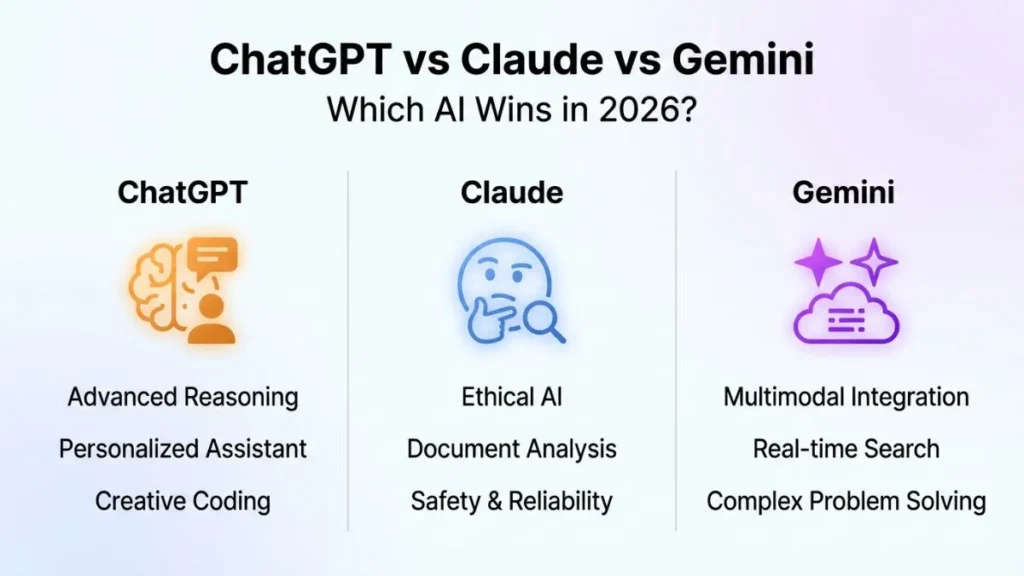
ChatGPT (GPT-5.5)
Best for: Consumer breadth- Voice mode and image generation
- Broadest integration ecosystem
- Terminal agentic workflows
- General daily use (most polished UX)
- Quick prototyping
Claude (Opus 4.7)
Best for: Quality-critical work- Complex software engineering
- Professional writing & editorial
- High-stakes factual work
- Tool orchestration & agents
- Instruction following precision
Gemini (3.1 Pro)
Best for: Scale & integration- Long document processing (2M ctx)
- Video & audio comprehension
- Google Workspace integration
- High-volume API production
- Scientific reasoning tasks
More from AIEarnerHub
AI Use Cases in Daily Life: The Only Framework That Actually Works
8 Best Free AI Apps Like ChatGPT You Must Try
ChatGPT vs These AI Chatbots —Who Actually Wins?
I Tried the Best ChatGPT Alternatives —Here’s What Happened
Why People Are Leaving ChatGPT(And What They’re Using Instead)
AI Assistants That Might Replace ChatGPT Sooner Than You Think
The Most Powerful AI Chatbots Ranked —And the Winner Might Surprise You
Top 10 Trending AI Startups in the USA for 2026
11 AI for Beginners HP Strategies That Actually Work
I Tried the Best Free ChatGPT Alternatives — Here’s What I’d Actually Use
10 Best AI Productivity Hacks 2026: GitHub Secrets That Save You Hours
ChatGPT vs Free AI Alternatives 2026: The Ultimate Power Showdown
AI Chatbots & Assistants: The Ultimate Guide to Intelligent Automation
Claude AI vs ChatGPT: Shocking 2026 Test Results Revealed
The Best ChatGPT Alternatives You Should Actually Try in 2026
Master Prompt Engineering: 10 Essential Tips for Beginners in 2026
AI Tools That Beat ChatGPT at Specific Tasks
Perplexity AI: 7 Mind-Blowing Features Revealed
AI Chatbots Are Competing Harder Than Ever — Here’s Why