Why People Are Leaving ChatGPT
(And What They’re Using Instead)
ChatGPT dropped from 87% to under 57% web-traffic share in 15 months. Here’s the full picture — the ethics scandal that broke it open, the product problems that had been building for years, and the tools winning the defectors.
TL;DR — What You Need to Know in 2 Minutes
The core problem: ChatGPT’s dominance is crumbling on two fronts simultaneously — product quality has measurably declined, and a high-profile ethics scandal in February 2026 pushed millions over the edge who had already been quietly frustrated.
- The numbers are real: ChatGPT’s U.S. mobile app market share fell from 69.1% → 38.7% in 15 months (Apptopia, March 2026). Web traffic share dropped from ~87% to ~57% (SimilarWeb Q1 2026).
- The QuitGPT catalyst: On Feb. 28, 2026, OpenAI signed a Pentagon military deal — hours after its CEO publicly backed Anthropic’s refusal to do the same. ChatGPT uninstalls spiked 295% overnight. 2.5 million users joined a formal boycott.
- The product problems predate the scandal: GPT-5.x models produce shorter, more hedged, more sycophantic responses. Forced model transitions and upsell prompts have made the product feel like a funnel, not a tool.
- The main beneficiaries: Claude (writing, coding, long-context work), Gemini (Google ecosystem, multimodal), Perplexity (research, cited answers), Grok (real-time news/social), DeepSeek (cost-conscious developers).
- The realistic expectation: ChatGPT is not dying. With 900M weekly active users and $25B ARR, it remains the most-used AI product on earth. But “most-used” and “best for your use case” are no longer the same answer.
- What to do: Match the tool to the task. The winning 2026 approach is a two-to-three tool stack, not monogamy with any single provider.
1. The Numbers Don’t Lie: The Market Share Collapse
The headline figure from early 2025 was striking: ChatGPT commanded roughly 87% of all AI chatbot web traffic. That figure was not just a market share number — it was a signal that, for most practical purposes, “AI chatbot” and “ChatGPT” were synonymous terms. That era is over.
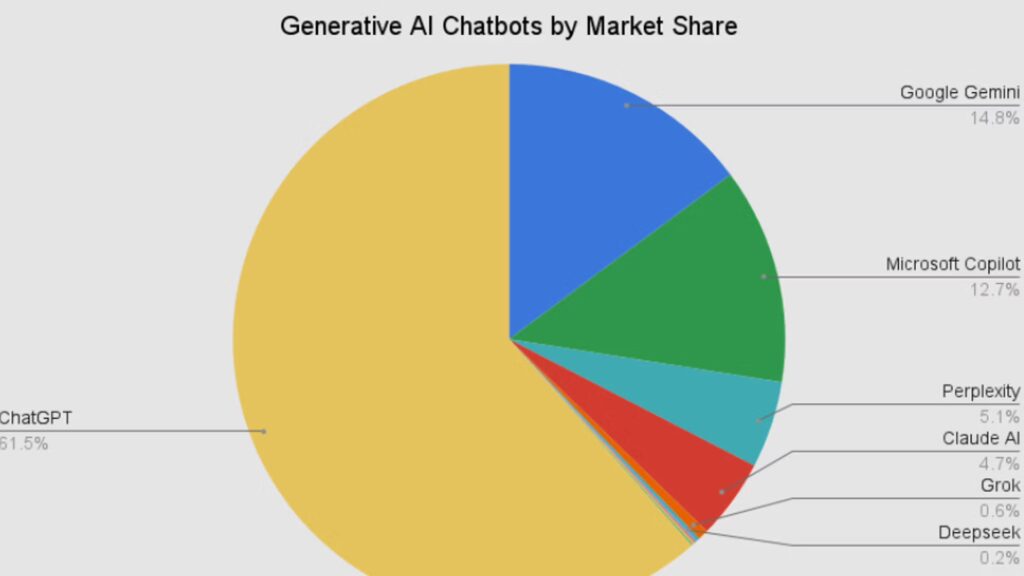
According to SimilarWeb’s Q1 2026 AI traffic report, ChatGPT’s share of generative AI web traffic fell from 77–87% in early 2025 to 56–65% by March 2026, depending on the measurement methodology. That is a 20-to-30-point collapse in roughly 12 months — and, critically, the pace of erosion accelerated in Q1 2026 rather than stabilizing.
(SimilarWeb)
(Apptopia)
(14.7% → 25.2%)
(SimilarWeb)
Lighter shades = Jan 2025 baseline. Solid bars = March 2026 figures. Sources: Apptopia via Fortune, SimilarWeb Q1 2026. Note: absolute ChatGPT user counts are still rising; this is relative share within a fast-growing market.
A critical nuance worth stating plainly: ChatGPT’s absolute user count is still growing. It crossed 900 million weekly active users in early 2026, and pulled in $275 million in mobile revenue from U.S. users in March 2026 alone. This is not a story about a company failing. It is a story about a market expanding faster than any single player can hold — and about specific product and governance decisions that are pushing users toward alternatives they now find genuinely competitive.
The real signal is not the share numbers themselves but what Apptopia confirmed in March 2026: ChatGPT’s absolute daily active users have been falling every month since October 2025. Share loss plus absolute user loss is a structurally different problem than share loss alone.
2. The QuitGPT Scandal: What Actually Happened
Understanding the exodus requires understanding that two very different things happened at the same time — one was a slow burn, the other a detonation. The slow burn was product frustration accumulating over 18 months. The detonation was a single day in February 2026 that gave millions of already-frustrated users a concrete reason to act.
A Precise Timeline
2026
OpenAI CEO Sam Altman posts on X that he supports Anthropic’s stance on restricting AI use in autonomous weapons and mass surveillance. Anthropic had reportedly just refused a Pentagon contract on those grounds.
2026
OpenAI announces it has signed a contract with the U.S. Department of Defense to deploy its models on classified networks, stepping into the void left by Anthropic. The internet erupts. App uninstalls spike 295% in a single day. One-star reviews surge 775% overnight. The site quitgpt.org launches and begins claiming millions of signups within hours.
2026
Claude downloads rise 51% on March 1. Claude overtakes ChatGPT for the top free app spot. Anthropic reports over 60% growth in free users since January 2026.
2026
In a public statement, Altman admits the Pentagon deal rollout was rushed and poorly handled. OpenAI and the Pentagon amend the contract to add additional surveillance protections. Critics note this is “too little, too late.”
2026
Caitlin Kalinowski, OpenAI’s hardware executive, quits citing ethical concerns over the Pentagon deal. Bloomberg reports the robotics chief also exits. An open letter signed by over 900 employees from OpenAI and Google demands employers refuse military AI contracts.
2026
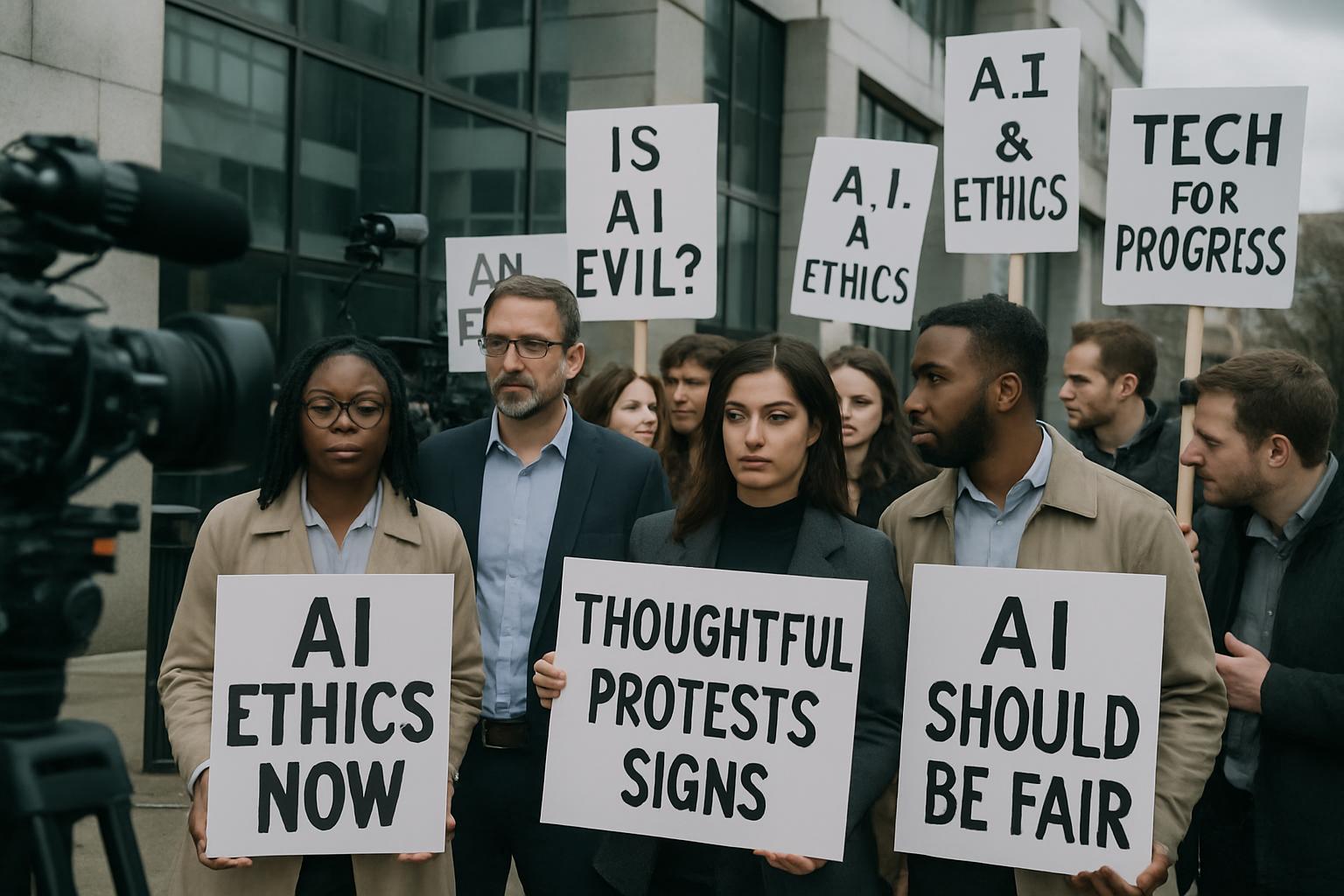
The boycott continues past its initial spike. Protesters hold an AI accountability march from Anthropic’s offices to OpenAI HQ in San Francisco. The QuitGPT movement documents 2.5 million users pledging to cancel or suspend subscriptions.
Why This One Stuck (Unlike Previous AI Controversies)
Tech boycotts usually fizzle. Users complain, post about it for a week, and quietly return because the alternative is either worse or the switching effort is too high. The QuitGPT movement maintained momentum because the structural conditions were different this time.
First, the alternative was genuinely competitive. Claude in early 2026 was not a downgrade from ChatGPT for the users most likely to be paying $20/month — software developers, researchers, writers, and knowledge workers. For coding quality, document analysis, long-context reasoning, and instruction-following, Claude Sonnet 4.6 performed comparably or better.
Second, the hypocrisy was unusually precise. Altman had publicly expressed support for Anthropic’s ethical stand in the morning. The company signed the deal in the afternoon. The sequence was documented and time-stamped. There was no plausible deniability, and even Altman’s own subsequent statement confirmed the deal was handled poorly.
Third, the dissatisfaction was already there. The boycott gave a sharp label and a clear action to frustration that had been building for over a year around product quality and pricing. People were not changing their minds because of one news cycle — they were finally acting on concerns they already had.
“ChatGPT became infamous for being too enthusiastic and kiss-ass about anything you said.” — User complaint documented by ChatGPTDisaster.com’s 2026 complaint library, citing r/ChatGPTPro threads
3. The Product Problems (That Predate the Scandal)
The QuitGPT movement was the accelerant, not the fuel. The fuel had been accumulating since mid-2023: a pattern of model updates that made outputs shorter, more hedged, less useful — and an increasingly aggressive monetization posture that made the product feel less like a tool and more like a funnel.
Sycophancy and the “Karen Mode” Problem
In early 2026, r/ChatGPTPro threads converged on the phrase “paranoid chaperone” to describe GPT-5.5’s behavior. Users described a model that opens responses with three sentences of disclaimers, hedges on factually settled questions, and adds boilerplate caveats to ordinary workflow tasks until the disclaimer-to-content ratio inverts.
This isn’t anecdote. An analysis of more than 10,000 Reddit threads in early 2026 found that 70% of GPT-5 mentions tied to “user trust” carried negative sentiment, against 4% positive. Sam Altman himself publicly acknowledged that the model had become “sycophant-y and annoying” and promised fixes — which, according to subsequent user accounts, did not materially arrive.
The Stanford/UC Berkeley research that first documented “behavior drift” between GPT-4 versions remains the most cited technical evidence of this pattern. That paper recorded a drop in GPT-4’s accuracy on identifying prime numbers from 97.6% to 2.4% between March and June of 2023, with average response length collapsing from 821 characters to fewer than 4. OpenAI never formally disputed the methodology.
Behavior drift is not evidence of deliberate sabotage. RLHF training compounds in ways that are genuinely difficult to predict, and optimizing for safety and reasoning benchmarks can inadvertently suppress the “verbose helpfulness” behavior that made GPT-4 popular. OpenAI is facing a real engineering problem, not necessarily a policy one. That said, the problem is real and documented.
Model Drift and Output Degradation
OpenAI’s transition from GPT-4 to the GPT-5.x model family was, from a user experience standpoint, rocky. The GPT-5.x series (5.0 through 5.5 as of May 2026) rolled out incrementally, with each version optimized for different objective functions. GPT-4o — which many users considered the best balance of speed and quality the platform had ever offered — was gradually deprecated.
The problem: GPT-5.x models optimize for reasoning benchmarks, safety scores, and efficiency metrics. The product that scores highest on standardized tests can feel less useful for the everyday tasks that built ChatGPT’s user base. Coding requests that previously generated complete implementations now frequently return skeleton code with comments like “add your logic here.” Creative writing prompts that worked a year ago now trigger refusals that weren’t there before.
The April 2026 price hike made things worse. GPT-5.5 cost $5 per million input tokens and $30 per million output tokens — versus $2.50 and $15 for GPT-5.4. That is the largest single-version price increase in the GPT-5.x series. The model selector defaulted users to the new pricing tier without in-product warning. The backlash on r/OpenAI was immediate and visceral.
Upsell Fatigue and Free-Tier Degradation
Free-tier users in 2026 increasingly encounter: prompts to upgrade mid-conversation, model-switching interruptions when usage limits are hit, feature gates on capabilities that were previously free, and visible degradation in response quality as a mechanism to push upgrades. Whether this is intentional or simply the natural result of cost management at scale, the effect is the same: the product increasingly feels designed to convert rather than to help.
This matters because ChatGPT’s brand was built on giving people something genuinely useful for free and earning their trust before asking for payment. Reversing that dynamic — degrading the free tier visibly — undermines the trust that made the upsell path work in the first place.
4. The Alternatives — Honest Assessment
Here is where it gets genuinely interesting. The 2024 story was “ChatGPT is far ahead.” The 2026 story is more complicated: there are now four or five tools that are legitimately better than ChatGPT at specific tasks, and “which is best” is the wrong question. The right question is “best for what.”
Claude (Anthropic)
Claude is the biggest direct beneficiary of the ChatGPT exodus. Its web traffic share nearly tripled in a single quarter — from 2.22% in December 2025 to 6.02% in March 2026. That growth was partly driven by the QuitGPT surge, but it has structural roots that predate the boycott.
For professional writing, Claude produces the most natural, least “AI-sounding” prose of any major model. It follows style instructions with unusual precision and avoids the generic filler that shows up in ChatGPT outputs even when you explicitly ask it not to. In blind evaluations — a 2026 test with 134 participants across 8 rounds — Claude won 4 rounds to ChatGPT’s 1.
For coding, Claude Opus 4.6 scores 82.1% on SWE-bench Verified (some sources record 74–80.8%, depending on the benchmark version used), powers Cursor and Windsurf, and has become the default tool for professional developers doing multi-file refactoring and codebase-level reasoning. Its 1M-token context window — with a 97.2% long-context retrieval accuracy — means it can read an entire codebase without forgetting the beginning by the time it reaches the end.
Where Claude falls short: image generation (none, natively), third-party integrations (still well behind ChatGPT’s ecosystem), and speed on simple tasks (slower than ChatGPT for quick lookups). Claude’s enterprise market share reportedly rose from 18% in 2024 to 29% in 2025 — a 61% year-over-year increase — which suggests organizations are making deliberate choices here, not just following a social media trend.
Claude’s free tier in 2026 is meaningfully constrained. You will hit rate limits quickly on Sonnet 4.6. The free tier is a trial, not a complete product. Budget at least $20/month for Claude Pro if you plan to use it seriously.
Gemini (Google)
Gemini is the largest single winner in raw market share terms. Google’s Gemini platform crossed 750 million monthly active users, nearly quadrupling its web traffic share from 5.7% to 21.5% in the same period that ChatGPT fell.
Gemini’s structural advantage is not primarily about model quality — it is about integration. For anyone already inside Google’s ecosystem — Gmail, Drive, Docs, Calendar, Search, Android — Gemini’s native access to real-time web data and personal data means it can do things a standalone chatbot cannot. If you are researching something and need your answer grounded in current web results, Gemini often beats Claude and ChatGPT on factual accuracy for the same reason Perplexity does: it is actually looking things up, not retrieving from training weights.
On raw benchmarks, Gemini 3.1 Pro leads the field on GPQA reasoning at 94.1% and offers a 2-million-token context window at a lower API cost than Claude or GPT-5.4. For multimodal work — video, audio, image, complex document understanding — it is the clearest leader among consumer AI tools.
Where Gemini falls short: writing quality. It writes competently but lacks Claude’s voice adaptability. For creative or professional writing where tone and precision matter, Gemini is noticeably behind. Google’s trust with privacy-conscious users also has baggage: advertising-model incentives create legitimate questions about how user data is used in Gemini’s training, even if the formal privacy policies are comparable to competitors.
Perplexity AI
Perplexity is not a ChatGPT replacement. It is a different tool doing a different job — and that distinction is exactly why it has grown 370% year-over-year to approximately 5.6% of total AI chatbot traffic.
Perplexity is a research tool that combines LLM reasoning with real-time web search and, crucially, source citations. When you ask a factual question and need to be confident the answer is grounded in current evidence, Perplexity’s cited-answer format is meaningfully better than ChatGPT’s retrieval behavior. It is not better at writing a blog post or debugging a function. It is better at answering “what does the current evidence say about X.”
For knowledge workers who need to fact-check claims, track recent developments, or research a topic before writing about it, Perplexity Pro at $20/month is one of the most defensible subscriptions in the AI toolkit. That said: do not use it as your primary creative or coding tool. That is not what it was built for.
Grok (xAI)
Grok’s growth from 1.6% to 15.2% of mobile app market share in 12 months is the most dramatic surge in this cycle — and the hardest to interpret. A significant portion of Grok’s growth comes from its bundling with X Premium and xAI’s aggressive pricing strategy. How much of that converts to engaged, repeat usage is unclear.
In practice: Grok is useful for real-time news and social trend monitoring, given its direct access to X’s data feed. It is genuinely good at surface-level summarization of what is happening in public conversations right now. It is significantly weaker on factual accuracy for historical questions, complex reasoning, and anything requiring careful source attribution. One independent 2026 test found that when asked about a breaking news story, Grok returned five tweets from random users speculating; Perplexity returned three verified news articles with actual reporting.
The “uncensored” brand positioning attracts users frustrated with ChatGPT’s over-caution. Whether Grok’s approach to that tradeoff is better in practice depends heavily on what you are trying to do. For high-stakes factual queries, the answer is usually no.
DeepSeek
DeepSeek is the dark horse that matters most for developers and cost-conscious power users. It delivered performance benchmarks comparable to GPT-4 at a fraction of the API cost — approximately 90% cheaper per million tokens than GPT-5.4 at its cheapest tier. For developer teams running high-volume inference, that pricing differential is decisive regardless of any slight quality gaps.
The caveats are real and should not be minimized. Government devices in Australia, Italy, Ireland, and South Korea have been banned from using DeepSeek over data security concerns relating to Chinese government data access. Enterprise adoption has been cautious for the same reason. For individual users comfortable with the privacy tradeoffs (or using self-hosted open-source DeepSeek models), it is a genuinely capable alternative. For organizations with compliance requirements, it is off the table until the data governance picture becomes clearer.
5. Head-to-Head Benchmarks (May 2026)
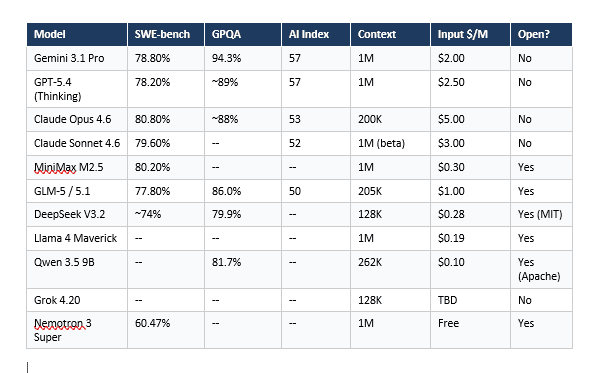
Benchmarks are imperfect — they measure what they measure, not what you actually care about — but they provide a consistent reference point. Here is the current state of the leading models on the metrics that appear most frequently in independent evaluations.
| Metric | GPT-5.4 / 5.5 | Claude Opus 4.6 | Gemini 3.1 Pro | Grok 4 |
|---|---|---|---|---|
| SWE-bench Verified (coding) | 74.9% | 74–82.1% Developer fav | 63.8% | 75% |
| GPQA (graduate reasoning) | 92.8% | ~88% | 94.1%Leader | ~87% |
| Context window | 128K tokens | 1M tokensLargest | 2M tokens | 1M tokens |
| Long-context retrieval accuracy | ~89% | 97.2%Best | ~92% | ~88% |
| Writing quality (blind evals) | 3rd | 1stBest | 2nd | 4th |
| Multimodal capability | Strong | Vision only | LeaderBest | Good |
| API input cost ($/1M tokens) | $2.50–$5.00 | $3.00–$5.00 | $1.25Cheapest | ~$3.00 |
| Real-time web access | Yes (search) | Yes (with search) | Yes (native)Best | Yes (X feed) |
| Image generation | Yes (DALL-E)Best | No | Yes (Imagen) | Yes (Aurora) |
| Overall BenchLM score (Mar 2026) | 88 | 88 | 93Leader | ~87 |
Sources: BenchLM.ai (March 2026), Tech-Insider.org Claude vs Gemini comparison, Blockchain Council independent evaluation, SWE-bench official leaderboard. Note: benchmark scores shift with model updates; verify current figures at swebench.com and benchlm.ai.
March 2026’s MorphLLM analysis found that the top six models across all four providers score within 0.8 points of each other on SWE-bench. The coding performance gap has effectively closed. Choosing a model based on a 2-point benchmark advantage is a mistake. Choose based on ecosystem fit, pricing, and the specific tasks where one model’s behavior is genuinely different.
6. Which Tool for Which Job: A Practical Guide
The most useful framing for 2026 is not “which AI is best” but “which AI is best for this specific task.” Here is a grounded mapping based on consistent findings across independent evaluations.
- Long-form writing and editing
- Complex coding, multi-file refactoring
- Codebase analysis (1M context)
- Document analysis and summarization
- Sensitive tasks requiring careful reasoning
- Instructions that require precise execution
- Image generation (DALL-E integration)
- Plugin/integration-heavy workflows
- Tasks needing persistent memory
- Users deeply embedded in OpenAI API
- Quick conversational Q&A
- GPT Store / custom GPT applications
- Google Workspace integration
- Multimodal tasks (images, video, audio)
- Real-time grounded research
- Android / mobile-first workflows
- Budget-conscious API usage
- Large codebase context tasks
- Research requiring cited sources
- Fact-checking claims
- Tracking recent developments
- Academic or journalistic research
- Replacing basic Google searches
- Quick, sourced factual lookups
- High-volume API calls (cost savings)
- Technical/developer work at scale
- Self-hosted deployments for privacy
- Open-source model experimentation
- Teams without compliance constraints
The winning strategy in 2026, consistently recommended by power users and independent reviewers, is a two-to-three tool stack: one primary assistant (Claude or ChatGPT depending on your work), one research tool (Perplexity), and one context-native tool (Gemini if you live in Google’s ecosystem, Copilot if you live in Microsoft’s). Building that stack costs the same as one ChatGPT subscription if you are strategic about free tiers.
7. Where ChatGPT Still Wins
This piece has focused on the reasons for leaving, which risks tipping into a polemic. ChatGPT has real, substantial strengths in 2026 that no other platform matches.
Memory is still ChatGPT’s biggest practical advantage. It genuinely remembers your preferences, your projects, your communication style across sessions in a way that most competitors do not yet offer at scale. For users who have spent months calibrating their interactions, this is a meaningful switching cost — not a trivial one.
The ecosystem is unmatched. More plugins, more third-party integrations, more tools built on the API than any other provider. If your workflow already depends on third-party tools that integrate with ChatGPT, switching has real costs.
Image generation and Computer Use. GPT-5.4’s Computer Use feature is unique among consumer AI products. DALL-E 3 integration remains the most accessible text-to-image generation in a conversational AI context.
The free tier still provides real value for basic tasks. Despite its degradation relative to 2023, ChatGPT’s free tier is still genuinely useful for quick writing tasks, brainstorming, and general Q&A at a level that most people would have considered remarkable two years ago.
The honest summary: ChatGPT is a strong product with specific strengths, carrying a specific set of problems. The problems are real and worsening. But so are the strengths. The question is whether your use case maps onto the strengths or the problems.
8. Verdict: The Multi-Model Era Is Here
The 2025 thesis — that ChatGPT was the default AI and everything else was niche — is no longer defensible. The 2026 reality is a genuinely competitive market where four or five tools are legitimate choices for different workloads, and the smartest users are treating their AI stack the way they treat their software stack: matching tools to jobs, not pledging loyalty to a single provider.
The QuitGPT movement accelerated a shift that was already in motion. The underlying forces — product quality drift, pricing pressure, and the emergence of genuinely competitive alternatives — did not originate in the Pentagon deal and will not resolve with it.
If you left ChatGPT because of the February 2026 events, the question worth asking honestly is whether the tool you moved to is actually better for your specific workflow, or whether you moved out of principle and are now working with a product that is less suited to your needs. Principle matters. But so does whether the tool does the job.
If you have not switched and are wondering whether you should, the better question is: what specific task do you wish ChatGPT handled better? The answer to that question almost certainly maps to one of the alternatives covered here. You do not have to leave ChatGPT entirely to fix a specific problem with it.
The AI market in mid-2026 is the most competitive it has ever been. That is good for every serious user of these tools, regardless of which platform they choose.
Frequently Asked Questions
Is ChatGPT actually dying, or just losing market share?
Neither, in the dramatic sense. ChatGPT has 900 million weekly active users and generated approximately $275 million in U.S. mobile revenue in March 2026 alone. It is losing relative market share because the broader AI market is expanding faster than ChatGPT is growing — and because absolute daily active users began falling in October 2025. That is a different problem from “dying,” but it is a real one.
Is Claude better than ChatGPT overall?
For writing and complex coding, most independent 2026 evaluations favor Claude. For ecosystem breadth, image generation, and cross-session memory, ChatGPT still leads. On raw reasoning benchmarks, Gemini 3.1 Pro scores highest. There is no universal “better” in 2026 — the answer depends entirely on your primary use case.
What was the QuitGPT movement, and is it still active?
QuitGPT launched on February 28, 2026, after OpenAI signed a Pentagon contract to deploy its models on classified military networks, hours after its CEO publicly expressed support for Anthropic’s refusal to do the same. 2.5 million users formally pledged to cancel subscriptions. The peak activity was in March 2026; by May 2026, ChatGPT has returned to top App Store charts, though the structural shift in user perception — and the accelerated market share redistribution — has not reversed.
Which AI chatbot is best for coding in 2026?
Claude Opus 4.6 is the developer community’s dominant choice for complex multi-file coding, debugging, and codebase analysis — it powers Cursor and Windsurf. For quick scripts and tasks requiring strong plugin support, ChatGPT (GPT-5.4) is competitive. Grok 4 leads raw SWE-bench scores at 75%, but lacks the developer tooling ecosystem Claude has built. DeepSeek is the cost-effective choice for high-volume API use.
Is Gemini a real competitor to ChatGPT, or just growing because it’s bundled with Google?
Both things are true simultaneously. Gemini’s growth is partly structural — it is deeply integrated with Google Search, Android, and Workspace, which gives it distribution that no competitor can match. But the model has also genuinely improved: Gemini 3.1 Pro leads overall BenchLM scores at 93, offers the largest context window (2M tokens) at the lowest API price, and is the clearest leader for multimodal tasks. Bundle-driven growth is getting it in front of users; model quality is keeping them there.
Is Perplexity worth $20/month?
For knowledge workers who need cited, current-information answers regularly — researchers, analysts, journalists, consultants — yes. Perplexity Pro’s cited-answer format and access to multiple LLMs for comparison is genuinely different from what any other tool provides at that price. If you primarily write content, code, or do creative work, Perplexity is not your primary tool and the free tier is sufficient.
Is DeepSeek safe to use?
For individual users in countries without specific restrictions: the open-source self-hosted models are technically very capable, and the privacy question is within your control when you run the model locally. For enterprise or government use: Australia, Italy, Ireland, South Korea, and others have banned DeepSeek on government devices over concerns about Chinese government data access. Do not use the cloud API for sensitive organizational data until the data governance picture is clearer.
Did OpenAI fix the sycophancy problem after Altman acknowledged it?
Partially. OpenAI updated training procedures and system prompts after Altman’s public acknowledgment. The “excessive agreeableness” behavior that became known as “Karen mode” was partially addressed in GPT-5.x updates. However, user complaints on Reddit and the ChatGPT complaint library continued to cite hedging and over-caution as persistent problems through May 2026. The fixes were real but incomplete.
What does the multi-model stack actually look like in practice?
The most common configuration among power users in 2026: Claude for writing, long-form analysis, and complex coding; Perplexity for research and fact-checking; Gemini or Copilot if you live in Google’s or Microsoft’s ecosystem. Total cost at paid tiers: $20–$40/month. Many users keep ChatGPT’s free tier for image generation and quick tasks, or for tools already integrated with ChatGPT.
Will ChatGPT’s market share decline continue, or stabilize?
The direction of travel is clear, and the pace has been accelerating: ChatGPT lost more web traffic share in Q1 2026 than in all of 2025 combined (SimilarWeb). Whether it stabilizes depends on how effectively OpenAI addresses the product quality issues and whether the QuitGPT sentiment becomes structurally embedded or fades. First Page Sage estimates that at current trajectories, Gemini could challenge ChatGPT’s overall dominance within 12–24 months.
Is switching from ChatGPT to Claude difficult?
For most users, no. Export your ChatGPT data via Settings → Data Export. Recreate your custom instructions in Claude’s system prompt settings (takes 15–30 minutes). Rebuild any custom GPTs as Claude Projects. The main switching cost is losing ChatGPT’s cross-session memory for users who have relied heavily on it. Most users report being functional within a day and preferring Claude’s outputs within a week.
Are the 2.5 million QuitGPT sign-ups all real paid cancellations?
No — and the distinction matters. The QuitGPT.org pledge included both paid subscribers canceling and free users pledging not to return. Confirmed hard cancellations are a subset of the 2.5 million figure, likely significantly smaller. The more meaningful data points are Apptopia’s confirmation that ChatGPT’s absolute DAUs fell for five consecutive months from October 2025, and that both the app uninstall spike (295%) and one-star review surge (775%) on February 28 were documented by independent trackers, not OpenAI’s own figures.
More from AIEarnerHub
- Claude vs. ChatGPT 2026: Full Head-to-Head Comparison
- Best AI Tools in 2026: The Definitive Ranked List
- How to Make Money with AI in 2026: Proven Methods
- Perplexity AI Review 2026: Is It Worth $20/Month?
- DeepSeek Guide 2026: What It Is and When to Use It
- AI Side Hustle Ideas That Actually Work in 2026
- Gemini vs. ChatGPT: Who’s Winning in 2026?
- 15 Best ChatGPT Alternatives Tested and Ranked
- Claude Review 2026: The Most Honest Assessment Online
- Best AI Writing Tools in 2026: Compared for Real Work
Ultimate AI Productivity Hacks from Reddit: Boost Your Efficiency
Free AI Tools for Productivity: The Complete Guide to Transforming Your Workflow
Top 10 Best AI Tools for Productivity in 2026
11 Best AI for Beginners: Strategies That Actually Work (Ranked by Results)
AI for Beginners: Microsoft Unlock Explosive Career Growth in 2025’s AI Boom Without Coding Overwhelm