The marketing definition of “AI email marketing” is: artificial intelligence that generates subject lines and automates send times. That version is real. It also explains approximately 20% of the performance gap between brands winning with AI and brands running it as a content shortcut.
The operational definition is different. It is: a system where AI decides who receives what message, when, based on live behavioral signals — and then generates the appropriate content for that decision. The copy is downstream. The decision layer is the product.
This distinction matters because it changes what you invest in, what you measure, and which tools actually move your numbers. Most 2026 AI email guides skip it. They jump straight to “here are 7 prompts for better subject lines.” This is the guide that doesn’t.
The misconception that’s costing you segmentation revenue
Here is the common version of an “AI-powered email program” in mid-2026: a team uses ChatGPT or the built-in AI writer in their ESP to draft copy faster, runs subject line A/B tests with AI-suggested variants, and may have turned on send-time optimization. Production has gotten faster. Results have moved 8–12%. They call it a win.
It is a win. It is also the floor, not the ceiling.
The ceiling is reached when you move AI from the content layer to the decision layer. The distinction sounds abstract until you see what it does to segment performance. Traditional demographic segmentation — age, location, purchase history brackets — produces predictable clusters that marketers could describe in a sentence. AI-driven behavioral segmentation produces outputs that no human would build, because a human would never have time to notice them.
“Women 25–44, purchased in last 90 days, AOV above $60”
“High probability to purchase [specific product category] within 14 days — currently showing declining engagement over 3 consecutive campaigns”
Segment describes the past. Useful for reporting, not for intervening before churn.
Segment is a predicted future state. You can intercept a defection before it happens.
One documented case tracked by ALM Corp showed customers identified by an AI propensity model were five times more likely to purchase than the rest of the list. The model wasn’t smarter than the marketer — it just processed 400 behavioral signals simultaneously instead of 3.
The two types of AI in your ESP — and why you need both
Most current writing treats “AI in email” as one thing. It is two things that are increasingly being fused inside the same platform, and knowing which is which changes how you evaluate any tool.
“Traditional email automation was about drawing boxes and arrows. Autonomous marketing is about setting goals and letting AI figure out the next best move.”
— Jackie Palmer, VP Product Marketing, ActiveCampaign| AI Type | What It Does | Where It Lives | Metric Impact |
|---|---|---|---|
| Predictive AI | Analyzes historical behavior to forecast future actions — purchase likelihood, churn risk, optimal send window, segment membership | Segmentation engine, send-time optimizer, lead scoring, lifecycle triggers | Revenue per recipient ↑18–45% |
| Generative AI | Creates content — subject lines, preview text, body copy, product descriptions, image variants — from prompts and brand guidelines | Email editor, A/B test generator, campaign builder | Production time ↓ ~90% |
| Agentic AI (2025–26 emergence) | Manages entire lifecycle journeys autonomously — determines next best action per subscriber based on current signals, not fixed rules | Klaviyo Flows AI, ActiveCampaign Autonomous, Salesforce Einstein Journeys | Conversion lift: 28%+ |
The meaningful shift in 2025 and 2026, noted in both the ALM Corp consolidated dataset and ActiveCampaign’s own product positioning, is that these types are converging inside the same platform. You no longer build a flow with branching logic. You set a goal — “maximize 30-day purchase rate for subscribers who abandoned in the last 7 days” — and the system builds and iterates the journey. This is the operational upgrade most brands haven’t made yet.
If you want to understand the full scope of AI prompt strategy being used by serious practitioners right now, the AI Earner Hub has been tracking real deployment patterns across email, content, and automation — particularly useful if you’re mapping how to integrate these tools into a broader workflow rather than just a single channel.
What AI email marketing actually looks like in production
Not what vendors say it looks like. What the documented cases show.
Managing 1.2M+ active subscribers. Used Klaviyo AI to implement hyper-targeted automated flows with personalization keyed to average order value. Welcome message variants, product recommendations, and post-purchase sequences were all AI-personalized at the segment level, not the individual level — a distinction worth noting for brands without first-party behavioral depth yet.
The lever: AOV-based personalization in the welcome series. Not AI-written copy — AI-decided content routing based on predicted customer value tier at the moment of signup.
Personal care brand that reached $100M+ annual revenue with an owned ecommerce store and retail partners including Target and Whole Foods. Adopted Klaviyo AI-powered flows and used AI-generated content for editing rather than creation from scratch — a model described by Klaviyo as “editing for style and voice rather than writing copy from scratch.”
The underlying mechanism: faster iteration cycles on flow content, plus AI-driven segmentation that surfaced subscriber groups the team hadn’t been explicitly tracking. The speed gain compounded — more tests run, more signals gathered, faster optimization.
The parent company of KFC, Pizza Hut, and Taco Bell ran an AI-driven email personalization pilot that combined in-house reinforced learning algorithms with natural language generation tools. Individual offers were generated based on behavioral factors specific to each recipient — order history, location patterns, frequency signals.
Notable constraint: they didn’t use a single off-the-shelf tool. They combined in-house reinforcement learning with third-party NLG. For most organizations, this is not the starting point — but the architecture signals where the market is heading at enterprise scale.
The actual workflow: where AI plugs in
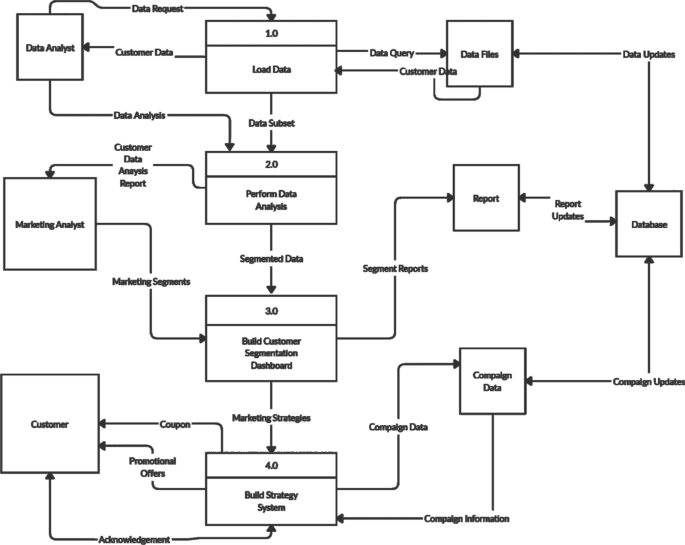
Described as a process because this one actually is sequential. Each stage feeds the next. Skipping stage 2 is why most AI email implementations plateau at “slightly faster production” instead of measurable revenue lift.
The tools that are actually being used in 2026
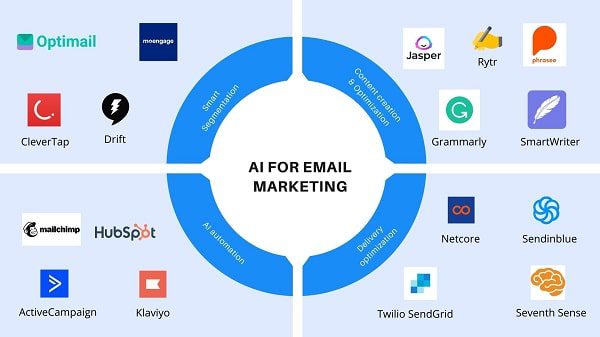
Not a comprehensive market map. These are the tools with documented performance data or significant platform integrations in active production as of mid-2026. The AI features that matter most are the decision-layer ones — segmentation and flow intelligence — not the content generators, which are largely commoditized.
The AI tools with the deepest behavioral segmentation (Klaviyo, Salesforce) require significant first-party data to produce the documented uplift numbers. If your list has limited behavioral history — fewer than 6 months of consistent engagement tracking — the 18–45% revenue lift projection is optimistic for your situation. Start with send-time optimization and AI-generated copy variants. Build the data layer in parallel.
AI content generation: what actually saves time and what doesn’t
The 340% jump in generative AI adoption for email tasks is real. So is the drop in production time — from 62% of teams needing 2+ weeks per email in 2024 to just 6% in 2025. That’s not noise, that’s a structural shift in how email teams operate.
What changed: teams are editing AI output rather than writing from scratch. The model drafts, the human tightens brand voice, checks factual claims, and cuts anything that reads like a template. This is faster. It’s also a different skill than copywriting — it’s editing with taste, which means teams who’ve historically outsourced “the creative part” now need judgment in-house.
Where generative AI legitimately accelerates
| Use Case | Time Saved (est.) | Quality Risk | Notes |
|---|---|---|---|
| Subject line variants for A/B testing | High (80%+) | Low | Produce 10 variants in 2 minutes. Filter for brand voice manually. This is the highest-ROI use of generative AI in email. |
| Transactional email copy (order confirmation, shipping, reset) | High (70%+) | Low | Low brand sensitivity, high volume. AI drafts are close to final with one pass. |
| Product description blocks in recommendation emails | Medium (50%) | Medium | Requires product data input. Output quality correlates with input specificity. |
| Newsletter body copy, long-form content emails | Medium (40%) | Medium–High | AI drafts flatten voice. Useful as structure scaffolding, not final output. Heavy editing required for brand-distinctive content. |
| Re-engagement sequences (“we miss you” campaigns) | Low (25%) | High | These emails live or die on emotional specificity. AI output tends toward cliché. The AI-generated “we miss you” and the human-written one are distinguishable, and the latter converts better in most tests I’ve seen reported. |
HubSpot’s VP of Marketing documented an experiment where 1:1 personalization at scale using generative AI increased conversion rates by 82%. The keyword is “1:1” — not mass-personalized, individually adapted. That result requires combining predictive segmentation (who gets what message) with generative execution (what that message specifically says to that person). Neither alone produces 82%.
The most common mistake when starting with AI email copy: treating the model’s first output as a draft. Treat it as raw material. The difference in final quality between teams that iterate through 3 AI passes vs. those that accept the first draft is large — and it’s the main reason outcomes diverge even when people are using the same tools. For a deeper breakdown of AI prompting strategies that translate directly to output quality in tools like these, AI Earner Hub covers the applied side in detail.
The compliance layer most guides skip
70% of email marketers expect up to half their operations to be AI-driven by end of 2026. The legal and ethical infrastructure for that hasn’t caught up.
Three specific risks that are currently unresolved for most teams:
Explainability of exclusions
If your AI model excludes a subscriber from a promotional campaign because a propensity score deemed them low-value, and that subscriber asks why, you need to be able to answer. Under GDPR Article 22, automated decisions that significantly affect individuals require human oversight and an explanation mechanism. Most current email AI implementations cannot produce a plain-language explanation of individual send/no-send decisions. That is a compliance gap, not a future consideration.
Inferred characteristic bias
AI segments that correlate with protected characteristics (even without explicitly using them) create fair-marketing risk. An AI model trained on behavioral data will sometimes identify patterns that correspond to demographic proxies. Document your segmentation logic and audit for disparate impact on a regular cadence.
Image generation and consent
AI-generated email images, particularly those depicting people, require the same consent review as stock photography — and in some EU jurisdictions, more. The 340% increase in AI image generation for emails in 2025 means this is no longer a theoretical risk. Build the review step into your production workflow now.
Before scaling AI personalization: document the decision logic for your 3 highest-volume flows, confirm your ESP can export per-recipient send rationale, and have someone in legal review your segmentation variables against applicable regulations. This takes less time to do proactively than to defend reactively. For current regulatory guidance on AI marketing in the EU, the European Data Protection Board publishes active guidance worth tracking.
Where to actually start (not where vendors say to start)
Vendors will tell you to start with their AI content generator because that’s what demonstrates value in a demo. The faster path to meaningful ROI starts differently.
First: audit your behavioral data completeness. Open rates, click patterns, purchase history, browse abandonment — these are the inputs your AI segmentation runs on. If you have less than 6 months of consistent tracking across these signals, the AI can’t reliably predict future behavior. Start collecting now, optimize the ESP later.
Second: pick one flow with high revenue potential and rebuild it with AI-driven segmentation. The abandoned cart sequence is the obvious choice — high intent, clear behavioral signal, measurable outcome. Let the AI propose the segments based on abandonment value, time to abandon, and prior purchase history. Compare to your current rule-based flow over 60 days.
Third: add AI copy generation to your A/B testing process, not your production process. Use it to generate 6 subject line variants per send. You’ll run more tests faster, build a data set of what language your list responds to, and gradually develop a model that’s trained on your audience’s actual behavior — not a generic training corpus.
One more thing, which I haven’t found widely documented but have observed in multiple practitioner accounts: the teams getting the largest lifts from AI email are not the ones who’ve replaced the most human judgment. They’re the ones who’ve used AI to increase the number of decisions they can make per week. More segments tested, more variants run, more flows reviewed and updated. The AI multiplies decision velocity. The human still owns the strategy.
Here’s the uncomfortable implication of everything above: if AI is doing the decision layer — who gets what, when, with what content — then the most important skill in email marketing is no longer writing. It’s knowing which goal to set, which signals to prioritize, and which outputs to trust. That’s a strategic and analytical function.
Which means that most “email copywriters” are now actually segmentation architects who happen to review copy. That transition is not yet reflected in job descriptions, team structures, or how most organizations have approached upskilling their email function.
By the time it is, the gap between teams who understood this in 2026 and those who didn’t will be three to four years of compounded behavioral data, optimized flows, and audience intelligence. Email gives you $36–42 back for every dollar spent. AI is not changing that ratio dramatically — it’s changing who earns it.
Sources referenced: Litmus State of Email Report 2025 · Klaviyo State of Email 2025 · ALM Corp AI in Email Marketing consolidated dataset (March 2026) · ZoomInfo 2025 Customer Impact Report · ActiveCampaign product documentation · Mailjet 2025 Email Trends Report · Singulate/HubSpot personalization study · Salesforce Marketing AI guide (updated June 2026). Data ranges reflect variance across industries and list quality tiers.
AI Tools That Might Change the Internet More Than ChatGPT
AI tools for digital marketing 2025: The Complete Guide to Revolutionizing Your Marketing Strategy
Email Marketing with AI Reddit: Best Guide
Free AI Email Marketing Wins: Top 7 Strategies for 2026
AI Email Marketing Generators in 2026: The Guide That Actually Tells You the Truth