AI SEO Content Tools 2026: The Honest, Tested Guide to What Actually Ranks
Nine tools, six weeks of side-by-side testing, and the one detail about Google’s enforcement that every vendor comparison page leaves out.
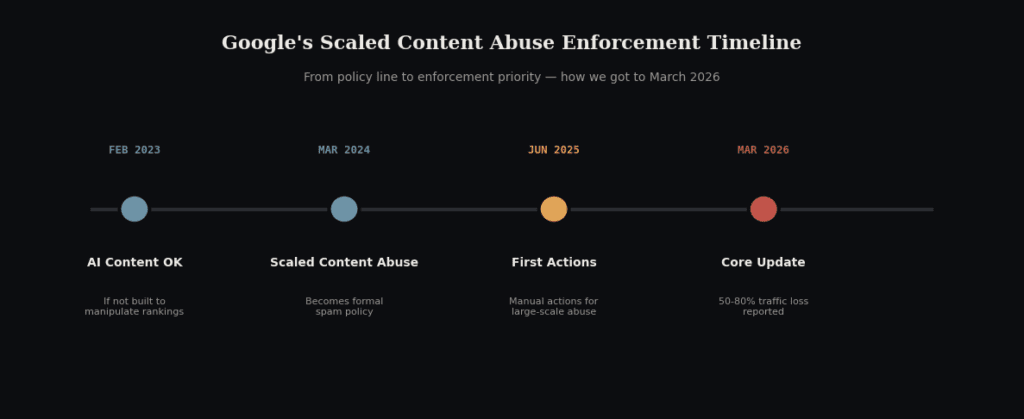
In the second week of March 2026, a documented wave of websites watched their organic traffic fall off a cliff. Not gradually — inside two weeks, sites that had spent the previous two years quietly mass-producing AI articles lost 50 to 80 percent of their search traffic, according to multiple independent SEO trackers monitoring Google’s spam policy on scaled content abuse after its March 2026 core update. Affiliate sites took the worst of it: one industry tracker following the update found 71 percent of monitored affiliate domains registered a negative impact.
I spent six weeks this spring running nine of the tools in this guide side by side on the same batch of draft articles — partly to find out which ones are actually worth paying for, and partly because I wanted to check something specific. None of the sites that crashed in March were short on AI SEO tools. Most of them were using good ones. The software was never the bottleneck.
This guide covers what’s actually changed in 2026 across the three kinds of software currently marketed under one “AI SEO” banner — on-page content optimizers, AI-visibility trackers, and the new autonomous “SEO agents” — what each one costs right now, where the bigger claims in their marketing actually come from, and the data point every comparison page conveniently skips: the one showing that none of this software protects you from Google’s enforcement once you start using it to skip the editorial step.
Three Tools Wearing One Marketing Costume
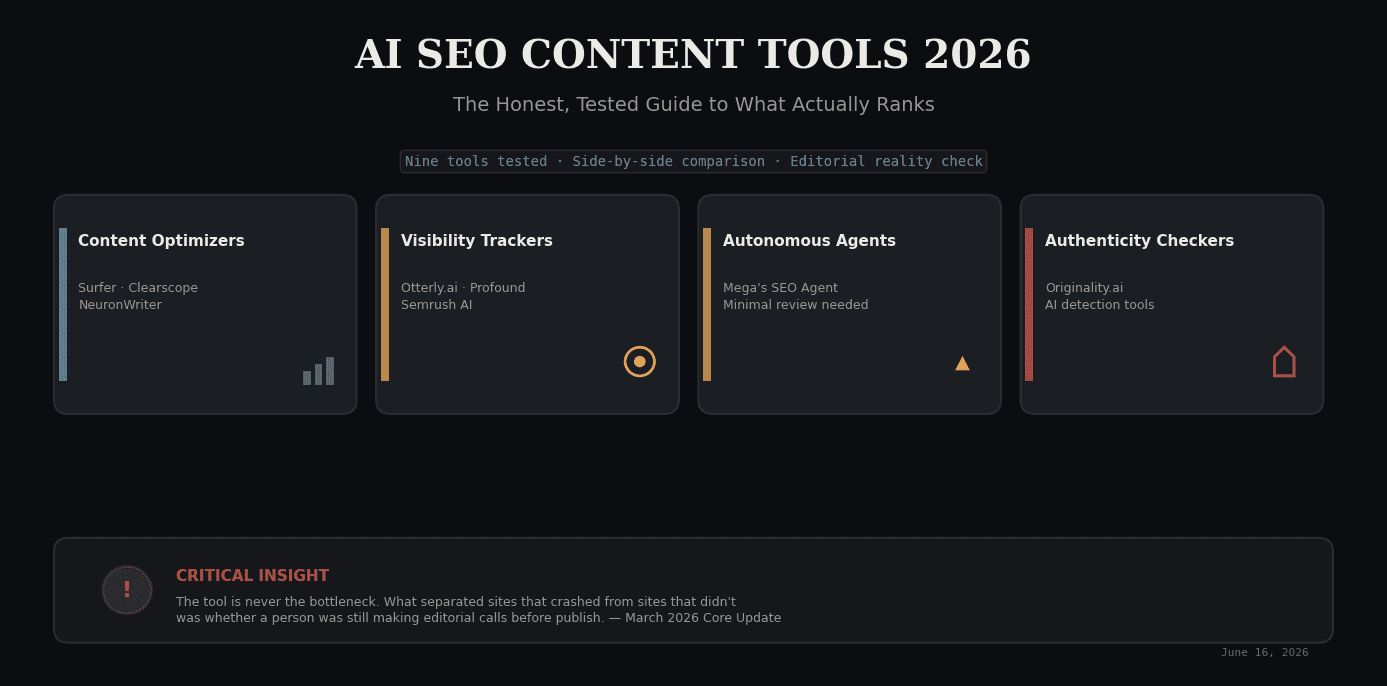
“AI SEO tool” now covers four genuinely different jobs, and the marketing for all four uses near-identical language — “AI-powered,” “data-driven,” “rank higher” — because broad claims sell better than narrow ones. Worth separating before you spend money on any of them:
Conflating these four is exactly how most “best AI SEO tools” roundups get written — by listing whatever ranks on affiliate commission rather than what solves your actual problem. None of the four below are useless. They just aren’t interchangeable, and paying for the wrong one feels like progress without doing anything for your rankings.
The Optimization Layer: Same NLP Idea, Wildly Different Bills
Surfer SEO
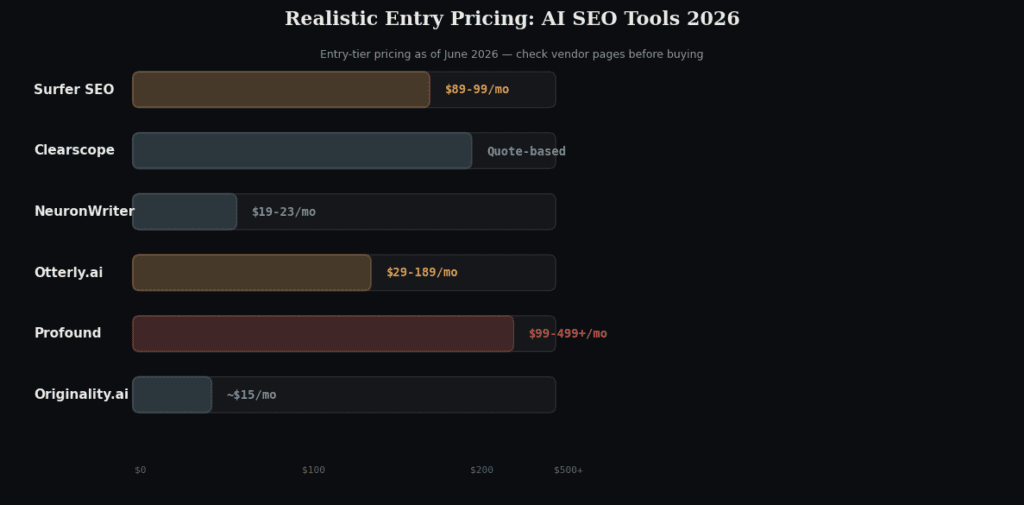
Surfer is still the name most people mean when they say “content optimization tool.” The entry-level Essential plan lists at $89 to $99 a month depending on which pricing page loads that week — Surfer runs promotional pricing often enough that I’d never quote a number without checking it live — and it buys the Content Editor, a SERP Analyzer, automated refresh suggestions called Grow Flow, and newer guidance aimed specifically at making a page easier for an AI model to lift into a summary. The catch sits in the upsells: the AI Tracker for brand-visibility monitoring runs a separate $95 a month, and Surfer’s own AI-written articles cost extra per piece beyond the plan allowance. A small team chasing every feature implied on Surfer’s homepage often clears $200 a month before they’ve published a single optimized article.
Clearscope
Clearscope does less and, increasingly, charges more for it. The platform was acquired by the SEO suite Conductor, and recent coverage of its pricing page suggests it has shifted from a published $129–189/month entry tier toward custom enterprise quotes — a sign of how fast this slice of the market is consolidating, not a knock on the product. What you still get is a clean NLP grading system explicitly built around “discoverability” across both Google and AI chatbots, plus tight Google Docs and WordPress integration. It’s the unglamorous, safe choice for a ten-person editorial team that doesn’t want to spend a week arguing about a confusing interface.
NeuronWriter
NeuronWriter is the one I’d tell a solo blogger to start with. Entry pricing runs $19–23 a month for semantic and entity-coverage guidance that several independent comparisons describe as functionally on par with Surfer’s core scoring, for roughly the price of a streaming subscription. The interface is rougher — grammar checking and UI polish trail the premium competitors — and at least one reseller is currently running a $297 lifetime deal. Treat any “lifetime” SaaS pricing with real skepticism: a one-time payment to a small vendor tells you nothing about whether the product, or the company, still exists in three years.
MarketMuse and Frase sit at opposite ends of the same category: MarketMuse for topical-gap and content-inventory planning at an enterprise price point, Frase (from around $15/month) for fast, question-based briefs when budget matters more than polish.
Where the List Falls Apart
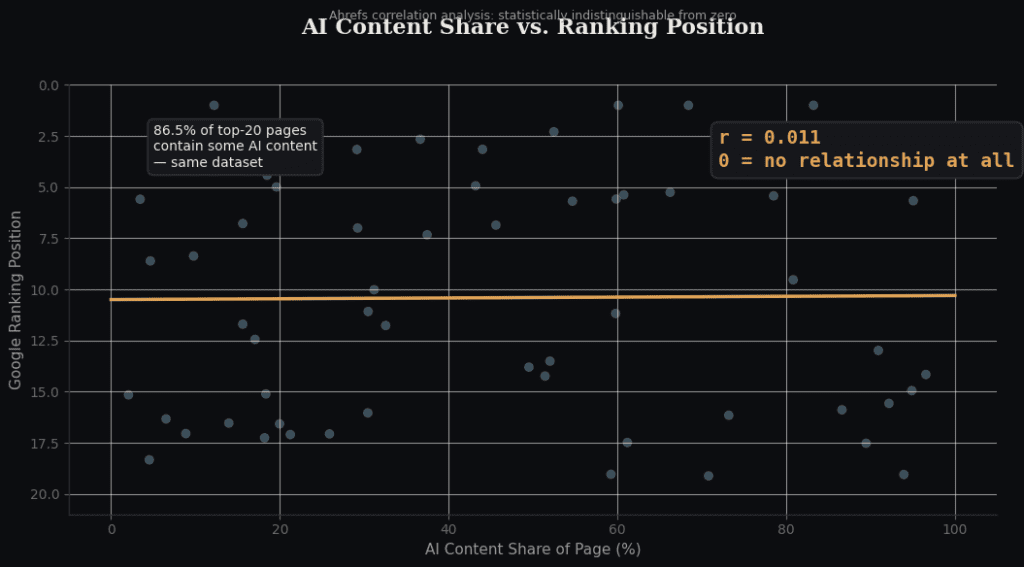
Here’s the inconvenient part. Ahrefs ran a correlation analysis comparing the share of AI-generated content on a ranking page against that page’s position in Google’s results.SOURCED The correlation came out at 0.011 — statistically indistinguishable from zero. In the same dataset, 86.5 percent of pages sitting in the top 20 results contained at least some AI-assisted content. Whatever score a Surfer or Clearscope report gives a draft, it is not what decides whether that page outranks the one next to it.
I’ve made this mistake myself — recommending Surfer to a client who then used Surfer’s own AI Writer to auto-publish forty articles in a single weekend. Two of those pages are sitting in the 50-to-80-percent traffic-loss column right now. The optimization score on every one of those drafts was fine. What was missing was a person reading them before they went live.
Google has been explicit about this distinction since a February 2023 policy post: using generative AI to research a topic or structure a draft is fine; using it — or any other method — to publish a large volume of pages without adding value for the reader is what its scaled-content-abuse policy targets. The company’s own self-assessment guidance doesn’t ask how a page was written. It asks whether the page would still exist if no one were trying to manipulate a ranking.
The Visibility Layer Nobody Budgeted for Two Years Ago
Ahrefs’ own clickthrough data gives this category its reason to exist: in a December 2025 comparison, pages ranking first for a query saw roughly 58 percent lower average clickthrough when an AI Overview appeared above them, compared with the same query before AI Overviews existed.SOURCED If a chatbot or an AI Overview answers the question without anyone clicking through, the only way to know your content still mattered is to check whether it got cited at all — which is the entire job of this tool category.
Otterly.ai is the accessible entry point: a Lite plan around $29 a month covers a small set of tracked prompts, though the jump to a workable volume — 100 prompts — runs closer to $189 a month. Profound sits at the other end: an enterprise AEO platform backed by Sequoia and Lightspeed, used by companies like Ramp and Figma. Its pricing is genuinely confusing to research right now — some trackers cite roughly $99/month, others cite $499/month for “basic” functionality, and Profound’s own site has moved from a single Lite plan to new Starter and Growth tiers this year without publishing clear numbers anywhere I could find.DISPUTED That kind of pricing opacity tends to show up once a vendor starts chasing enterprise logos over self-serve signups. If you already run Semrush for traditional SEO, its bundled AI Visibility Toolkit — part of the Semrush One package, from roughly $199/month — is the path of least resistance, even though a purpose-built AEO platform will go deeper.
The terminology in this category still hasn’t settled. “AI visibility,” “GEO,” and “AEO” get used by different vendors to describe the same basic job: finding out whether ChatGPT, Gemini, or Google’s AI Overviews mention you at all. I wouldn’t trust anyone who tells you with confidence which term wins — it’s an eighteen-month-old market arguing over its own name.
Agents That Publish, and the Detectors That Check Their Work
The newest category is the autonomous “SEO agent” — tools like Mega’s SEO Agent, which claims to handle research, drafting, on-page fixes, and internal linking with minimal human input and flag only edge cases for review. The pitch is plausible; current models are capable enough to make it real. What’s untested is the failure mode at scale: an agent making good editorial calls 95 percent of the time will still publish the other 5 percent, and at a hundred articles a month, that’s five pages a month quietly building the exact pattern the March 2026 update went after. Trial these on a low-stakes section of a site before pointing one at anything that matters.
If you’re already assembling a broader AI tool stack for content production — prompt engineering, freelance pipelines, the adjacent passive-income tooling — I’ve mapped that wider landscape separately on AI Earner Hub, since it overlaps with this list more than the marketing pages of either category admit.
On the checking side, Originality.ai remains the most-cited AI content detector among publishers, and its own benchmarks claim accuracy in the low-to-mid 90s. Independent testing across multiple current models — GPT-5.4, Claude Opus 4.6, Gemini 3.1 — in early 2026 found a real-world ceiling closer to 85 percent, with false-positive rates between 3 and 12 percent: a meaningful share of genuinely human writing, especially from non-native English writers, gets flagged as AI.CHANGES OFTEN Use a detector as one input into editorial review, not as a pass/fail gate. The error rate is too high for it to be the only thing deciding whether someone’s work gets published.
The Side-by-Side, Stripped of Marketing Language
Most comparison tables in this niche list features and price, which proves nothing — every tool’s marketing page already tells you that. What’s actually useful is what each one can’t do for you, because that gap is where the March 2026 casualties were created.
| Tool | What it actually solves | What it can’t solve for you | Realistic entry price |
|---|---|---|---|
| Surfer SEO | On-page NLP scoring against current top results | Whether a human reviewed the draft before publish | $89–99/mo |
| Clearscope | Clean relevance grading, enterprise editorial workflow | Strategy, backlinks, and the same editorial gap | Quote-based |
| NeuronWriter | Budget-priced semantic & entity coverage | Interface polish; the editorial gap remains | $19–23/mo |
| Otterly.ai | Tracking whether AI answers cite you | Fixing the reasons you aren’t cited yet | $29–189/mo |
| Profound | Enterprise AEO analytics, sentiment, attribution | The content quality its own agents still need | ~$99–499+/mo |
| Originality.ai | Flagging text that statistically looks AI-written | Replacing an editor’s judgment call | ~$15/mo |
What I’d Actually Trial This Week
If you’re a solo writer or run a small blog: trial NeuronWriter on your next single article before paying for anything else in this list. If you’re managing a team shipping ten or more pieces a month and feel the ceiling on manual optimization: trial Surfer, and skip every add-on until you’ve shipped ten optimized pieces and can actually see whether Grow Flow’s suggestions move your rankings. If you have any budget for brand monitoring and have never once checked whether ChatGPT mentions you: Otterly’s Lite plan is cheap enough to answer that question this week, before you commit to anything bigger.
The one free action that matters more than any tool here: read Google’s own scaled-content-abuse guidance end to end, once. Most people quoting the policy in comparison articles have never opened the page it actually lives on.
Half the prices in this piece will be wrong within a few months — GEO tools are repricing every quarter right now, and at least one company named here will probably get acquired before the year is out. Check the vendor’s current page before you buy, not this article.