
In This Guide
- The real problem with this category
- 2026 market reality
- Jasper AI — the team tool
- Copy.ai — GTM automation
- Anyword — performance scoring
- Writesonic — SEO value play
- Rytr — the budget case
- Full comparison table
- Google’s 2026 position on AI content
- Which tool should you actually use
You Think This Is a Feature Comparison. It Isn’t.
Every AI copywriting tool comparison I’ve read approaches this the same way: rate the output on five criteria, publish a table, conclude that “it depends on your needs.” That conclusion is correct and also completely useless.
What actually matters in 2026 is different. Most of these platforms use the same underlying model — GPT-4o in most cases, occasionally Claude — and then build a UI layer on top. A few have built something genuinely proprietary. The price gap between them ranges from $7.50/month to $1,000+/month for the same foundational capability. Understanding which side of that gap you’re on before you commit is the actual decision.
This guide doesn’t pretend to be neutral. I have opinions, and where my observation conflicts with the marketing copy on the vendor’s own site, I’ll tell you which one I trust.
One thing upfront: This is a comparison of AI copywriting tools specifically — platforms optimized for marketing copy, ads, emails, and content. General-purpose tools like ChatGPT Plus and Claude aren’t excluded, but they’re treated as baselines rather than competitors in a category they weren’t built for.
The 2026 Landscape: What Actually Changed
The AI content market surpassed $14.8 billion globally in 2024 and projections put it above $80 billion by 2030. That number tells you the trajectory but not the texture. Here’s what actually shifted in the twelve months to mid-2026:
tools daily in 2026
with disciplined AI workflows
are AI-generated as of 2025
for most serious tools
The dirty truth nobody puts in their roundup: Copy.ai, Jasper, Writesonic, and Rytr all run on OpenAI’s API at their core. The differentiation you’re paying for is the wrapper — templates, brand memory, integrations, and workflow automation. For some teams, that wrapper is worth $500/month. For others, they’re paying $49/month to add a few prompts to GPT-4o they could write themselves in an afternoon.
Anyword is the exception. Its Predictive Performance Score trains on actual ad conversion data across networks — that’s not a wrapper trick, that’s a data moat that took years to build.
Jasper AI: The Platform That Became Its Own Category
Jasper stopped positioning itself as an “AI writing tool” sometime in late 2024. Its current description — “the agent workspace built for modern marketing teams” — tells you exactly who it’s for and, by omission, who it isn’t.
Three months with Jasper in early 2026 produced genuinely good marketing copy. The brand voice feature is the best in the category: upload your existing content, tell it your tone, give it your no-go words, and it holds that identity across asset types in a way that no other tool on this list fully replicates. For a team of five producing 40,000 words of branded content monthly, that consistency alone saves 8–12 hours of editorial review per month. At $59/seat (annual), that math works.
Where it breaks: Jasper’s technical content — deep-industry white papers, legal copy, engineering documentation — comes out generic even with brand voice active. The model’s strength is marketing pattern recognition, not domain expertise. If your product has real complexity, you’ll be rewriting 30–40% of what it generates.
Pricing in mid-2026: Pro plan at approximately $59/seat/month (annual billing). Business plans start around $125/seat with SSO, custom training, and API access. A 7-day free trial runs on the Pro plan. Some older sources reference a “Creator” tier at $49 — Jasper’s current pricing page confirms this has been consolidated into Pro.
Who should not pay for Jasper: Freelance writers, solo bloggers, small business owners producing fewer than 20,000 words monthly, or anyone whose primary copy need is ad headlines and social posts. Cheaper tools cover that ground for half the cost.
Copy.ai: When the GTM Machine Ate the Writing Tool
Copy.ai made a strategic pivot that most review sites haven’t caught up with: it’s now positioning as a “GTM Operating System” — workflow automation for go-to-market teams — rather than an AI copywriter. That’s either an accurate description of where it’s going or a clever repositioning to escape the commodity writing tool race. Probably both.
The free tier is genuinely useful. Not in a “stripped down to make you upgrade” way, but in a “I can actually accomplish real tasks” way. For short-form output — email subject lines, ad variations, social posts, product descriptions — Copy.ai generates fast, editable copy without a steep learning curve. Its Workflows feature, which chains prompts together into automated sequences, is the thing that separates it from tools charging the same price.
The friction point: Copy.ai is built for outbound sales and marketing operations teams more than content strategists. If you need SEO-optimized long-form articles, the tool feels like it’s apologizing for existing. It generates the article, but the SEO structure, internal linking, and content depth still require significant editing. For someone running a content operation, that editing load undercuts the time savings.
Current pricing: A free tier with meaningful access, a Starter plan at around $29/month (annual), and an Advanced plan at $249/month for teams that need the full workflow automation suite. The free plan is the best entry point in this category — no card required.
Anyword: The Only Tool With a Real Data Moat
Anyword is the most interesting product in this comparison, and it’s consistently underrated because it doesn’t look flashy in demos. The Predictive Performance Score — which forecasts how copy will convert before you publish — is trained on actual campaign data across Meta, Google, and LinkedIn ad networks. That’s not a feature. That’s a defensible position that took years and millions of data points to build.
Amazon, IBM, and Greenhouse use it. That’s not coincidence — those are companies running enough paid ad spend that reducing creative testing cycles by predicting winners saves real money. A 40% reduction in A/B testing budget over six months, which is what brands combining Anyword with structured testing report, becomes significant at $50K+/month in ad spend.
Where Anyword fails: long-form content. The Blog Wizard exists, but if your primary need is 2,000-word SEO articles, Jasper or a direct Claude/GPT API workflow gets you further. Anyword’s model depth in specialized domains — deep tech, legal, industrial equipment — is also a known gap. The base model doesn’t speak fluent “B2B SaaS enterprise infrastructure” without custom model training, which sits behind the Business plan pricing.
Pricing: Starts at $39/month for the Starter plan. The Business plan, which includes custom model training and the full analytics suite, runs significantly higher. Worth a trial only if you’re actively running paid campaigns.
Writesonic: The Value Play That Actually Works
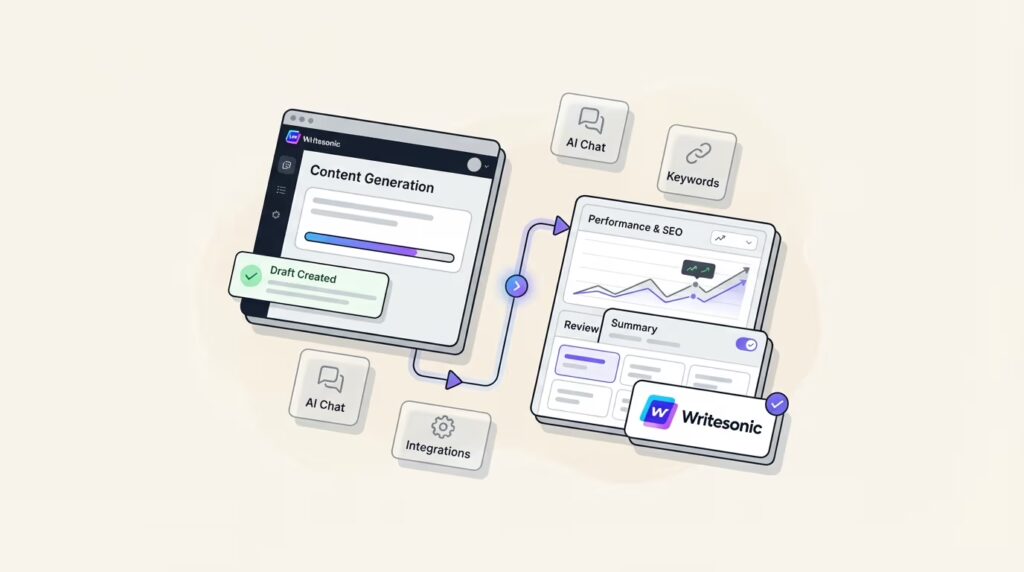
Writesonic has done something rare in this category: it improved substantially without raising prices proportionally. The current platform includes an AI article writer, a Chatsonic interface (with real-time web access — something Jasper lacks natively), landing page copy, product descriptions, and a Surfer SEO integration that makes keyword optimization a natural part of the writing workflow rather than an afterthought.
The Surfer integration matters more than it sounds. Writing 1,500 words and then pasting into a separate SEO tool creates friction that most writers quietly skip after the first two weeks. When keyword suggestions appear inline as you write, the optimization actually happens. Traffic outcomes for blogs using Writesonic with Surfer integration are, anecdotally, better than Writesonic alone — not because the words are different, but because the SEO hygiene is maintained.
The honest trade-off: Writesonic’s brand governance is noticeably weaker than Jasper’s. For a solo creator or small team where brand enforcement happens through human editorial review, that’s fine. For a 20-person marketing department where consistent voice is a compliance issue, the gap matters.
It can switch between GPT-4, Claude, and Gemini depending on the task — a flexibility that Jasper’s closed architecture doesn’t offer. At Standard plan pricing (around $16/month, annual), it offers the strongest value-per-dollar ratio in the category for volume content producers.
Rytr: The One Nobody Wants to Admit They Use
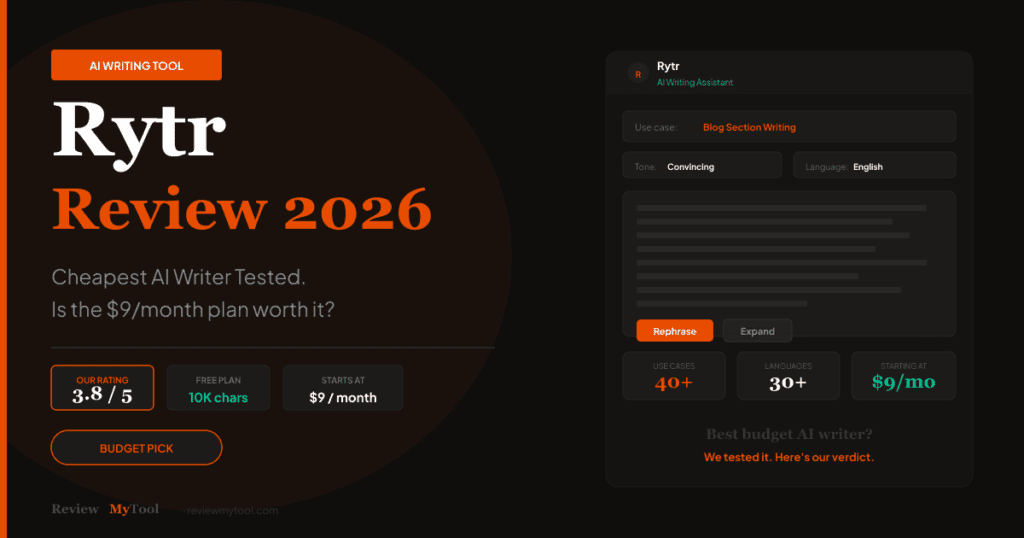
At $7.50/month for the Saver plan and $29/month for Unlimited, Rytr costs 85% less than Jasper. The output is not 85% worse. For a specific set of tasks — product descriptions, email copy, short blog intros, social captions — Rytr generates usable first drafts that require editing but not complete reconstruction.
The tool won’t train on your brand voice. It won’t automate a multi-step sales workflow. It won’t predict your ad performance. But for a freelance writer, a Shopify store owner, or a one-person content team producing straightforward copy, those features weren’t on the shopping list anyway.
The 40+ use case templates and 30+ language support make it the most accessible entry point in the category. If you’re new to AI copywriting and uncertain whether any of this will save you meaningful time, start here before committing to a $59/seat Jasper account.
Side-by-Side: What You’re Actually Getting
Pricing as of June 2026. Always verify on vendor pricing pages before purchasing.
| Tool | Starting Price | Core Model | Brand Voice | SEO Integration | Free Tier | Team Features | Best For |
|---|---|---|---|---|---|---|---|
| Jasper AI | ~$59/seat/mo | GPT-4o + proprietary | ✓ Best-in-class | ⚑ Via SurferSEO plugin | 7-day trial only | ✓ Full suite | Marketing teams, agencies |
| Copy.ai | Free / ~$29/mo | GPT-4o | ⚑ Basic | ✗ Limited | ✓ Genuinely useful | ⚑ Starter level | GTM, outbound, sales ops |
| Anyword | ~$39/mo | Proprietary + GPT-4o | ✓ Strong | ✗ Not core feature | Limited trial | ⚑ Growing | Paid ad performance |
| Writesonic | ~$16/mo | GPT-4o / Claude / Gemini | ⚑ Moderate | ✓ Native Surfer integration | ✓ Free plan available | ⚑ Basic collaboration | SEO bloggers, small teams |
| Rytr | ~$7.50/mo | GPT-4o | ✗ No | ✗ No | ✓ Free plan | ✗ No | Solos, budget users |
| ChatGPT Plus | ~$20/mo | GPT-4o | ⚑ Via Custom GPTs | ✗ No | Free tier (GPT-3.5) | ✗ No | Power users, flexibility |
The Google Situation in 2026 (And Why It Changes Everything)
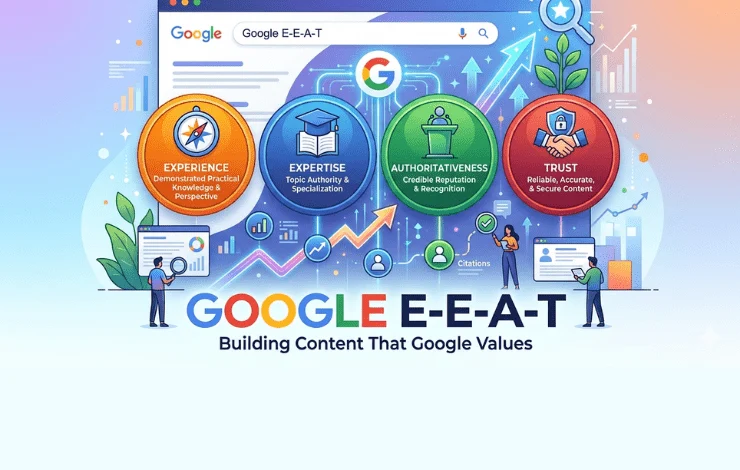
Google’s position has been stated clearly enough that we should stop dancing around it. As Google’s John Mueller put it in November 2025: “Our systems don’t care if content is created by AI or humans. What matters is whether it’s helpful for users.” The March 2026 search quality rater guidelines reinforced this without qualification.
What does get penalized: mass-produced AI output published without expert editing or original insight. The sites that saw 50–90% traffic drops in the 2025 Helpful Content cycles were content farms operating at volume, not editors using AI tools to accelerate their writing process. That distinction matters enormously for how you evaluate these tools.
The real 2026 risk isn’t using AI copywriting tools. It’s using them as a substitute for expertise rather than an accelerant for it. Google’s algorithm has gotten measurably better at detecting content that lacks domain depth, specific experience, and genuine user value — none of which any tool on this list provides automatically.
The practical implication: using any AI copywriting tool without a review layer — a human editor who adds specific expertise, verifies claims, and injects genuine observation — is a bet that Google won’t notice the absence of depth. Choosing the right AI tools for your workflow is only half the equation; the editorial layer you build on top of them is the other half.
Who Should Actually Buy What
The Honest Decision Matrix
One thing this guide won’t tell you is which tool produces the “best” copy in isolation — because there is no such thing. Output quality is a function of prompt quality, editing quality, and how well the tool’s strengths match the task. A Jasper output written with a vague prompt and published unedited will underperform a Rytr draft written with precision and reviewed by someone who knows the subject. The tool is 30% of the outcome. Your process is 70%. Building that process is where the real leverage is.
What Happens When All of This Gets Commoditized Faster Than Expected
The underlying models powering these tools are improving at a rate the pricing hasn’t caught up with. Anthropic and OpenAI both released meaningfully more capable models in the first half of 2026. The “proprietary advantage” that justified a $59/seat price in 2024 erodes faster than the subscription contracts that anchor enterprise pricing.
Anyword’s data moat — conversion-correlated performance scores trained on billions of real ad outcomes — is the most defensible position in the category. Jasper’s brand voice training is valuable but replicable. Copy.ai’s workflow automation is a good bet on where enterprise marketing teams are going. Writesonic’s price positioning leaves room to grow without risk.
The tools that don’t survive the next eighteen months are the ones adding a UI to an API and calling it a platform. You know which ones those are.