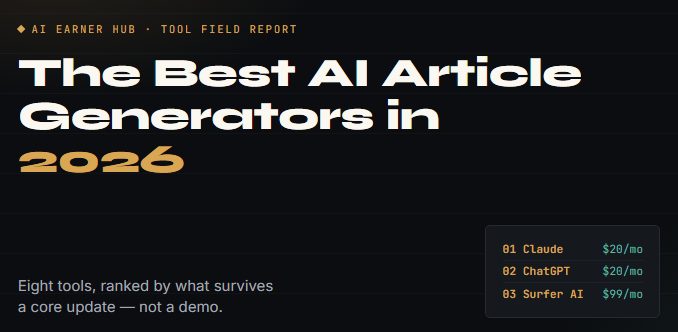


The Best AI Article Generators in 2026, Ranked by What Survives a Core Update
Eight tools, real June 2026 pricing, and the one variable every comparison chart leaves out.
“Quality,” in almost every AI writing tool roundup, means one thing: does the paragraph sound like a person wrote it. That’s the definition vendors are selling, because it’s the one their demo video can win. It is not the definition that decides whether your article is still ranking in ninety days.
The definition that actually matters now is closer to this: did a human add something to the draft that didn’t exist anywhere else, and would a quality rater call the result a page worth keeping rather than the fortieth rewrite of the same five facts. Sounding human is a side effect of that. It was never the goal.
That’s why this ranking looks different from the “best for tone,” “best for SEO,” “best for budget” listicles. Those categories are still here, with current June 2026 pricing for each tool. They’re just ranked under a harder constraint: does the workflow this tool encourages survive contact with Google’s scaled content abuse policy, which applies, in its own words, no matter how the content was produced.
The Prose-Quality Myth, and Why It’s Measuring the Wrong Thing
Ask ten people which AI writing tool is “best” and nine will answer based on a blind taste test — which model’s paragraph felt least mechanical. That test is real and worth knowing. In a blind comparison run in February 2026 with 134 participants, Claude won four of eight rounds in a field that also included ChatGPT, which won one. Separately, a 90-day production test across fifteen tools scored Claude 9.4 out of 10 for output quality. If “best paragraph” were the whole question, this article could end right here.
It isn’t the whole question. Google said so directly, twice, in the same year.
Google’s own developer documentation states that generative AI is genuinely useful for research and structure, but using it to produce many pages without adding user value can violate the scaled content abuse policy — language that applies equally to AI drafts, scraped pages, and bulk human writing. The March 2026 core update turned that from policy text into a live consequence: sites that had been mass-publishing AI drafts with no editorial layer saw traffic drops in the 50-to-80% range, according to tracking-tool analysis published the same month. A February 2026 update before that had already pushed Semrush’s volatility sensor to 9.4 for the same reason. None of those sites failed because their AI tool wrote a clumsy sentence. They failed because nothing happened to the draft after the tool finished.
So this ranking answers two questions at once, not one: which tool produces the strongest raw draft, and which workflow around that tool actually gets a human to add the thing AI cannot supply on its own — direct, first-hand experience, the first E in E-E-A-T. A tool can win the first question and still be the wrong default for the second. A few of them do exactly that.
Eight Tools, Ranked Against Real Use, Not a Demo
Pricing below reflects what each vendor was charging in June 2026, cross-checked against the live pricing page and at least two independent trackers. Two of these companies — Copy.ai and Writesonic — have repriced and renamed their tiers often enough this year that the review sites actively disagree with each other about what they cost. Where that’s true, I’ve said so instead of pretending to a precision nobody actually has right now.
| Rank | Tool | Best for | June 2026 entry price | The catch |
|---|---|---|---|---|
| 01 | Claude Opus 4.8 / Pro |
Long-form, argument-driven prose | $20/mo (Pro) | No SEO scoring, no brand-voice memory, no template library. You build the whole workflow yourself. |
| 02 | ChatGPT GPT-5.5 |
One subscription for writing, search, images, code | $20/mo (Plus) | The strongest all-rounder, but it didn’t lead the head-to-head prose blind test above. |
| 03 | Surfer AI | NLP-scored drafts built against ranking competitors | from $99/mo (annual) | A three-minute draft reads like a three-minute draft until a human rewrites the back half. |
| 04 | Jasper | Agencies and teams needing a locked brand voice | $39–59/mo per seat | Real monthly cost climbs to roughly $158 once you add the Surfer integration most workflows actually need. |
| 05 | Writesonic Article Writer 6.0 |
Cited, real-time-researched drafts on a mid budget | ~$16–49/mo* | *Depends which week you check. Tier names have changed at least three times since January. |
| 06 | Koala AI | Solo affiliate bloggers on a hard budget | from $9/mo | No SEO scoring at all. Treat every draft as a first pass, never a final one. |
| 07 | Copy.ai | Short-form marketing copy at team level | Free, or $29/mo | Real workflow automation now starts near $1,000/mo. There’s almost nothing priced in between. |
| 08 | Gemini 3.1 Pro / 3.5 |
Free drafting bundled into Docs and Gmail | Free, or $19.99/mo | Weakest of the eight at persuasive copy. Strongest at accurate, data-grounded first drafts. |
Six of these are worth a longer look — what each one actually changes about your Tuesday, not just what sits on the pricing page.
The One That Wins Blind Tests and Still Isn’t the Right Default
Claude is the model behind both numbers in the chart above, and for a single writer producing research-heavy, argument-led long-form work, it’s the strongest raw draft on this list, full stop. There’s no SEO score, no brand-voice file, no “generate full article” button — you write in a chat window and you build your own structure around it, which is exactly the kind of work I went through when mapping out the difference between predictive, generative, and agentic AI for this site earlier this year.
That lack of scaffolding is also the honest reason it’s not the right single tool for a five-person content team. No brand-voice memory means every writer has to re-explain the house style every session. No template library means every content type starts from a blank page. The unpopular opinion buried in that: the model that wins every blind test is frequently the wrong default for anyone who isn’t the one writing alone.
The Generalist You Already Have a Subscription To
GPT-5.5, OpenAI’s flagship since its April 23, 2026 release, is the closest thing to a single tool that does everything: writing, web search, image generation, code, in one $20/month subscription. It didn’t lead the prose blind test, but it doesn’t need to win that contest to be the rational default for someone who wants one bill instead of four.
The honest trade: a generalist optimized for agentic, multi-step work is not the same thing as a tool optimized for sentence-level prose. You’re trading a small amount of polish for not having to think about which app to open.
The Three-Minute Draft, and What It Costs You Later
Surfer AI generates a full, NLP-scored article in roughly three minutes by reading the top-ranking pages for a keyword and building structure to match. As a research shortcut, that’s genuinely useful — it’s the fastest way to see what a SERP actually rewards. As a finished article, it’s a problem, because the entire method is designed to converge on what already ranks.
Here’s the trade-off stated as bluntly as I can put it: Surfer’s score will get you ranking-shaped content in three minutes. It will not get you a single sentence someone would screenshot and send to a colleague, because “screenshot-worthy” and “matches the average of the top ten results” are opposite goals. You get one or the other, not both, unless a person goes back in afterward.
Brand Voice Is the Feature, the Subscription Stack Is the Bill
I was skeptical of Jasper’s Brand Voice feature when it first showed up — it read like a gimmick, a fancy name for “paste in some old posts.” After running it against blind reader comparisons on real client drafts, the gimmick was my assumption, not the feature. Trained on enough of a brand’s existing copy, it noticeably tightens consistency across writers, which matters the moment you’re publishing under one name from three different people.
What it doesn’t fix is the price tag hiding behind the price tag. Jasper’s Pro plan runs $59/month annually for one seat, but it has no real SEO scoring of its own — most serious workflows pair it with Surfer, which adds another $99/month. One detailed teardown of a month running both tools together put the real combined cost near $158/month per seat, not the $59 on the homepage. It’s the same consistency-versus-cost tension we ran into covering AI email marketing on this site, where keeping a brand voice steady across channels kept colliding with the deliverability and tooling costs nobody mentions in the demo.
The Budget Tier Nobody Reviews Honestly
Writesonic’s Article Writer 6.0 pulls in real-time web data and can attach citations to a draft, which is a genuine edge over tools that hallucinate confidently in a vacuum. The honest problem is the pricing page itself: tier names have shifted from Lite to Starter to Standard and back across review sites published in the same month, and entry pricing has been reported anywhere from $16 to $49 a month depending on which snapshot you load. Confirm the live checkout price before you commit a card.
Koala AI sits a level below that, starting near $9/month with real-time research baked in, and it’s the most defensible single choice for a solo affiliate blogger publishing two or three posts a week on a hard budget. It has zero SEO scoring of its own, so the tool I no longer recommend pairing it with is any “generate and publish straight to WordPress” automation — fine for low-stakes niche content, a genuine liability the moment the topic touches health, money, or anything else where a reader’s decision actually carries risk.
Free, Accurate, and the Worst Tool Here for Persuasion
Gemini’s free tier has no daily cap on standard queries, and the full Pro-tier model is bundled into Google AI Pro at $19.99/month alongside 2TB of storage and Gemini access inside Gmail, Docs, and Slides — genuinely good value if you’re already paying for Google storage. In head-to-head drafting tests, it produces clean, well-organized, factually grounded copy.
It is also, consistently, the weakest of the eight at anything that needs to persuade rather than inform — email copy in particular tends to land as informational where a Jasper or Copy.ai draft would push toward a decision. That’s not a flaw to fix with a better prompt. It’s a constraint worth knowing before you build a sales sequence around it.
Short-Form Speed, Long-Form Mismatch
Copy.ai’s free tier (2,000 words a month) and its $29/month Chat plan are genuinely fast for ad copy, email subject lines, and social captions — short-form is where the tool was built to live. The gap shows up the moment you need a 2,500-word article: there’s no real SEO scoring, no Surfer-style integration, and the company’s own pricing has jumped this year from a $49 mid-tier to workflow-automation pricing that starts near $1,000/month, with almost nothing sitting between the two. Good tool, wrong job, if long-form is the job.
Why the #1 Tool on This List Still Wrecks Sites
None of the eight tools above can supply the first E in E-E-A-T. Experience — having actually done the thing you’re writing about — is not a setting in any of these products, no matter how high its blind-test score runs. You have to add it yourself, on every article, or the rest of the workflow doesn’t matter.
That’s not a soft point. Google’s scaled content abuse policy doesn’t care which of these eight tools produced the draft. It cares whether a real human added value before it went live, and in 2026 that policy has teeth: the March core update’s 50-to-80% traffic drops and February’s spike to a 9.4 volatility reading both landed on sites that had automated the writing and skipped the editing, not on sites that simply used AI somewhere in the process. The number one tool in this ranking, run through a publish-without-review pipeline at scale, fails the exact same way the budget tool does. The model underneath is not the variable that decides the outcome. The human layer is.
Match the Tool to the Bottleneck, Not the Topic
The question worth asking isn’t “which tool writes best.” It’s “what’s actually stopping me right now” — budget, brand consistency across writers, an SEO score you can show a client, or raw prose quality you’re willing to build a workflow around yourself. That answer changes the pick more than the topic ever does, and it’s the same question to ask before stacking two or three of these into one pipeline, which is what most teams publishing at real production volume end up doing.
Everything in this ranking will be partially wrong by August.
What This Ranking Gets Wrong by August
Gemini 3.5 Pro is scheduled for general availability sometime this month, after Google held it back from its 3.5 Flash launch in mid-May. A model code-named “iris-alpha” is already showing up in OpenAI’s backend logs, the same leak pattern that preceded GPT-5.5’s launch back in April — if history repeats, a GPT-5.6 release follows within weeks of you reading this. Claude Opus 4.8 shipped May 28, and Anthropic is already previewing what comes after it. Every number in the chart above was accurate the week it was checked. None of it is a fixed law.
What doesn’t expire is the test, not the result: run your own real draft — the messy one, not the vendor’s cherry-picked demo prompt — through whichever tool you’re evaluating, and re-run that test every quarter instead of trusting a ranking you read once. Release notes tell you what changed. Only your own draft tells you whether it changed anything that matters for what you publish.
Pick from the table above for what your production calendar needs this week. Just don’t mistake any of it for a permanent answer — in this market, there isn’t one.