AI Productivity & Search · Field Notes
Hidden in Plain Sight: How AI Keyword Tools Find What Your Spreadsheet Can’t See
A practical look at the actual mechanism behind “AI-powered” keyword research — not the marketing copy, the math — and why it surfaces opportunities that volume-sorted lists throw away by default.
Sort any keyword export by volume and the bottom of the list looks like garbage. Row after row reading “0” or “10,” wedged beneath the obvious money terms sitting at the top. Most keyword research stops right there, at the sort button. That’s a problem, because somewhere in that bottom third sits the most honest signal available: the exact words a real person typed into Google the day they had the problem your content is supposed to solve.
The zero isn’t a fact about demand. It’s a fact about measurement.
Google’s own ad tooling rounds small numbers down, for privacy and product reasons that have nothing to do with whether anyone is actually searching, and most third-party keyword databases inherit that rounding wholesale. Keyword-tool vendors themselves now openly estimate that the overwhelming majority of distinct queries Google processes in a given month fall under ten searches each. Sorted by volume, a list like that isn’t ranking opportunity, it’s ranking noise — with the real opportunity sitting underneath, unmeasured.
This is the specific blind spot that AI-driven keyword research closes. Not by guessing harder. By changing what gets measured in the first place, and by exploiting a mechanism — Google’s own query fan-out — that most keyword research articles mention in passing and almost none connect back to the actual workflow of finding a keyword. That connection is the point of this piece.
Illustrative — modeled on the gap keyword vendors describe between tool-reported volume and search log behavior, not pulled from a single dataset.
01 — The FloorThe Measurement Floor Problem
Every keyword tool has a measurement floor: a point below which it stops distinguishing “almost no searches” from “no searches.” Below that floor, distinct queries get bucketed, smoothed, or rounded to zero, regardless of whether five people searched it or fifty. That’s not a flaw unique to one vendor; it’s a structural limit of building a tool on top of sampled, privacy-constrained ad-auction data.
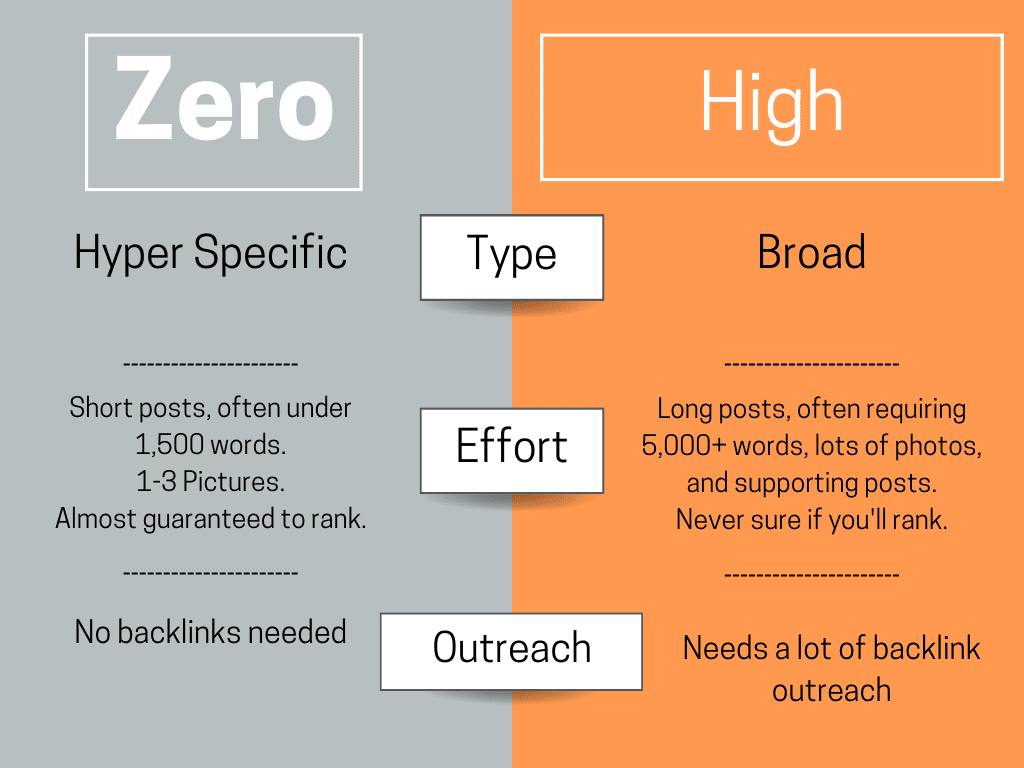
The practical consequence is that an entire category of real, specific, often high-intent search behavior never clears the bar that traditional keyword research uses to decide what’s worth writing about. SEOs have informally tracked this for years under the name Keyword Golden Ratio — a rough heuristic comparing how many pages Google indexes with the exact phrase in the title against reported volume, on the theory that a low ratio signals real, under-served demand the volume column is hiding. It’s a workaround, not a measurement. It exists because the actual measurement doesn’t.
AI-driven tools don’t fix the floor — nobody has access to Google’s raw query log — but they change the unit of analysis. Instead of asking “how many people searched this exact string,” they ask “how many people searched anything that means roughly this,” and that second question can be answered with confidence even when every individual phrase in the cluster shows zero. A handful of zero-volume variants, clustered correctly, behaves statistically like one real keyword with real volume. The variants were never the noise. They were the signal, just split across too many bins to see individually.
Practitioners who mine Google Search Console for queries already earning impressions — rather than relying on a forecasting tool at all — routinely surface dozens of exact phrases sitting at “—” or single-digit volume in Ahrefs and Semrush alike, already generating clicks. The first-party data and the third-party forecast are describing two different things, and the forecast is the one more likely to be wrong.
02 — The MechanismVectors, Not Words: What “AI-Powered” Actually Means Under the Hood
Strip away the marketing language and the actual technical shift is specific: keyword tools moved from matching strings to comparing positions in space. Every phrase gets converted into a vector, a list of numbers, placed inside a high-dimensional coordinate system where meaning, not spelling, determines distance. Two phrases that share zero words but mean almost the same thing — say, “startup lawyer” and “legal counsel for founders” — land close together in that space. Two phrases that share every word but mean different things land far apart.
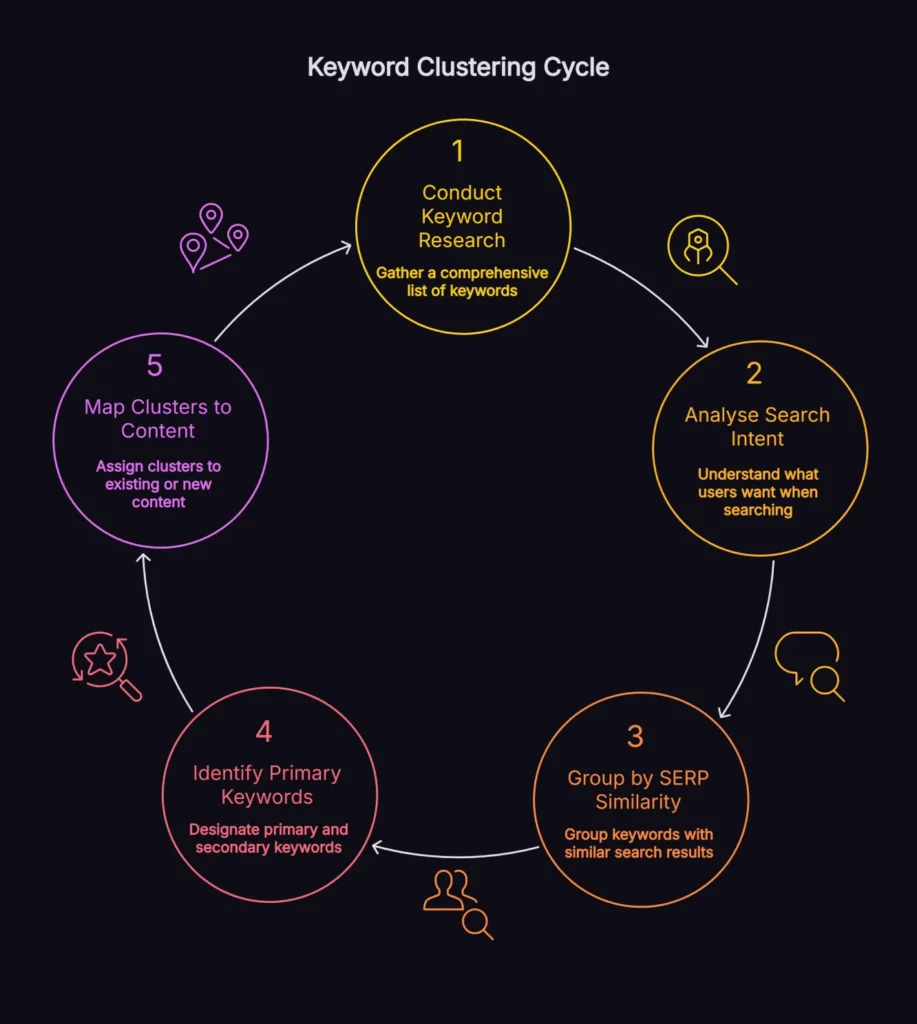
This isn’t new to 2026. Mike King’s research at iPullRank traces Google’s use of embeddings back to Word2Vec in 2013, running through the Hummingbird update, long before “AI SEO” was a category anyone sold. What’s new is that this same technique is now sitting inside consumer keyword tools instead of locked inside Google’s own ranking systems — and that clustering algorithms like BERTopic can take a pile of embeddings and group them into human-readable topics automatically, the way a researcher used to do by hand, squinting at a spreadsheet at midnight.
Here’s the part worth sitting with for a second, because it sounds like a parlor trick until you see what it does for keyword research specifically: subtract the vector for “man” from the vector for “king,” add the vector for “woman,” and the nearest point in that space is “queen.” The math captures relationships, not just similarity. Applied to search queries, that means a tool can recognize that “how to reset X without the manual” and “X troubleshooting no documentation” occupy the same functional space — the same underlying need — even though a string-matching tool would treat them as unrelated.
Practically, this is why a phrase reporting zero volume can still get pulled into a high-confidence content recommendation. The tool isn’t measuring that one phrase in isolation anymore. It’s measuring the density of meaning around it — how many semantically adjacent phrases, questions, and rewordings cluster nearby — and that density is visible even when every individual point in the cluster reads zero on its own.
Simplified illustration of clustering by meaning rather than exact wording. Real embedding models use hundreds of dimensions; this flattens that down to two for clarity.
One honest limitation worth flagging here: clustering by semantic similarity is not the same as clustering by intent, and the better tools on the market still confuse the two. Ahrefs’ own clustering groups keywords by both semantic closeness and SERP overlap, which catches more than meaning alone, but it can still merge phrases that mean similar things while pulling up very different result types — a comparison query and a transactional one, sitting side by side in the same “cluster” because the words are close even though the searcher’s next move isn’t.
03 — The SourceGoogle Already Wrote Your Hidden Keyword List — It’s Called Fan-Out
Here’s the connection most coverage of AI keyword tools skips entirely, and it’s the most useful thing in this article if you only take one idea away from it.
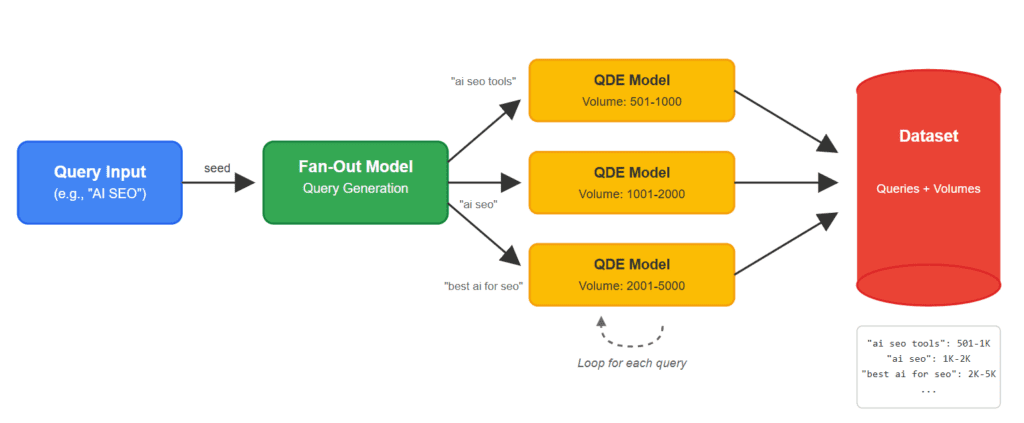
When Google rolled out AI Mode, the company described the underlying retrieval method in plain terms in its own announcement: AI Mode breaks a question down into subtopics and issues a large number of related searches simultaneously, then synthesizes the results into one answer. Google calls this query fan-out. A simple factual question doesn’t trigger much fan-out. A complex, multi-part question can spin off dozens of sub-queries behind the scenes, none of which the searcher ever sees or types themselves.
Sit with what that actually means for keyword research. Take a query like “best AI tools for freelance writers on a tight budget.” A human researcher manually building a content brief might generate three or four related angles. Google’s fan-out, hitting the same query, generates searches across pricing tiers, free-tier limitations, comparison against specific named competitors, accuracy concerns, and workflow fit — each one a real query, each one a real ranking opportunity, and almost none of them ever surfacing in a keyword tool’s suggestion list because nobody types them directly into the search box. They only exist as Google’s internal expansion of someone else’s question.
Illustrative fan-out tree built from the pattern Google describes in its AI Mode documentation, applied to an original example query.
This is also where the better AI keyword tools quietly earn their keep. Several practitioners now run a target query through a fan-out simulator — open-source options like iPullRank’s Qforia, or simply prompting a capable LLM to “decompose this query the way Google’s AI Mode would” — and cross-reference the output against a tool’s clustering suggestions. Where the two lists overlap is about as close to a confirmed hidden opportunity as keyword research gets without access to Google’s actual logs.
The keyword was never missing. It was distributed across forty sub-queries nobody had grouped together yet.
04 — The ToolsWhere the Big Three Actually Differ
Vendor pages make every AI keyword feature sound interchangeable. They aren’t. Each platform built its AI layer to solve a slightly different bottleneck in the old workflow, and each has a specific, documented weak point worth knowing before you trust it with a client’s content calendar.
Ahrefs built its AI features around intent: a button inside Keywords Explorer literally labeled “Identify intents” sends the live SERP through a model and returns a read on what Google is actually rewarding for that query, alongside AI-assisted keyword generation and an AI Content Helper that scores drafts against top-ranking competitors. Semrush built its AI features around structure: Keyword Strategy Builder takes a handful of seed terms and outputs an entire pillar-and-subtopic content plan, with clustering and SERP-feature analysis baked in, rather than a flat list you have to organize yourself.
Both companies now ship automated intent classification, and the honest accuracy numbers are worth knowing before you trust either blindly. One independent benchmark of Semrush’s AI-powered Intent filter against a manually labeled set of 50,000 English keywords put it at roughly 92 percent accuracy — but specifically on single-intent queries. That accuracy collapses on the keywords that matter most commercially: anything shaped like “best X for Y,” where informational and transactional intent overlap on the same SERP. Practitioners testing this against real client backlogs report the automated pass resolves maybe 60 to 70 percent of a list cleanly, leaving exactly the highest-value, mixed-intent terms for manual review.
| Tool | What the AI does | Entry pricing (reported) | Honest limitation |
|---|---|---|---|
| Ahrefs | AI “Identify intents” reads the live SERP per query; AI Content Helper scores drafts against top competitors; clusters by semantic similarity + SERP overlap. | From ~$129/mo | Clustering can merge similar wording with different searcher intent — semantic closeness isn’t intent closeness. |
| Semrush | Keyword Strategy Builder auto-generates pillar + subtopic content plans from seed terms; Intent filter auto-classifies large lists. | From ~$139.95/mo | Intent accuracy drops sharply on mixed-intent commercial queries — exactly the highest-value terms. |
| Free / first-party stack | Google Search Console for already-ranking zero-volume queries; a general LLM prompted to fan-out a seed query; manual incognito SERP checks. | $0 | No automated clustering or scale — works for one topic at a time, not a 10,000-keyword sweep. |
If you’re already layering general AI workflows into how you produce content — the kind of prompt-chaining and tool-stacking we cover more broadly on AI Earner Hub — this combination of a paid clustering tool plus a free fan-out prompt is the version of “AI keyword research” that actually holds up once you check its work against a live SERP, rather than the version that just looks impressive in a screenshot.
05 — The WorkflowA 45-Minute Workflow for Finding Keywords Your Competitors Can’t See
This is genuinely sequential — each step filters the list down before the next one costs you more time — so it’s worth following in order rather than cherry-picking.
- ~10 MINPull your own first-party signal firstExport Search Console queries for the topic, sorted by impressions, not clicks. Anything already getting impressions at a “—” or single-digit reported volume in your paid tool is a confirmed real query, not a guess — start there before generating anything new.
- ~10 MINRun the same seed topic two waysFeed it into your clustering tool of choice (Ahrefs or Semrush), and separately prompt a capable LLM to decompose it the way Google’s AI Mode fan-out would. Keep both lists open side by side.
- ~10 MINFlag the overlap, not the unionWhere the tool’s cluster and the model’s fan-out agree, that’s your highest-confidence set. Where they disagree, that’s not necessarily wrong — it’s just unverified, and goes to the next step instead of straight into a content brief.
- ~10 MINRun intent classification, then check the messy middle by handLet the tool’s AI intent feature sort the obvious informational and transactional terms automatically. Pull up the live, incognito SERP for anything tagged “mixed” or “commercial investigation” — that’s the dangerous middle where automated classification is weakest and the money usually is.
- ~5 MINBuild one pillar, not ten orphan pagesGroup the survivors into a single page with real subtopic depth, rather than a thin page per keyword. The semantic clustering that found these terms in the first place is the same logic that rewards covering them together.
06 — The Trade-OffWhat These Tools Won’t Show You: The CTR Math
Finding the keyword has gotten easier. What happens after you rank for it has gotten harder, and no AI keyword tool’s dashboard makes that trade-off obvious.
Ahrefs’ original analysis of 300,000 keywords found a 34.5 percent lower click-through rate for the top-ranking page when an AI Overview appeared, comparing informational queries before and after the U.S. rollout. Re-running that same study against more recent data, Ahrefs reported the gap had widened to a 58 percent drop. Using a different method entirely — tracking the real browsing behavior of roughly 900 people rather than aggregated keyword data — the Pew Research Center found an 8 percent click rate on searches with an AI Overview present, versus 15 percent without, a 46.7 percent relative decline. Google publicly disputed Pew’s methodology and sample size; independent estimates still cluster in the same general direction even where the exact number moves.
None of this means keyword research stopped mattering. It means the thing you’re optimizing for, for a large share of informational queries, quietly changed from “get the click” to “get cited inside the answer the click never happens for.” Those are different jobs. One rewards a clean, scannable answer near the top of the page that’s easy for a model to lift cleanly. The other still rewards depth, structure, and a reason to keep reading past the first paragraph. Most content briefs still only optimize for the second one.
An unpopular opinion worth stating plainly: chasing more keyword volume is the wrong instinct for a lot of purely informational content right now. A term that gets cited inside an AI-generated answer, even without a click, can still build the brand recognition and entity association that shows up later in a branded search — and branded queries are the one category that consistently keeps higher click-through rates in every study above.
07 — The LimitWhy Finding the Keyword Is the Easy Part Now
Google’s most recent core update — its second of 2026, rolling out in May — landed with the same message the company has repeated since folding its Helpful Content system into core ranking: there’s nothing special creators need to do beyond making content genuinely useful to the people reading it. Google’s search advocates have said directly, more than once, that the ranking systems don’t evaluate whether content was written by AI or by a person — they evaluate whether it was made to serve a reader or to game a ranking signal.
That’s the ceiling on everything in this article. An AI tool can locate a gap in the search landscape with real precision — that part is genuinely solved. It cannot fill that gap with expertise it doesn’t have. A perfectly identified, perfectly clustered, zero-volume keyword opportunity, answered with a thin, generic paragraph that could sit on fifty other sites unchanged, still loses to a worse keyword answered by someone who actually knows the subject. The tools generate candidates. They don’t validate them, and they definitely don’t write the part that makes a reader trust what they’re reading.
This workflow costs you triage time you don’t get back. A list of two hundred AI-clustered keyword candidates is not a content calendar — someone still has to open a live, incognito SERP for every survivor before any of it becomes real work. The tools don’t remove that step. They just make it the only step left worth arguing about.
Questions that come up after running this
Three that surfaced repeatedly while testing this workflow against real backlogs.
Do zero-volume keywords actually bring real traffic?
Often, yes. Tools round small numbers down for measurement and privacy reasons, so “zero reported” isn’t the same as “zero real searches.” Pages built around a cluster of these phrases, rather than one isolated term, regularly pick up impressions and clicks that never showed up in any forecast. Verify first: check the live, incognito SERP before committing real production time to a single zero-volume term in isolation.
Is Ahrefs or Semrush better for AI-assisted keyword research?
They overlap more than the marketing suggests. Ahrefs leans on AI for intent identification and content scoring; Semrush leans on AI for clustering and full content-plan generation. Neither replaces a human check on the mixed-intent, high-value queries — both still misclassify the commercially ambiguous middle that tends to convert best.
Will AI Overviews and AI Mode make keyword research pointless?
No, but they change what a found keyword is worth. Click-through rates on informational queries that trigger an AI Overview have dropped substantially across independent studies, so the win shifts, for a real share of queries, from ranking to being cited inside the generated answer itself. Keyword research still locates the opportunity — what you build on top of it now has to account for a much higher chance the click never happens at all.
Every specific feature named in this article — Ahrefs’ intent button, Semrush’s Strategy Builder, the exact accuracy benchmarks — is a snapshot of mid-2026. Some of it will be renamed, rebuilt, or quietly retired within a year, the way Semrush’s own clustering tool already went through one rename. The mechanism underneath it won’t age the same way: embeddings, the measurement floor, and query fan-out are how search retrieval works now, not a feature set one vendor can discontinue. Before trusting any tool’s intent label or cluster suggestion going forward, spot-check the top five candidates against a live SERP yourself. That habit will outlast every product name in this piece.