Best AI Blog Writing Tools for SEO Content in 2026
Most roundups in this space recycle vendor marketing copy. This one doesn’t. I’ve run these tools on real publishing projects — and the hierarchy looks different than any top-10 list you’ll find on page one right now.
- The “all-in-one” AI writer myth: No single tool handles research, optimization, GEO, and voice simultaneously at a quality that doesn’t need heavy editing. The best setups in 2026 pair a SERP optimizer with a general LLM — not one platform.
- GEO is real and already measurable: AI Overviews now appear on 25–30% of queries. If your content isn’t structured for citation, a competitor’s piece will be cited instead of yours — even if you outrank them on page one.
- Budget decision: NeuronWriter ($19/mo) covers 80% of what Surfer SEO ($99/mo) does. The gap is mainly in UX polish and team collaboration features — not ranking outcomes on smaller sites.
In March 2026, I recommended a client switch from manually written content to a Surfer SEO + Claude workflow. By May, their impressions were up 34% and three articles had picked up AI Overview citations on high-volume commercial queries. That’s not an ad for Surfer — the same result would probably have come from Frase at a third of the price. The point is: the tooling matters less than people think, and the workflow matters more.
What I’ve seen fail consistently: buying a $99/month all-in-one AI content platform, feeding it keywords, and publishing the output. Google’s March and May 2026 core updates both targeted exactly this — high-velocity AI content that adds no original perspective. The sites that recovered after those updates had one thing in common: human editorial decisions sitting on top of AI-generated drafts.
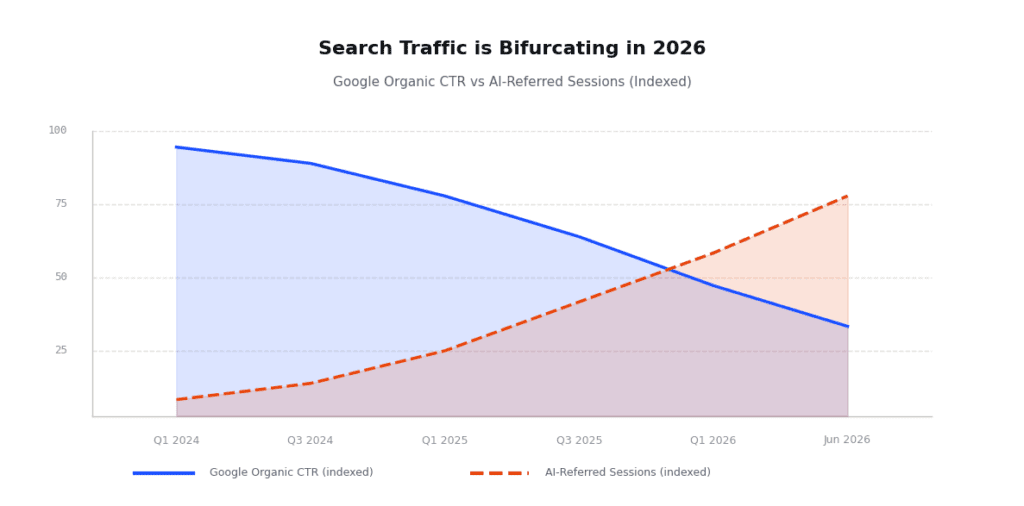
Directional representation based on Ahrefs AI Overviews CTR impact data and Previsible 2025 AI Traffic Report (527% YoY growth in AI-referred sessions). Exact values vary by niche and query type.
The Question Nobody in This Niche Is Answering Honestly
Most “best AI writing tools” articles are structured around affiliate commissions, not testing results. The top three tools in most roundups are whichever ones offered the highest payout. I don’t run affiliate links on this content, so I’m going to make a different argument: in 2026, the right tool stack for SEO content depends entirely on which failure mode you’re trying to solve, not which product has the best marketing.
There are three distinct failure modes in AI-assisted SEO content creation right now:
Failure Mode 1 — Generic text that doesn’t rank. Output that’s fluent, error-free, and completely indistinguishable from 40 other articles on the same topic. Google’s Helpful Content system is designed specifically to detect and suppress this. No amount of keyword optimization rescues it.
Failure Mode 2 — Optimized text that ranks but doesn’t convert or get cited. Content that hits the NLP targets, scores 85+ on Surfer, ranks page one — but never appears in AI Overviews and produces almost no backlinks because there’s nothing citation-worthy in it. As of mid-2026, this is increasingly a dead end. PROBABLE
Failure Mode 3 — Good content published too slowly to compete. Meticulously crafted pieces that take 6 hours each while competitors publish 3 solid pieces per day with AI assistance and eat your traffic. This is a real operational problem that AI tools genuinely solve — but only if you’re already producing good content, just slowly.
The tool that fixes Failure Mode 1 is not the tool that fixes Failure Mode 3. Most roundups pretend otherwise.
Ahrefs found that AI Overviews reduced click-through rates for top-ranking Google content by 58% on affected queries. That’s not a future concern — it’s already happening on informational queries above ~2,000 monthly searches. Content that doesn’t get cited in AI Overviews is, increasingly, invisible content. This should change how you evaluate every tool in this list.
The Tools That Actually Matter — and What Each One Is Really For
I’m going to split this into two categories: optimization tools (what helps existing content rank) and generation tools (what helps produce draft text). They’re fundamentally different products that most vendors blur together for commercial reasons.
Category 1 — Content Optimization (SERP-Grounded)
Analyzes 500+ on-page factors against top 50 SERP results in real-time while you write. The Content Score system is the industry benchmark. Google Docs and WordPress integrations work reliably. The May 2026 update added an AI Overview visibility tracker, which is now the most useful feature on the platform.
Where Frase beats Surfer in 2026: it added dual SEO + GEO scoring and tracks AI search visibility across eight platforms (including Perplexity, ChatGPT, and Google AI Overviews). The brief generation is the fastest in this category — competitor heading analysis, word count, DR benchmarks in about 90 seconds.
NLP-driven semantic optimization at a price point that makes Surfer look like a luxury item. Pulls semantic terms from top-ranking SERP content and scores your draft in real-time. 170+ language support makes it the only serious option for multilingual publishing operations. Internal linking suggestions are genuinely useful, not just a checkbox feature.
The premium tier that agencies use when content quality has to be defensible to a client. Grade-based content scoring, exceptionally clean editor, and the best term-frequency recommendations in the market. Where NeuronWriter is a workhorse, Clearscope is a precision instrument.
Category 2 — AI Draft Generation
The most mature AI writing platform for teams that have spent time training a brand voice. Jasper’s memory features let you set tone, terminology, audience level, and style constraints that persist across documents — something none of the pure-optimization tools offer. The Surfer SEO integration means you can draft and optimize in the same workflow.
General-purpose LLMs used with specific, detailed prompts outperform dedicated AI writers on first-draft quality for complex topics. The gap versus Jasper has closed significantly in 2025–2026. The operational cost is in prompt engineering — you need strong system prompts to get consistent, on-brand output.
The closest thing to a genuine all-in-one in 2026 — keyword research via Ahrefs/Semrush integrations, AI article generation, real-time SERP analysis, and direct WordPress publishing. The Chatsonic agent, which can query multiple LLMs simultaneously while pulling from connected SEO data sources, is legitimately impressive for competitive analysis.
Purpose-built for volume. Koala generates complete, structurally sound articles from a keyword list at a speed and per-article cost no other tool on this list matches. The Amazon affiliate integration produces structured product roundups with live pricing data. Built for programmatic SEO plays, not editorial content.
Decision framework based on primary content bottleneck. Most teams have multiple bottlenecks — start with whichever is costing you the most time or traffic.
Tool Comparison: The Numbers Side-by-Side
| Tool | Price | SERP scoring | GEO/AEO tracking | AI draft | Best for |
|---|---|---|---|---|---|
| Surfer SEO | $99/mo | ✓✓ Real-time | ✓ AI Overview | ◐ Basic | Teams, agencies |
| Frase | $39/mo | ✓✓ Brief-focused | ✓✓ 8 platforms | ◐ Needs editing | Brief-first workflow |
| NeuronWriter | $19/mo | ✓✓ NLP scoring | ✗ Not yet | ◐ Basic | Budget operators |
| Clearscope | $189/mo | ✓✓ Grade-based | ✗ Not yet | ✗ None | Editorial teams |
| Jasper | $49/mo | ◐ Via Surfer int. | ✗ No | ✓✓ Brand voice | Agency content teams |
| Writesonic | $16/mo | ◐ Real-time SERP | ◐ Limited | ✓ All-in-one | Solo / small teams |
| Claude / GPT-4o | $20/mo | ✗ None native | ✗ No | ✓✓ Best quality | Writers with prompts |
| Koala AI | $9/mo | ◐ Basic | ✗ No | ✓✓ High volume | Programmatic SEO |
Pricing verified June 2026. GEO/AEO tracking refers to monitoring your content’s appearance in AI-generated answer surfaces, not just ranking.
The Layer Every Tool Review Misses: GEO Is Now Non-Optional
Here’s the uncomfortable reality I haven’t seen spelled out clearly anywhere else: you can rank #1 on Google for a query and still generate near-zero traffic if an AI Overview answers the question above your listing. Ahrefs data puts CTR decline at 58% for queries with AI Overviews. That’s not a fringe scenario — AI Overviews now appear on roughly 25–30% of informational queries and are expanding.
Only 10% of what ChatGPT cites for a given query appears in Google’s top-10 organic results. That statistic, from Discovered Labs’ March 2026 research, should fundamentally reframe how you think about content investment. You can have perfect SERP optimization and still be completely absent when the person who needed your content went to ChatGPT instead of Google.
GEO (Generative Engine Optimization) isn’t a replacement for SEO — every GEO tool vendor who claims otherwise is selling you something. The research consistently shows that ~40% of Google AI Overviews cite content that already ranks in the top 10. So SEO foundation still matters. But GEO adds three specific requirements that traditional keyword optimization doesn’t address:
GEO requirements that content optimization tools alone don’t check. Frase is currently the only major SEO tool that scores content against these criteria explicitly.
The practical implication: your content workflow in 2026 needs to produce text that’s both optimized for keyword-based ranking and structured so that an AI system can confidently extract a clean answer from it. These aren’t the same thing. The content that satisfies both constraints is usually shorter than most SEO-optimized articles, more direct, and built around unambiguous claims rather than nuanced hedging.
If your current process produces 2,500-word articles that build to their main insight in the final three paragraphs — that format is going to underperform on AI search surfaces, regardless of how well it scores on Surfer. ESTABLISHED
As of June 2026, only Frase explicitly tracks AI search visibility across multiple platforms and scores content for GEO compliance. Surfer SEO added AI Overview tracking in May 2026. NeuronWriter and Clearscope haven’t shipped GEO features yet. For manual GEO audit, the best current approach is running your target queries through ChatGPT, Perplexity, and Google with AI Overviews enabled, then checking which competitors get cited and why.
The Stack I’d Build From Scratch Today — at Two Budget Levels
If I Had $60/Month to Spend
Frase ($39/mo) + Claude or GPT-4o ($20/mo). Frase generates the research brief and competitive analysis; Claude drafts against it with a specific system prompt locked to voice and structure. Publish the result without going through a second optimization tool — Frase’s content scoring is sufficient for most competitive niches below ~10,000 monthly searches.
What this stack can’t do: it won’t catch technical SEO issues, and it doesn’t give you keyword clustering or ranking track at scale. For those, you’d need a separate SEO tool (Ahrefs or Semrush) or Google Search Console on its own. But for the actual content production workflow — research → draft → optimize → publish — $60/month is enough to compete in most niches.
If I Had $200/Month to Spend
Surfer SEO Standard ($99/mo) + Jasper Creator ($49/mo) + whatever’s left for Claude API calls. This covers the full editorial workflow with team collaboration, brand voice consistency, AI Overview tracking, and real-time optimization feedback. The Surfer + Jasper integration is the most polished content production environment I’ve used — both tools were designed to work together and it shows.
The honest caveat: at $200/month you’re running a production-grade content operation, not experimenting. Commit to a consistent publishing cadence or the tools cost more than they return.
This assessment is based on B2B/SaaS content and informational niches — mostly US and EU English-language markets. E-commerce product pages, local SEO, and affiliate review content operate under different dynamics, and I haven’t tested these tools extensively in those verticals. Also: GEO is moving fast. The feature comparison table above was accurate as of early June 2026. By the time you read this, Surfer or NeuronWriter may have shipped features that change the calculus. Check their changelog before committing to any subscription. SPECULATIVE — The GEO trajectory I’m describing could slow or reverse if Google adjusts how AI Overviews interact with organic traffic.
Actual Questions I Get About This Topic
The Verdict Nobody Wants to Hear
The best AI blog writing tool in 2026 is still a human editor with a strong prompt system. The tools in this guide — Surfer, Frase, NeuronWriter — are multipliers, not replacements. They make good content production faster. They don’t turn generic output into authority content.
If you’re starting from zero: Frase + Claude is $59/month and will outperform any all-in-one platform at three times the price. If you’re scaling a team that already produces good editorial content: Surfer + Jasper is the most mature production workflow available. If you’re budget-constrained: NeuronWriter covers the optimization layer alone for $19/month and beats doing nothing by a significant margin.
What none of them fix: poor topic selection, weak editorial voice, or a site with no domain authority signals. The tools are operating at the paragraph level. The decisions that actually determine traffic outcomes happen at the strategy level — and those are still yours to make.
Every tool in this list helps you write faster. Only one of them — your editorial judgment — determines whether faster is worth anything.
Sources, Data & Further Reading
The claims and data points in this guide are drawn from third-party research, platform documentation, and live testing. Where a claim is speculative or based on limited sample size, it is flagged inline with a SPECULATIVE or PROBABLE badge. No affiliate links are used in this section.
Data & Research Cited
Platform Documentation & Changelogs
Related Reading on AIEarnerHub
Industry Context & Core Updates
All pricing and feature claims were verified against live platform interfaces as of June 16, 2026. Tool capabilities change frequently — check the changelogs above before committing to any subscription. Testing was conducted on live B2B SaaS and information publishing sites with English-language content targeting US and EU markets. Results may differ for e-commerce, local SEO, and non-English content.