
AI Chatbots & Assistants in 2026:
The Complete Guide
987 million users. An $11B+ market. ChatGPT losing 19 percentage points of share in 12 months. This guide cuts through the noise with real data, honest assessments, and everything you actually need to know — whether you’re deploying, building, or just trying to keep up.
- The market hit $11B+ in 2026 and is on track for $72B by 2035. This is not a trend — it’s infrastructure.
- ChatGPT’s dominance is cracking. Market share dropped from 87% to 64–68% in 12 months. Google Gemini grew 370% YoY.
- Agentic AI is the actual story. By end of 2026, 40% of enterprise apps will have task-executing AI agents — up from under 5% last year.
- ROI is real and measurable. $0.50 average cost per chatbot interaction vs. $6.00 human. Bank of America’s Erica: 2 billion interactions, 98% resolved in under 44 seconds.
- Multimodal is no longer optional. 63% of businesses are now investing in voice AI. By 2027, 40% of generative AI solutions will be multimodal.
- The ethics gap is growing. Only 69% of CX leaders have ethical AI plans. That’s a problem waiting to become a scandal.
- Mobile is where the real battle is. ChatGPT’s US mobile daily share fell from 69% to 45% in one year. Gemini is eating its lunch on Android.
- Specialization is the new moat. Healthcare, banking, and HR chatbots are outperforming general-purpose bots in every measurable metric.
What AI Chatbots Actually Are in 2026
Look, the definition has changed. When most people say “chatbot,” they still picture that annoying little widget that asked “How can I help you today?” before routing you to a knowledge base article you didn’t need. That version is dead — or at least dying fast.
Today’s AI assistant is something different. It understands nuance, maintains context across an entire conversation, can look things up, execute tasks, and in some cases, operate autonomously for hours without a human in the loop. We’re talking about systems powered by large language models — and the jump in capability between 2022 and 2026 has been genuinely dramatic.
| Dimension | Legacy Chatbot (pre-2022) | AI Assistant (2026) |
|---|---|---|
| Core technology | Decision trees, scripted flows | Large language models + RAG + tool use |
| Interaction | Text only, narrow intent | Text, voice, image, document |
| Context window | Single turn or session-only | Multi-session memory, persistent context |
| Task capability | FAQ, basic routing | Multi-step workflows, API execution |
| Personalization | Name + account number | Behavioral, historical, real-time adaptive |
| Failure mode | “I didn’t understand that” | Hallucination, over-confidence |
| Market value (2026) | Essentially replaced | $11B+ and climbing fast |
The Market: Who’s Winning, Who’s Sliding
Here’s the headline that should actually surprise you: ChatGPT’s market share dropped by 19 percentage points in 12 months. That’s not a small correction. That’s tectonic movement in a market that barely existed three years ago.
From January 2025 to January 2026, ChatGPT went from 86–87% of the generative AI chatbot market to 64–68%. On mobile — where most real-world usage actually happens — its US daily active user share fell from 69% to 45%. Still massive. But no longer untouchable.
The broader market picture? $10.32–$11.45B in total chatbot revenue in 2026, up from $8.7B in 2024. The generative AI chatbot segment specifically sits at $12.98–$13.19B — growing faster than the overall market at 31% CAGR. The trajectory to $72B by 2035 is looking more like a floor than a ceiling.
Where the money is actually going
North America holds 30–38% of global market share — driven by high labor costs, deep VC funding, and fast enterprise adoption. But the Asia-Pacific region is where the growth rate is most aggressive, with China deploying chatbots for shopping, service, and interactive marketing at government-backed scale.
How We Got Here — A Quick Timeline
Types of AI Assistants — And Which to Use When
Lumping all AI chatbots together is like calling every vehicle a car. The use case shapes the technology, the integration, and the ROI profile. Here are the five types actually worth understanding in 2026:
ROI by Industry: Real Numbers
Here’s the thing that convinced most CFOs I’ve talked to: the per-interaction economics aren’t even close anymore. A human customer service interaction costs an average of $6.00. An AI chatbot interaction? $0.50. That’s a 12x cost difference at comparable (and sometimes better) resolution rates.
Erica wasn’t built overnight. It took years of iteration to get to where it is today. But the results are the kind of numbers that end internal debates about AI investment.
| Industry | Key Metric | Source |
|---|---|---|
| Retail / E-commerce | 36% increase in repeat purchases via post-sale AI (Gorgias); 29% cart abandonment reduction; $112B+ in forecast chatbot-driven retail sales | MarketsandMarkets, Gorgias |
| Banking | 90%+ success rate for interactions by 2026; 25% revenue increase; 110.9M US chatbot banking users projected; $7.3B annual savings globally | Springs, SQ Magazine |
| Healthcare | $543.65M market in 2026; appointment no-shows down 18% via proactive AI; projected $150B in annual US healthcare savings from conversational AI | Statista, multiple |
| Sales / Marketing | 28% of website visitors become qualified leads via AI; 23.7% of inquiries convert to sales without any human touch (first-touch AI qualification) | Multiple industry reports |
| HR & Internal Ops | 62% of employees use virtual assistants for HR needs; chatbot-powered career sites generate more candidate leads than standard forms | Gartner |
| Contact Centers | Gartner projects $80B in contact center labor cost reductions by end of 2026 | Gartner |
Agentic AI — The Shift That Changes Everything
This is the part most articles gloss over because it’s hard to explain without getting technical. But it’s the most important trend happening right now, so here’s the honest version.
Traditional chatbots respond. Agentic AI acts. The difference is that an agent can:
- Break a goal into sub-tasks autonomously
- Call external APIs to gather information or execute actions
- Verify its own outputs and course-correct
- Operate over hours, not seconds, across multiple systems
- Hand off to humans when it hits the edges of its competence
Both ChatGPT (with GPT-5 agentic features) and Gemini (with agentic API capabilities) are racing to deploy this at scale. The platform that delivers reliable agentic capabilities first will likely lock in enterprise customers for years — because once your workflows are built around an agent, switching is genuinely painful.
Gartner called it early: by 2026, 40% of enterprise applications will feature task-specific AI agents. That number was under 5% in 2025. If you’re in enterprise software and you’re not thinking about this, you’re already behind.
Integration patterns that actually work
| Pattern | How it works | Where it excels |
|---|---|---|
| RAG (Retrieval-Augmented Generation) | Bot pulls from a live knowledge base before answering | Customer support, internal HR bots — anywhere accuracy to a specific corpus matters |
| Tool Use / Function Calling | Bot calls APIs mid-conversation to take action | Booking systems, CRMs, inventory — wherever the chatbot needs to do something, not just say something |
| Multi-agent Orchestration | Specialist agents hand off to each other | Complex enterprise workflows — e.g., a lead-gen agent hands to a CRM agent hands to an email agent |
| Human-in-the-loop | Agent escalates to human at confidence threshold | Healthcare, legal, any high-stakes context — reduces hallucination risk dramatically |
Risks Nobody Talks About Honestly
Most AI chatbot content online is either hype or fear. The honest truth is somewhere more boring and more important.
Hallucination — the problem that hasn’t been solved
Every major LLM still hallucinates. The rate has dropped significantly with GPT-4 and Claude 3.5+ architectures, but it hasn’t gone to zero. In a customer support context, a confident wrong answer can do more damage than no answer at all. The mitigation: RAG over verified sources + confidence thresholds + human escalation paths. Don’t deploy without all three in high-stakes scenarios.
The legacy integration wall
63% of banks report difficulty integrating chatbots with legacy core systems. This isn’t an AI problem — it’s a data architecture problem. If your underlying systems are 20-year-old monoliths with no clean APIs, you’ll spend more on integration than on the AI itself. Factor this into your ROI math upfront.
The 30% abandonment threshold
A study by Aivo found that over 30% of customers will abandon a brand over a poor chatbot experience. Bad experiences tend to come from lack of empathy and auto-responders that don’t actually solve anything. A chatbot that makes people feel dismissed is worse than no chatbot — because it actively damages trust.
The ethics gap is real and growing
Only 69% of CX leaders have ethical AI plans in place. That leaves nearly one in three deploying AI that may have bias, privacy, or fairness issues baked in without any structured plan to detect or address them. In 2026, with EU AI Act enforcement ramping up, “we didn’t think about it” is not a defensible position.
Best Tools Right Now: Honest Comparison
There’s no single “best” — it depends entirely on your use case, team size, technical depth, and what you’re optimizing for. Here’s the breakdown that actually helps:
| Tool | Best For | Strengths | Watch Out For |
|---|---|---|---|
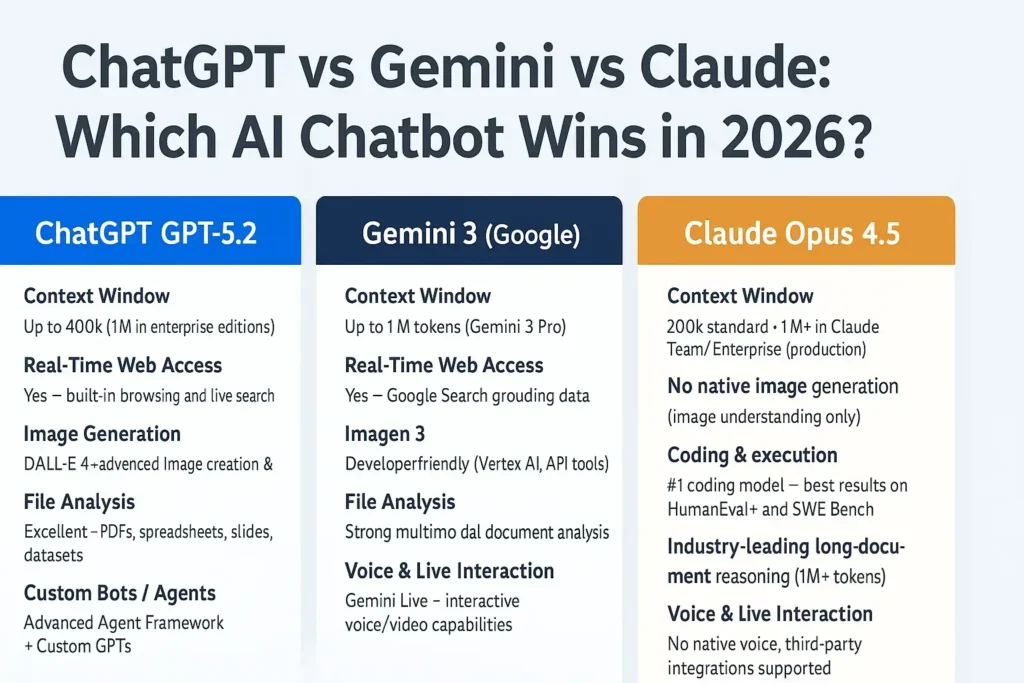
| ChatGPT / GPT-4o (OpenAI) | General use, content, coding, broad enterprise | Best multimodal capability, massive ecosystem, fastest tool use, GPT-5 agentic push | Pricing at scale; market-share slide signals users exploring alternatives |
| Google Gemini | Mobile-first, Google Workspace users, quick queries | Best mobile UX, deep Android integration, 2B monthly visits and climbing | Less customizable for enterprise; can feel surface-level for complex tasks |
| Anthropic Claude | Enterprise safety-critical deployments, coding, long documents | Lowest hallucination rate for reasoning tasks, strong safety guardrails, growing enterprise traction | Smaller tool ecosystem; lower consumer awareness than ChatGPT/Gemini |
| Perplexity | Research, cited answers, competitive intelligence | Web-native, always-current answers, strong citation quality | Not for task execution; limited customization; a search tool with a chat interface, not a full assistant |
| Microsoft Copilot | Microsoft 365 users, enterprise Office workflows | Deep Office integration, good for internal knowledge retrieval | Stagnated at 1.2% market share despite massive Windows/Office distribution — suggests UX isn’t converting |
| Zendesk AI / Intercom | Customer support teams, helpdesks | Purpose-built for support workflows, native CRM integration, solid analytics | Narrow use case; not a general assistant; pricing can escalate at volume |
What’s Coming 2026–2027
I’ll be straight with you: predicting AI timelines is humbling work. Things happen faster than expected, then slower, then sideways. But based on where the actual R&D dollars and enterprise commitments are going, here are the shifts most likely to matter:
1. Multimodal becomes baseline, not a feature
40% of generative AI solutions are expected to be multimodal by 2027 (Gartner). Voice, image, document — all in the same conversation, all handled naturally. Right now this is a differentiator. In 18 months it’ll be table stakes.
2. Proactive AI — from reactive to anticipatory
The next generation of assistants won’t wait for you to ask. They’ll monitor patterns — browsing behavior, calendar, communication history — and surface relevant information before you realize you need it. This makes some people uncomfortable, for good reason. But enterprises building for it now will have a significant lead.
3. Federated learning and privacy architecture
Data privacy regulation is tightening globally. Federated learning — training AI models without centralizing sensitive data — is moving from academic to production. Expect it to become a procurement requirement in healthcare and finance within 18 months.
4. Specialized domain models, not general LLMs
The era of “one model to rule them all” is over. Healthcare chatbots trained on clinical data, legal bots trained on case law, financial advisors trained on regulatory filings — these beat general-purpose LLMs in their domains. Every enterprise will eventually run specialized models for core functions.
5. The explainability mandate
Regulators want to know why the chatbot gave that answer. Explainable AI — systems that can narrate their reasoning — is moving from a nice-to-have to a compliance requirement in regulated industries. The EU AI Act is the leading edge of this wave, but it won’t be the only one.
Frequently Asked Questions
📚 Sources & References
- Azumo — 50 Chatbot Statistics in 2026 (March 2026)
- Chatbot.com — Key Chatbot Statistics 2026
- Nadcab — AI Chatbot Market Size Trends 2026–2032
- ColorWhistle — AI Chatbot Statistics & Trends (April 2026)
- Dante AI — AI Customer Service Statistics 2026 (March 2026)
- Vertu / Similarweb — AI Chatbot Market Share 2026
- DemandSage — AI Chatbot Statistics 2026
- First Page Sage — Top Generative AI Chatbots by Market Share (April 2026)
- Thunderbit — AI Chatbot Stats 2026
- Gartner — AI Predictions 2026 (enterprise agent adoption, contact center savings, CX trends)
- McKinsey Global Survey on AI Adoption 2025–2026
Top 10 AI Automation Tools for Business in 2026: Drive 50% Efficiency Gains with Agentic Workflows
AI Automation Tools Free: Transform Your Workflow Without Breaking the Bank
McKinsey AI Use Cases: The Game-Changing Applications Transforming Business Operations
AI for Small Business Marketing: Ultimate Guide to Growth
Best AI Automation Tools 2025: Your Ultimate Guide to Streamlined Success