
AI Social Media Managers for TikTok Shop
A working framework for deciding what to hand to AI, what to keep human, and how to stay inside the FTC and EU disclosure rules that took effect this year — built from public product data, platform documentation, and regulatory filings rather than vendor demos.
Type “AI social media manager for TikTok Shop” into Google and you’ll get two kinds of article. One is a listicle of eight tools with affiliate links and no explanation of what actually breaks when you automate a product feed. The other is a vendor blog dressed up as a guide, where every comparison happens to favor the company writing it. Neither tells you the thing that actually matters in September 2026: which parts of TikTok Shop content production are safe to hand to AI right now, which parts carry real legal exposure if you get them wrong, and how to tell the difference before you find out the hard way.
This piece is built around a decision framework — I’m calling it the Task Ledger — rather than a tool ranking, because the tool landscape changes every quarter and the underlying decision doesn’t. It also spends more time than most competitors on the part nobody wants to write about: the disclosure rules that became enforceable in the US, New York, and the EU during 2026, because that’s the part that can turn a content-automation win into a five-figure liability.
The Tally — Read This If You Have Four Minutes
Why This Question Is Worth Answering Right Now
Start with the honest version of the market-size story, because it’s more useful than the round number everyone quotes. TikTok does not publish TikTok Shop’s financials as a standalone line item, which means every “global GMV” figure you see is an outside estimate, and the estimates disagree by a wide margin. Momentum Works and Tabcut, whose tracking methodology is cited by name and dated, put global TikTok Shop GMV at an estimated $64.3 billion for full-year 2025, with the first half of 2026 alone reaching $50.3 billion — up 92% year over year, with $11.8 billion of that inside the United States. Other trackers report 2025 global GMV anywhere from $66 billion to figures that round differently depending on which markets and which quarter’s exchange rates they use.
That spread matters for a practical reason: if you’re reading a competitor’s “TikTok Shop is now an $84 billion channel” claim in a sales deck, ask which tracker, which period, and which markets it covers before you build a budget around it. Probable is the honest label for GMV-scale claims in this space — treat any single-source figure with round numbers and no methodology link as closer to Speculative.
What is not in dispute: TikTok Shop is growing faster than any Western e-commerce channel of comparable size, and the platform has spent 2026 shipping AI tooling specifically for merchants, not just creators. In January 2026, TikTok rolled out “List with AI,” a feature that turns a single product photo and a short description into a full listing automatically Established — and TikTok’s Video Scheduler now lets Creator and Business accounts queue content up to 30 days out natively. Neither of those replaces a strategy. They just mean the floor for “doing nothing” has moved, and third-party AI tools now have to add value above a native baseline that didn’t exist eighteen months ago.
The Task Ledger: A Framework for Deciding What to Automate
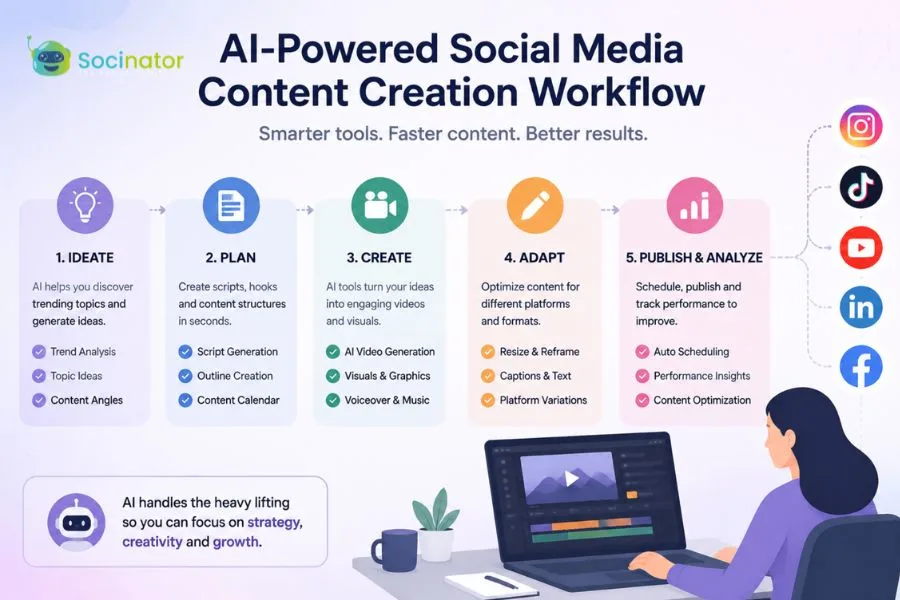
Most “AI tools for TikTok Shop” content skips straight to a tool list. That’s backwards — it treats automation as a shopping decision instead of an operating decision. Before you evaluate a single product, you need to know what you’re actually trying to automate, because “AI social media manager” is being used to describe at least five genuinely different jobs, and the failure modes for each are different.
Here is the framework I use when a seller asks where to start. It is a synthesis built for this article, not an external data claim, so I’ve tagged it accordingly.
Task Ledger Framework Framework
For every piece of TikTok Shop content, assign it to a layer, then apply that layer’s automation ceiling — the point past which AI output needs a human sign-off before it goes live.
- Research layer — product angle discovery, trend spotting, competitor tracking. Automation ceiling: high. Wrong output here just costs you time, not money or legal exposure.
- Production layer — scripts, video variants, captions, thumbnails. Automation ceiling: medium-high for volume, low for final brand voice. Wrong output here damages trust, not the law.
- Publishing & testing layer — scheduling, A/B hook testing, Spark Ads triggering. Automation ceiling: medium. Wrong output here burns ad spend.
- Compliance layer — AI disclosure labels, claims review, platform policy checks. Automation ceiling: none, by design. This is the one layer where “AI drafted it, human approved it” is not optional — it’s the legal standard now (see the disclosure section below).
- Support layer — DMs, comment triage, order-status questions. Automation ceiling: high for classification and routing, low for anything touching refunds, medical claims, or safety.
The reason this matters more than a tool ranking: a tool that is excellent at the production layer (say, a video-variant generator) tells you nothing about whether it’s safe to trust at the compliance layer, and most of the “AI social media manager” positioning blurs that line on purpose, because “does everything” sells better than “does one thing well.”
What’s Actually in the Toolchain Right Now
Rather than rank tools — rankings age out within a quarter in a category this young — here’s how the current toolchain maps onto the Task Ledger layers, based on what these products’ own documentation and independent coverage describe them as doing. None of the figures below come from first-party testing on my end; where a claim originates from the vendor rather than an independent source, it’s marked accordingly.
| Ledger layer | What it covers | Examples in market | Confidence on claims |
|---|---|---|---|
| Research | Product/trend discovery, competitor listing analysis | Kalodata, Nexscope | Probable — category descriptions consistent across sources |
| Production — text | Listing drafts, captions, hook variants | TikTok’s native List with AI; ChatGPT, Jasper as general drafting layers | Established for the native feature |
| Production — video | URL-to-video generation, editing, localization/dubbing | CapCut, Creatify.ai, HeyGen | Probable — functions confirmed, output quality not independently benchmarked here |
| Publishing & testing | Scheduling, multivariate hook testing, Spark Ads triggering | TikTok’s native Video Scheduler; Autoreach.ai-style testing agents | Established for scheduler; Speculative for third-party win-rate claims |
| Creator/affiliate matching | Finding, vetting, and contracting affiliate creators | Storika, Euka, alongside legacy platforms like GRIN and Aspire | Speculative — database-size claims (e.g., “7M+ creator profiles”) are vendor-reported |
| Support | Ticket classification, FAQ responses, routing | Zendesk AI, Tidio / Lyro | Probable — general customer-support AI category is mature outside TikTok Shop specifically |
What I won’t do here
A lot of “elite” content on this exact topic promises a first-party head-to-head test — identical products run through five tools with a 1–10 scorecard. I’m not going to fake that. Running that test honestly means paying for every tool, generating real listings, and tracking real conversion data over weeks, which no article can compress into a single publish date without either lying about the methodology or padding the scores. If a competing article shows you a precise “8.7/10” score for a TikTok content tool with no described testing protocol, ask what the protocol actually was before you trust the number.
A Practical Decision Checklist Before You Add a Tool
One of the more useful frameworks circulating in this space right now — worth crediting directly — comes from Nexscope’s own guidance for TikTok Shop sellers: before adding any AI tool to your stack, define its task, owner, input, output, review step, and success metric. If any of those six elements is unclear, the tool usually adds output volume without improving the actual decision you’re trying to make. That’s a sharper filter than most “best tools” roundups offer, and it holds up regardless of which specific products you’re evaluating.
Layer that against the Task Ledger above and you get a workable pre-purchase checklist:
- Which ledger layer does this tool actually sit in — and does its marketing claim a higher layer than it delivers?
- Who reviews the output before it’s public, and how long does that review actually take per item?
- What happens the first time the tool generates a claim about the product that isn’t true? (If the answer is “we haven’t thought about that,” that’s your answer.)
- Does the tool’s output need an AI-disclosure label under FTC, NY, or EU rules — and does the tool make that label easy to attach, or does it get lost in export?
The Part Most Guides Skip: Disclosure Law Changed Under Your Feet in 2026
This is the section that separates a genuinely useful guide from a repackaged tool list, because 2026 is the year AI-content disclosure stopped being a best practice and became enforceable law across three overlapping jurisdictions at once.
Three things converged this year:
- The FTC’s “double disclosure” standard. A post needs two separate labels, not one — that the content is commercial (the existing #ad requirement) and that AI was used to create or substantially modify it. A hashtag doing double duty for both does not satisfy either requirement on its own. For video, both disclosures need to appear as on-screen text in the first three to five seconds; for images and text, near the content itself, not buried in a bio or terms page Established — this builds directly on the FTC’s Endorsement Guide update from October 2023, clarified further in March 2025.
- New York’s synthetic-performer law, effective June 9, 2026, which specifically targets AI-generated “performers” in ads meant to look like real humans reaching New York consumers Established.
- The EU AI Act’s Article 50 transparency duty, applicable from August 2, 2026, which requires AI-generated or manipulated content that could be mistaken for authentic to be marked in a machine-readable format, not just a visible label, if it reaches EU consumers Established.
Separately, the FTC’s rule against fake reviews — finalized in late 2024 — is being actively enforced in 2026 against AI-generated reviews presented as authentic consumer experiences, whether they appear on a brand’s own site, a marketplace listing, or an affiliate post. If your AI social media manager is drafting anything that could be read as a customer testimonial, that draft needs the same scrutiny as a human-written fake review would.
None of this means AI-generated TikTok Shop content is risky by default. Routine AI editing of your own real footage — color correction, captions, trimming — generally doesn’t trigger a label. The risk sits specifically at the point where a viewer could reasonably mistake AI output for an unaltered, authentic human performance, claim, or review. That’s a narrower bar than “any AI was involved,” and it’s worth training whoever owns your compliance layer on the distinction rather than either over-labeling everything or under-labeling out of habit.
How the Ledger Plays Out: An Illustrative Walkthrough
To make the framework concrete without inventing a fake case study with fabricated numbers, here’s a composite scenario built from patterns described across the sourcing above — not a real seller, and deliberately labeled as such.
Illustrative composite — not a real business Framework
A skincare seller with one hero product runs research through an AI trend tool weekly (research layer — high automation, low risk). Video hooks get generated in batches of eight to ten variants using a URL-to-video tool, then a human editor picks the three worth publishing and rewrites any claim-adjacent language — “clears breakouts,” “dermatologist recommended” — that the AI drafted without a source (production layer — automated volume, human gate before publish, because unsupported efficacy or credential claims are exactly what the FTC’s fake-review and deceptive-claims enforcement targets). Scheduling and initial A/B hook testing run on autopilot inside the platform’s native scheduler (publishing layer — automated). Every video that used AI voice, an AI-generated model, or AI editing beyond basic trimming gets a mandatory on-screen “AI-assisted content” label added before it’s queued, checked by a named person, not a tool (compliance layer — human-owned, no exceptions). DM triage for order questions runs through a support AI; anything mentioning an allergic reaction or refund dispute routes to a human immediately (support layer — automated triage, human escalation on anything with legal or safety weight).
When Not to Automate — Honestly
I’ll admit a mistake I made early in evaluating this space: I initially assumed AI-drafted product descriptions were low-risk by default because they’re “just marketing copy.” They’re not low-risk when the product touches health, safety, or a regulated claim — a supplement, a skincare active, a children’s item — because that’s exactly where AI models are most prone to generating a confident, specific, and unverified claim, and it’s exactly where the FTC’s deceptive-claims and fake-review enforcement is most active in 2026. If your product category touches any of those, the production-layer automation ceiling drops from “medium-high” to “low,” full stop, regardless of how good the tool’s output looks.
More generally, don’t automate:
- Any claim you can’t point to a source for — “clinically proven,” “doctor recommended,” “cures,” “guaranteed results.”
- Responses to a complaint, safety concern, or refund dispute that could become a public dispute if handled wrong.
- The decision to label something as AI-generated. That decision needs a named human owner, not a checkbox a tool sets automatically and might get wrong.
- Anything you would be embarrassed to defend to a regulator with the phrase “the AI wrote that” as your explanation.
Frequently Asked Questions
Do I have to disclose AI use if I only used AI to edit real footage of my product?
Generally no. Routine editing — trimming, color correction, adding captions to real footage — is treated differently from generating or substantially altering content in a way that could mislead a viewer about authenticity. The distinction that matters legally is whether a viewer could reasonably mistake the result for unaltered, authentic human content.
Does TikTok’s own “List with AI” feature count as content I need to disclose?
The disclosure requirements target consumer-facing content that could be mistaken for authentic human work — an AI-assisted product listing description is a different risk category from an AI-generated video of a “person” using the product. Still, if the AI-drafted listing text includes a specific claim it can’t support, that’s a deceptive-claims issue independent of AI-disclosure rules.
Is a single #ad hashtag enough if the content is also AI-generated?
No. Under the FTC’s current framework, the commercial-relationship disclosure and the AI-involvement disclosure are treated as two separate requirements. One label covering both is not considered sufficient.
Which AI tools should I trust for final, unreviewed publishing?
None, currently, for anything touching a product claim, a testimonial-style statement, or a disclosure decision. The research and initial-draft layers are mature enough to run with light review; the compliance layer should stay entirely human-owned.
How reliable are the “AI cuts production time by 60%” style statistics I keep seeing?
Treat any round percentage like that as marketing color unless the source names a methodology and a sample. Several such figures circulate across vendor blogs in this space without a traceable primary study behind them — that doesn’t make them false, but it does mean they shouldn’t drive a budgeting decision on their own.
Why do TikTok Shop’s GMV figures vary so much between sources?
TikTok doesn’t publish TikTok Shop financials as a standalone figure, so every public number is a third-party estimate. Trackers differ on which markets they include, whether platform-subsidized discounts are counted, and which quarter’s exchange rates they apply — which is enough to explain a swing of ten or more billion dollars between two “2025 global GMV” headlines.
Is live shopping worth automating hook-testing for?
Live-stream commerce is a growing share of TikTok Shop activity, and independent-leaning sources describe meaningfully higher conversion during live sessions than standard video posts. Automated multivariate hook testing before you go live is a reasonable use of the publishing layer — just don’t let an AI agent make the “should we go live” call without a human checking inventory and staffing first.
What’s the single most common mistake sellers make when adopting these tools?
Treating “AI social media manager” as one product category with one risk level, instead of five layers with five different risk levels. That’s the whole reason this article leads with the Task Ledger instead of a tool list.
Do affiliate creators need to disclose AI involvement too, or just the brand?
Both. FTC guidance treats the brand as responsible for ensuring disclosure compliance across content it pays for or materially controls, which includes affiliate and creator content — outsourcing the disclosure decision to a creator or agency doesn’t remove the brand’s exposure.
Will these rules keep changing before this article’s next update?
Almost certainly at the state level — multiple US states were considering AI-disclosure legislation as of mid-2026. The federal FTC framework and the EU AI Act’s core transparency dates are more settled, but a state-by-state patchwork is the most likely source of near-term change worth re-checking.
Where This Came From
Every load-bearing figure in this article is linked at the point it’s used rather than collected in a bibliography, so you can check the date and methodology in context. Where sources disagreed — which happened most often on TikTok Shop’s exact GMV — that disagreement is shown rather than resolved into a single confident number, in line with our standing editorial policy against presenting contested figures as settled facts.
Related on AI Earner Hub:
More AI Social Media Manager coverage Social Media Automation category AI SEO Content Tools 2026: The Honest, Tested Guide Best AI Article Generators, Ranked by What Survives a Core Update Site FAQUpdate Ledger
- Sept 21, 2026 — Initial publication. GMV figures, disclosure-law dates, and tool landscape current as of compilation in September 2026.