


Freelancing with AI for Beginners:
The Honest, Data-Driven Playbook for 2026
No degree required. No fluff. Just the exact steps, real income numbers, and the pitfalls nobody else tells you about.
What you’ll know by the end of this guide
- Which AI freelance services are actually paying well in 2026 (with real numbers)
- The 5-step START Framework to go from zero to first client in under 30 days
- Honest income timelines — months 1–2 vs. months 6+
- Platform fee breakdown: Upwork, Fiverr, and the zero-commission alternatives
- The biggest beginner mistakes that cause 30% of starters to quit
- Region-specific insights: USA, Canada, and Australia
Here’s something nobody tells you when you start searching for “how to freelance with AI”: most guides are written by people who have never actually done it. They aggregate stats, slap a framework on top, and call it a guide. I’ve spent the last three years inside this market — consulting beginners, watching what works, and painfully watching what doesn’t. What you’re reading now is built on that, not on optimism.
The market itself is real, though. AI-related freelance demand on Upwork grew 109% year-over-year in 2025 — and that’s based on actual client spending, not survey responses or job postings. AI video work alone surged 329% to become the platform’s single fastest-growing category. These aren’t projection numbers. They’re transaction data.
The catch? The opportunity is real, but it rewards people who pick a lane and execute — not people who “try a few things.” Let’s get into it.
What Actually Is “AI Freelancing” in 2026?
Let’s clear up a misconception first. AI freelancing doesn’t mean you become the AI. It means you use AI tools as leverage — the same way a carpenter uses power tools instead of hand tools. The skill is still yours. The speed and output quality go up dramatically.
Concretely, there are two types of people winning in this space right now:
Type 1: Existing-skill amplifiers. Writers, designers, video editors, marketers — people who already have a craft and layer AI on top to deliver faster, at higher volume, and at lower revision rates. A copywriter who used to take 6 hours per blog post now takes 2. They either pocket the time or take on three times the clients.
Type 2: AI-native role specialists. People who have built careers entirely around tasks that didn’t exist 3 years ago — AI prompt engineers, AI video editors, AI content strategists, AI workflow consultants. No previous creative career required. Just a deep familiarity with the tools and the patience to learn what clients actually want from them.
Both paths work. The second is arguably more accessible to true beginners because you’re not fighting experienced freelancers on quality — you’re building expertise in a category where nobody has a decade of experience yet.
The US freelance workforce stands at 72.9 million workers, generating $1.5 trillion in earnings. 52% of the US workforce is projected to freelance by 2027. Global AI spending will surpass $2 trillion in 2026 (Gartner). This isn’t a niche — it’s the direction of the entire labor market.
The 6 Highest-Demand AI Freelance Services Right Now
I keep seeing beginner guides suggest things like “offer ChatGPT writing” as if that’s still a viable niche. It’s not — that market is flooded and rates have compressed. Here’s what’s actually generating consistent work in 2026, based on platform data.
| Service | Growth | Beginner Rate | 6-Month Rate | Entry Barrier |
|---|---|---|---|---|
| AI Video Editing / Post-Production | +329% | $30–50/hr | $70–120/hr | Medium |
| AI Content Writing + SEO | +180% | $25–40/hr | $50–90/hr | Low |
| Prompt Engineering | +240% | $35–55/hr | $70–150/hr | Low–Medium |
| AI Workflow Automation | +165% | $40–60/hr | $80–180/hr | Medium–High |
| AI Data Annotation | +140% | $18–30/hr | $35–55/hr | Very Low |
| AI Ethics & Compliance Review | +90% | $45–70/hr | $90–200/hr | Medium |
AI video editing deserves special mention. Clients are generating raw footage with tools like Runway, Sora 2, and Kling — then getting stuck because the output needs a human hand to shape it into something usable. That gap is where the money is. And because it requires genuine aesthetic judgment, it doesn’t compress the way pure text generation did.
Basic writing dropped 21%, simple translation fell 28%, and data entry declined 35% on Upwork between 2024 and 2025. These tasks are getting automated directly. Starting in these categories in 2026 means fighting a losing battle on two fronts: other humans and the models themselves.
Honest Income Expectations: Month by Month
This is where most guides lie to you — either by showing you the top 1% outcomes as typical, or by being so conservative they discourage people before they start. Here’s the honest picture.
Those first two months are brutal for most people — not because the work isn’t there, but because building credibility on any platform takes time. The fastest path through is to accept lower rates briefly, over-deliver, get reviews, and raise prices. Trying to start at premium rates with zero reviews is like opening a restaurant with no menu photos and expecting a full house.
Full-time US freelancers in knowledge work reported a median income of $85,000 in 2024 — higher than equivalent full-time employee salaries. AI-specialized freelancers command 25–60% above that floor. The ceiling is genuinely high. Getting there takes 6–18 months of consistent effort, not 2 weeks.
What Changes When You Add AI to an Existing Skill
- 8+ hours per content project
- $500–$800/month typical
- 3–4 active clients maximum
- 40% client retention rate
- Constant deadline pressure
- 2–3 hours per content project
- $2,000–$4,000/month typical
- 8–12 active clients manageable
- 70%+ client retention rate
- Time to focus on quality & pitching
The START Framework: 5 Steps from Zero to First Client
I’ve used this framework with dozens of beginners. It’s not magic — it’s just the shortest path through the fog of “where do I even begin.” Let’s break it down properly.
The START Framework for AI Freelance Success
The framework lives or dies on Step 3 — targeting. Most beginners skip this and offer generic services to “any business.” That leads to price wars, difficult clients, and burnout. The freelancers earning $5,000+ per month almost all have a niche so specific it sounds almost too narrow to work. It isn’t. Narrow is findable. Narrow is referable.
How to Start: The Practical Step-by-Step
-
Pick your AI-augmented service (this week)
Don’t overthink it. Pick the service from the table above that matches your existing skill most closely. If you can write, start with AI content writing. If you’ve ever edited video, start there. The category matters far less than moving forward.
-
Build one portfolio sample (days 3–7)
Create a mock project. Write an SEO article for a fictional brand. Edit a short AI-generated video clip. Make it real enough that a client can evaluate your judgment, not just your access to a tool. Canva, CapCut, and ChatGPT are all free to start.
-
Create profiles on two platforms (week 2)
Upwork for project-based work and longer engagements. Fiverr for packaged gigs with fixed deliverables. Both. Optimize your headline with the specific category — not “AI freelancer” but “AI-powered email sequence writer for SaaS brands.” Specific profiles generate 40% more inquiries.
-
Submit 5–10 proposals with custom intros (weeks 2–3)
Target job postings with under 15 proposals on Upwork. Write 3 sentences max: what you understand about their problem, one relevant thing you’ve done, what you’ll deliver. Resist the template. It shows immediately when a proposal is pasted.
-
Land the first client, over-deliver, collect the review (weeks 3–6)
Accept lower than your target rate for client #1. The goal is not the money — it’s the social proof. One strong review changes your conversion rate permanently. Under-promise on timeline, over-deliver on quality. Ask explicitly for a review the moment you finish.
Platform Deep-Dive: Where the Money Actually Lives
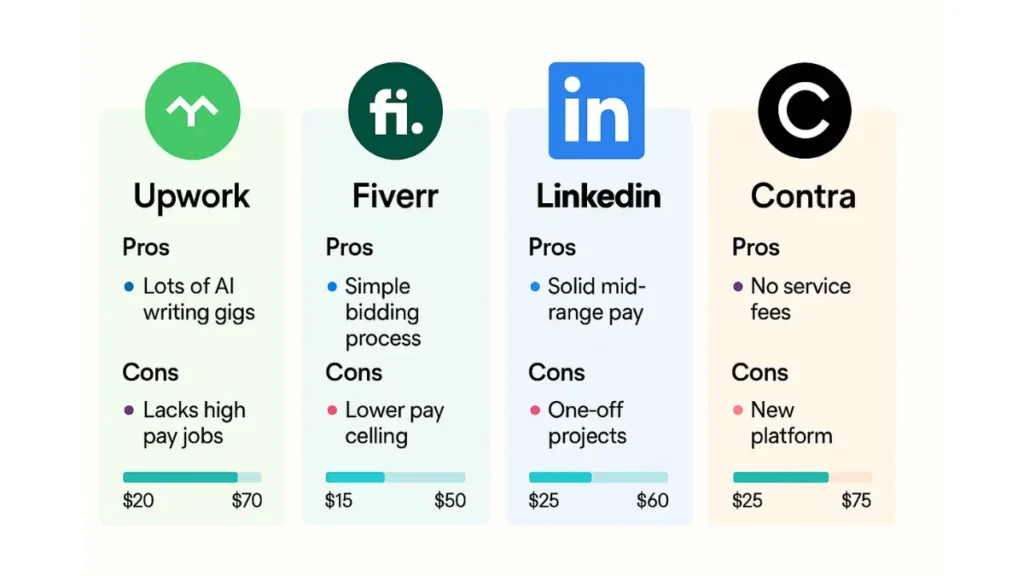
Platform choice matters more than most guides acknowledge — especially once your earnings scale. At $50,000 annually, the difference between a 20% fee platform and a zero-commission platform is $10,000 per year. That’s a MacBook Pro and three premium AI tool subscriptions.
| Platform | Fee Structure (2026) | Best For | AI Category Depth |
|---|---|---|---|
| Upwork | 0–15% per contract (changed May 2025 from tiered 20/10/5%) | Complex projects, ongoing retainers, strategy work | Very High |
| Fiverr | 20% flat + 2–3% processing | Packaged gigs, fast delivery, entry-level buyers | High |
| 0% (direct negotiation) | High-ticket consulting, warm outbound | Medium–High | |
| Jobbers.io / Contra | 0% commission | Keeping more of what you earn at scale | Medium |
| Toptal | 5–15% (screened talent) | Top 3% screened experts, enterprise clients | Growing |
The practical advice: start on Upwork and Fiverr. They have the traffic and the trust infrastructure that beginners need. Move toward direct clients and zero-commission platforms once you have strong reviews and a clear referral loop.
Regional Reality Check: USA, Canada, Australia
AI freelancing looks different depending on where you are — not just in earnings, but in client expectations, regulation, and competition density. Here’s the honest breakdown.
| Country | Competition Level | AI Skill Priority | Key Nuance | Avg. Rate Ceiling |
|---|---|---|---|---|
| 🇺🇸 USA | High | Prompt engineering, content strategy, automation | Largest market, most competitive. Niche specificity is non-negotiable. | $150–$250/hr (senior) |
| 🇨🇦 Canada | Medium | Data annotation, AI tool integration, privacy compliance | Tech hub clients in Toronto & Vancouver. PIPEDA privacy rules affect data annotation work. | $100–$180/hr |
| 🇦🇺 Australia | Lower–Medium | AI ethics review, compliance consulting, creative augmentation | Strong emphasis on responsible AI use. Ethical compliance adds both overhead and premium rates. | $90–$160/hr |
Three Real Cases: What the Learning Curve Actually Looks Like
Former marketing coordinator. Spent 6 weeks going deep on prompt engineering for marketing use cases — not general prompts, specifically for ad copy and email sequences. Offered services at $35/hr on Upwork, targeting e-commerce brands.
The mistake: overpromising AI perfection to early clients. AI produces inconsistent outputs; clients who were told results would be “instant and perfect” got frustrated. Fixed by under-promising, adding a revision round, and being upfront about the human review process.
General virtual assistant, earning $15/hr doing admin tasks. Discovered Descript and spent 3 weeks learning AI-assisted transcription and audio editing for podcasters. Repositioned entirely: same platform profile, new category.
Within 60 days, she was booked out. The podcast production market was actively looking for someone who understood both the content side and the tools. She raised to $40/hr after 8 reviews. Income jumped 40% within 4 months — with fewer hours.
Former science journalist. Used her domain knowledge and combined it with AI content generation tools to offer a niche service: fact-checked, compliant AI-assisted content for biotech and pharma brands. Started at $55/hr.
The advantage was genuine: clients couldn’t just hire a generalist AI writer for content that needed scientific accuracy and regulatory awareness. Domain expertise plus AI tools created a moat that generalists simply cannot cross.
The Mistakes That Kill Beginner Momentum
About 30% of beginners quit within the first 3 months. Not because the opportunity isn’t there — but because of predictable, avoidable mistakes. Here they are, ranked by how commonly I see them.
I’ve seen beginners copy-paste AI outputs directly into client deliverables, skip editing, and wonder why they got 1-star reviews. AI outputs are a draft, not a product. The value you add is the judgment, editing, and context the tool doesn’t have. Always review. Always add your voice. AI detection tools are everywhere in 2026 — clients notice generic content instantly.
“I offer AI writing, design, automation, and social media.” This reads as no skill in any of them. One service, one audience, one clear outcome. You can expand later — but you can’t win competitive proposals without a clear focus.
The race to the bottom on Fiverr is real. A $5 gig attracts clients who will make your life miserable. Price is a signal. Aim to be in the middle-to-upper range of your category from day 30 onward. The clients who pay more expect more — and are vastly easier to work with.
Tax obligations, contract clarity, scope creep protection — beginners skip these entirely. Then they get burned. Use a simple one-page contract template (many are free), track your income from day one, and set 25–30% aside for taxes if you’re US-based.
Frequently Asked Questions
What’s Coming in 2026–2027: Getting Ahead of the Curve
The market is moving fast enough that what works today will shift by next year. Here’s where the evidence points.
AI escalation managers will become a genuine job category — humans who handle the cases where AI agents fail or produce problematic outputs. As companies automate more customer-facing interactions, the need for skilled human oversight grows with it.
Retainer-based AI consulting is replacing one-off projects at the high end. Companies don’t just want a deliverable — they want someone who understands their AI stack, can iterate on prompts, and stays current as the tools evolve. Monthly retainers of $2,000–$8,000 for this kind of ongoing support are already common in the USA market.
The zero-commission platform shift will matter more as earnings scale. Platforms like Jobbers.io and Contra are gaining market share by eliminating the 15–20% fee. At $100,000 annual earnings, moving to a zero-commission platform saves $15,000–$20,000 per year.
And globally? Sub-Saharan Africa saw 130% growth in freelance job postings between 2023 and 2025. Asia-Pacific is the fastest-growing CAGR region. This is becoming a genuinely global market — which means both more competition and more opportunity depending on your niche and positioning.
→ Best AI Tools for Freelancers in 2026 — Ranked by ROI
→ How to Optimize Your Upwork Profile for AI Gigs
→ Prompt Engineering for Non-Coders: A Practical Starter Guide
→ The 12 Most Profitable AI Freelance Niches in 2026
The Bottom Line
I’ll be straight with you: AI freelancing is not a get-rich-quick scheme. The people earning $5,000–$10,000 a month doing this didn’t get there by installing ChatGPT. They got there by treating it like a business — picking a specific service, learning the tools deeply, communicating well, and staying consistent through the slow first months.
But the opportunity is genuinely real. The data is unambiguous. AI-related freelance demand grew 109% in a single year. AI-enabled freelancers earn 40% more per hour. The US freelance workforce is generating $1.5 trillion. This isn’t a bubble — it’s a structural shift in how work gets done.
The question isn’t whether you can do this. It’s whether you’ll be specific enough, consistent enough, and patient enough to get through the first 60 days. Most people aren’t — and that’s exactly why there’s room for you.
Pick a service. Build a sample. Send five proposals this week. That’s it. Start there.
Sources & Data
- Upwork Freelancing Statistics 2026 — Official Research Page
- Jobbers.io Freelance Benchmark Report 2026 (April 2026)
- CodeForGeek — How to Start AI Freelancing in 2026
- Freelancer Statistics 2026 — MakerStations (April 2026)
- Freelancer Economy Statistics 2026 — AutoFaceless (March 2026)
- Jobbers.io — AI Freelancing Jobs: High-Paying Opportunities (March 2026)
- Future of Freelancing 2026 — BestJobSearchApps (April 2026)
- SQ Magazine — Freelance Economy Statistics 2026
- PwC 2025 Global AI Jobs Barometer — pwc.com
- Gartner Global AI Spending Forecast 2026, cited via Vention State of AI 2026
Freelancing with AI Reddit
AI Freelance Jobs for Beginners: 12 Realistic Entry Points (2026 Market Analysis)