

Generative AI Freelance Jobs: How to Earn $100–$300/hr in the Fastest-Growing Market of the Decade
Real numbers, actual niches, an honest look at what’s working — and what’s quietly killing beginners’ income.
⚡ Quick Answer (TL;DR)
Generative AI freelance jobs are paid gigs where you use tools like ChatGPT, Midjourney, or custom LLMs to produce content, visuals, code, or strategic advice for clients. As of early 2026, demand for AI-related skills on Upwork grew 109% year-over-year, with AI video editing alone up 329%. Rates range from $40/hr for entry-level content work to $300/hr for AI strategy consulting. To start: pick one niche, complete a free course in 2 weeks, publish 8–10 portfolio samples, then pitch on Fiverr or Upwork. Realistic timeline to first paying gig: 3–6 weeks. Realistic first-year income (part-time): $25,000–$55,000.
Why This Market Is Genuinely Exploding — and Where Most Beginners Go Wrong
Here’s the thing nobody says clearly enough: generative AI didn’t just create new job types. It restructured the economics of freelancing so thoroughly that two freelancers doing technically the same work — say, writing blog posts — can now earn 4x different rates depending purely on how they’ve positioned their AI skills.
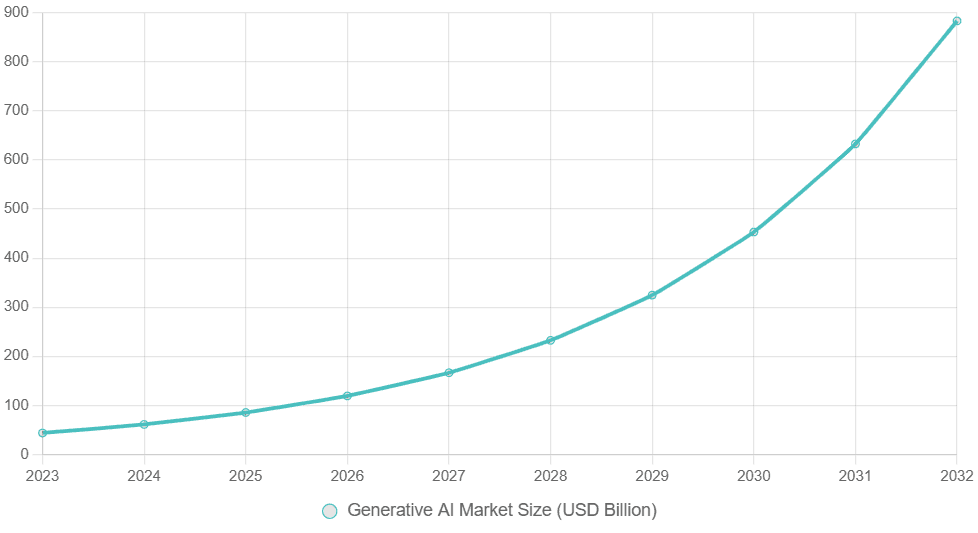
The numbers back this up. Upwork’s 2026 In-Demand Skills report — which tracks what clients actually paid for, not just what they searched — shows AI-referenced skills grew 109% year-over-year. Gartner projects global AI spending to surpass $2 trillion in 2026, growing toward $3.3 trillion by 2029. And 5.6 million independent workers in the US earned over $100,000 annually in 2025, up from 3 million in 2020.
But here’s the honest flip side — and I want to be upfront about it because most guides skip this part entirely. A Brookings Institution study found a 21% decrease in job postings for automation-prone writing and coding roles within 8 months after ChatGPT launched. Image-related job posts fell 17%. Freelancers in highly exposed occupations saw a 5% drop in earnings.
So the market is simultaneously creating premium opportunities for AI-savvy freelancers and quietly hollowing out the bottom end of the market for those who haven’t adapted. The gap between those two outcomes is mostly about specialization and positioning — not talent, not years of experience.
The Numbers That Actually Matter in 2026
Source: Upwork In-Demand Skills 2026 — based on verified freelancer earnings, U.S. marketplace, Jan–Dec 2025.
One thing that struck me looking at these numbers: the 329% figure for AI video editing isn’t because AI suddenly makes video editing easy. It’s because clients now expect video deliverables that would have required a full production team two years ago — and freelancers who can deliver that with AI tools are essentially operating like a one-person studio. That’s the model worth understanding.
The 6 Generative AI Freelance Niches by Earnings Potential
Not all niches are equal, and some that sound exciting pay less than others that sound boring. Here’s what the market actually rewards right now, ranked by ceiling — not floor.
| Niche | Hourly Rate | Skill Floor | 2026 Demand | Best Platforms |
|---|---|---|---|---|
| AI Strategy Consulting | $80–$300/hr | High — needs domain expertise | Very High | LinkedIn, Contra, direct |
| AI Video Generation & Editing | $60–$200/hr | Medium — video sense needed | +329% YoY | Upwork, direct pitches |
| AI Integration / Automation | $60–$180/hr | Medium — API basics help | +178% YoY | Upwork, Toptal, Guru |
| Prompt Engineering | $50–$150/hr | Low–Medium | High | Upwork, PromptBase, LinkedIn |
| AI Content & Copywriting | $40–$100/hr | Low — writing skills transfer | Moderate (competitive) | Fiverr, Upwork, direct |
| AI Image / Design Generation | $40–$100/hr | Low–Medium | Moderate (recovering) | 99designs, Fiverr, direct |
A quick note on AI content writing — it deserves honesty. It’s the most accessible niche but also the most saturated. The 17% decline in basic content job postings is real. You can still earn well here, but you have to bring something beyond “I can run ChatGPT”: deep subject matter expertise, a distribution angle, or SEO strategy alongside the writing itself. Generic content mills are dying. Specialist AI-assisted content creators are not.
AI video generation, on the other hand — that growth rate isn’t peaking. The tools (Runway, Pika, Sora API integrations) are still maturing, which means clients are willing to pay a serious premium for someone who actually knows what they’re doing. I’ve seen freelancers with six months of experience billing $8,000+ on single video projects for startups.
Which Niche Actually Fits You? A Realistic Decision Tree
Forget the generic advice to “follow your passion.” The real question is: what can you deliver at a professional quality level within 4–8 weeks of focused learning? Here’s how to think it through.
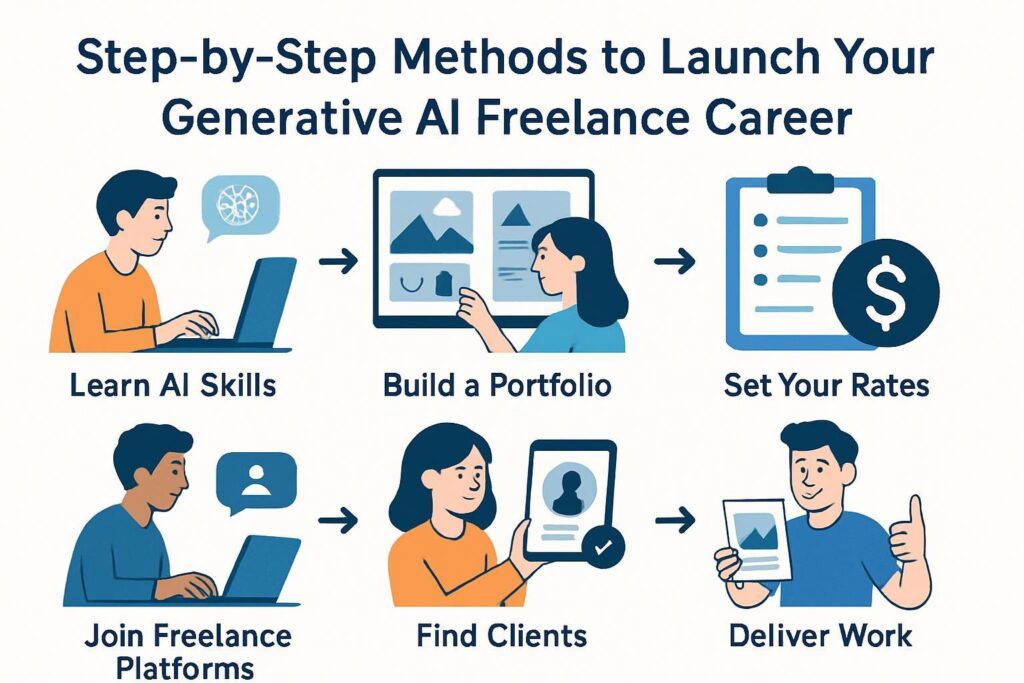
Step-by-Step Launch Playbook (Weeks 1–12)
I’ve watched a lot of people over-complicate this. The honest framework is: get competent, prove it publicly, then pitch. That’s it. Here’s what that looks like in practice.
Weeks 1–2: Build genuine competency in one tool
Don’t spread yourself across five tools immediately. Pick one based on your niche (see above), then spend two focused weeks producing outputs daily. The goal isn’t to take a course — it’s to generate 20 real outputs that you’d actually feel comfortable showing a client.
Free resources worth your time: Microsoft’s Generative AI for Beginners (12 hours, genuinely good), Google’s free Generative AI certificate, and for prompt engineering specifically, OpenAI’s own prompt engineering guide is still the most practical starting point.
Weeks 3–4: Build a portfolio that removes client risk
Take 3 fictional client briefs — say, a boutique hotel, a D2C supplement brand, and a SaaS startup — and produce 3–4 deliverables for each. This gives you a portfolio that feels industry-specific rather than generic. Upload to Behance, a simple Carrd site, or a public GitHub repo depending on your niche.
One thing that actually matters: include a short note on your process for each piece. What prompt structure did you use? How did you iterate? What would you do differently? This signals expertise far better than the final output alone.
Weeks 5–8: Land your first 3 clients
| Niche | Pitch Template That Works | Where to Send It |
|---|---|---|
| AI Content | “I’ll write 4 SEO articles in your vertical using AI-assisted research — delivered in 72 hours, includes 2 rounds of edits.” | Upwork, direct LinkedIn outreach to content managers |
| AI Video | “Here are 3 short-form videos I created for a fictional [industry] brand — I can produce 8–10 per week for your team.” | Direct pitch to marketing directors, Upwork |
| AI Integration | “I can connect your customer support system to an LLM that auto-categorizes and drafts responses — typical setup: 5–7 days.” | Upwork, Toptal, cold email to ops directors |
| AI Consulting | “Free 45-minute AI readiness assessment for [industry] teams — I’ll show you exactly where AI can save 8+ hours/week.” | LinkedIn, Contra, referral network |
Weeks 9–12: Systemize, raise rates, add retainers
By week 12, you should have 3–5 completed projects and reviews. Now you raise your rates by 20–30% for new clients — this is not optional if you want to scale. The single biggest income mistake new AI freelancers make is staying at their launch rate for too long because they’re afraid of losing clients. Clients who’ve seen your work rarely leave over a 25% increase.
Target retainers aggressively. A $2,500/month retainer from two clients is more valuable than $5,000 in one-off gigs because it’s plannable. Aim for 30–40% of income from retainers within six months.
Tools That Are Actually Worth Paying For in 2026
There are approximately 400 AI tools screaming for your attention right now. Most are noise. Here’s what the tools landscape actually looks like for working freelancers.
| Tool | Best For | Honest Assessment | Cost |
|---|---|---|---|
| ChatGPT (GPT-4o) | Content, prompting, research, code | Still the most versatile. The $20/mo Pro tier is worth it from day one — the free tier is too limited for client work. | Free / $20/mo Pro |
| Claude (Anthropic) | Long-form content, analysis, nuanced writing | Better than GPT-4o for document-heavy work and nuanced tone matching. Use both — they complement each other. | Free / $20/mo Pro |
| Midjourney v7 | Marketing visuals, brand imagery | Still the quality leader for photography-style outputs. Discord-based interface is annoying but you get used to it. | $10–$60/mo |
| Runway Gen-3 | AI video generation | The professional standard for AI video right now. If you’re in video, this is non-negotiable. | $15–$95/mo |
| GitHub Copilot | Code generation, AI integration work | Legitimately adds 30–55% to developer output speed. Study shows it doesn’t just autocomplete — it changes how you architect solutions. | $10/mo |
| Zapier / Make | Workflow automation for clients | Essential for AI integration freelancers. Many clients will pay $500–$2,000 for a well-built automation workflow you build in hours. | Free / $20–$99/mo |
Start with ChatGPT + one niche-specific tool. Don’t subscribe to five tools and spread your learning thin. Depth with two tools beats breadth across ten — especially when clients ask you to demonstrate expertise in discovery calls.
You can explore more resources and platform comparisons at AIEarnerHub — including updated reviews of emerging tools that didn’t exist six months ago.
The Risks Nobody Is Being Honest About
Most “how to start AI freelancing” guides read like recruiting brochures. Let me give you the version I wish someone had given me earlier — because some of these risks have cost freelancers real money and reputation.
IP and Copyright Exposure
AI-generated outputs — especially images — exist in genuinely murky legal territory in 2026. Several major cases are still working through courts. Some clients have been burned by using AI images commercially and want indemnification clauses in contracts.
→ Include clear IP/ownership language in every contract. Use tools like Copyleaks on text outputs. For images, stick to tools with explicit commercial use licenses.
AI Hallucinations Hitting Your Reputation
GPT-4o still confidently produces false statistics, fabricated citations, and incorrect technical details. If you deliver this to a client without verification, you own the mistake — not the tool.
→ Every factual claim in AI-generated content needs human verification before delivery. This isn’t optional — it’s your professional liability management.
Market Saturation at the Bottom
The 21% decline in basic writing job posts is real and continuing. Basic AI content work is commoditizing fast. Rates at the bottom of the market have dropped 15–25% since 2023.
→ Specialize vertically and strategically from the start. A “healthcare SaaS content writer using AI” commands 3–4x the rate of “AI content writer.”
Platform Dependency Risk
Upwork and Fiverr take 20% of your earnings and can suspend accounts with limited recourse. Over-reliance on one platform is a single point of failure many freelancers only discover the hard way.
→ After your first 5 clients, start moving relationships off-platform where possible. Build a direct client base worth at least 40% of income within year one.
Future Scenarios: What to Plan For
The honest answer is that nobody knows exactly how the AI-freelance market looks in 2028. But here’s a realistic scenario analysis based on current trajectories.
🚀 Best Case
AI agents mature and create hybrid roles where freelancers manage fleets of AI agents. Demand for human oversight, strategy, and QA grows faster than automation eliminates basic tasks. Top specialists build agencies around AI+human teams and earn $200K–$500K+ annually.
⚖️ Most Likely
Bottom-tier AI work continues commoditizing. Mid-tier specialists hold rates with continuous upskilling. True experts in vertical niches (healthcare AI, legal AI, financial AI) see premium growth. Average AI freelancer income: $70K–$120K/year by 2028.
⚡ Worst Case
Regulatory tightening on AI content + autonomous AI agents capable of end-to-end execution compress rates across the board. Freelancers who haven’t built direct client relationships and differentiated expertise see a 30–40% income hit.
The throughline in all three scenarios: deep vertical expertise and direct client relationships are the two things that hold value. Everything else is more fragile than it looks.
20-Step Launch Checklist
- Honestly audit your existing skills — writing, design, technical, strategic? Pick your niche from there.
- Set up ChatGPT Pro ($20/mo) and one niche-specific tool (Runway, Midjourney, or GitHub Copilot).
- Complete one free foundational course (Microsoft GenAI for Beginners or Google’s certificate).
- Spend two weeks generating 20+ real-world outputs daily — portfolio before clients.
- Create 3 fictional client case studies across different industry verticals in your niche.
- Build a simple portfolio site on Carrd or Behance (free, takes 2 hours).
- Add a “process” section to each portfolio piece — what was your prompt strategy, how did you iterate?
- Create profiles on Upwork and Fiverr — complete every section, no shortcuts.
- Write your profile headline around vertical + tool + outcome, not “AI expert.”
- Set launch rates at the market median (not low to “build reviews” — this attracts bad clients).
- Send 10 personalized pitches in week 5 using the templates from this guide.
- Connect with 5 potential clients on LinkedIn with a value-first message (share a tip, not a pitch).
- Deliver your first project 20% over-quality — first reviews set your reputation trajectory.
- After 3 reviews, increase rates by 25% for new clients.
- Propose a monthly retainer to every client after project completion.
- Join at least one vertical AI community (there are strong Slack groups in every major industry sector).
- Set up a simple contract template with IP, revision, and payment terms before you need it.
- Track time per project for 8 weeks — you’ll need this data to price accurately.
- Register as a business entity in your jurisdiction (this protects you legally and looks more professional).
- Monthly review: earnings, reviews, hours/project, client satisfaction. Adjust positioning quarterly.
For deeper platform strategy and updated tool reviews, AIEarnerHub.com covers the freelance AI market in detail — including commission-free platform alternatives that can add 15–20% to your take-home income.
FAQ
For content, prompt engineering, and image generation: no. For AI integration, automation, and chatbot development: basic API familiarity helps a lot, but you don’t need to be a developer. Many successful AI integration freelancers use no-code tools like Zapier or Make to build client automations with no traditional coding at all.
Part-time (15–20 hrs/week): $20,000–$45,000. Full-time with focused niche: $40,000–$80,000. These are realistic, not best-case numbers. Top 10% of specialized AI freelancers earn $100,000–$200,000+ in year one, but that typically requires existing domain expertise in a high-value vertical.
At the generic level — yes, absolutely. Basic AI content writing is already commoditized and rates are compressing. But at the specialized vertical level (healthcare AI content, legal workflow automation, fintech AI integration), demand is genuinely outpacing supply. The market is bifurcating: generalists are getting squeezed while specialists are seeing premium growth.
This is an actively evolving area. As of 2026, the general position in most jurisdictions is that AI-generated content without substantial human creative input may not receive full copyright protection. Practically: always disclose AI use in your contracts, include IP indemnification clauses, and verify any AI-generated content that makes factual claims before delivering it to clients. When in doubt, run content through your own editing and revision process to add the human creative layer.
Upwork for mid-to-high-value technical and strategy work. Fiverr for productized, lower-ticket services (good for building initial reviews). Contra and Braintrust for experienced freelancers who want zero platform commission. LinkedIn for direct consulting and strategy clients. Direct outreach becomes more valuable than any platform as you build a client base. See more platform comparisons at AIEarnerHub.
Three things that hold value across all scenarios: deep vertical expertise (AI alone is not a niche), direct client relationships off-platform, and the ability to manage and direct AI systems rather than just operate them. The freelancers who will thrive in 2028 are the ones who are learning to orchestrate AI workflows, not just run individual tools.
Sources & References
- ① Upwork In-Demand Skills 2026 Report — verified client earnings data, U.S. marketplace, Jan–Dec 2025
- ② Brookings Institution: Is Generative AI a Job Killer? — INFORMS peer-reviewed study on freelance market impacts
- ③ Jobbers.io: AI Freelancing Jobs 2026 — citing Gartner AI spending projections
- ④ DemandSage: 19 Freelance Statistics 2026 — global freelancer counts, earnings data
- ⑤ SelfEmployed.com: AI Freelance Skills Demand 2026 — Upwork data analysis and practitioner guidance
- ⑥ Carry: 2026 Gig Economy Trends — U.S. freelance market size and income data
- ⑦ World Economic Forum: Future of Jobs Report 2025 — fastest-growing skill categories
- ⑧ McKinsey: The State of AI 2024/2025 — organizational AI adoption rates
Generative AI use cases examples
Freelancing with AI for Beginners in 2026
Freelancing with AI Reddit
AI Freelance Jobs for Beginners: 12 Realistic Entry Points (2026 Market Analysis)
Top 10 Remote AI Freelance Jobs
N8n Plans and Pricing: The Complete Guide to Unlimited Workflow Automation
OpenAI Prompt Engineering Guide 2026 – Master AI Prompts