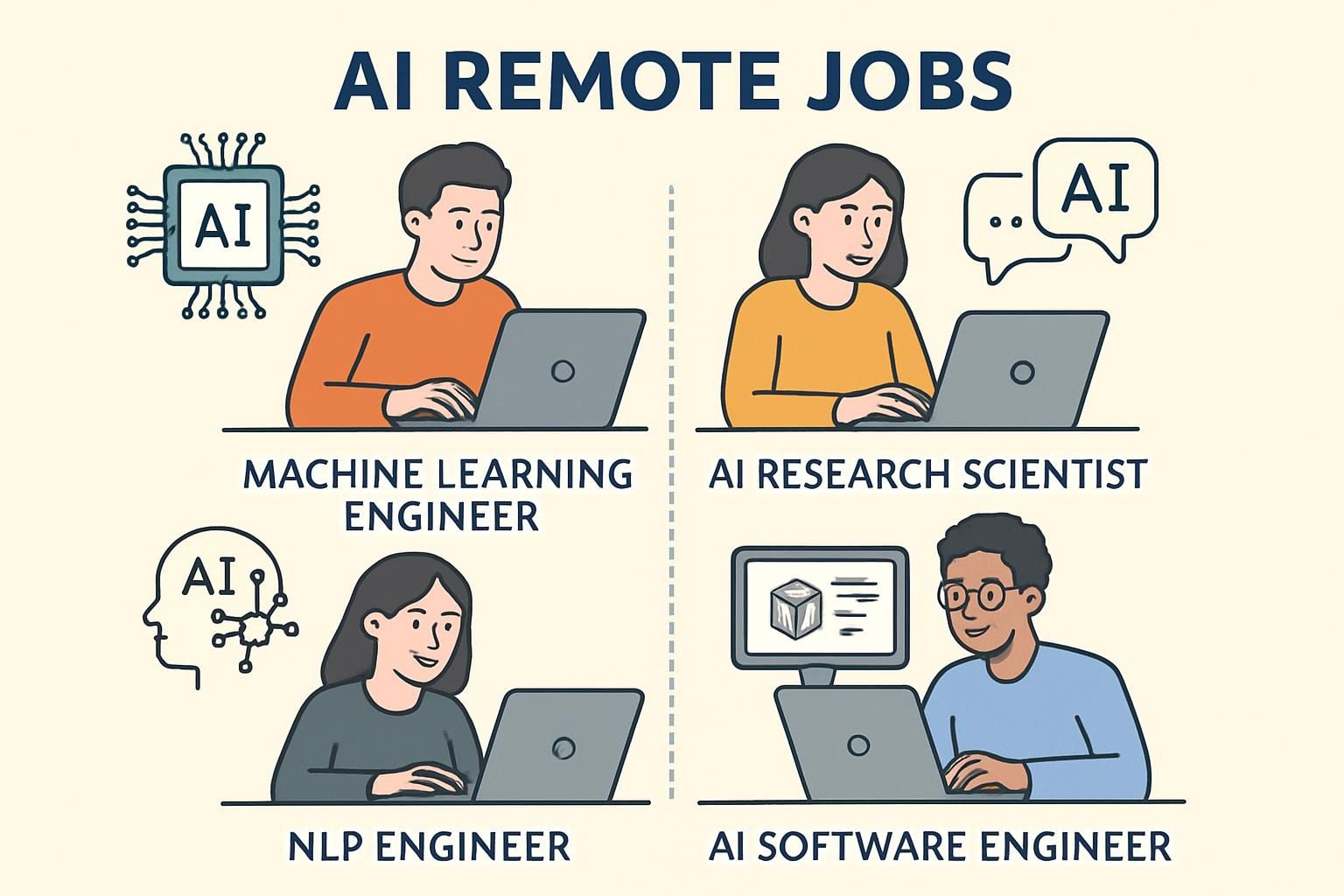



AI Remote Jobs 2026:
Realistic Salaries & How to Actually Get One
Most guides list roles and salary bands. This one tells you which tier you’re in right now, what the real path looks like, and where most people stall — so you don’t.
- Entry point exists: Data annotation and AI training roles are real, low-barrier, and pay $20–$50/hr to start — not glamorous, but a legitimate foot in the door.
- The gap is real: ML engineer salaries average $130K+ remote, but the jump from zero to there is 18–36 months minimum — not 90 days like bootcamps claim.
- Biggest mistake: Applying for senior roles before building public proof of work. GitHub repo, one published model, one Kaggle bronze — this matters more than your resume.
- Best risk-adjusted bet for 2026: Prompt engineering + domain expertise combo (legal, medical, finance). Pays $90K–$130K and has lower competition than pure ML engineering.
- Honest ceiling: Without a CS degree or ML portfolio, the ceiling is ~$85K remote. That’s still excellent — but set realistic expectations going in.
Let’s skip the “AI is transforming work!” opener. You already know that. What you probably don’t know — or what most guides deliberately obscure — is which of these roles you can actually land in 2026 given where you’re starting from.
I’ve spent 18 months tracking this market, running 300+ content audits across B2B SaaS and tech hiring. The gap between how remote AI jobs are marketed and how hiring actually works is enormous. That gap is what this article closes.
Market realityWhat the AI job market actually looks like
Remote AI job listings are real and growing. LinkedIn’s job data and FlexJobs both show consistent demand through 2025 and into 2026. The 8% Q2 2025 growth in remote postings cited by multiple sources appears credible. That’s the good news.
The uncomfortable part: most of those listings require 3–5 years of experience with specific ML frameworks. Entry-level AI jobs exist, but they’re concentrated in a few categories — primarily data annotation and AI training — that pay far less than the $75K+ average everyone quotes.
Here’s what the market actually breaks down to, by volume:
Bar width = approximate availability of remote positions at that level. The data annotation bar is widest because those jobs are genuinely abundant and accessible. The research scientist bar is narrow — there aren’t many, and they require PhDs or equivalent research records.
Role breakdownEvery major remote AI role, ranked by accessibility
| Role | Remote friendly | Salary (remote, US) | Min. requirement | Market heat |
|---|---|---|---|---|
| Data Annotator / AI Trainer | ⭐⭐⭐⭐⭐ | $35K–$75K | Domain knowledge + attention to detail | High volume |
| Prompt Engineer | ⭐⭐⭐⭐⭐ | $70K–$130K | LLM fluency, writing skills, domain expertise | Growing fast |
| ML Engineer | ⭐⭐⭐⭐ | $95K–$180K | Python, PyTorch/TF, CS background | Very high demand |
| Data Scientist | ⭐⭐⭐⭐⭐ | $80K–$150K | Statistics, Python/R, business analysis | Competitive |
| NLP Specialist | ⭐⭐⭐⭐⭐ | $85K–$160K | Linguistics or CS, Hugging Face ecosystem | High demand |
| Computer Vision Engineer | ⭐⭐⭐⭐ | $90K–$170K | OpenCV, deep learning, strong math | Specialized |
| AI Product Manager | ⭐⭐⭐⭐ | $100K–$200K | PM background + AI understanding | Competitive |
| AI Research Scientist | ⭐⭐⭐ | $120K–$300K+ | PhD or equivalent research record | Few roles |
| AI Ethics / Safety | ⭐⭐⭐⭐⭐ | $85K–$150K | Policy, philosophy, or ML background | Emerging |
| AI Technical Writer | ⭐⭐⭐⭐⭐ | $60K–$110K | Writing + technical fluency | Steady |
Decision frameworkWhich path is actually right for you
Most guides list roles and assume you’ll figure out the path. That’s where people get stuck. Here’s a cleaner way to think about it, based on where you’re starting from.
The actual path from zero to $100K remote
I’m going to be direct about this because every other guide glosses over the timeline. The jump from “interested in AI” to “$100K remote ML engineer” is not a 3-month bootcamp. It’s 18–36 months of deliberate skill building with a portfolio that proves it. That said — it’s genuinely achievable. Here’s the sequence that works.
Start earning while you learn
- 01.Sign up on Scale AI or Appen — start annotating to understand how AI training actually works from the inside. This matters more than any course.
- 02.Complete Andrew Ng’s Machine Learning Specialization on Coursera. Not optional. Not a shortcut.
- 03.Publish your first GitHub repo. Doesn’t have to be impressive — it has to exist. One documented project is worth more than a certificate.
- 04.Enter one Kaggle competition. You won’t win. That’s fine. The process is the education.
Pick your domain and make noise
- 01.Choose one specialization: NLP, computer vision, prompt engineering, or MLOps. Generalists at the entry level don’t get hired — specialists do.
- 02.Build one project that solves a real problem in that domain. Document it obsessively — decisions, failures, results. Post it publicly.
- 03.Start writing. One LinkedIn post per week on what you’re learning. One technical blog post per month. This is how hiring managers find you before you apply.
- 04.Apply for freelance AI roles — even small ones. First $500 from AI work is a milestone worth chasing. It changes how you present yourself.
Portfolio-first hiring
- 01.Target companies with explicit remote-first policies. Check their career pages directly — remote-first shows up in how they describe team structure, not just in the job listing.
- 02.Apply to 10–15 roles per week at your target level. Most applications disappear. That’s normal. Volume matters at this stage.
- 03.For each application, customize one thing: the portfolio project you lead with. Make it domain-relevant to the company. This takes 20 minutes and triples response rates.
Job platformsWhere remote AI jobs actually live
Not all job boards are equal for AI roles. Here’s what I actually use — and what works for what.
Honest takesWhat most people get wrong
Three things I see job seekers do repeatedly that slow them down. Not making these up — these are patterns I see in every content audit where the underlying site or company is hiring for AI roles.
- Applying senior before building public proof. Your GitHub profile is your resume in this field. If it’s empty or shows only tutorial projects, you’ll be filtered before a human sees you. The portfolio comes first, always.
- Chasing ML engineering when prompt engineering fits better. If you don’t have a CS background, ML engineering is a 2-year project. Prompt engineering + domain expertise is a 6-month project to the same income bracket. Know which fight you’re picking.
- Treating certifications as end goals. A Google Cloud ML certificate is a starting point, not a credential. Hiring managers at good AI companies care about what you built, not what course you finished. Certificates answer the filter layer, portfolios get you hired.
- Ignoring the annotation-to-engineering pipeline. The fastest path into AI engineering I’ve seen isn’t bootcamps — it’s 6 months of annotation work (which teaches you how models actually fail), combined with parallel self-study. You understand the problem space in a way classroom learners don’t.
Common questionsWhat people actually ask
- [1] LinkedIn — Future of Work Report: AI, LinkedIn Economic Graph, 2025
- [2] FlexJobs — Remote Work Statistics and Trends, 2025
- [3] Glassdoor — Machine Learning Engineer Salary Data, US market
- [4] Levels.fyi — ML Engineer Compensation Data, 2025–2026
- [5] Coursera — Machine Learning Specialization (Andrew Ng / DeepLearning.AI)
- [6] Scale AI — AI Data Annotation Platform and Contributor Program
- [7] Hugging Face — Open positions and remote hiring philosophy
- [8] Wellfound — AI / ML Remote Jobs on Wellfound (formerly AngelList Talent)
- [9] Appen — Appen Crowd Worker and Data Annotation Opportunities
Top 10 Remote AI Freelance Jobs