

Free AI Courses in 2026:
The Honest Truth
Nobody Tells You
Everyone publishes “Top 10” lists. Nobody asks whether the completion rate panic is real, who the data actually covers, or what actually makes people finish. Let’s fix that.
The short version (before we get into it)
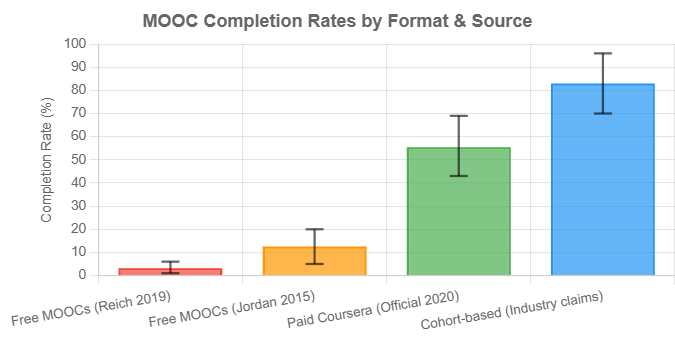
- Free self-paced MOOCs show 3–15% completion. But 52% of registrants never watch a single video — so calling it “failure” misses the point.
- Paid courses average ~55% completion — mostly because payers are already pre-selected for commitment, not because $49 rewires your brain.
- No randomized controlled trial has ever proven that payment causes completion. It’s confounded. Stop repeating the narrative.
- What actually works: week-1 deadlines, forum participation, short videos, frequent sessions — all available free.
- For 60%+ of the world, bandwidth, language, and payment infrastructure are bigger barriers than willpower.
- The best free combos in 2026: Google Generative AI Path + Elements of AI for non-coders; fast.ai + MIT 6.S191 for builders.
Here’s what bugged me about every “free AI courses” article I kept reading: they all open with the same statistic. “Only 5% of MOOC students finish their courses.” Then pivot to: “So you should pay for accountability.” Then drop an affiliate link.
That framing is lazy. And a little dishonest. I spent a few weeks digging through the actual primary research — Coursera’s internal dataset of five million enrollments, Justin Reich’s 2019 Science paper, Katy Jordan’s meta-analysis of 221 MOOCs — and what I found is more complicated, more interesting, and actually more useful than the “$49 psychology” take.
This piece is my attempt to give you the real picture.
First: The Completion Rate Numbers You Keep Seeing Are Technically True — and Completely Misleading
Free self-paced MOOCs complete at somewhere between 3% and 15% depending on the platform, the course, and the year you look. That number is real. But here’s the thing almost nobody mentions:
52% of MOOC registrants never view the first lecture. They sign up — often out of curiosity, or to bookmark for later, or because the registration was free — and then they simply never open the course. If you exclude that group and look at people who actually started, completion rates jump to roughly double the headline figure.
Think about that differently. A physical library book is “checked out” at the library and returned unread half the time. We don’t call libraries failing institutions because of that. The free barrier to entry produces a different kind of enrollment behavior than a paid one — and that’s a feature, not a bug. It means access is open.
The Selection Bias Problem Nobody Talks About
That gap between 5% and 55% looks enormous. It isn’t comparing apples to apples. It’s comparing two completely different populations of learners.
Free registration is one click. Paid enrollment means you already own a credit card, you have discretionary income, you’ve decided this is worth money, and you’ve gone through a purchase flow. You’re pre-filtered before you start. Of course your completion is higher — you self-selected for it.
“Structure beats content, but selection bias beats structure. The 10× completion gap reflects who enrolled, not what the course did to them.”
On top of that, paid Coursera enrollments include graded assignments (unavailable in free audit), official certificates, recruiter visibility, and progress tracking with real consequences. Calling “$49 = commitment psychology” misattributes a package effect to a single variable.
No published randomized controlled trial compares “free course + hard weekly deadline” vs. “paid course + flexible deadline.” Until that study exists, any claim that payment causes completion is an assumption dressed up as data. We simply don’t know which component drives the effect — the money, the graded work, the certificate, or the recruiter access.
What Actually Drives Completion — Backed by Real Data
This is the part most articles skip entirely because it doesn’t have a clean affiliate angle. Coursera analyzed ~5 million enrollments and published their findings. Here’s what their data shows moves the needle:
Source: Coursera Drivers of Quality in Online Learning, 2020 (n≈5M enrollments). All effects observational — selection bias applies.
Notice what’s on that list. None of it requires payment. Frequent short sessions, week-one momentum, posting in forums — all free. If you’re learning on Kaggle or MIT OpenCourseWare right now and you do those things, you’ll outperform the average paid Coursera learner who binge-watches once a month.
Before you pay for any course: block 30 minutes every single day for the first two weeks, post at least one question or comment in the community, and watch videos in chunks under 10 minutes. Do that and you’ve already addressed the main completion predictors — without spending a cent.
The Infrastructure Elephant in the Room
There’s a version of this debate that never gets mentioned in the US/UK publications: for a majority of the world’s potential learners, the $49 question is irrelevant because the actual obstacles are entirely different.
- 📶Bandwidth — A 720p lecture video runs 1–2 GB per course. In several African and South Asian markets, that’s 15–20% of the average monthly mobile data budget. The bottleneck isn’t motivation; it’s megabytes.
- 🌐Language — 90%+ of top-rated AI courses are English-only. Elements of AI (available in 26 languages) is a rare exception. Most learners in Latin America, Southeast Asia, and the Middle East are learning in their second or third language under cognitive load that native speakers never experience.
- 🕐Time zones — Live cohort sessions scheduled for US Eastern time exclude working-hours learners in Asia, Africa, and Oceania. “Cohort accountability” is partly a geographic privilege.
- 💳Payment infrastructure — Credit card penetration is under 10% in several large emerging markets. “Just pay $49 for accountability” isn’t advice — it’s a non-starter for a large chunk of the people most hungry for AI skills.
- 💻Hardware — Deep learning assignments often demand GPU access. Without Google Colab (which itself needs reliable bandwidth), those assignments simply aren’t completable locally.
Recommending “pay for commitment” to someone whose monthly household income is $200 and whose internet plan costs $30 isn’t pragmatic advice. It’s tone-deaf. The conversation about AI education access has to include these realities, or it’s just talking to a narrow slice of the global audience that already has most of the advantages.
The 2026 Free AI Course Shortlist (Curated Honestly)
I’ve organized this by learner type rather than platform prestige. The honest answer is: the right course for you depends on what you already know, how much time you have, and what you want to do with the knowledge. There’s no universal #1.
For Complete Beginners — No Code, No Math
Elements of AI
The most accessible conceptual introduction to AI that exists. Covers machine learning, neural networks, NLP, and societal implications — without a single line of code.
AI Essentials + Generative AI Learning Path
Google’s free modules cover generative AI basics, prompt engineering, and Gemini tools. The learning path includes 35 free Google Cloud credits monthly for hands-on labs.
AI for Everyone — Andrew Ng
Non-technical overview of what AI can and can’t do, how to build AI projects inside organizations, and what it means for your career and industry. About 10 hours total.
For Technical Learners — Code Required
Kaggle Learn (Full Path)
Free micro-courses covering Python, ML, deep learning, NLP, and more. Browser-based notebooks mean zero setup. 4–8 hours per course. This is criminally underrated.
Short Courses — RAG, Agents, Prompt Eng.
1–2 hour focused modules on RAG pipelines, AI agents, LangChain, function calling. Genuinely practical. This is where working AI practitioners go to fill specific gaps fast.
Practical Deep Learning for Coders
Code-first, top-down teaching philosophy. You build working models before you understand all the math. Controversial pedagogically — and genuinely effective for the right learner.
University-Level — Deep Technical Foundations
| Course | Institution | Time | Difficulty | Certificate | Best For |
|---|---|---|---|---|---|
| MIT 6.S191 Intro to Deep Learning |
MIT | ~20 hrs | Intermediate | No cert | Updated annually. Best free course for current DL fundamentals. Strong on transformers and generative models. |
| Stanford CS231n CNNs for Visual Recognition |
Stanford | ~40 hrs | Advanced | No cert | Classic computer vision. Some 2017 videos but core concepts are timeless. Requires linear algebra comfort. |
| Harvard CS50 AI Intro to AI with Python |
Harvard | ~30 hrs | Intermediate | Free cert (edX fee opt) | Covers search, knowledge, uncertainty, ML, neural nets, NLP. Best structured intro for people with some Python. |
| ML Specialization Stanford + DeepLearning.AI |
Stanford | 1–3 months | Beginner–Inter. | Cert = paid | Free audit available. No graded assignments on audit. Best foundational ML course if you want depth over speed. |
| CMU 11-785 Intro to Deep Learning |
CMU | ~60 hrs | Advanced | No cert | Graduate-level rigor. Free recordings and assignment outlines. Only for serious practitioners. |
The Myths vs. Reality Breakdown
“Free MOOC completion rates are proof the format doesn’t work.”
Half of registrants never open the course. Many intend to sample content, not finish. “Low completion” reflects open access behavior, not educational failure.
“Paying $49 creates the psychological commitment you need to finish.”
Paid learners also get graded assignments, certificates, and recruiter access. The completion boost is a package effect. Payment alone has never been tested in an RCT against free + deadlines.
“The best free AI courses are all on Coursera and Udemy.”
MIT, Harvard, CMU, fast.ai, Kaggle, and Elements of AI collectively cover the full spectrum of AI education — and none require payment to access core content.
“Free AI education access is mostly solved now.”
Bandwidth costs, English-only content, US-timezone scheduling, and credit card requirements exclude the majority of the world’s learners. Free URLs ≠ free access.
Which Combination Should You Actually Use in 2026?
Stop trying to find the one perfect course. The research is clear: frequent short sessions beat occasional marathon sessions. Mix and match based on your schedule and learning style.
Non-coder entering AI: Elements of AI (30 hrs conceptual) → Google AI Essentials (practical tool literacy) → AI for Everyone (strategic business context)
Developer getting into ML: Kaggle Python + ML micro-courses → fast.ai Part 1 → DeepLearning.AI short courses (specific applied gaps)
Serious practitioner wanting depth: MIT 6.S191 (current DL fundamentals) → Stanford ML Specialization audit → CMU 11-785 recordings → build a portfolio project
Low-bandwidth context: Elements of AI (text-heavy, data-light) → Kaggle Learn (cloud-hosted notebooks, no local GPU needed)
What This Analysis Cannot Claim (and Won’t)
A lot of online content in this space makes claims the data doesn’t support. For the record, here’s what remains genuinely unknown:
- ❓Payment causes completion. The causal effect has never been isolated in a controlled experiment. We have correlation, not causation.
- ❓AI-course-specific completion rates in 2025–2026. No published meta-analysis exists for AI courses specifically in this period. The best primary data is still 2019–2020.
- ❓Employment outcomes from free courses. No controlled study links MOOC completion to job placement or salary change. Testimonials ≠ evidence.
- ❓Universal “best” course. Anyone claiming there’s one best free AI course is either selling something or hasn’t thought about the diversity of learner contexts.
The Uncomfortable Honest Summary
The high-quality free AI education exists. That’s not the bottleneck anymore. Harvard, MIT, Stanford, fast.ai, Kaggle, Google — the content is sitting there, often better than what you’d pay $500 for in a bootcamp five years ago.
The real challenges are structure (which you can create yourself if you know what the data says), infrastructure (which is a policy problem, not a personal failing), and the fact that most “completion rate” discourse is designed to sell you a paid upgrade rather than help you actually learn.
If you pick one thing from this: show up for week one like your career depends on it, post in the community, keep your sessions short and daily, and don’t let the 5% headline convince you that free means futile.
It doesn’t.
Primary Sources & References
- Coursera (2020). Drivers of Quality in Online Learning — n≈5M enrollments, official platform research
- Reich & Ruipérez-Valiente (2019). The MOOC Pivot. Science — MIT / edX dataset, n≈5.6M learners
- Jordan (2015). MOOC Completion Rates Revisited. IRRODL — Meta-analysis of 221 MOOCs
- MIT 6.S191: Introduction to Deep Learning
- Stanford CS231n: CNNs for Visual Recognition
- Harvard CS50 AI: Introduction to Artificial Intelligence with Python
- Elements of AI — University of Helsinki + MinnaLearn
- Kaggle Learn — Free Micro-Courses
- fast.ai — Practical Deep Learning for Coders
- DeepLearning.AI Short Courses
Disclosure: No affiliate relationships with any platform listed. All course recommendations are independent. This analysis relies on observational data — causal claims about payment vs. completion are not supported by existing evidence.
Last Updated: May 2026 | ← More at AIEarnerHub