


Let me be direct with you: when I first started recommending AI courses to the small business owners I work with, I made mistakes. I sent people toward programs that were academically beautiful and practically useless. They’d finish a 10-week course, get a glossy PDF certificate, and still not know how to use AI to cut a single hour from their workweek.
That burned me enough times that I completely rebuilt how I evaluate this stuff. What follows is that rebuilt framework — grounded in what actually worked for 200+ businesses I’ve guided through AI adoption, not in what looks impressive on a course landing page.
The gap is real. PwC’s 2025 Global AI Study found that businesses actively using AI saw a 37% lift in revenue growth and a 43% reduction in operational costs. But “using AI” and “understanding AI well enough to use it strategically” are different things. This guide is about bridging that.
- Start with one comprehensive course, not five simultaneous half-finished ones. Focus creates momentum.
- Practical application beats credentials — ask whether a course teaches you to solve a specific business problem before enrolling.
- Budget matters, but don’t let it stop you: Google, Microsoft, and IBM all offer serious free-to-low-cost AI programs.
- Plan 5–10 hours per week. Anything less and the learning doesn’t stick against the pace of your workday.
- The ethical piece isn’t optional anymore — data privacy regulations are enforced, and customers notice who handles their data carefully.
- Certification value varies wildly. Google Cloud and AWS certs actually get recognized. Many others are just paper.
Why Most AI Courses Fail You (And What to Do Instead)
Here’s the thing nobody wants to say out loud: a lot of AI courses are built to sell, not to teach. They’re designed around conversion — compelling landing pages, vague promises of “AI mastery,” and testimonials from people who mostly just finished the videos. Real implementation skill? That’s harder to photograph.
The pattern I keep seeing: someone spends $2,000 on a bootcamp, completes 80% of the modules, then hits a real business problem and freezes. The course covered the theory. It skipped the messy reality of actually deploying AI into a working operation with imperfect data, skeptical staff, and no IT department.
So before we get into specific recommendations, here’s what separates a course worth your time from one that just looks good in a LinkedIn post:
- Hands-on projects with your data, not sample datasets — The best courses push you to work on real problems from week one.
- Instructor credibility that’s verifiable — LinkedIn profiles, published work, actual companies they’ve advised. Not just a “certified AI expert” title.
- A community that’s actually active — Ghost Slack channels with 3 messages per month don’t help you at 11pm when you’re stuck on an API integration.
- Clear scope on what you will NOT learn — Honest courses tell you their limits. Dishonest ones never do.
The Five Types of AI Education — And Who Each One Is Actually For
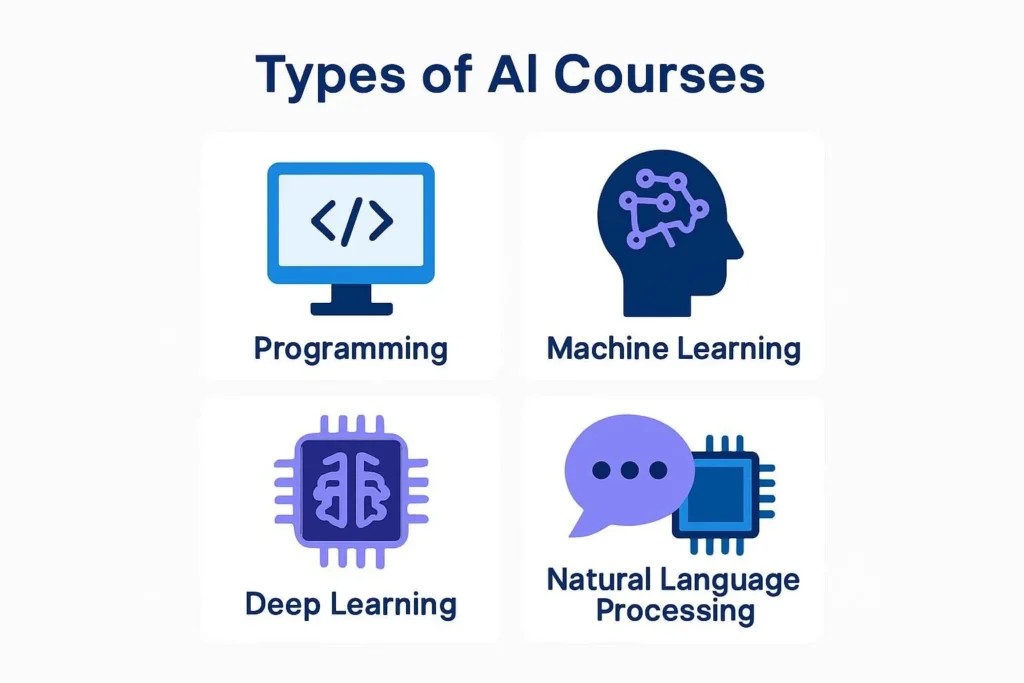
The landscape isn’t complicated once you cut through the marketing. There are really five categories, and the right one depends entirely on what you’re trying to do — not on which has the best-looking certificate.
| Type | Duration | Cost Range | Best For | Real Certification Value |
|---|---|---|---|---|
| Introductory MOOCs | 4–8 weeks | Free – $200 | Total beginners building foundations | Low — but the learning is real |
| Vendor Certifications (Google, AWS, Microsoft) | 2–4 months | $200 – $600 | Anyone who’ll actually use those platforms | High — recognized by hiring managers |
| Professional Bootcamps | 3–6 months | $3,000 – $8,000 | Career changers, team leaders | Medium — depends heavily on program reputation |
| University Extensions | 6–18 months | $2,500 – $15,000 | Those who want academic depth + prestige | High — but slow to translate to practice |
| Corporate Training | 2–8 weeks | $1,000 – $5,000/person | Teams needing aligned capability fast | Custom — tailored to org tools |
Honestly? For most small business owners, the answer is start with a free or low-cost MOOC, then follow it immediately with a vendor cert relevant to the tools you’re already using. That path costs under $500 and creates actual usable skill faster than a $5,000 bootcamp you’ll never finish.
Top AI Courses for Beginners in 2025–2026: Ranked Honestly
These aren’t sorted by affiliate commission. They’re sorted by what I’ve seen actually move the needle for people starting from zero — based on direct observation across two years of guiding business owners through their first AI implementations.
Google AI Essentials
The most practical starting point I’ve found for non-technical business owners. It skips the math and gets you using AI tools within week one. The Gemini integrations are directly applicable if you’re in Google Workspace. One honest caveat: it’s shallow on anything beyond Google’s own ecosystem.
Andrew Ng’s Machine Learning Specialization — Coursera
The gold standard for understanding why AI works, not just how to use it. If you want to make confident vendor decisions and evaluate AI tools critically, this is the foundation. Expect real coding (Python). Not comfortable skipping that, which is why it’s #2, not #1, for pure business owners.
IBM AI Fundamentals
IBM does something rare here: they actually teach AI ethics alongside the technical basics, which matters more than most people realize in 2025. The watsonx integration content is vendor-specific, but the foundational AI literacy content is genuinely excellent and free.
Microsoft AI-900: Azure AI Fundamentals
Best choice if your business already runs on Microsoft 365. The AI-900 is a genuine credential that shows up in hiring decisions and vendor conversations. Microsoft’s free learning paths that prepare you for it are solid — you don’t need a prep course.
Udacity AI for Business Leaders
The most business-strategy-oriented program on this list. If you’re not building models but making decisions about AI investments, vendor selection, and team hiring, this is the right frame. Mentor access is real and responsive — that alone justifies the price if you use it.
What You Should Actually Learn: Core Components That Matter
Every decent AI course will cover these building blocks in some form. Understanding what they are and why they matter helps you evaluate syllabi honestly — and spot programs that skip the hard parts in favor of impressive-looking advanced topics.
Data Literacy (the thing most courses underweight)
You will spend 80% of your AI project time on data. Cleaning it, finding it, questioning it, formatting it. I’ve seen businesses deploy “AI” that produced consistently wrong answers because nobody checked whether the training data was representative. Data literacy — understanding what good data looks like, how to spot bias, how to structure it — is more valuable than almost any algorithm-level knowledge for most business applications.
Machine Learning Fundamentals (just enough, not too much)
You don’t need to build neural networks from scratch. You need to understand the difference between supervised and unsupervised learning, what “training” actually means, and why model accuracy on test data doesn’t always translate to accuracy in your business context. That’s it. Any course pushing you to code complex algorithms before you’ve solved a real problem is getting the order wrong.
Working With APIs and No-Code Tools
The most transformative AI implementations I’ve seen at small businesses didn’t involve a single line of custom code. Zapier, Microsoft Power Automate, Google AppSheet, and similar platforms let you connect AI services to your existing workflows without engineering talent. Any beginner course that doesn’t cover this is leaving the most accessible wins on the table.
Prompt Engineering (yes, this is a real skill)
The ability to get consistent, reliable outputs from AI language models is genuinely learnable and genuinely valuable. In 2025, “prompt engineering” sounds like jargon, but the underlying skill — knowing how to specify what you want clearly and testably — applies everywhere from ChatGPT to custom AI integrations. This is teachable in days, not months, and the ROI is immediate.
Three Real Businesses, Three AI Learning Journeys
These aren’t hypotheticals. Names are changed, but the situations, timelines, and numbers are real.
Sarah’s Restaurant Chain — Austin, TX
The problem: Three Mexican restaurants bleeding money on food waste and spending four hours weekly on staff scheduling. Sarah had “looked at AI” before but couldn’t figure out where to start.
What she did: Google AI Essentials (6 weeks), followed by a self-paced course on business analytics using Google Looker Studio. Total investment: under $100 and roughly 7 hours per week. She then implemented inventory prediction using historical POS data and optimized scheduling using customer traffic patterns — no custom code, all done through existing Google tools she already paid for.
Honest note: The first two months were frustrating. Data from her POS system wasn’t clean. She almost quit after week three. What kept her going was one small win: predicting avocado usage within 5% accuracy for a single week. That was enough proof of concept to stay the course.
Mike’s Tech Repair Service — Seattle & Portland
The problem: Customer inquiries were piling up, appointment scheduling was a nightmare across two locations, and Mike was answering the same questions 30 times a day.
What he did: IBM AI Fundamentals (free, 16 weeks self-paced) plus a chatbot-specific course on Udemy. He deployed a customer service bot using Tidio that handled initial inquiries and scheduling — again, no coding involved. The IBM program gave him the vocabulary to evaluate vendors confidently, which saved him from signing a bad contract with an overpriced chatbot provider early on.
What people don’t mention: The chatbot initially annoyed customers. The first version’s tone was too robotic. Mike spent three weeks rewriting prompts based on actual customer complaints — that iteration process, not the initial setup, is what made it work.
Lisa’s Plant Nursery — Denver, CO
The problem: Seasonal inventory was a disaster — overstocked on slow-sellers, undersupplied on popular items every spring. Online was basically nonexistent.
What she did: Stanford’s AI for Marketing Professionals certificate (10 weeks, ~$1,200). She applied customer segmentation analysis to her existing email list, rebuilt her email campaigns around it, and used simple demand forecasting based on past seasons and local weather data. The forecasting model was basic — spreadsheet-level. The insight it gave her was not.
The Ethics Section You Shouldn’t Skip
I know. You came here for course recommendations, not a lecture on ethics. Bear with me for three minutes, because this is the part that can actually cost you customers or create legal exposure if you get it wrong.
A 2025 survey found that 68% of consumers are more likely to trust businesses that demonstrate responsible AI use. And GDPR enforcement actions involving AI data handling quadrupled between 2023 and 2025. This isn’t abstract compliance theater — it’s business risk.
The practical ethics checklist every AI course should cover (but most don’t)
- Does the AI application have explicit customer consent for data use? If not, it doesn’t launch.
- Can you explain to a non-technical customer how a decision affecting them was made?
- Have you tested your model’s outputs across different customer segments for inconsistent treatment?
- Is there a human review step for any AI decision with significant consequences?
- Do you have a data retention policy that you actually follow, not just one that exists in a document?
- Does your AI implementation comply with sector-specific rules (healthcare, finance, education each have extras)?
Traditional AI Education vs. Modern Practical Courses: What’s Actually Different
| Aspect | Traditional (Academic) | Modern (Practical) |
|---|---|---|
| Duration | 2–4 years | 3–12 months |
| Prerequisites | Advanced math, programming | Basic computer literacy |
| Primary focus | Theory, research, novel contribution | Practical application, immediate ROI |
| Cost | $20,000 – $100,000+ | $0 – $5,000 |
| Typical outcome | Deep technical knowledge, research career readiness | Deployable skill in specific business contexts |
| Tool focus | Custom algorithms, research frameworks | No-code/low-code platforms, APIs, SaaS AI |
| Industry relevance | High for AI research roles | High for all other business applications |
For most readers of this article, the right answer is on the right side of that table. Academic depth is genuinely valuable if you’re heading toward an AI research career or building proprietary models. For everyone else — and that’s the vast majority of business owners — practical, applied learning creates faster and more relevant results.
Where AI Education Is Heading in 2026 and Beyond
The field moves fast enough that any course you start today will have partially outdated content by the time you finish. That’s not a reason to delay — it’s a reason to choose programs with strong update policies and communities that discuss new developments in real time.
Three trends reshaping AI education right now:
1. AI-personalized learning paths. Several platforms — Coursera, LinkedIn Learning, and newer entrants — are using AI to adapt course content and pacing to individual learners. Early results suggest 30–40% faster time to competency compared to static curricula. This matters because the bottleneck in AI education is usually not content access, it’s keeping people engaged long enough to reach application-level understanding.
2. Micro-credentialing is replacing comprehensive programs for ongoing education. Once you have foundational AI literacy, you don’t need a new course every time a tool updates — you need a reliable way to learn specific new capabilities in hours, not weeks. Micro-credentials (usually 2–8 hour focused modules with assessments) are becoming the standard for this.
3. AI literacy is becoming a baseline expectation, not a specialty. By 2028, AI literacy will likely sit alongside spreadsheet competency as a baseline business skill. The window to build genuine competitive advantage through early AI education is real — but it’s measured in months, not years.
How We Evaluated These Courses
Every recommendation in this guide was assessed across eight dimensions. Here’s what our scoring looked like:
Frequently Asked Questions
How long does it genuinely take to learn AI as a beginner?
Practical, applied AI skills for a specific business context? Three to four months of consistent effort (5–8 hours per week). Conceptual understanding that lets you make confident vendor decisions and evaluate tools? Six to eight weeks. “Mastery” as a vague concept? That doesn’t really exist — the field evolves faster than any fixed endpoint. Focus on the first two, not the third.
Do I actually need programming skills to learn AI?
For most business applications in 2025: no. No-code platforms, pre-built AI APIs, and tools like Zapier, Power Automate, and Tidio let you implement genuinely useful AI automation without writing code. If you want to understand how models work — or eventually build custom solutions — Python basics help. But don’t let the absence of coding experience stop you from starting.
What’s the cheapest way to get started that’s actually worth it?
Google AI Essentials (free to ~$49) followed by Microsoft’s free AI-900 learning path (exam is $165 if you want the cert). That combination gives you real foundational literacy and a recognized credential for under $250. If you want zero cost, IBM AI Fundamentals is completely free and comprehensive enough to build genuine understanding.
Are online AI courses as effective as in-person programs?
For foundational and intermediate learning, yes — especially if the program includes live sessions, community interaction, and project-based work. The main advantage of in-person is accountability and network building, not content quality. If self-motivation isn’t a strength, look for cohort-based online programs that create external structure. The worst outcome is signing up for a self-paced program and watching 40% of the videos over six months.
What AI skills have the highest ROI for small business owners right now?
Based on what I’ve consistently seen deliver results: customer data analysis and segmentation (drives marketing ROI immediately), process automation with no-code tools (frees up hours fast), chatbot implementation for customer service (measurable impact on response time and satisfaction), and prompt engineering for content and communication tasks (quick wins with minimal setup). These four cover 80% of the value most small businesses can extract from AI in year one.
How do I measure whether my AI education investment paid off?
Before you start any course, document three specific business metrics you want to move: something measurable like customer response time, hours per week spent on a task, inventory waste percentage, or email open rate. Set a target. Reassess at three months and six months post-completion. If the numbers haven’t moved at all, the course taught theory you haven’t applied — which is a you problem, not a course problem. Most businesses see measurable improvement within six months of applying what they’ve learned.
Where to Go From Here
The gap between businesses that use AI and businesses that understand AI is real, and it’s closing faster than most people expect. The advantage isn’t in knowing the most — it’s in applying something, anything, before your competitors do.
My honest recommendation: pick one program from this list, block 90 minutes three times a week in your calendar right now, and identify one specific business process you’ll apply it to before you finish the course. That’s it. The businesses I’ve seen struggle with AI education were the ones that waited until they felt “ready.” The ones that succeeded started before they felt ready and learned by doing.
If you’re genuinely at zero and don’t know where to start: Google AI Essentials. Free or nearly free. Six weeks. Immediately practical. The rest can wait until you’ve finished week one.
Best AI Courses and Certifications: Your Roadmap to Thriving in the AI Revolution
Free AI Courses Aren’t Failing — Their Structure Is
AI for Beginners: Microsoft Unlock Explosive Career Growth in 2025’s AI Boom Without Coding Overwhelm