
The Multi-Vendor AI Imperative: How to Build an AI Marketplace That Doesn’t Fail
78% of enterprises deploy AI. The single-vendor model is structurally dead. Here is the four-layer architecture, sequencing framework, and failure autopsy you need before you build — not after.
- 37% of enterprises now run 5+ AI models in production. Multi-vendor isn’t a trend — it’s the baseline.
- The EU AI Act’s high-risk compliance deadline is August 2, 2026. Miss it, and you lose 6–9 months of EU enterprise pipeline. That’s not a recoverable wound.
- Build the compliance layer before the transaction layer — not concurrently. The 2024 cohort who got this backwards lost millions in frozen ARR.
- No single provider should exceed 30% of your marketplace GMV at maturity. Ever.
- The best GTM sequence: 3–5 anchor providers → 100 enterprise accounts → open the flywheel. In that order.
The Structural Shift: Why Single-Vendor Is Already Dead
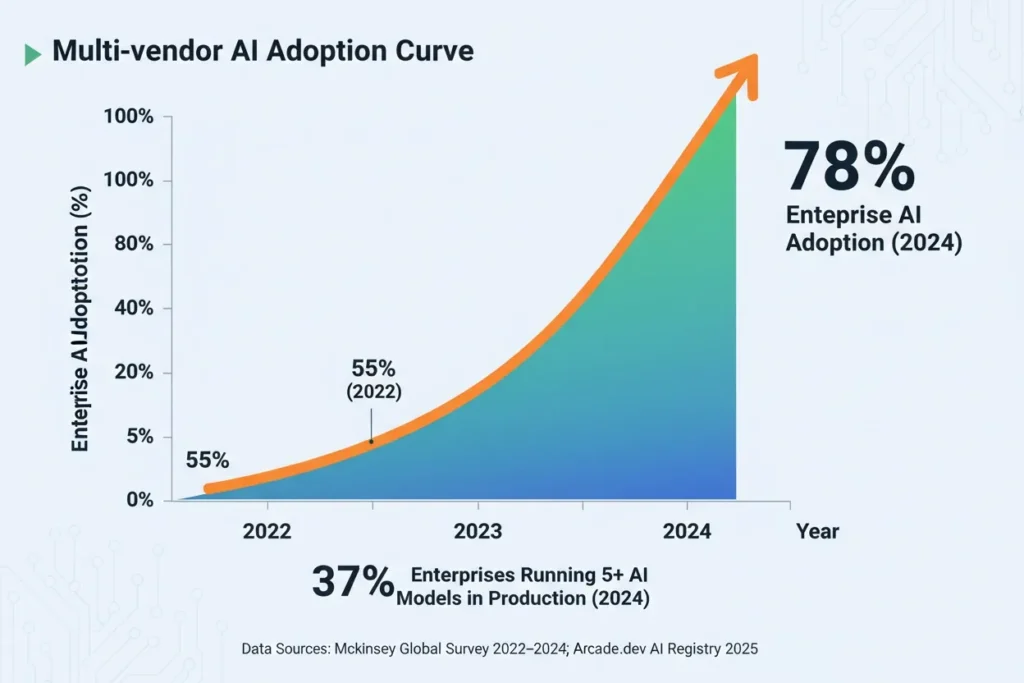
Let’s start with what the data actually says, because the narrative around AI adoption has been oddly slow to catch up to the numbers. McKinsey’s Global AI Survey tracked enterprise AI adoption going from 55% in 2022 to 78% in 2024 — a 42% increase in two years. That’s not gradual adoption. That’s a compression event.
But here’s what’s more significant than the adoption rate: how enterprises are deploying. Multi-model is the new default. 37% of enterprises now run five or more AI models in production — up from 29% previously. They’re not doing this because they’re AI-maximalists. They’re doing it because they got burned.
Enterprises that locked into single-vendor AI contracts in 2023–24 are learning something procurement teams are now codifying into policy: capability concentration creates switching costs that compound faster than the technology improves. You end up locked into a vendor’s pricing, deprecation schedule, and capability roadmap simultaneously. That’s a bad position to be in when the model that was state-of-the-art six months ago is now mid-tier.
“The single-vendor AI contract is structurally obsolete. The question isn’t whether multi-vendor wins — it’s who captures the infrastructure layer that makes it work.”
The infrastructure layer of the AI economy — the deployment, integration, and orchestration layer sitting between raw model capability and enterprise workflow — is where marketplace builders compete. And it’s currently underserved relative to the demand it’s absorbing. That gap is what makes 2026 an inflection point, not just another growth year.
Three Converging Forces Driving This Shift
1. The Multi-Variable Provider Selection Problem
Picking an AI provider used to be simple — maybe two or three real options, mostly differentiated by price. Not anymore. No single provider dominates across cost, latency, accuracy, and compliance simultaneously. AWS Bedrock alone offers 100+ models from Amazon, Anthropic, AI21, Cohere, Meta, Mistral, and Stability AI — and still doesn’t cover GPT-4 (Microsoft/Azure exclusive) or Google’s latest Gemini releases. That proliferation has made provider selection genuinely multi-dimensional in a way that enterprises can’t navigate without selection infrastructure.
2. Procurement Policy Has Shifted — Not Just Preference
Enterprise procurement teams have been burned by API deprecations, pricing changes mid-contract, and capability regressions. Vendor diversification has moved from “nice to have” to explicit procurement policy. The U.S. Office of Management and Budget now directs federal agencies to “minimize vendor lock-in and potential switching costs through contractual requirements” — including data portability, model documentation, and interoperability mandates. When the federal government writes this into policy, enterprise legal teams follow within 12–18 months.
3. Regulatory Intermediary Value Is Real Now
The compliance environment tightened in ways that most infrastructure builders didn’t predict two years ago. The EU AI Act’s August 2, 2026 enforcement deadline for high-risk systems creates structural demand for entities that can represent a curated, audited set of providers across multiple regulatory frameworks. Only 17% of AI vendors commit to full regulatory compliance — per Stanford CodeX’s analysis. That gap is enormous. And it flows to intermediaries who’ve already built the infrastructure.
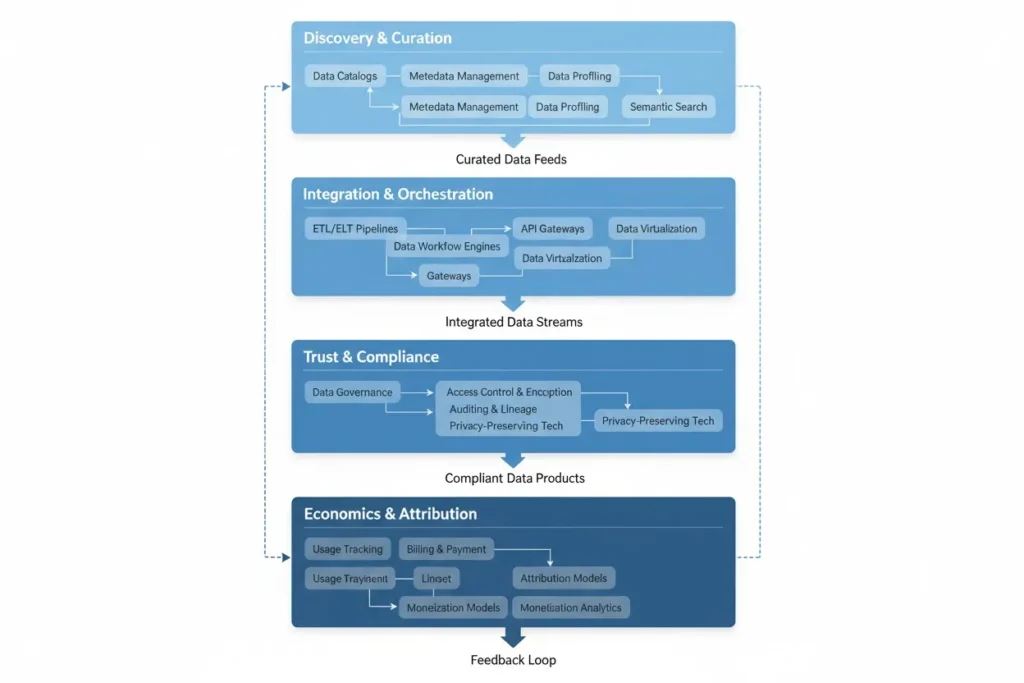
The Four-Layer Architecture (Sequence Is Everything)
The most consistent failure pattern in 2024 marketplace launches wasn’t a bad product. It was a correct product built in the wrong order. Builders who launched transaction infrastructure before trust infrastructure, or who prioritized provider acquisition before buyer experience, built platforms that worked technically and failed commercially. Every time.
Each layer below is independently deployable. Each is also a prerequisite for the one that follows. Don’t treat this as an architecture diagram. Treat it as a sequencing constraint.
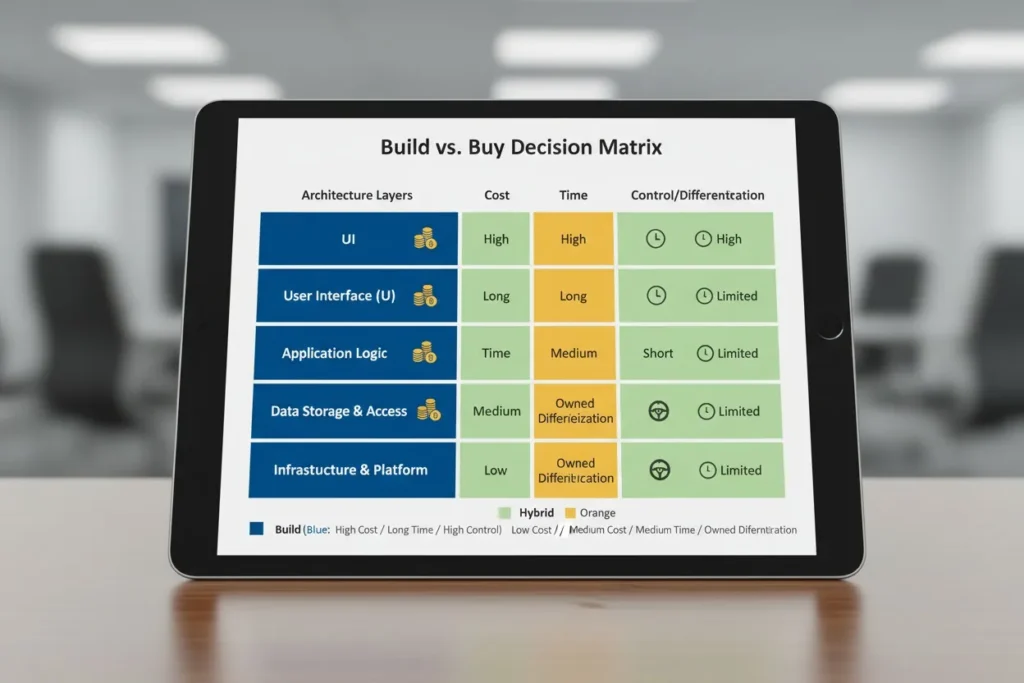
Build vs. Buy: The Decision Framework
Most enterprise marketplace builders should not build all four layers from scratch. The relevant question is which layers to own and which to license — and the answer follows directly from where differentiation lives.
| Dimension | Build In-House | Buy / License | Hybrid (Recommended) |
|---|---|---|---|
| Time to first transaction | 12–18 months | 6–10 weeks | 10–16 weeks |
| Differentiation ceiling | Full ownership | Vendor-limited | Own the moat layers |
| Total Year-1 cost | $1.0M – $1.5M | $50K – $200K | $600K – $1.4M |
| Compliance risk | High (internal audit burden) | Shared (vendor + buyer) | Defined by contract |
| Best for | Hyperscalers with existing infra | Speed-to-market priority | Most enterprise builders |
| Recommended path | License integration + trust layers. Build proprietary curation logic and economics engine. This concentrates differentiation precisely where buyers pay a premium — curation signal quality and attribution precision — while compressing timeline on the infrastructure components buyers treat as table stakes. | ||
Cost methodology: Build estimates from Rubrik/Predibase TCO analysis ($1M–$1.5M annual for in-house GenAI platform). Buy estimates from Aisera and Isometrik ($50K–$200K annual subscription). Hybrid estimates assume licensed integration/trust layers plus proprietary curation/economics development. Ranges reflect team size, region, and infrastructure scale variations.
Five Revenue Vectors: How Marketplace Economics Actually Work
Marketplace builders who model revenue as a single take rate on transactions consistently underperform those who build across multiple monetization vectors from the start. These five vectors reflect monetization patterns actively deployed by marketplace operators as of Q1 2026 — not theoretical constructs.
Go-to-Market Sequencing: The Three-Phase Launch
Sequence discipline in AI marketplace launches is not a preference — it’s the difference between a platform that compounds and one that stalls. The 2024 failures weren’t primarily product failures. They were sequencing failures: the right thing built at the right quality, in the wrong order.
- Sign 3–5 foundation model providers — not more. Selectivity signals credibility.
- Evaluation suite must be complete before first public listing.
- Secure design partners, not promotional relationships.
- Lead with compliance wrapper — eliminates the #1 enterprise objection.
- Concierge treatment for first 100 enterprise accounts. Every one of them.
- These accounts define your reputation in ways no marketing budget can revise.
- Open fine-tuning pipeline to third-party data providers.
- Launch SI/GSI partner program with ≥3 active partners before announcement.
- A partner program with no visible participants reads as aspiration, not operation.
When the 40% threshold is crossed, the flywheel is turning independently of your sales team. That’s the moment the marketplace stops being a product and starts being an asset.
What Killed the Class of 2024: Three Failure Autopsies
The 2024 cohort of AI marketplace launches was well-funded and, in several cases, technically sophisticated. The failures were instructive precisely because they weren’t naive mistakes — they were the mistakes made by builders who had read the right frameworks and still got the application wrong. Worth understanding in detail.
Three Forward Patterns Reshaping the Market in 2026
Three Concrete Actions — With Actual Deadlines
The foundational assumption worth naming directly: AI deployment is not being suppressed. The technology is already load-bearing infrastructure for energy grids, food systems, and industrial supply chains in ways that cannot be unwound by policy preference. The question for marketplace builders isn’t whether AI gets deployed. It’s whether the deployment gets managed by platforms that earn trust, or by platforms that extract from it. That distinction is where the durable commercial positions get built — and 2026 is the year it becomes legible which platforms are which.
The window: Marketplaces that reach 100 enterprise accounts before Q4 2026 will have the curation credibility, compliance infrastructure, and data flywheel that make them structurally difficult to displace. Those that don’t will be acquiring customers for a platform their larger competitors will be acquiring them for.
- McKinsey Global Survey on the State of AI, 2022–2024
- Grand View Research: AI as a Service Market Size Report
- SNS Insider: AI as a Service Market Report, 2033
- Rubrik/Predibase: Build vs. Buy GenAI Stack TCO Analysis (2024) — $1M–$1.5M annual build cost vs. $50K–$200K buy cost
- Aisera: Build vs. Buy AI Agents (2026) — $8.3M+ 3-year build TCO
- Isometrik: Build vs. Buy AI Decision Framework (2025)
- White House OMB: AI Acquisition Memorandum M-24-18 (2024)
- Modulos AI: EU AI Act High-Risk Compliance Deadline (2025)
- Stanford CodeX: Third-Party AI Risk Analysis (2025) — 17% vendor compliance commitment rate
- Censinet: HIPAA and AI Algorithm Risk (2024)
- TrackTik: Why Security Software Deals Stall at Procurement (2026) — 6–9 month procurement cycles
- Art of Procurement: State of AI in Procurement 2026
- Infosys BPM: Agentic AI in Procurement 2026 Playbook
Failure mode case studies are composites synthesizing observed patterns across multiple 2024 marketplace operators. Specific figures represent illustrative magnitudes at Series A scale. Agentic procurement growth rates are early estimates from pilot deployments; actual adoption varies by vertical. Cost ranges reflect North American market conditions; regional variations apply.
Generative AI in Banking 2026: What’s Actually Deployed, What Failed, and Why the Harvest Year Is Harder Than the Hype
AI INFRASTRUCTURE: INVESTMENT THESIS 2.0
AI Tools That Might Change the Internet More Than ChatGPT
The AI productivity paradox consists of three distinct issues.
The Top AI Companies in India: Advice That Sounds Right—But Is Quietly Holding You Back
AI Video Generation: Enterprise Deployment Trade-offs in Late 2025
Scale AI: The Complete Guide to Enterprise AI Data Transformation
88% of Companies Say They Use AI—Only 7% Actually Produce Anything With It: The $47B Governance Arbitrage of 2026