

Free AI Courses with Certificate (2026):
The Honest Map of What’s Actually Free
Most “free AI certificate” lists hide the catch. This guide tells you exactly what costs nothing, what costs $49, and which credential a hiring manager will actually recognize.
Workers with AI skills now earn a 56% wage premium over peers in identical roles without those skills — per PwC’s 2025 Global AI Jobs Barometer, drawn from close to a billion job ads across six continents. That premium doubled from 25% in a single year. The financial incentive to learn AI has never been clearer.
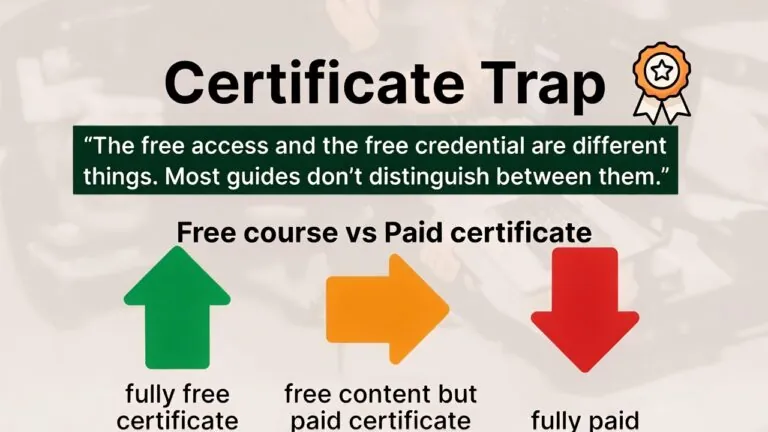
What’s murkier is the credential landscape. Search “free AI course with certificate” and you’ll get dozens of listicles recommending programs that — on closer inspection — require a Coursera subscription, a LinkedIn Learning account, or an exam fee to actually receive the certificate. Free access to the content and a free credential are two entirely different things. And most guides don’t distinguish between them.
This guide does. It maps the genuinely free courses, the ones where learning is free but the credential costs money, and the honest middle ground. Then — a question most guides completely dodge — it identifies which credentials carry real hiring weight.
The Credential Trap: Why “Free” Requires a Second Look
The dominant business model in online AI education is simple: give away the course content, charge for the verified certificate. Platforms maximize enrollment numbers with free access, then monetize through credential fees. Rational pricing — but it creates a systematic information gap for anyone searching “free AI certificate.”
Three examples from courses that appear on nearly every “free” list:
Google AI Essentials — Not free. Google’s own page states $49/month on Coursera after a seven-day trial. Most learners finish in one month, so the effective cost is $49. That’s a reasonable price for a well-designed beginner credential. It is not free.
DeepLearning.AI Short Courses — Content is free to access, but DeepLearning.AI’s documentation states certificates require a Pro subscription. Content: free. Certificate: paid.
Elements of AI (University of Helsinki) — Genuinely free. The University of Helsinki certificate is included at no cost after passing quizzes. This is the exception, not the rule.
“The free access and the free credential are different things — and most guides don’t distinguish between them.”
This matters beyond pedantic consumer accuracy. Learners optimizing for résumé value need to know whether they’ll end up with a shareable credential after investing hours of work. A course audit without a certificate is a learning experience, not a professional credential — a meaningful distinction when you’re planning career investments.
The Full Landscape: What’s Free, What’s $49, What’s Misleading
Here’s a full comparison of major free and nearly-free AI courses as of May 2026, sorted by certificate type. The “Certificate Status” column is the one most lists leave out.
| Course | Provider | Cert Status | Cert Cost | Time | Level |
|---|---|---|---|---|---|
| Elements of AI | Univ. of Helsinki / MinnaLearn | ✓ Free Cert | $0 | 20–30 hrs | Beginner |
| IBM AI Fundamentals | IBM SkillsBuild | ✓ Free Cert | $0 | Self-paced | Beginner |
| Microsoft Learn AI Paths | Microsoft | ✓ Free Badge | $0 | 3–10 hrs | Beg–Int. |
| AI & Career Empowerment | Univ. of Maryland (Smith) | ✓ Free Cert | $0 | Self-paced | Beginner |
| DeepLearning.AI Short Courses | DeepLearning.AI | ~ Content Free | Pro sub. req. | 1–2 hrs each | Int.–Adv. |
| AI for Everyone | DeepLearning.AI / Coursera | ~ Audit Free | ~$49 or aid | ~6 hrs | Beginner |
| Google AI Essentials | Google / Coursera | ✗ Paid Only | $49 | ~10 hrs | Beginner |
| edX AI Courses (audit) | MIT, Harvard, others | ✗ Paid Cert | $99–$300 | Varies | All levels |
Key: ✓ Free Cert = no payment required · ~ Content Free = learning free, credential paid · ✗ Paid = full credential requires payment. Financial aid is available on Coursera for most listed courses. Prices verified May 2026 — always confirm on the provider’s site.
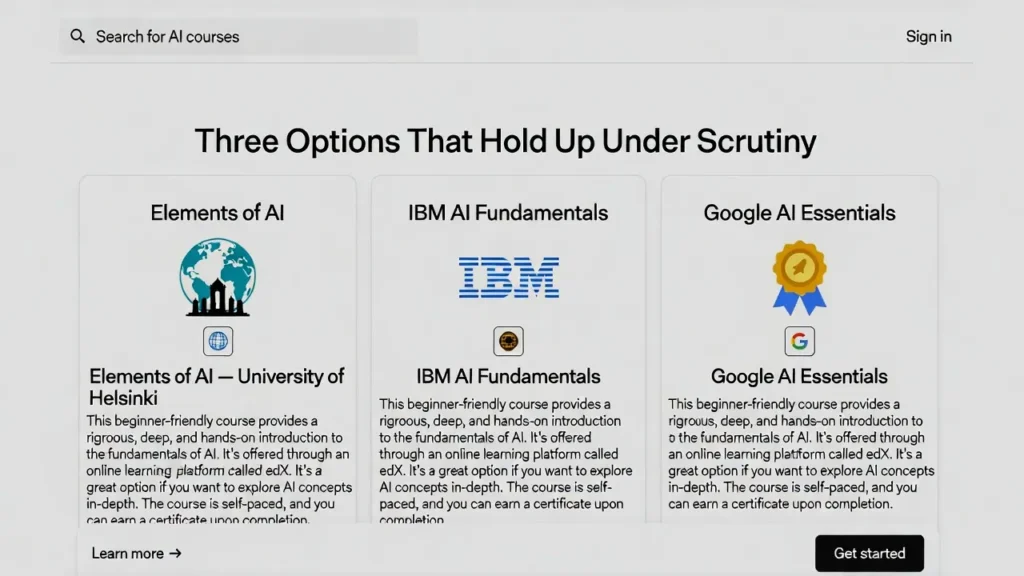
Three Courses That Hold Up Under Scrutiny
Three programs consistently deliver real value regardless of your budget. Here’s an honest breakdown of what each one gives you — and what it doesn’t.
Elements of AI — The Best Pure Free Option
Built by MinnaLearn and the University of Helsinki with a clear mission: make AI literacy accessible worldwide, across languages, without requiring a CS background. The course has reached over one million students globally — a platform-reported figure, though no independent audit is available.
The honest tradeoff: this is deliberately conceptual. It won’t teach you to build anything. For a manager, policy analyst, or journalist who needs to understand what AI can and cannot do well enough to participate in decisions at work, it’s excellent. For someone who wants to demonstrate applied technical skill to an employer, it’s the start of a curriculum — not the end of one.
The University of Helsinki certificate is verifiable and carries real academic legitimacy. It costs $0. If you’re completely new to AI and can’t spend $49, start here.
IBM AI Fundamentals — The Best Verifiable Free Badge
The key distinction here is verifiability. IBM’s badge goes through Credly — recruiters can click a link to confirm the credential. That separates it from PDF certificates that can’t be validated. In larger enterprise hiring processes, that verification step actually matters.
IBM’s enterprise alignment is an advantage if you’re targeting roles at large organizations. No prior technical experience required. The certificate is genuinely free, no strings attached.
Google AI Essentials — The Case For Paying $49
Let me be direct about what this is and isn’t. Google AI Essentials is not free. But $49 for a 10-hour course with a Google-branded certificate is still a remarkably good deal in the professional development market.
The consistent critique from reviewers: it’s beginner-level by design, and the examples stay vague. A reviewer who completed it in five hours noted the material rarely specifies the actual tools or mechanisms behind what it describes. If you already use ChatGPT or Gemini regularly, some sections may feel familiar. The credential’s value is the Google brand on your résumé, not technical depth — and for many job seekers, that’s a completely rational investment. Just don’t call it free.
Which Certificate Actually Matters to Employers
Most free-course guides skip this entirely. They list courses without addressing what actually happens when a hiring manager sees one of these certificates on a résumé.
The honest answer: no free or low-cost AI certificate substitutes for demonstrated project work in technical hiring. A January 2026 analysis by Nucamp found that employers prioritize demonstrable projects, code, and deployed demos over certificates — noting that free programs from CS50, fast.ai, and DeepLearning.AI can be sufficient groundwork, but the portfolio is what earns interviews. Certificates are a signal, not proof.
That said, signal matters differently depending on role type.
Marketing, Ops, PM
Engineer, Data Scientist
Framework drawn from Nucamp (Jan. 2026), The Interview Guys (Feb. 2026), and PwC’s 2025 Global AI Jobs Barometer. Reflects general patterns — not universal employer behavior. Your specific industry and company size matter more than any list.
DeepLearning.AI: The Content Is Exceptional — Understand What You’re Getting
Andrew Ng’s DeepLearning.AI platform occupies an unusual position in this landscape. Its short courses — typically one to two hours each — cover topics that university curricula genuinely haven’t caught up to: agentic workflows, fine-tuning large language models, real-time voice agent construction, retrieval-augmented generation. Nucamp’s January 2026 analysis describes these as averaging approximately 4.9/5 from practicing developers, noting the platform “tends to move in sync with what practitioners actually need.” The platform has reported more than 7 million learners (self-reported; no independent audit found).
The catch is structural. DeepLearning.AI’s own documentation confirms that a Pro subscription is required to receive a certificate. Short courses are free to access and complete; certificate access is paid. For engineers building skills rather than résumé signals, this is a great deal. For someone who needs a verifiable credential for a job application or promotion, the subscription cost is an additional consideration.
The practical framework: Use DeepLearning.AI to build the skills. Use Elements of AI, IBM SkillsBuild, or Google AI Essentials to earn the certificate. Neither fully substitutes for the other — the short courses teach you to build; the certificate programs teach you to explain and signal credibly.
Where This Market Is Heading (2026–2027)
Two structural forces are reshaping the free AI education market in ways that will change these calculations within the next 12–24 months.
Degree requirements are declining
PwC’s 2025 Barometer found the proportion of AI-augmented job postings requiring a formal degree dropped from 66% to 59% between 2019 and 2024. That’s a seven-percentage-point shift in five years. As degree requirements fall, the relative importance of practical demonstrated skill and micro-credentials increases — making the gap between “audit with no cert” and “cert with no project work” more consequential. Neither extreme serves the learner well when employers are sorting on demonstrated capability.
AI skills are changing 66% faster than in other occupations
That’s up from 25% the prior year. This acceleration means any single certificate has a shorter shelf life than credentials in stable fields. A one-time AI certificate is not permanent currency — it depreciates faster than you’d expect. The implication: continuous learning paths (platforms like DeepLearning.AI that ship new short courses as technology evolves) are structurally more valuable than fixed one-time credentials, even without certificates.
Microsoft’s Applied Skills model is worth watching
Microsoft’s ongoing expansion of its Applied Skills micro-credential system — including the free AI Challenge credentials offered through early 2026 — pushes toward scenario-based proof of capability rather than knowledge quizzes. If this model gains hiring-manager recognition, it could shift the credential landscape toward verifiable demonstrated skills rather than course completion certificates. That’s a fundamentally different signal structure. As of this writing, no independent study has measured whether Microsoft Applied Skills credentials are broadly recognized in hiring; that data will accumulate over the next year or two.
Your 3-Step Plan: What to Do With This Information
The 56% wage premium for AI skills is real and growing. The path to capturing it runs through demonstrated ability, not certificate collection. Here’s the optimal sequence for most learners:
Get a genuinely free certificate first
Establish baseline fluency and a shareable credential at no cost. Elements of AI for non-technical learners. IBM SkillsBuild for those targeting enterprise roles. University of Maryland Smith School if you’re a career changer targeting business roles. These cost nothing and produce something verifiable.
Layer in DeepLearning.AI short courses for applied skills
Content is free. Certificate is not. Treat these as skill-building, not credential-collecting. Pick the short courses most relevant to your specific role — agentic workflows, RAG, fine-tuning, or prompt engineering. One or two hours each, and they’re consistently excellent.
Build one project and document it publicly
Deploy something small — an API integration, a prompt engineering workflow, a simple automation. Document it on GitHub or a personal site. This is what separates candidates who understand AI from candidates who can prove it. No certificate does this work for you.
- PwC (June 2025). 2025 Global AI Jobs Barometer. Analysis of close to one billion job ads across six continents.
- Google (2026). Google AI Essentials — pricing and program details. Official platform page, verified May 2026.
- DeepLearning.AI Community Forum (September 2025). How do certificates and accomplishments work. Official FAQ.
- IBM SkillsBuild. Artificial Intelligence Fundamentals. Program page, verified May 2026.
- University of Helsinki / MinnaLearn. Elements of AI. Program page, verified May 2026.
- Credly. IBM AI Fundamentals digital badge. Credential verification page.
- University of Maryland, Smith School. Free AI and Career Empowerment Certificate.
- Microsoft Learn. Microsoft Applied Skills & Credentials. Verified May 2026.
- Nucamp (January 2026). Best Free AI Courses and Learning Resources in 2026.
- The Interview Guys (February 2026). Google AI Essentials Review 2026.
Learner counts noted as platform self-reported where no independent audit was found. Certificate status verified against official platform documentation as of May 2026; pricing and policies change — always confirm before enrolling.