AI Search Optimization Tools:
Rank or Be Cited?
The Wrong Question.
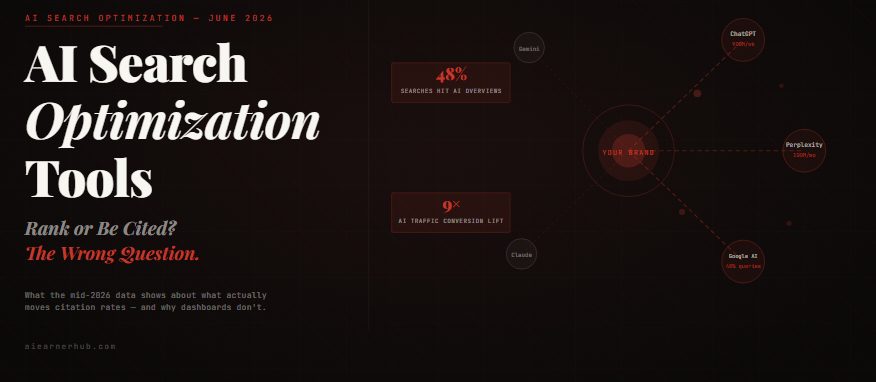
The tools marketed as “AI SEO” are solving two different problems at once — and conflating them costs you strategy clarity and budget. Here is the operational difference, and what the mid-2026 data actually shows about what moves the needle.
The Definition Everyone Uses Is Marketing Copy
“AI Search Optimization” is typically defined as the practice of improving your content so AI assistants surface it higher in their answers. That is the vendor definition — written by people selling subscription dashboards. The operational definition is messier and considerably more useful: it is the practice of getting your content into the retrieval pool that AI systems draw from when they construct answers, at the moment a user’s question matches something you wrote.
The distinction matters because the two definitions prescribe opposite strategies. Vendor definition → buy a monitoring tool, track your “AI share of voice,” optimize toward brand mentions. Operational definition → fix your robots.txt, restructure your content for extraction, build multi-source corroboration so AI systems trust your claims. You can do the second without spending a dollar on software. You cannot do the first without spending a dollar on software and still accomplish the second.
Most “AI SEO tools” are measurement tools, not optimization tools. They tell you where you stand. They do not move you. Knowing your AI citation rate has gone from 2% to 4% is worth something. But the thing that moved it from 2% to 4% was a content decision made in a text editor, not a dashboard.
The Number That Changes Everything: 17%
At mid-2025, about 75% of pages that ranked in Google’s top 10 for a query also appeared as cited sources in the AI Overview for that query. That overlap gave traditional SEO a de facto pass into AI — rank well, get cited almost automatically.
By early 2026, that number had dropped to somewhere between 17% and 38% depending on which study you believe. The Mersel AI analysis puts the floor at 17%; others are more generous. Even using the generous number, less than half of top-10-ranked pages are AI-cited for the same query. That is not a rounding error — it is a structural decoupling. Ranking and being cited are now distinct outcomes requiring distinct inputs.
What caused the decoupling? Google’s AI Overview and AI Mode pull from a different retrieval logic than PageRank. They weight structural clarity (can the answer be extracted in a passage?), entity corroboration (is this claim supported across multiple trusted sources?), and freshness (is there a 2026 data point or is the page citing 2022 figures?). A page at position 4 with well-structured answer capsules in its H2 sections will outperform a position 1 page written as flowing editorial prose with no extractable units.
You Can Measure AI Visibility in a Weekend. The Harder Problem Is Knowing What to Do on Monday.
Every GEO platform will tell you your “share of voice” across ChatGPT, Perplexity, Gemini, and Google AI Overviews. Profound captures actual front-end user interactions across ten AI engines and reportedly backed by $35M from Sequoia. Evertune offers base-model API access with statistical rigor around source influence analytics. Otterly starts at $39/month and covers the basics. They all, in some form, tell you the same thing: here is what percentage of relevant AI responses include a mention of your brand.
What none of them do — and what the category cannot do by definition — is automatically fix the content gap that’s causing low citation rates. That gap is always one of five structural problems:
The diagnostic question — which of these five is your problem — takes two hours to answer without a paid tool. Check your server logs for GPTBot. Read the first 60 words under each H2. Look at your sitemap’s last-modified dates. Run a schema validator. A $39/month citation tracker will not answer these questions faster than your own eyes on the HTML source.
I’m not arguing against measurement tools. Profound and Evertune solve real problems at enterprise scale where you cannot manually sample 50 AI queries daily across 10 AI engines. The error is buying the tool before diagnosing the structural problem — because the tool score will improve once you fix the structural problem, not the other way around.
The Real Tool Stack for AI Visibility — What Each Actually Does
| Tool | Category | What it actually does | Pricing (mid-2026) | Honest caveat |
|---|---|---|---|---|
| Profound | Measurement | Real user interaction data across 10+ AI engines including ChatGPT, Perplexity, Google AI Mode, Gemini, Copilot. Includes 400M+ prompt dataset and AI crawler analytics. | Enterprise (custom) | Overkill for sites under 500K monthly sessions. The data depth is real; the price requires a clear ROI model. |
| Evertune | Measurement | Unlimited competitor tracking, base model API access, source influence analytics. Strong statistical rigor — shows which sources AI pulls from, not just whether you’re mentioned. | Enterprise (custom) | Best in class for competitive intelligence. Still a measurement tool, not an optimization engine. |
| SE Visible | Measurement | Tracks brand presence in AI responses with sentiment tagging. Pitched at mid-market. | Mid-market tiers | Newer platform — data breadth still developing compared to Profound. |
| Otterly | Monitoring | Entry-level AI citation monitoring across core AI engines. Gets you the basic signal without enterprise complexity. | From $39/month | Good starting point. Does not have Profound’s prompt-volume data. Enough to justify or refute GEO investment. |
| Semrush / Ahrefs | Traditional SEO | Both added AI Overview tracking modules in 2025. Semrush’s AI Overview position tracking is now reasonably mature. | Existing subscriptions | Good for Google AI Overview specifically. Not designed for ChatGPT/Perplexity citation tracking. |
| Schema validators (Google Rich Results, Schema.org) | Optimization | Free. Confirms your structured data is parseable. AI crawlers consume JSON-LD before flowing content. | Free | Most impactful free action. Still skipped by 60%+ of sites that claim to care about AI visibility. |
| Cloudflare AI Crawl Metrics | Technical audit | Shows which AI bots are hitting your site, at what rate, and whether they’re being blocked. Critical if you’re on Cloudflare (which changed its default AI-blocking config in 2025). | Free (Cloudflare dashboard) | Non-negotiable first step for any Cloudflare user before buying any GEO tool. |
One thing not in that table: I no longer recommend buying any standalone “AI content optimizer” that promises to rewrite your pages for AI retrieval. I tried two of them on client content in Q4 2025. The output was structurally correct — answer capsules at the top, question-format headings — but the writing was audibly mechanical. AI systems did not preferentially cite the rewritten versions because the rewritten versions had lost the specificity that made the original content trustworthy. Bland extraction-optimized prose is a trap.
ChatGPT and Perplexity Operate Differently. So Does the Optimization.
Most articles on this topic treat AI engines as a monolith. They are not. The citation mechanics differ enough that a single content strategy fails one of them.
Practically: a brand that exists only on its own website with no Reddit presence, no independent press coverage, and no LinkedIn mentions will struggle with ChatGPT citations regardless of how well-structured its pages are. The model builds answers from consensus — if you are only mentioned in sources you control, that is not consensus. A Series A fintech startup in the data cited by Mersel AI grew AI citation share from 2.4% to 12.9% in 92 days. The tactic was not technical. They launched a community presence strategy on relevant forums and got three independent editorial pieces written about their methodology. Their pages did not change.
Perplexity is the opposite case. Clean HTML, visible publish dates, structured data, fast server response times, and content that answers the specific sub-query — these matter more than off-site mentions for Perplexity because it performs real-time retrieval before constructing each answer. A page published three weeks ago with a clear answer capsule can outrank a Wikipedia-level authority page if it directly addresses the user’s question fragment. Getting cited in Perplexity requires passing two gates: source selection (your page appears in retrieval) and answer absorption (Perplexity uses your content in the actual answer). Most brands that fail Perplexity citations fail the first gate — their page is retrievable in theory and invisible in practice because the answer is buried 800 words in.
When a user asks ChatGPT or Perplexity a complex question, the AI breaks it into smaller sub-queries and searches for each separately. “Best email marketing platform for a small e-commerce store under 10,000 subscribers” might decompose into “email marketing platforms 2026,” “email marketing e-commerce features,” and “email marketing pricing small business.” You need content that ranks for each fragment — not just the full query. Most content strategies target the parent question and ignore the component sub-queries entirely. That is why pages rank for a category term but never appear in AI answers about that category.
The Sequence That Actually Matters — Before Any Tool Purchase
This is not a “10-step framework.” It is four checks, in order, that determine whether you have a structural problem or a content problem. Structural problems require zero-dollar fixes. Content problems require writing, not software.
Check 1: Can AI crawlers reach you?
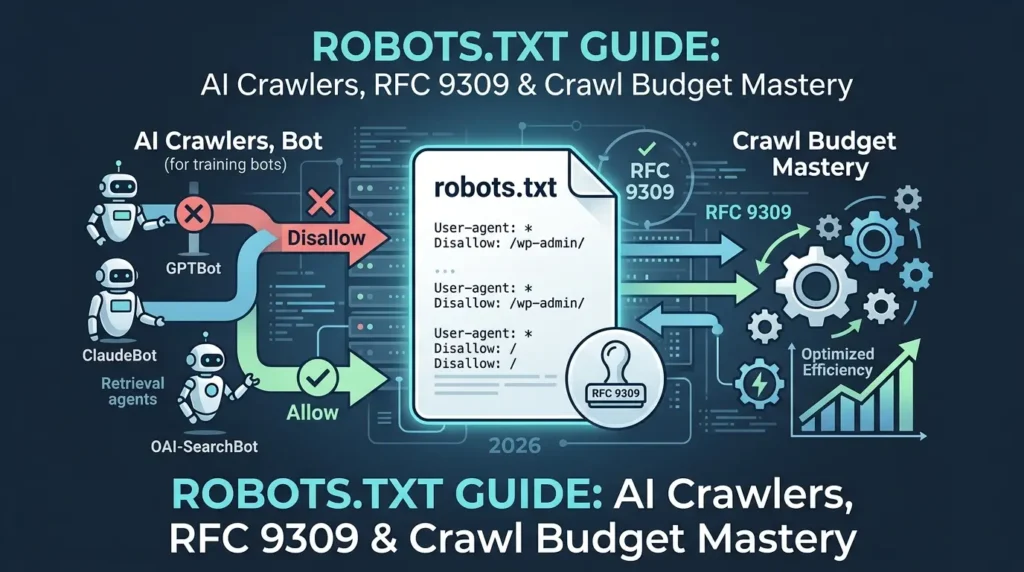
Open your robots.txt. Look for User-agent lines that mention GPTBot, ChatGPT-User, ClaudeBot, PerplexityBot, or Google-Extended. If you are on Cloudflare, open the AI Crawl Metrics page in your dashboard — Cloudflare changed its default configuration in 2025 to block AI bots, meaning a large number of sites on Cloudflare are currently invisible to AI crawlers without any conscious decision having been made. This single issue accounts for a substantial fraction of low AI citation complaints I’ve seen — pages with excellent structure that simply aren’t being fetched.
Check 2: Is your content extractable?
Read the first 60 words under each H2. They should answer the section’s implied question standalone — without requiring the reader (or AI) to continue reading. If those 60 words are scene-setting or transitional prose, that section will not be cited. The AI crawlers extract the opening passage of each section. If the opening passage contains no informational payload, the rest of the section’s content is irrelevant to citation probability.
Check 3: Do your data points have timestamps?
Every statistic in a content piece competing for AI citations needs a visible publication year or at minimum a “as of [period]” qualifier. A sentence reading “60% of searches end without a click” will be selected over “a majority of searches end without a click” because AI systems can evaluate the specificity and currency of the first and cannot evaluate the second. If your most cited statistics are from 2022, they will lose to a 2026 competitor claiming the same ground even if your domain authority is 20 points higher.
Check 4: Is your claim corroborated elsewhere?
Search your company name or key claims in ChatGPT and Perplexity with a fresh session. Count how many independent sources (sources you do not own) mention you or your data in the top results. If the answer is zero, ChatGPT will not build consensus around you. The fix is not buying a PR firm — it is getting genuinely interesting proprietary data into the world and making it easy for journalists, bloggers, and forum participants to reference it with attribution.
Allowing AI Crawlers Means Allowing Training Data Extraction
This is the part of AI visibility strategy that produces genuine disagreement, and I have not seen a satisfying resolution to it. To be cited by AI systems, you must allow their crawlers to access your content. Allowing those crawlers means your content may be ingested into training datasets. For news publishers and high-value proprietary research, this trade-off is genuinely uncomfortable — and the Reuters Institute documented a 33% decline in Google traffic to 2,500+ publisher sites between November 2024 and November 2025, partly attributable to this dynamic.
The options are not clean. Block AI crawlers → zero AI citations, zero training data extraction. Allow all AI crawlers → maximum citation potential, maximum training exposure. Allow selective crawlers → partial citation coverage, partial exposure. There is no configuration that maximizes citations while eliminating training exposure, because the same crawlers that perform retrieval for answers also perform training data collection.
The practical resolution most publishers with proprietary data are landing on: allow retrieval crawlers for real-time AI search (Perplexity’s crawler, Google’s Googlebot including AI Mode) while blocking training crawlers more aggressively. The problem is that user-agent identification is imperfect and crawlers do not always accurately represent their purpose. This is a live controversy without a settled answer as of mid-2026. Anyone claiming otherwise is either oversimplifying or selling you something.
AI Referral Traffic Converts at 15.9%. That Is the Actual Case for All of This.
Everything above is operational logic. Here is why it matters commercially. According to Seer Interactive’s analysis, ChatGPT referral traffic converts at 15.9% versus 1.76% for standard Google organic search — roughly 9x. Perplexity referral traffic converts at approximately 10.5%. The reason is mechanical: by the time a user clicks from an AI answer to your website, they have already consumed a synthesized research session inside the AI interface. They arrive with specific intent and a working understanding of the category. They are not beginning their research. They are finishing it.
This reframes the traffic-loss conversation. Yes, AI Overviews are cutting organic clicks — Pew Research found users click 8% of the time with an AI Overview present versus 15% without one, a 46.7% relative decline. Ahrefs measured a 34.5% CTR drop for position-1 rankings across 300,000 keywords when AI Overviews appear. Those numbers are real and the decline is structural, not cyclical.
But the visitors who do arrive are converting. Sites that earn AI citations — appearing inside the answer rather than below it — can see CTR increases of up to 35% for those pages, because being the cited source is a visible authority signal. A brand mentioned in AI responses experiences 91% higher paid CTR — a halo effect that extends to their entire advertising footprint. The analysis tool you need first is not a citation tracker. It is your own analytics, segmented by referral source, filtered for perplexity.ai and chat.openai.com, with a conversion rate column. If you are already getting AI referral traffic, the case for investment in optimization pays itself through that number before you model anything else.
For more on building AI-optimized content strategies, the AI Earner Hub resource library covers practical implementation across content, tools, and monetization approaches.
Everything written here will be partially outdated by Q4 2026. Google’s AI Mode is expanding to 200+ countries. ChatGPT’s retrieval mechanics update faster than any optimization guide can track. Perplexity’s source-selection algorithm has changed meaningfully at least twice since early 2025.
The one thing that will not change: AI systems favor content written by someone who actually understands the topic over content written by someone who understands citation mechanics. The extractable-answer-capsule technique works until AI systems get better at inferring intent from flowing prose — which they are already doing. The durable competitive advantage is having something true and specific to say, said in a form that is easy to verify. Every optimization technique in this piece is a temporary advantage layered on top of that. If you start with the technique and skip the substance, the advantage disappears on the next model update. If you start with the substance, the technique is a two-hour project, not a quarterly strategy.