
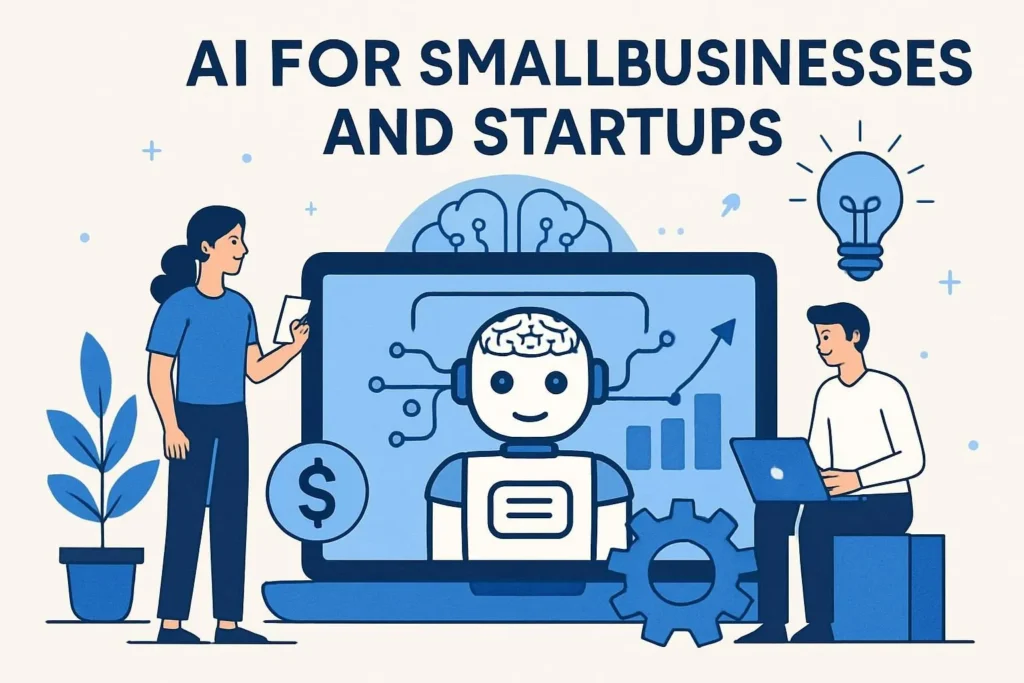
AI for Small Businesses:
What’s Actually Working in 2025
63% of small businesses now use AI daily. The gap between early adopters and laggards is widening fast. Here’s the no-fluff playbook — what tools work, what the ROI really looks like, and how to start without burning time or money.
daily in 2026
performance gains
YoY vs non-adopters
(up from 40% in 2024)
⚡ TL;DR — What you need to know right now
- AI adoption among small businesses hit 63% in early 2026 — a 127% jump from 2023. The 2025 inflection point is real.
- Small businesses are now closing the gap with large enterprises. In early 2024, large firms used AI at 1.8× the rate of SMBs. By mid-2025, small businesses were actually growing faster.
- 83% of small businesses that adopted AI report measurable performance gains — mostly from productivity and automation, not from cutting jobs.
- The businesses winning are not the ones with the most tools. They’re the ones with the cleanest data and the clearest starting point.
- Top use cases: marketing automation (53%), sales workflows (49%), and customer support (46%).
- Biggest risk isn’t cost. It’s starting with 10 tools instead of one, and data that isn’t AI-ready.
- In 2026, agentic AI — systems that act on goals autonomously — is the next frontier. Now’s the time to build the foundation.
In this guide
What Does “AI for Small Business” Actually Mean in 2025?
Let’s skip the 1950s history lesson. You’ve read it a hundred times. What you actually need to know is this: in 2025, “AI for small businesses” means cloud-based software you can start using this afternoon — no data scientists, no enterprise budgets, no IT department.
It means ChatGPT drafting your customer emails at 2am. It means Zapier triggering automated workflows when a new order comes in. It means a chatbot on your website that handles the same 40 questions customers ask every week — so you don’t have to.
The difference from three years ago? The tools stopped requiring you to be technical. A food truck owner in Austin can now use AI in Google Sheets to plan weekly inventory. A one-person branding studio can have Gemini draft 20 client proposals in the time it used to take to write one.
Create content, write copy, draft emails
Tools like ChatGPT, Claude, and Gemini. Great starting point. Takes 20 minutes to get real value.
Connect tools, trigger workflows, save hours
Zapier, Make.com. Handles the repetitive glue between your apps — no coding required.
Turn your data into decisions
Tableau Pulse, Google Analytics 4. Spots patterns you’d miss manually. Forecasts demand.
Chatbots, support agents, sales assistants
Tidio, Freshdesk Freddy. Handles tier-1 customer queries 24/7. Customers often can’t tell the difference.
Visuals, videos, branded assets
Canva Magic Studio, Adobe Firefly. Turns a text prompt into a professional-looking social post in 30 seconds.
Invoicing, forecasting, expense tracking
QuickBooks AI, Sage. Categorizes transactions automatically, flags anomalies, forecasts cash flow.
The Numbers Nobody’s Disputing Anymore
The debate about whether AI is hype is over for small businesses. The adoption curve is one of the fastest in business technology history — faster than broadband, faster than mobile. Here’s what the most credible sources are actually showing in 2026.
Sources: BizBuySell Insight Report 2026, U.S. Chamber of Commerce 2025, SBA Office of Advocacy
The 2025 startup cohort reached 10% AI adoption in just 6 months. The 2019 cohort took over 6 years to hit the same milestone.
A few numbers worth sitting with. The Federal Reserve’s own analysis found that by end of 2025, about 18% of U.S. firms had formally adopted AI into business functions — and over 78% of the entire U.S. labor force now works at a company that has adopted AI in some form.
The U.S. Chamber of Commerce put generative AI adoption among small businesses at 58% in 2025, up from 40% in 2024. That’s not a rounding error — that’s a structural shift. And per the BizBuySell 2026 Insight Report, 63% now report daily use.
The part most people miss: the smallest firms are moving fastest. The SBA found that businesses with 1–4 employees now show the second-highest AI adoption rate in recent Census data. Solo operators aren’t waiting. They can’t afford to — AI is letting them do the work of three people.
| Data Source | Finding | Date |
|---|---|---|
| BizBuySell Insight Report | 63% of small businesses use AI; 83% report measurable gains; Q1 2025 was the inflection | 2026 |
| U.S. Chamber of Commerce | 58% use generative AI (up from 40% in 2024); 96% plan to adopt emerging tech | 2025 |
| Federal Reserve (FEDS Notes) | 18% of firms adopted AI formally; 78% of U.S. workforce at AI-adopting firms | Apr 2026 |
| SBA Office of Advocacy | Small-large firm gap closing fast; micro-firms show second-highest adoption rate | Sep 2025 |
| JP Morgan Chase Institute | 2025 startup cohort reached 10% adoption in 6 months vs 6+ years for 2019 cohort | Apr 2026 |
| Intuit & ICIC | 89% of small businesses leveraging AI, especially for repeatable task automation | 2026 |
| Capsule CRM / Forbes | 91% of SMBs using AI report revenue boosts; AI adopters 2× more likely to show YoY growth | 2025–2026 |
Why This Moment Specifically Matters
Here’s something the strategy consultants won’t tell you directly: the biggest competitive advantage in AI doesn’t go to the company with the biggest budget. It goes to the one that moves early enough to build data and process habits before the tools become commoditized.
We’re right at that window. The tools are cheap (many are free). The learning curve is shorter than it’s ever been. And most of your direct competitors — especially if you’re in a local market — haven’t started yet.
of SMBs using AI believe it’s now common among their peers. Only one-third of non-users agree. If you’re not using it, you’re probably underestimating how quickly the gap is widening.
The economic case is simple. Productivity is the primary driver — 78% of adopters cite this as the main reason. Automation follows at 56%, with a 94% increase in automation-focused use over just two years. The businesses that started in 2023–2024 now have two years of refined prompts, cleaner data, and trained workflows. Starting cold in 2026 isn’t impossible. Just harder.
Also worth knowing: only 8% of businesses that adopted AI report any job reduction. The dominant effect is augmentation — people doing more with the same hours. The food truck that used AI for scheduling expanded to more locations. The branding agency that automated client proposals took on 40% more clients. The pattern repeats across industries.
Where AI Is Actually Delivering for Small Businesses
Not all AI use cases are equal. Some sound exciting in a pitch deck and deliver almost nothing in practice. Others are boring, invisible, and save you two hours a day. Let’s separate the real wins from the noise.
Marketing & Content (the biggest unlock for most SMBs)
This is where most small businesses start, and for good reason — the time savings are immediate. AI-generated first drafts for emails, social posts, product descriptions, and ad copy are genuinely faster than doing it manually. Not perfect, never publish without editing, but a solid 80% draft in 30 seconds beats staring at a blank screen.
53% of small businesses use AI in marketing, making it the most common category. The wins here include personalized email campaigns (tools like Klaviyo have AI segmentation built in), social media scheduling with AI-generated captions (Buffer, Later), and SEO-optimized blog drafts. One caveat that matters: generic AI content ranks worse than specific, experience-backed writing. Use AI for speed, not as a substitute for genuine expertise.
Customer Support (often the fastest ROI)
If your support team answers the same 30 questions repeatedly, a chatbot is almost always worth it. Tidio’s free tier alone handles basic queries with enough competence to meaningfully reduce inbound volume. Freshdesk Freddy adds sentiment analysis and ticket routing on top. Across the industry, AI customer service tools are reducing response times by 40–60% and boosting satisfaction scores for businesses that implement them thoughtfully.
The realistic ceiling: chatbots still frustrate customers when the query is complex or emotional. Design them to escalate gracefully, not to be a wall between customers and humans.
Sales Workflows (the underrated one)
HubSpot’s AI features, Salesforce Einstein, and even standalone tools like Apollo.io now handle lead scoring, follow-up sequencing, and pipeline analysis automatically. For a solo founder who’s also the sales team, this is huge — it’s like having a junior SDR who never forgets to follow up. 49% of small businesses now use AI in sales, up substantially from two years ago.
Operations & Finance (where the invisible savings pile up)
QuickBooks AI categorizes transactions, flags anomalies, and generates cash flow forecasts. Sage does similar for slightly larger operations. Neither is glamorous. Both save hours every month and reduce the kind of small errors that compound into big problems. A food truck owner I came across through the Google Cloud case studies used Gemini in Sheets to manage inventory and scheduling — the result was 50% less planning time and enough efficiency to add two new market locations in one season.
Top AI Tools for Small Businesses in 2025–2026
Below is a comparison of the tools that consistently show up in real-world SMB implementations. Prices are starting tiers as of April 2026 — always check the current pricing page before committing.
| Tool | Category | Best for | Starting price | Free tier? | Honest caveat |
|---|---|---|---|---|---|
| Canva Magic Studio | Creative / Marketing | Social graphics, branded visuals, short videos | Free / $14.99/mo | ✔ | Limited advanced editing; IP usage terms worth reading |
| Zapier | Automation | No-code workflows connecting 5,000+ apps | Free / $20/mo | ✔ | Free tier is genuinely useful; paid needed for multi-step |
| Tidio | Customer Service | E-commerce chat, lead capture, basic support | Free / $29/mo | ✔ | Free tier is quite capable; upgrade needed for analytics |
| Jasper | Copywriting | Long-form blogs, email campaigns, ad copy | $39/mo | ✗ | Gets generic without good prompting; no free tier |
| Microsoft Copilot | Productivity | Teams, Word, Excel, Outlook integration | $30/user/mo | ✗ | Only worth it if you’re already a Microsoft 365 shop |
| Vertex AI (Google) | Advanced / Custom AI | Multimodal apps, custom model fine-tuning | Pay-as-you-go | ✔ (credits) | Powerful but requires technical setup; not a day-1 tool |
| Hugging Face | Open-source AI | Custom models, cost-sensitive deployments | Free / $9/mo | ✔ | Requires developer comfort; not plug-and-play |
| QuickBooks AI | Finance | Invoicing, cash flow forecasting, expense tracking | $30/mo | ✗ | SMB-tailored and compliance-aware; best if already in ecosystem |
| Otter.ai | Meetings | Transcriptions, action items, meeting summaries | Free / $8.33/mo | ✔ | Audio quality affects accuracy; background noise is its enemy |
| Buffer | Social Media | Post scheduling, AI captions, audience analytics | Free / $6/mo | ✔ | Basic analytics on free tier; great value for solo operators |
How to Actually Start (Without Wasting a Month)
The most common AI implementation failure for small businesses isn’t technical. It’s trying to do everything at once, getting overwhelmed, and concluding “AI doesn’t work for us.” Here’s a five-step approach that consistently produces results within 30 days.
- 1
Identify your most painful, repetitive task
Not the most exciting AI opportunity. The most annoying recurring task that takes 3+ hours a week. Customer FAQ responses? Writing product descriptions? Scheduling? That’s your starting point. AI should solve a real pain, not demonstrate technological ambition.
- 2
Pick one tool and use the free tier for 2 weeks
Match the tool to the task. Don’t buy anything yet. ChatGPT free covers most copywriting needs. Tidio free covers basic chatbot needs. Zapier free covers simple automations. Spend two weeks using it daily before making a decision.
- 3
Measure the time saved, not the quality
Track hours. That’s the one metric that matters at the start. If a tool saves you 5 hours a week and costs $20/month, it’s a no-brainer. If it saves 30 minutes and costs the same, reconsider. Most business owners undercount how much time they actually spend on manual tasks — the number is usually higher than they think.
- 4
Build your data before you need it
The tools available in 2027 will be significantly more powerful. But they’ll only work as well as the data you’ve been collecting. Start using structured data formats, document your processes, and centralize customer data now. This is the step most people skip and the one that creates the biggest ceiling later.
- 5
Expand with a second tool only after proving the first
Once you’ve seen measurable ROI from tool one, identify the next highest-value task. Add one tool at a time. Build integrations between them (Zapier is useful here). In three to six months, you’ll have a lightweight AI stack that runs on its own.
Five Small Businesses That Did This for Real
Enough theory. Here’s what AI implementation looks like in practice, across five real businesses — not funded tech startups, not enterprise pilots.
Digits integrated Google’s Looker and Gemini models to fully automate bookkeeping and expense categorization for small businesses. The result wasn’t just efficiency — it was financial clarity that previously required a CFO to produce. Processing time dropped from hours to minutes, and small business clients could finally see real-time cash flow without an accountant on retainer.
Founder Lauren Magenta integrated Google Workspace with Gemini to draft personalized client welcome emails, manage course enrollments, and handle routine correspondence. For a solo operator trying to run both the delivery and the sales side of a business, this kind of leverage is exactly what AI is built for. The time recaptured went directly into client work and new business development.
This is my favorite example, partly because it’s so far from the “AI is for tech companies” narrative. The owners used Gemini in Google Sheets to manage event scheduling and inventory forecasting. Planning time dropped by 50%. That freed up enough operational bandwidth to add two new market locations — not because AI did the selling, but because it removed the friction of running the back-end.
They deployed Gemini for Google Workspace to generate safety checklists and restructure new employee onboarding. Three days compressed to 12 hours is the kind of operational gain that compounds. Staff spend their first day actually learning the job, not filling out paperwork. Operational cost reduction came in at around 40%. For a healthcare business where compliance and documentation are unavoidable overhead, that matters enormously.
Guardian used Gemini in Sheets to organize factory production data and build predictive maintenance schedules. For a manufacturer with seasonal demand spikes, unexpected downtime is a serious cost. A 35% reduction in downtime means bikes actually ship when retailers need them — and that translates directly to wholesale relationships and repeat orders.
The Honest Risks (Because Nobody Talks About These Enough)
Look, AI adoption isn’t risk-free. The tools are genuinely useful and the efficiency gains are real — but there are a few places where things go wrong for small businesses, and it’s worth being direct about them.
⚠ Data privacy is the most common hidden risk
35% of small business AI adopters cite data privacy as their top concern, and they’re right to. When you paste customer data into an AI tool, where does it go? Many free tiers use your input to improve their models. Read the privacy policies before feeding sensitive customer data into any tool — GDPR and CCPA exposure are real for small businesses.
AI Hallucinations
Generative AI makes things up confidently. Product specs, legal claims, statistics — always verify before publishing. Human review of AI output isn’t optional, it’s non-negotiable.
Over-reliance Without Oversight
27% of businesses review all AI output before use. The other 73% are gambling. The businesses that get burned by AI are usually the ones that stopped checking.
Bias in Outputs
AI trained on biased data produces biased outputs. This matters most in hiring, customer targeting, and personalization. Diverse training data and periodic output audits are the defense.
Tool Sprawl
The average SMB attempting AI adoption buys 4–6 tools and integrates 0–1 effectively. Every disconnected tool is an ongoing cost with diminishing returns. Start narrow, go deep.
What’s Coming in 2026 — and What to Do About It Now
The tools available in 2023 look quaint compared to what’s being deployed now. What’s being tested in 2026 will look similarly transformative in another two years. Here are the five trends that matter for small businesses specifically — not the enterprise buzzwords, the ones that will hit your industry.
Bar = estimated relevance score for SMBs specifically, based on Gartner, Deloitte, and Forrester 2025–2026 research
The practical implication of agentic AI for small businesses is significant. In 2023, AI helped you write faster. In 2025, AI helps you work faster. In 2026, AI starts completing tasks for you. A solo founder will soon be able to run sales, marketing, and operations functions that currently require a 3–5 person team — not because the AI is perfect, but because it handles enough of the mechanical work that one person can oversee all of it.
The businesses that are building clean data pipelines and documented processes today are the ones that will get 10× value from agentic tools when they become accessible. The investment now is structural, not just operational.
Ready to Start? Here’s Your 15-Minute First Step
Pick one tool from the comparison table above. Sign up for the free tier. Use it on one real task this week. That’s the whole plan. Everything else follows from that first result.
Browse AI Tools for SMBs →Frequently Asked Questions
Sources & Further Reading
- BizBuySell Quarterly Insight Report 2026: Small Business AI Adoption
- Federal Reserve FEDS Notes: Monitoring AI Adoption in the U.S. Economy (April 2026)
- JP Morgan Chase Institute: Understanding AI Use Among Small Businesses (2026)
- SBA Office of Advocacy: AI in Business — Small Firms Closing In (September 2025)
- USM Systems: Small Business AI Adoption Statistics (updated 2026)
- Capsule CRM: Small Business AI Adoption Statistics for 2026
- Service Direct: 2025 Small Business AI Report
- OECD: AI Adoption by Small and Medium-Sized Enterprises (2025)
- Google Cloud: Real-World Generative AI Use Cases (Digits, Guardian Bikes, Own Your Brand)
- McKinsey: The State of AI 2025
AI for Small Business Book: The Ultimate Guide to Leveraging Artificial Intelligence in 2025
Best AI Courses for Beginners 2025: Your Complete Guide to Getting Started
10 Free AI Tools SMBs Need in 2026
AI-Powered Success: The Complete Guide for Small Business Owners
Best AI for Small Business: The Complete Guide to Smart Automation & Growth
FAQ