

How to Use AI Software for SEO in 2026:
Tools, GEO, and Workflows That Actually Work
The no-fluff guide — real tool breakdowns, a 6-step workflow you can copy, and the GEO numbers you need to stop ignoring.
Traditional SEO still works. But the rules just changed — fast.
Let me be honest about something the other guides won’t say up front: a big chunk of what you optimized for in 2023 is worth less now. Not worthless. Less. The reason isn’t that SEO died — it’s that a second game opened up alongside it, and most brands are still playing only the first one.
Here’s the actual picture. Google AI Overviews now appear in roughly 25% of all searches. When they do, Seer Interactive’s study of 25 million organic impressions found organic CTR drops by 61% — from 1.76% down to 0.61%. Brutal, right? But here’s the flip: if you’re the cited source inside that Overview, you get a 35% CTR boost compared to every other result on the page. The game didn’t disappear. It split in two.
AI-referred sessions — from ChatGPT, Perplexity, Gemini, and others — grew 527% year-over-year in the first five months of 2025. And those visitors convert 4.4 times better than traditional search traffic. So yes, you may be getting fewer clicks overall. But the ones you do get are sharper, more intentional, and more likely to turn into customers.
That’s the context. Now let’s talk tools and tactics to actually take advantage of it.
80% of ChatGPT citations do not rank in Google’s top 100 for the same query (Ahrefs, August 2025). ChatGPT is building a citation ecosystem based on content structure and semantic authority — not just traditional rankings. You can win AI visibility without dominating Google.
Two very different things get called “AI SEO tools” — know which you need
This distinction matters before you spend a dollar. In 2026, “AI SEO tool” actually covers two separate categories that solve different problems.
The first: AI-accelerated traditional SEO — tools that use machine learning to speed up keyword research, content briefs, technical audits, and rank tracking. Faster. Smarter. Same fundamental goal as before. The second: AI visibility and GEO tools — platforms tracking whether your brand appears in ChatGPT responses, Google AI Overviews, and Perplexity summaries. Didn’t exist three years ago. Critical now.
Some platforms handle both. Most don’t. Knowing which gap you actually have saves you from a messy, expensive tool stack.
| Feature | AI-Accelerated SEO | AI Visibility / GEO |
|---|---|---|
| Keyword research & clustering | ✓ Core function | — Rarely included |
| Real-time content scoring | ✓ Yes (Surfer, Clearscope) | — Not the focus |
| Technical site audits | ✓ Semrush, SE Ranking | — Not included |
| Track brand in ChatGPT/Perplexity | — Legacy tools can’t | ✓ Primary function |
| Google AI Overview visibility | — Not built for this | ✓ Yes |
| Citation share vs. competitors | — Not available | ✓ Yes |
| Best examples in 2026 | Surfer, Clearscope, Ahrefs, SE Ranking | Semrush AI Toolkit, Ahrefs Brand Radar, Writesonic GEO |
The honest recommendation for 2026: you probably need one solid tool from each category. Not six. Two, used consistently, beats ten scattered across your browser bookmarks.
What’s worth using in 2026 — and who each one is for
I’m going to skip the padded 22-tool roundups. Here are the ones that consistently come up in real SEO practitioner conversations on LinkedIn and Reddit, verified against independent reviews from teams like OneLittleWeb (40+ tools tested on live client accounts) and Whatagraph (agency-focused, unsponsored evaluation).
The comprehensive choice if you want one platform covering keyword research, technical audits, rank tracking, AND AI visibility. The AI Visibility Toolkit tracks your brand across 50+ prompts in ChatGPT, Perplexity, and Google AI Overviews with sentiment analysis — crucial, verified data. Semrush Copilot flags daily technical issues, keyword gaps, and competitor moves. Use the “Personal Keyword Difficulty” score over the standard metric; it’s more accurate for your specific domain.
From ~$139/month · Free trial availableStill the clearest real-time content optimizer available. The Content Editor scores your draft against live SERP data and tells you exactly what’s missing — not just keywords but entities, questions, and structure. Strong correlation between Surfer scores and ranking improvements, particularly for informational queries. For AI Overviews specifically: Surfer’s SERP consensus approach (mirroring what top-ranking pages say) maps well to how Google selects Overview sources. Integrated workflow means you don’t jump between tools to optimize for both SERP and AI results.
From $89/month · No free planAhrefs’ Brand Radar is legitimately impressive: it monitors your brand across 243M+ monthly prompts derived from real “People Also Ask” data — not synthetic queries some tool made up. Covers ChatGPT, Perplexity, Gemini, Copilot, Google AI Overviews, Google AI Mode, YouTube, TikTok, and Reddit. The 110-billion keyword database powering it means AI feature recommendations are built on arguably the richest SEO dataset in the industry. The Aleyda Solis quote on this tool is worth reading: she called it one of the most comprehensive ways to understand what drives AI answers.
From $129/month · Limited free tools availableIf tool-switching drives you crazy, Writesonic bundles SEO research, content writing, content optimization, site audits, and AI search tracking (GEO) in one interface. The AI Search Tracking covers ChatGPT, Perplexity, Google AI Overviews, Gemini, Claude, and Microsoft Copilot. Chatsonic — their AI SEO agent — lets you query multiple LLMs with real-time SEO data streaming in simultaneously. The $249/month Professional plan is a real commitment; test on a single content cluster before committing.
From $249/month for full AI features · 7-day free trialPredictive analytics, white-label reporting, and solid AI Rankings Report for LLM visibility — at a price point that doesn’t require a client budget conversation. If you’re managing 10–30 client accounts and need consistent, reliable data without Semrush enterprise pricing, this is the one. Tested well for full-scale AI-driven SEO automation. Cross-check its keyword volumes against GSC before trusting them fully (standard practice for any tool).
From ~$55/month · 14-day free trialPremium content relevance scoring with content decay alerts — it tells you when a page is losing topical authority before the traffic drop shows up in GSC. Worth it specifically for sites publishing 20+ articles/month that need ongoing quality control rather than just launch optimization. Pricier than alternatives; justify it with volume.
From $189/monthAfter Google’s January 2026 algorithm update, content optimizer scores became a less reliable proxy for rankings — one independent SEO tested adding recommended keywords to a dropped article with no improvement. Content score is useful for direction, not a guarantee. Always cross-check tool recommendations against GSC data. If they diverge by more than 15–20%, trust GSC.
The 6-step process — repeatable, scalable, tested
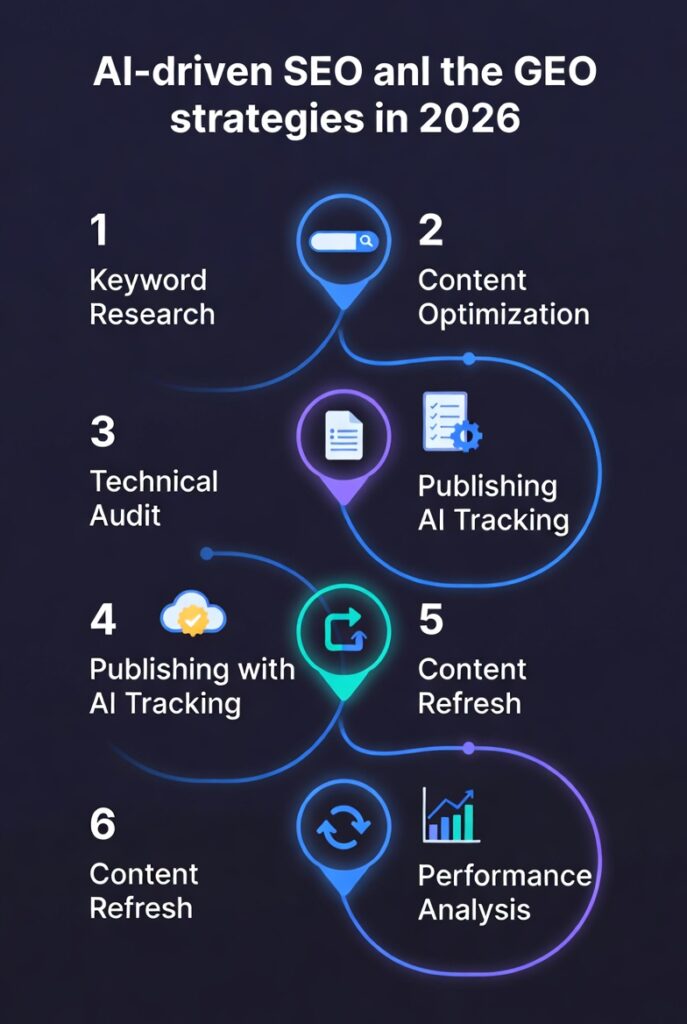
This isn’t a theoretical framework. It’s the actual sequence used by teams producing content that ranks and gets cited in AI responses. The key difference from older guides: steps 4 and 6 are where most people fail, and they’re the ones that matter most in 2026.
robots.txt to allow GPTBot and Claudebot if you want AI citation potential; blocking them means AI can’t train on or cite you. Consider adding an LLMs.txt file — a plain-language document explaining how your site wants to be used by large language models.GEO in 2026: what the data actually says, not the hype version
Generative Engine Optimization got overloaded with buzzwords in late 2024. Let me give you the clean version, with the numbers that actually matter.
GEO was coined in a 2023 Princeton/Georgia Tech/Allen Institute paper that showed specific content techniques could lift brand visibility in AI responses by up to 40%. By early 2026, it’s operational standard — not experimental. 98% of CMOs are now investing in Answer Engine Optimization (Conductor, 2026). The 47% of brands with no GEO strategy aren’t being cautious; they’re ceding ground.
The practical implication of that 80% stat: you don’t need to be ranking #1 on Google to get AI citations. ChatGPT prioritizes content structure, semantic authority, and freshness over traditional ranking signals. This is both a threat (your #1 ranking doesn’t guarantee AI citations) and an opportunity (newer sites with well-structured content can compete for AI visibility faster than traditional SEO allows).
What actually gets you cited
Based on the Princeton GEO paper and 2025–2026 practitioner data, these are the content patterns with the highest citation lift:
- A clear, self-contained direct answer of 40 words or fewer near the top of the page — this is what AI extraction pulls from
- Specific statistics with source attribution inline (not just a footnotes section) — AI engines favor citable, verifiable data points
- FAQPage schema wrapping your Q&A sections — structured data matters for Google AI Overviews specifically
- Entity relationships made explicit — don’t just mention concepts, connect them: “X is a type of Y used for Z when [condition]”
- Content freshness signals: date of publication, “updated [date]” markers, and explicit data currency notes
- Reddit/Quora/forum presence — these are among the most-cited sources in both AI Overviews and ChatGPT responses; you need a community footprint
- Bing-indexed content — because ChatGPT Search draws from Bing’s index, not Google’s
“GEO is not replacing SEO. They are converging. AI models use live web search to find sources — which means traditional SEO directly powers AI visibility. The most effective approach is to optimize for both simultaneously.”
— LLMrefs, GEO 2026 Guide (verified via web research, April 2026)One thing worth saying plainly: don’t over-structure for AI at the expense of humans. Content that’s nothing but bullet points and robotically formatted FAQ sections frustrates readers who arrive through any channel. The best GEO content reads naturally and helpfully for humans first — the structured data layer is additive, not the foundation.
Common mistakes — some of them expensive
- Publishing AI drafts without editing. This is how sites got hammered in Google’s 2024–2025 content quality updates. Generic, low-authority content at scale — even “well-scored” content — no longer survives algorithm scrutiny. The draft is a starting point, not the output.
- Blocking AI crawlers. Nearly 80% of top news publishers now block at least one AI training crawler. For most content sites, this is a mistake — it removes you from citation eligibility. Blocking AI bots to “protect content” often just means being invisible in the AI answer ecosystem.
- Chasing content scores without GSC validation. Post-January 2026 update, multiple SEOs found that high content scores didn’t correlate with recovery. Always cross-check: if tool data and GSC diverge by more than 15%, trust GSC.
- Measuring only traditional metrics. Impressions are up 49% on average for sites with AI Overview presence — but traffic is down 15–35%. If you’re only watching sessions, it looks like collapse. Add “AI citation share” and “AI referral conversion rate” to your dashboard now, before your quarterly review.
- Stacking six tools. I’ve seen teams buy Semrush, Ahrefs, Surfer, Clearscope, SE Ranking, and two GEO trackers simultaneously. Workflow chaos ensues, nothing gets used well, and the monthly bill hits $1,500+. Two tools used consistently beat six tools used badly. Always.
- Publishing and forgetting. The 3-month citation cliff is real. If a piece is still generating traffic and you haven’t touched it in four months, you’re probably already losing AI citation share for it. Schedule refreshes into your content calendar, not your backlog.
Your 2026 AI SEO checklist — start here
This is the minimum viable version. One tool, one workflow, one cluster of pages. Prove it works before you scale it.
- Audit your highest-traffic 10 pages with one all-in-one tool (Semrush or SE Ranking). Note technical issues and content gaps before touching anything else.
- Pick two core tools — one for content optimization (Surfer or Clearscope), one for AI visibility tracking (Semrush AI Toolkit or Ahrefs Brand Radar). That’s it for now.
- Build one complete topic cluster using the 6-step workflow above. Run it for 30 days before judging results.
- Add a GA4 segment for ChatGPT.com and Perplexity.ai referral traffic. Track this separately from organic search from day one.
- Add a 40-word direct answer paragraph to your top 10 existing pages, plus FAQPage schema. No full rewrites needed — this single change affects AI Overview eligibility.
- Check
robots.txtfor GPTBot and Claudebot blocks. If they’re blocked, decide intentionally whether to keep them blocked — not by default. - Set a 10-week content refresh reminder for every published piece. Put it in your calendar, not a to-do list that never gets checked.
- Review LLMs.txt policy and bot configuration quarterly — this is infrastructure now, not a one-time setup.
GEO results are faster than traditional SEO in some ways and slower in others. Zapier saw AI citations appear within three months of restructuring content — that’s faster than most traditional ranking timelines. But citation positions are beginning to concentrate around early movers in many niches. The window is real. It’s also narrowing.
- GEO 2026: The State of Generative Engine Optimization Right Now — AI CTR data, ChatGPT referral share, citation patterns (April 2026)
- Soar Agency — The 2026 Guide to Generative Engine Optimization — Seer Interactive study (25M impressions), Reddit/OpenAI deal context
- Frase.io — GEO Guide 2026 — citation decay data, 527% AI session growth, GEO vs SEO comparison
- Tim Soulo (Ahrefs CMO) — Best AI SEO Tools for 2026 — Ahrefs Brand Radar detail, Writesonic assessment (February 2026)
- OneLittleWeb — Best AI SEO Tools (40+ tools tested on live client accounts, December 2025)
- Self Made Millennials — What’s Not Working & Best AI SEO Tools in 2026 (January 2026 update, content score limitations)
- Geoptie — GEO Definitive Guide 2026 — Zapier case study, Gartner 25% traffic drop projection
- Incremys — 2026 GEO Statistics — 2.6% CTR at position 1 with AI Overview, 4.4× conversion rate, ROI data (January 2026)
- Seer Interactive — Study of 25M organic impressions; CTR impact of AI Overviews (2025)
- Ahrefs — “80% of ChatGPT citations don’t rank in Google top 100” finding (August 2025)
Reviews
AI SEO Tools: The Ultimate Guide to Boosting Your Search Rankings
$350K AI Exit: 7 Side Hustle Nation AI Strategies for 2026
AI Changed SEO in 2026: What 40 Tools Reveal About the New Rules