
The One-Person AI Agency in 2026: A Realistic $10K/Month Blueprint
Most “AI agency” guides show you a screenshot of someone else’s Stripe dashboard. This one shows the unit economics, the tools that survive past client #3, and the points where solo operators quietly fail — cross-checked against eleven independent 2026 sources, every one of them linked below so you can verify it yourself.
Yes, $10,000/month is realistic for a solo AI operator — but it’s a sales-and-positioning outcome, not a tooling outcome. The repeatable path is: win 1–2 clients doing workflow assembly (L2) work priced at $1,500–$15,000 per build, convert your best client into a licensed, retained system (L3) at roughly $2,800–$7,000/month, and stack 2–3 of those. Most people need 4–8 months of largely unpaid pipeline-building before the math below turns into real income.
- The reality check nobody sells you
- The Leverage Stack: what to actually sell
- What the market really pays in 2026
- The tool layer: real costs at scale
- Unit economics: your first $10K month
- The 90-day build sequence
- Three illustrative operator scenarios
- Where solo operators actually break
- When this is the wrong move
- Regional and regulatory notes
- Myths vs. facts
- Pre-launch checklist
- Glossary
- FAQ
The reality check nobody sells you
I want to get one admission out of the way, because it will save you months. An early “AI content automation” experiment I ran around a single wrapped prompt landed two retainer clients in a week — and lost both within sixty days, because the output didn’t survive contact with an actual editor. The tool was never the business. What I’d confused was “I can operate this software” with “I have something a business will keep paying to keep.”
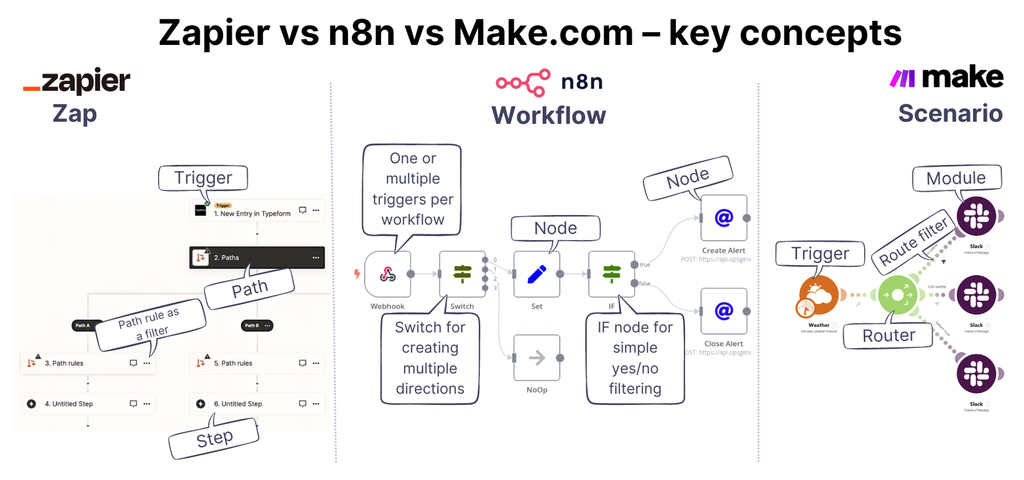
The unpopular part: for most people reading a “one-person AI agency” guide in 2026, the AI is the cheapest and least differentiating layer of the business. The barrier to wiring together a chatbot or a workflow has collapsed — Zapier, Make, and n8n all shipped native AI agent capabilities this year, and a competitor can copy your visible tech stack in an afternoon.[7] What doesn’t copy that fast is judgment about which automation is worth building, the relationships that get you past a first project, and the discipline to charge for outcomes instead of hours.
That doesn’t mean $10K/month solo is unrealistic — cross-checking the pricing sources below against each other turns up a consistent band, not a single agency’s marketing number. It does mean the path looks less like a screenshot and more like the framework below.
The Leverage Stack: a framework for deciding what to sell
Every solo AI operator is selling from one of four layers, and each layer has a different ceiling, defensibility, and time-to-first-dollar. This framing is original to this piece — you won’t find it phrased this way elsewhere, though the underlying idea (productize before you strategize) echoes standard agency-building advice.
| Layer | What you’re actually selling | Time to first client | Ceiling (solo) | Defensibility |
|---|---|---|---|---|
| L1 — Task Execution | Using an AI tool to do a task faster (writing, image editing, transcription) | Days | Low — priced against your hours | Very low, easily commoditized |
| L2 — Workflow Assembly | Connecting tools (CRM, forms, LLM, calendar) into a working automation | 2–4 weeks | Moderate — $1,500–$15,000 per build | Moderate — technical switching cost for the client |
| L3 — Owned System | A licensed agent or bot the client depends on operationally, billed as setup + monthly license | 1–3 months | High — recurring revenue compounds | High — you hold the IP and the API keys |
| L4 — Judgment Layer | Deciding what to automate and what not to (the audit/strategy role) | 3–6 months (needs credibility first) | Highest per hour, hardest to scale alone | Highest — this is what AI cannot do for the client |
The path this blueprint follows is deliberate: start at L2 for cash and case material, convert your best L2 clients into L3 retainers (this is where the $10K/month actually comes from), and use L4 credibility to raise your ceiling once you have 3–4 proof points. Selling L4 (strategy/audit) on day one with no delivery history is the single most common reason solo operators stall at $0.
What the market really pays in 2026
Pricing sources published this year converge on a similar picture, though exact numbers shift with how each source defines “simple” versus “complex,” and whether “retainer” means ongoing new builds or maintenance-only. Freelance-level automation work runs roughly $1,000–$10,000 per simple workflow, with boutique-tier projects landing between $5,000 and $50,000.[1] Digital Agency Network’s 2026 pricing guide puts standard automation builds at $2,500–$15,000+, with ongoing managed-operations retainers running $500–$5,000+/month.[2] Taskip’s separate review of US/EU agency pricing put the median monthly retainer for small-to-mid-market clients between $2,800 and $7,000.[3]
Bar heights are illustrative, not linearly scaled, so the small and large bands stay legible on one chart. A solo operator typically competes in the Freelancer and Boutique bands. Source: SuperDupr, “Best AI Automation Agencies 2026”.[1]
The pricing-model shift matters as much as the numbers: hourly billing is losing ground because AI collapses execution time, so agencies are moving to outcome-based and licensing models — a flat setup fee plus a recurring “agent license” fee that covers maintenance and model-cost drift.[6] This is the highest-leverage pricing decision you’ll make: price the workflow’s business outcome, not the hours it took you to assemble it.
The tool layer: what to build on, and what it actually costs at scale
Entry pricing is nearly irrelevant once you have real client volume. What erodes margin on a retainer is the cost curve as usage grows — and, for n8n specifically, whether you’re on managed Cloud or self-hosting.
| Platform | Entry price (Aug 2026) | Billing unit | Cost at 10,000 runs/mo, 8-step workflow | Best fit |
|---|---|---|---|---|
| Zapier | $19.99/mo (annual), 750 tasks | Per task — every successful action step | ~$250–400/mo[7] | Non-technical operators, fastest time-to-first-demo, 8,000+ app integrations |
| Make | $9–16/mo, 10,000 credits | Per credit — one per module action/trigger | ~$150–200/mo[7] | Visual builders who need more branching logic than Zapier without n8n’s complexity |
| n8n Cloud | ~$20/mo, 2,500 executions | Per workflow execution — not per step | ~$50/mo[7] | Technical operators who want per-execution pricing without managing their own server |
| n8n Self-hosted | Free software; typically $5–20/mo in server costs | Unlimited executions — no per-run fee at all | ~$5–20/mo in infrastructure, plus your own maintenance time | High-volume technical operators who can own updates, backups, and uptime themselves |
Entry pricing checked against each vendor’s live pricing page as reflected in FuturePicker’s August 2026 breakdown[7], cross-checked against Parseur[8] and GolmTech[9]. Automation vendors reprice frequently — verify current tiers before quoting a client.
Build your first 2–3 client workflows on whichever tool you already know; speed to a working demo matters more than the theoretical cost curve at zero clients. But the moment you sign your first retainer, model the per-run cost on n8n Cloud (or self-hosted) before you quote a monthly fee — a workflow running 10,000 times a month can cost 5–8x more on Zapier than on n8n Cloud for identical output.[7] That gap is your margin, not a free lunch.
Unit economics: modeling your first $10K month
The following is a transparent financial model with stated assumptions — not a claim about any specific real client. Every number is adjustable to your own market and skill level.
Assumptions: 3 recurring retainer clients plus 1 one-off project per month; average retainer fee $2,800/month (bottom of the Taskip 2026 SMB retainer band[3]); one-off project fee $3,600; tool and API costs averaging 12% of retainer revenue (comfortably under the 15% Margin Leak Test threshold above); roughly 8 hours/week of unpaid sales and delivery admin.
Illustrative model — swap in your real fees and cost ratios. Roughly 84% of gross survives to net in this scenario once tool costs, payment processing, and light contractor help are subtracted.
The uncomfortable part of this model is that it assumes you already have 3 retainer clients. Getting there is a sales problem, not a technology problem, and it’s the part most quick-start guides skip. Realistically, most solo operators need 4–8 months of unpaid pipeline-building — cold outreach, a couple of free audits, one or two underpriced pilot projects — before the retainer math above becomes real income rather than a spreadsheet.
The 90-day build sequence
- Weeks 1–2 — Pick one narrow niche and one narrow workflow. “AI automation for X” is not a niche. “Lead-qualification bots for solo dental practices” is. Narrow enough that you can become the obvious expert in a market you can actually reach by DM or referral.
- Weeks 3–4 — Build one demo workflow on your own dime. Use it to generate a real before/after number (hours saved, response-time drop, leads captured) you can show, not just describe.
- Weeks 5–8 — Run a paid pilot, underpriced on purpose. The goal here is a documented result and a testimonial, not margin. Cap it at one client so you can hand-hold the delivery.
- Weeks 9–12 — Convert the pilot to a retainer using an agent-licensing structure (setup fee + monthly license covering maintenance and model-cost drift), then use the pilot’s result as outreach proof for clients 2 and 3.
Three illustrative operator scenarios
These are modeled composites built from the pricing and cost data above — not verified individual case studies — to show how the same framework plays out differently by starting point.
| Starting point | Likely entry layer | Realistic month-6 outcome (modeled) | Main constraint |
|---|---|---|---|
| Marketing freelancer, no-code background | L2 (Zapier/Make builds) | 2 retainers ≈ $4,000–6,000/mo | Sales cadence — has the skill, lacks outbound reps |
| Developer with SaaS/API experience | L2 → L3 fast (n8n, custom agents) | 1 licensed agent client + 1 project ≈ $6,000–9,000/mo | Underpricing technical work relative to value delivered |
| Ex-agency strategist, no build skills | L4 (audit/strategy), subcontracts build work | Slower start, ≈ $3,000–5,000/mo by month 6, compounding after | Needs a technical partner to fulfill |
Where solo operators actually break
The five failure points, honestly
- Underpricing L2 work as if it were L1. A working automation that saves a client 10 hours a week is worth far more than the 6 hours it took you to build — price the outcome.
- No maintenance clause. APIs change, models get deprecated, vendors reprice. Without a licensing/retainer structure, every model update becomes unpaid emergency work.
- Overbuilding before selling. Spending months perfecting a platform nobody has agreed to pay for yet.
- Single points of failure. If you’re out sick for a week, do your clients’ automations keep running? Solo doesn’t mean undocumented.
- Treating the pilot’s underpricing as permanent. The pilot discount was supposed to buy proof, not set your market rate forever.
When this is the wrong move
Skip or delay this path if you have no existing network or credibility to draw a first client from and no budget to survive an unpaid 3–6 month pipeline; if you dislike sales conversations more than you dislike a day job (this business is sales-first, tool-second); or if you’re drawn to it purely because “AI agency” is trending. Custom, multi-tool agent builds with real integrations, error handling, and audit logging run well above the single-purpose $1,500–$5,000 band — closer to the $50,000+ tier once enterprise-grade custom development is involved.[10] If your first-niche idea already requires that tier of build, it’s a signal you’re scoping an agency project, not a solo pilot — reconsider the niche before reconsidering the business model.
Regional and regulatory notes
The pricing bands above reflect primarily US and EU market data, with agencies elsewhere (e.g., Noida-based NextAutomation[10]) sometimes running lower on entry pricing — a reminder these bands aren’t globally uniform. If you’re operating from or selling into the EU, factor in the EU AI Act’s risk-tiering, which adds compliance overhead for “high-risk” categories — hiring, credit, biometric use cases. Those are worth avoiding as a solo operator’s first niche given the compliance burden relative to solo capacity. Contract and data-processing terms — who owns client data flowing through your automations, where it’s stored — should be explicit in writing before any workflow goes live, wherever you’re based. This is general orientation, not legal advice; a client in a regulated vertical (health, finance, hiring) is worth a real contract review before you build anything.
Myths vs. facts
Pre-launch checklist
- Chosen one narrow niche you can name in one sentence (industry + workflow)
- Built one demo workflow with a real, documented before/after number
- Decided your entry automation platform based on your own technical comfort, not theoretical cost
- If planning to use n8n at volume, decided cloud vs. self-hosted before quoting a retainer, not after
- Run the Margin Leak Test on your planned retainer pricing before quoting it
- Drafted a maintenance/licensing clause covering API changes and model deprecation
- Confirmed who owns client data flowing through the automation, in writing
- Documented the workflow well enough that someone else could keep it running if you’re out sick
- Set a hard end date on your “pilot discount” pricing before you offer it
Glossary
- Workflow assembly (L2)
- Connecting existing tools — CRM, forms, an LLM, a calendar — into a working automation, typically billed per project.
- Owned system / agent license (L3)
- A bot or agent the client depends on operationally, sold as a setup fee plus a recurring license fee that covers upkeep.
- Agent licensing model
- A pricing structure — flat build fee plus recurring monthly fee — that bundles maintenance and model-version drift into recurring revenue instead of unpaid emergency work.
- Per-task vs. per-execution billing
- Two different ways automation platforms charge: per-task counts every action step in a workflow; per-execution counts one full workflow run regardless of step count. The difference compounds sharply at volume.
- Margin Leak Test
- A pre-quote check: if execution volume × per-run tool cost exceeds 15% of the monthly fee you plan to charge, you’re pricing on hope rather than unit economics.
Frequently asked questions
Do I need to know how to code to start a one-person AI agency?
No. Zapier and Make are built for no-code operators and can carry you through your first several clients at the L2 (workflow assembly) layer. Coding becomes valuable mainly when you move to n8n for cost efficiency at scale or need custom API integrations Zapier and Make don’t support natively.
How much should my first client pay me?
Deliberately underprice the first pilot, often near your cost, to secure a documented result and a testimonial. Then price clients 2 and 3 within the market bands cited above — roughly $1,500–$5,000 for a single-purpose build, plus an ongoing license or retainer fee.
Should I charge hourly, per-project, or retainer?
Project or retainer, not hourly. Since AI collapses execution time, hourly billing directly punishes you for getting faster. A setup fee plus a monthly license fee is the model gaining the most traction industry-wide in 2026.
What’s the realistic timeline to $10K/month?
For most people starting with no existing client base, plan on 6–12 months, with the first 3–6 months largely unpaid pipeline-building. Anyone promising faster without an existing network or reputation is skipping the sales problem.
Which automation platform should I pick first?
Whichever you can move fastest in for a working demo — usually Zapier if you’re non-technical. Re-evaluate on n8n once a client’s workflow runs at real volume, and decide cloud vs. self-hosted based on whether you’re willing to own uptime yourself.
Is the AI automation agency niche already too saturated?
The generic “AI automation agency” positioning is crowded — the market grew roughly 6x between 2024 and 2026. A narrow vertical niche, a specific industry plus a specific workflow, is not, which is why the framework above starts with narrowing before building.
What happens when the client’s automation breaks or the AI model changes?
This is exactly what a monthly license or retainer fee is for — build maintenance and model-version drift into your recurring pricing from day one rather than treating it as unpaid emergency work later.
Can I run this alongside a full-time job?
Yes, for the first 2–4 months of pipeline-building and one pilot client. Delivery and client-support responsiveness typically become the bottleneck once you’re past 2–3 retainer clients.
Why do retainer price quotes vary so much between sources?
Because “retainer” describes three different products: maintenance on an already-built system (cheapest), an ongoing multi-workflow build relationship (middle), and effectively running a client’s automation function for them (most expensive). Always confirm which one you’re quoting or being quoted.
What’s the single biggest reason solo operators fail at this?
Treating it as a technology problem instead of a sales-and-positioning problem. The tooling is genuinely commodity-level in 2026; the scarce resource is a narrow niche, a proof point, and consistent outbound.
Sources cited (all links verified August 2026):
- [1] SuperDupr — “Best AI Automation Agencies 2026 (Pricing + How to Choose)”
- [2] Digital Agency Network — “AI Agency Pricing Guide 2026”
- [3] Taskip — “AI Automation Agency Cost: How Much Should You Budget in 2026?”
- [4] AutomateNexus — “Best AI Automation Agencies for Small Business (2026): An Honest Comparison” — disclosed-bias source publishing its own real project pricing
- [5] Taskip — “AI Automation Agency Pricing: What to Charge in 2026”
- [6] The JADA Squad — “AI Automation Agencies: 2026 Guide”
- [7] FuturePicker — “n8n vs Zapier vs Make (2026): Real Pricing Compared”
- [8] Parseur — “n8n vs Zapier vs Make — Which Automation Tool Is Best in 2026?”
- [9] GolmTech — “Zapier vs Make vs n8n: Pricing and Features (2026)”
- [10] AI Makers — “Best AI Automation Agencies for SMBs 2026”
- [11] Intuz — “Make vs n8n vs Zapier — Detailed Guide (2026)”
Automation and agency pricing changes frequently — confirm current rates on the linked pages before quoting a client.