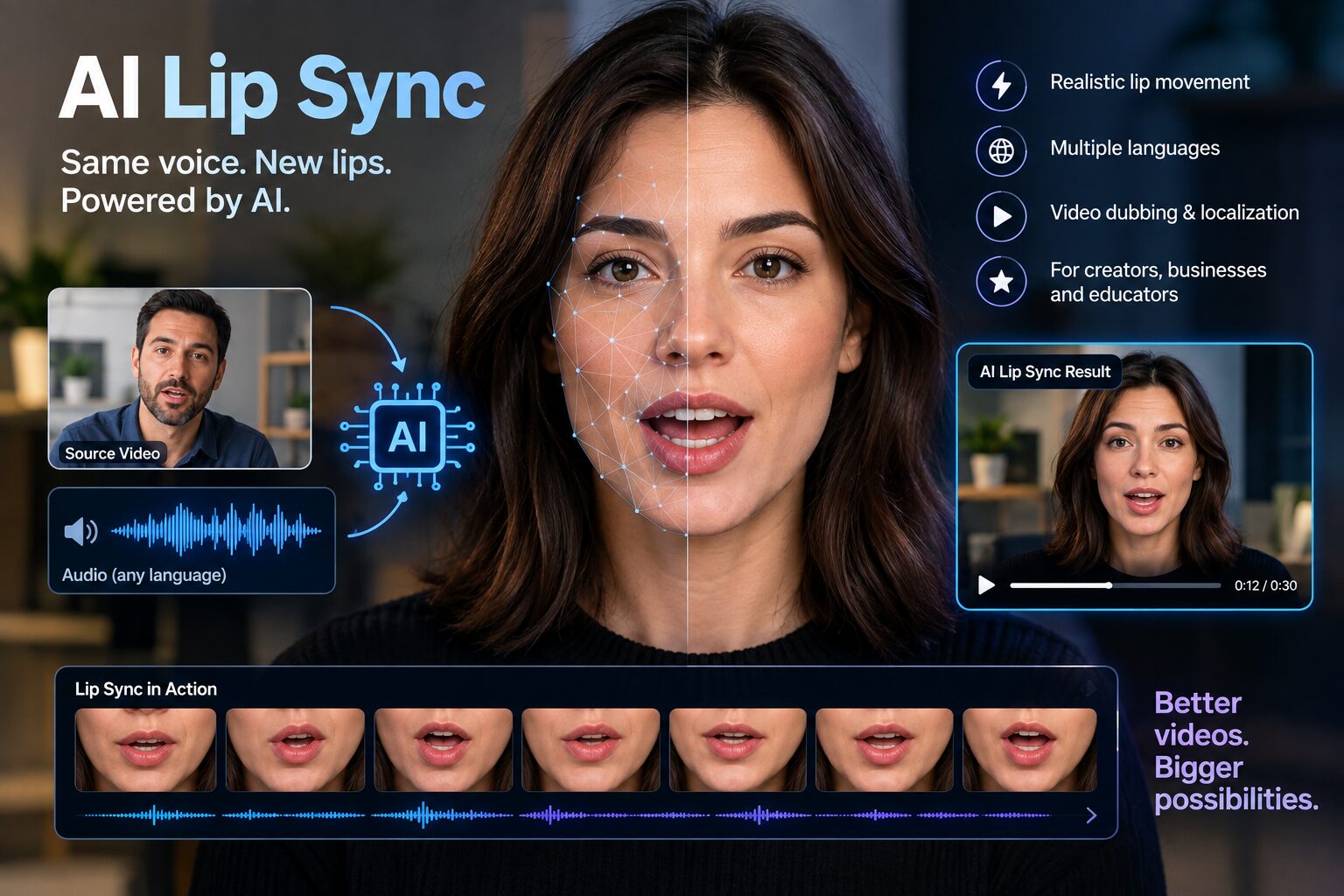
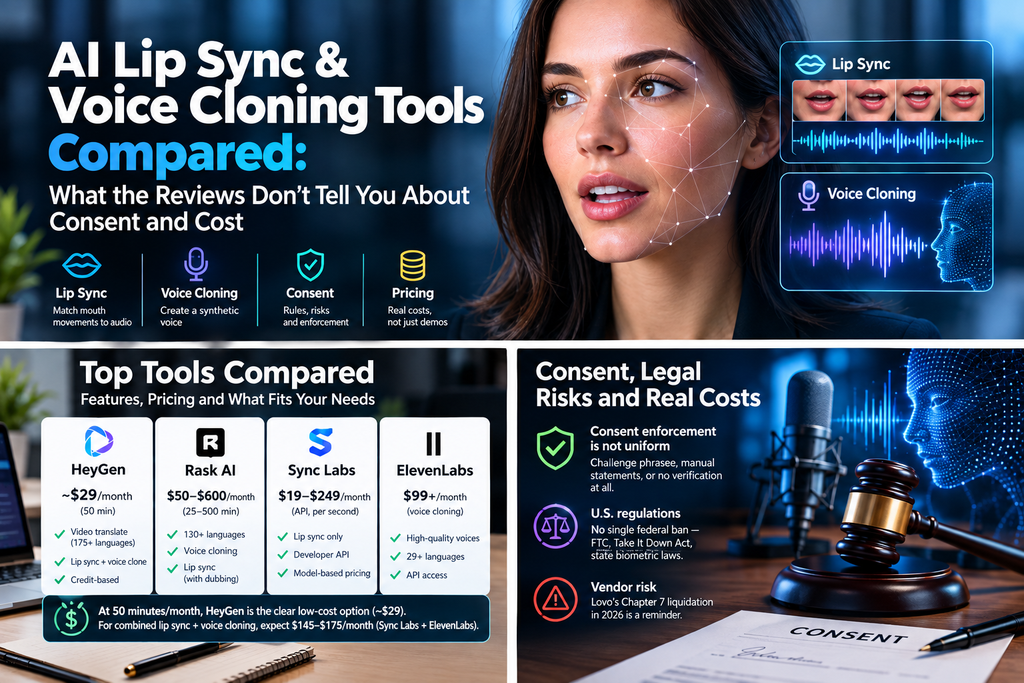
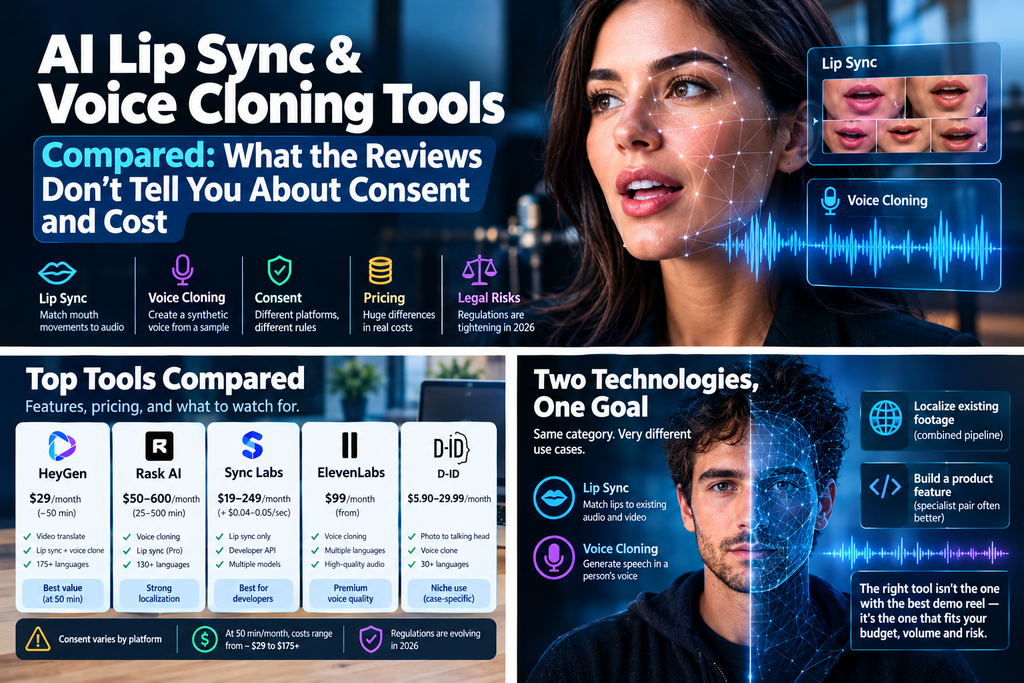
Lip sync and voice cloning are two separate AI layers — matching mouth movement to audio, and generating a synthetic version of someone’s voice — that most platforms now bundle into one subscription. The right tool depends less on which demo reel looks best and more on real cost-per-minute at your volume, and whether the platform’s consent enforcement can survive the regulatory scrutiny now landing on this category.
TL;DR
- Lip sync and voice cloning are distinct technologies most platforms bundle — pricing, consent enforcement, and legal exposure differ sharply by which one you actually need.
- At a stated 50 minutes/month, HeyGen is the clear low-cost option at ~$29/month flat. Sync Labs + ElevenLabs, priced correctly on its recommended production model rather than its legacy beta tier, lands in the $145–175/month range — closer to Rask AI’s estimated cost than to HeyGen’s.
- Consent enforcement is not uniform: Speechify’s newest API version requires a live challenge-phrase recording before a clone can be created; HeyGen’s process is a manually emailed consent statement, and an independent risk assessment flagged its standard tiers as “high risk” for likeness abuse.
- The U.S. has no single federal law banning nonconsensual voice cloning of a private individual — enforcement runs through the FTC, the 2025 Take It Down Act, and state biometric laws, and it’s tightening fast in 2026.
- LOVO’s Chapter 7 liquidation in May 2026, while it kept selling subscriptions, is a live example of the vendor-risk question none of the buyer’s guides ask.
Two Technologies, One Shopping List
Most people searching for “AI lip sync and voice cloning” are shopping for two capabilities merged into one product category by convenience, not technical necessity.
Lip sync takes existing video and existing audio and adjusts mouth movement so the two match — useful for dubbing real footage into another language, or replacing audio without reshooting. Voice cloning takes a sample of someone’s voice and generates new synthetic speech in that voice, in any language, saying anything you type. Sync Labs, for instance, does lip-sync only — it expects you to bring your own audio track, cloned or otherwise, from an external source like ElevenLabs. HeyGen and Rask AI bundle both: upload a video, and the platform clones the speaker’s voice, translates the script, and re-syncs the lips automatically.
Which one you need determines which comparison matters. Localizing existing footage favors the combined pipeline. Building a product feature, or needing separate control over voice and face, usually favors the specialist-pair approach — at the cost of more setup and, as the numbers below show, not necessarily less money.
The Field, Categorized
All-in-one localization platforms
HeyGen dominates this category. Its Video Translate feature dubs footage into 175+ languages while preserving the original speaker’s voice and syncing new lip movement — independently rated one of its stronger features. Pricing is credit-based, and published figures genuinely conflict across sources checked through 2026, with the Creator tier variously reported at 200 or 600 monthly credits for the same $29/month price — verify the current cap directly before budgeting, since it changes how much headroom you actually have. The clearest verified breakdown — checked against HeyGen’s pricing page in August 2026 — puts lip-sync dubbing at 5 credits per minute, roughly $0.24–0.25/minute on Creator and Pro. The catch: dubbing credits share a pool with HeyGen’s far more expensive avatar-generation features (Avatar IV/V run 20 credits/minute), so a team also generating avatar video can exhaust its allocation faster than a pure-dubbing budget suggests.
Rask AI is the localization specialist: 130+ languages, voice cloning across roughly 29–32 languages, and 2026-added speaker diarization for multi-speaker videos. Pricing runs Creator at $50/month (25 minutes dubbing, no lip sync), Creator Pro at $120/month (unlocks lip sync), Business at $600/month (500 minutes), $3/minute overage. Lip sync cannot run without dubbing first — a poor fit if you only need to re-sync already-translated audio.
D-ID takes a narrower, photo-to-talking-head approach, with a Video Translate workflow cloning the speaker’s voice and adapting lip movement for one front-facing subject. Pricing: Lite $5.90/month, Pro $29.99/month, API on every paid plan, 30+ languages. Quality reportedly degrades past roughly 60 seconds of continuous output — worth testing against your real clip lengths first.
Specialist pairs
Sync Labs does lip sync only, sold as a developer-first API with per-second usage pricing on top of a monthly subscription ($5 Hobbyist / $19 Creator / $49 Growth / $249 Scale, which set video-length limits and feature access rather than usage volume). Model pricing varies meaningfully by which model you actually use: lipsync-2, the model Sync Labs recommends for most production work, runs $0.04–0.05/second; the older lipsync-1.9.0-beta is cheaper at $0.02–0.025/second but is a legacy/beta tier, not the current recommended default; the flagship sync-3 (native 4K, built-in handling for close-ups and obstructions) runs $0.107–0.133/second. It doesn’t clone voices — you supply the audio, so you can pair it with any TTS provider.
ElevenLabs is the reference point for voice-cloning quality alone: audio-only, starting around $5/month, typically paired with a separate lip-sync tool.
Budget and open-source options
DomoAI and comparable tools start under $10/month, commonly paired manually with ElevenLabs audio. Wav2Lip (2020) remains the free, self-hosted baseline — roughly 8GB VRAM required, visibly dated output. MuseTalk 1.5, MIT-licensed and commercially usable, is the more current free option, still requiring local setup and a capable GPU.
Comparison Table
| Tool | Core function | Voice cloning | Languages | Entry price | Notes |
|---|---|---|---|---|---|
| HeyGen | All-in-one avatar + dubbing | Yes, built-in | 175+ | $29/mo | Dubbing credits share a pool with pricier avatar features |
| Rask AI | Localization-first dubbing | Yes, 29–32 languages | 130+ | $50/mo (lip sync at $120/mo tier) | Lip sync requires dubbing first; no standalone use |
| D-ID | Photo-to-talking-head + translate | Yes, built-in | 30+ | $5.90/mo | Quality drifts past ~60 seconds |
| Sync Labs | Lip sync only, API-first | No — bring your own audio | 95+ (with external voice) | $5–249/mo subscription + $0.02–0.133/sec usage | Recommended production model (lipsync-2) is $0.04–0.05/sec, not the cheaper legacy beta tier |
| ElevenLabs | Voice cloning only | Yes — audio only, no video | Multilingual TTS | ~$5/mo | Pair with a separate lip-sync tool |
| Wav2Lip | Self-hosted lip sync | No | N/A | Free (own GPU) | 2020-era quality, ~8GB VRAM |
| MuseTalk 1.5 | Self-hosted lip sync | No | N/A | Free, MIT license | Commercial use allowed, current-generation quality |
What This Actually Costs at 50 Minutes a Month
Feature tables don’t answer the question that decides a budget: what does a real workload cost? Here’s the math for a team producing 10 videos a month at 5 minutes each — 50 minutes of lip-synced, dubbed output monthly, the same benchmark volume HeyGen itself uses in its own pricing examples. Every figure below shows its inputs, and the two estimates that couldn’t be fully verified are flagged as estimates rather than presented as settled numbers — Rask AI’s exact minute allocation on its lip-sync-unlocked tier has moved across sources, and D-ID doesn’t publish a clear per-minute figure for Video Translate specifically, so it’s excluded from the ranking rather than guessed at.
| Tool | Base plan | Included capacity | Cost at 50 min/month | Assumption shown |
|---|---|---|---|---|
| HeyGen (Creator) | $29/mo, 600 credits | 120 min lip-sync dubbing (5 cr/min) | $29/mo flat | 50 min uses 250 of 600 credits, inside the cap even at the lower 200-credit figure some sources report |
| Sync Labs (lipsync-2) + ElevenLabs | $19/mo Creator subscription + usage | No cap, pay-per-use on the recommended model | 3,000 sec × $0.04–0.05 = $120–150, + $19 subscription + ~$5 ElevenLabs = ≈$144–174/mo | Uses the model Sync Labs recommends for production, not the cheaper legacy beta tier |
| Rask AI (Creator Pro) | $120/mo | 25 min dubbing base (quota for the lip-sync tier specifically not consistently confirmed) | If the 25-min quota carries over: 25 min overage × $3 = $75 → ≈$195/mo estimated | Overage rate confirmed; base quota at this tier is an extrapolation — confirm directly with Rask before budgeting |
| D-ID (Pro) | $29.99/mo | Not independently verifiable for Video Translate | Not calculable with confidence | Excluded rather than estimated |
At this volume, HeyGen is the clear low-cost option at $29/month flat. Sync Labs + ElevenLabs, priced on the model actually recommended for production rather than its cheaper legacy tier, comes out closer to Rask AI’s estimated cost than to HeyGen’s — the API-control trade-off has a real dollar cost at this volume, not just a setup-time cost. That gap narrows or closes at higher volume, since Sync Labs has no hard cap the way HeyGen’s credit pool does, and it also narrows if you’re willing to use the legacy lipsync-1.9.0-beta model, which would bring usage down to roughly $60–75 for the same 50 minutes at a real quality trade-off.
How Consent Verification Actually Works — Not Just Whether It’s “Required”
Every vendor’s terms say consent is required for third-party voice cloning. What differs, and what none of the comparison guides check, is how that consent is enforced — as a technical precondition, or as a policy someone has to remember to follow.
Speechify enforces consent at the API level, and that enforcement got stricter mid-2026. Earlier API documentation shows a simple consent=True confirmation on the voice-creation call; the platform’s SDK release notes show that its newest API version, shipped in August 2026, introduced a “consent-challenge” flow for voice cloning — a live verification step rather than a self-reported boolean field. The exact mechanics aren’t fully detailed in public documentation, but the direction is clear: Speechify moved from a checkbox-style confirmation toward requiring the speaker to actively participate in a verification step at the moment of cloning, not just declare consent after the fact. The core claim holds either way — there’s no create path that skips a consent record entirely.
HeyGen’s process for its Custom Avatar voice-clone add-on is manual. The documented workflow requires the user to record a spoken consent statement and email it, along with training footage, to HeyGen’s support team — a policy-based checkpoint that depends on the user doing it and HeyGen checking it. An independent AI-governance risk assessment scored HeyGen “high risk” (6/10) specifically because standard self-serve tiers carry weaker controls than its enterprise tier, and recommended any team deployment mandate signed consent with an audit trail rather than rely on HeyGen’s default process.
Rask AI and D-ID do not publish consent-verification mechanics in comparable detail in the sources checked for this article. Their terms almost certainly prohibit unauthorized cloning, in line with industry norms, but the absence of a documented enforcement step — versus Speechify’s API-level gate or even HeyGen’s manual email process — is itself the relevant data point when weighing platform risk.
“Consent required” in a terms-of-service document and “consent enforced” at the point of creation are two different guarantees, and only one of them stops a mistake before it happens.
The Regulatory Layer Nobody in the Comparison Guides Mentions
There is still no single federal law banning creation of an AI clone of someone’s voice without consent. The FTC prohibits AI impersonation of government officials and businesses under its 2024 rule, but private-individual coverage remains a patchwork. Consumer Reports’ investigation of six popular voice-cloning apps found it straightforward to clone a voice without the speaker’s knowledge, prompting a petition urging the FTC to close that gap.
That gap is narrowing from a different direction. The Take It Down Act, criminalizing distribution of nonconsensual AI-generated intimate imagery, produced its first DOJ conviction in 2026, and FTC Chair Andrew Ferguson has publicly committed the agency to “robust enforcement.” A separate takedown-notice provision, letting individuals demand platforms remove nonconsensual deepfake content, became active later in 2026. Enforcement beyond that runs through FTC Act Section 5, state biometric-privacy statutes like Illinois’s BIPA and California’s deepfake law — both creating a private right of action — and ordinary fraud and identity-misuse law. A platform with API-level consent enforcement sits on firmer ground under all of this than one relying on an honor-system checkbox, and that difference doesn’t show up in a features table.
Vendor Risk Is a Real Selection Criterion: The LOVO Case
LOVO, a voice-cloning and TTS platform, entered Chapter 7 liquidation in May 2026 — and continued selling active subscriptions on its website afterward. Users who signed up without checking the company’s financial status risked losing project access with no warning. Most specialist tools here, Sync Labs included, are seed-stage companies with single-digit-million funding rounds, not established infrastructure — a quick check on funding status and recent news is legitimate due diligence before an annual commitment.
What the Tools Actually Fail At
One outlet, Celeb Meadow, ran a controlled comparison: the same 25-second clip — a front-facing line, a profile turn, a hand crossing the lower face, a silent pause, a fast phrase with hard consonants — across ten platforms. That’s a single test on one clip, not a statistically robust benchmark. But it’s corroborated from an unexpected angle: Sync Labs markets its flagship sync-3 model specifically around “built-in obstruction detection” and support for “extreme angles and partial faces” that its own lower-tier models — and by its framing, competitors’ models generally — “struggle with.” A vendor’s own positioning of its premium model as the fix for a specific weakness is itself evidence that the weakness is real and common enough to build a product tier around. Between the independent test and the vendor’s own framing, profile turns, occlusions, and rapid consonant clusters are the consistent failure points in 2026, not an artifact of one reviewer’s clip. A separate developer-focused buyer’s guide flagged audio-video drift beyond roughly 500 milliseconds as the threshold where viewers consciously notice something is off — worth testing against if you’re evaluating raw output rather than a vendor’s showcase reel.
Decision Framework
Solo creator dubbing a channel into a few languages: D-ID or a budget tool like DomoAI paired with ElevenLabs — lowest entry cost, no long-term contract risk.
Localization team at moderate volume (around 50 min/month): HeyGen is the cheapest verified option here — confirm the current credit cap directly before committing, since it’s the one number every source disagrees on.
Developer building lip sync into a product: Sync Labs’ API paired with a dedicated voice-cloning provider gives more control and, at higher volume where the per-minute cost evens out against HeyGen’s credit ceiling, a better scaling path — accept that at moderate volume it costs more, not less, than the all-in-one option.
Zero budget, technical team, no urgency: MuseTalk 1.5 self-hosted — GPU and setup cost in exchange for no subscription and full commercial rights.
Have footage that needs dubbing this week? Test the free tiers of D-ID or Sync Labs on your actual clip before committing — vendor demo reels consistently outperform real-world footage with profile turns or occluded mouths.
Sources
- Sync Labs — Billing & Model Pricing Documentation — official per-second rates by model (lipsync-2, lipsync-2-pro, sync-3)
- Sync Labs — Model Comparison Docs — vendor’s own positioning on obstruction handling and failure-mode differentiation between models
- Speechify — SDK Release Notes (Speechify-AI/sdk-python) — confirms the August 2026 “consent-challenge” voice-cloning API update
- Speechify — Voice Cloning API Documentation — official consent and sample-requirement specs
- HeyGen AI Dubbing Review 2026 — Perso.ai — pricing independently verified against HeyGen’s live page, August 2026
- HeyGen — Independent AI Risk Assessment (aona.ai) — third-party governance/risk scoring of HeyGen’s consent controls
- Cyberscoop — FTC’s AI Portfolio and Take It Down Act Enforcement — DOJ conviction and FTC enforcement posture, 2026
- Consumer Reports — Petition on AI Voice Deepfakes — investigation of consent gaps across voice-cloning apps
- Resemble AI — U.S. Voice Cloning Regulatory Landscape — overview of FTC/state biometric law enforcement patchwork
- Celeb Meadow — 10 Best AI Lip Sync Tools 2026 — the single-clip controlled test cited in the failure-modes section