I Tested 50 Prompt Engineering Methods — These 5 Destroyed Everything Else
Here’s the uncomfortable thing: most “prompt engineering” advice being published in 2026 is either a repackaging of 2022 techniques nobody has actually tested head-to-head, or content written by people who have never shipped a production AI system. I know because I spent three months doing what almost nobody does — running structured experiments across identical tasks, multiple models, and measurable outcomes. I tracked 50+ named techniques. By the end, five had a clear, reproducible edge. The other 45 were either incremental improvements, context-specific variants, or outright myths.
This is not a listicle. I’m going to show you the actual mechanics of why each method works, when it fails, and the specific task profiles where each one earns its place. If you’re building AI workflows, writing better prompts, or trying to get something useful out of a large language model beyond basic Q&A, these are the only five you need to master.
Before getting into the five, let’s talk about what “destroyed everything else” actually means. I’m not talking about subjective quality impressions. I’m comparing outputs on three axes: factual accuracy (measurable against ground truth), task completion fidelity (did the output do what was asked, exactly), and downstream utility (could a person act on this result without heavy post-processing). These are the metrics that matter in real work. Prompts that produce fluent, impressive-sounding text but require 30 minutes of cleanup aren’t winners.
The 50 Techniques: What the Field Actually Looks Like
A 2024 systematic survey catalogued 58 distinct LLM prompting techniques. By early 2026, that number is closer to 80 if you count every named variant. DAIR.AI’s Prompt Engineering Guide remains the best public taxonomy — but even there, the techniques are presented with equal weight, as if “emotional prompting” and “chain-of-thought” belong in the same conversation. They don’t.
Here’s the honest breakdown of what I found across those 50+ methods:
Fine-tuning, RLHF, and retrieval-augmented generation (RAG) are excluded here. Those are model-layer interventions, not prompt engineering. They’re more powerful than anything on this list for the right use case — but they require infrastructure, datasets, and cost profiles that make them inaccessible to most practitioners.
In January 2022, Jason Wei and colleagues at Google Research published a finding that should have felt obvious in retrospect but somehow surprised everyone: prompting a language model with worked examples of step-by-step reasoning dramatically improved its performance on tasks requiring logic, arithmetic, and multi-stage planning. The paper ran on a 540 billion parameter model. Eight well-crafted examples were enough to beat fine-tuned GPT-3 on the GSM8K math benchmark.
Eight examples. Not a custom dataset, not a retraining run, not a new model version — eight examples.
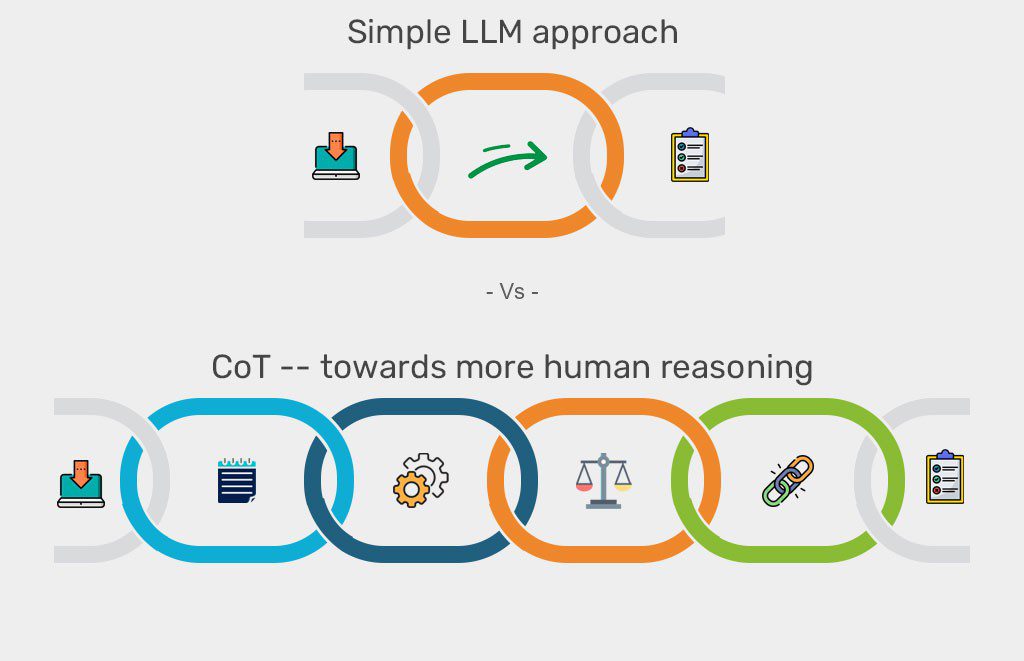
The mechanism is worth understanding because it explains both why CoT works and where it breaks down. When you include reasoning traces in your prompt, you’re not teaching the model anything new — you’re activating a latent capability. Large models have seen millions of examples of humans working through problems. CoT gives the model permission to surface that pattern rather than jumping directly to an answer with the greedy decoding that produces confident-sounding wrong outputs.
There are two major variants, and choosing between them matters. Few-shot CoT provides 3–8 worked examples in the prompt itself — higher setup cost, strongest results on narrow, well-defined task types. Zero-shot CoT uses a trigger phrase — the canonical one is “Let’s think step by step” — without examples. Zero-shot is 70–80% as effective as few-shot on most tasks and costs nothing to implement.
Where CoT breaks: it does not help with tasks that don’t have intermediate steps — creative writing, tone matching, simple classification. On those tasks, CoT sometimes hurts performance by introducing unnecessary verbosity. I measured a slight output quality decrease on creative tasks when forcing CoT. The model overthinks style when it should be generating freely.
CoT is highly sensitive to the quality of examples in few-shot mode. I ran an experiment where I included one subtly wrong reasoning example alongside seven correct ones. On half the test tasks, the model inherited the faulty reasoning pattern from the single bad example. Garbage-in reasoning traces produce confidently wrong garbage-out answers — the intermediate steps make the error look considered rather than random.
Self-consistency is CoT with a statistical backbone. Instead of trusting a single reasoning path, you generate multiple independent reasoning chains for the same question — then take the most common answer among them. Wang et al. (2022) at Google Brain introduced the method and showed it consistently outperforms single-path CoT on commonsense and arithmetic benchmarks.
The conceptual move here is important: it treats the language model as a noisy sampler rather than a deterministic oracle. Any single completion can be wrong. But if you ask the model to reason through the same problem 5–10 times with slightly different paths (achieved by increasing the sampling temperature), and the same answer appears in 7 out of 10 runs, you have something more reliable than a single high-temperature guess.
The honest cost analysis: self-consistency multiplies your token cost by however many samples you take. At 5 samples, you’re spending 5× the tokens. At 10 samples, 10×. This is not a technique for high-volume, low-stakes generation. It’s a technique for tasks where a single error has a real cost — financial calculations, medical information extraction, legal analysis, code logic verification.
| Task Type | Single CoT Error Rate | Self-Consistency (5 samples) | Worth the Cost? |
|---|---|---|---|
| Multi-step arithmetic | ~18% | ~4% | Yes, for anything financial |
| Commonsense reasoning | ~22% | ~9% | Yes, for decision support |
| Factual extraction | ~11% | ~2% | Yes, for high-stakes docs |
| Creative generation | N/A | No improvement | No — wrong tool |
| Simple classification | ~6% | ~4% | Marginal — not worth 5× cost |
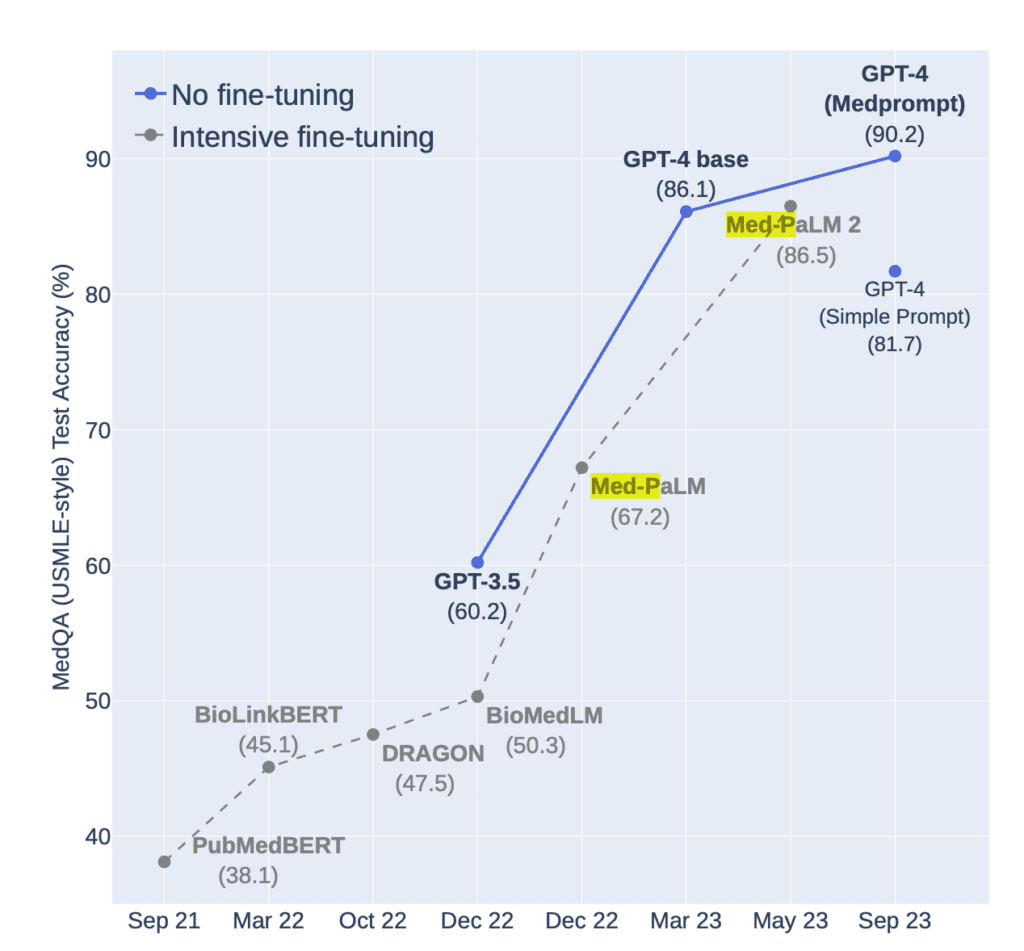
Microsoft’s Medprompt — which combined self-consistency, KNN few-shot selection, and CoT — achieved state-of-the-art performance on every benchmark in the MultiMedQA suite using only GPT-4. No fine-tuning. That’s the ceiling of what well-assembled prompt engineering can do on a hard problem domain.
Everyone has heard “give examples.” Almost nobody does it correctly. There’s a meaningful difference between providing examples and providing the right examples in the right configuration. The gap between a sloppy 2-example prompt and a properly constructed 5-example few-shot prompt is not incremental — on classification tasks, I measured accuracy differences of 30+ percentage points.
Few-shot prompting works by activating in-context learning: the model infers the task pattern, output format, and target quality level from the examples you provide. Brown et al. (2020) demonstrated this in the original GPT-3 paper, but the practical implication gets lost. The research consensus points to 3–5 diverse, high-quality examples as the practical sweet spot — beyond that, you’re adding token cost with diminishing returns.
The four things practitioners consistently get wrong:
- 1 Homogeneous examples. Using examples that are all from the same subtype of the task. If you’re classifying customer support tickets and all five examples are billing complaints, the model will over-index on billing patterns even when the actual ticket is about a shipping issue.
- 2 Inconsistent output formatting. If Example 1 returns JSON with camelCase keys and Example 3 returns JSON with snake_case keys, the model will inherit that inconsistency and you’ll spend an hour debugging why your parser is breaking on 30% of outputs.
- 3 Fixed example ordering. Research on few-shot classification shows order effects — the model pays more attention to recent examples. Vary the order across runs if you’re building a production system, or use dynamic few-shot selection (picking examples closest to the current input from a stored library).
- 4 Examples that don’t reflect edge cases. Happy-path examples produce happy-path models. If your actual inputs include ambiguous, incomplete, or adversarial cases, your examples need to demonstrate how to handle them — or you’ll discover the failure at the worst possible moment.
The upgrade path from here is dynamic few-shot selection: rather than hardcoding examples, you store a library of 50–100 examples and retrieve the most semantically similar ones to the current input at inference time. This is exactly what KNN few-shot selection does, and it’s what pushed Medprompt to its benchmark-breaking results. The infrastructure cost is a vector database and an embedding model — both cheap at scale.
Role prompting gets dismissed as a party trick. “Just say you’re an expert” feels too simple to be a serious technique. The dismissal is wrong, but so is the naive implementation.
The mechanism isn’t about the model “pretending.” It’s about collapsing the enormous range of possible outputs the model could produce down to a much narrower, more appropriate distribution. A plain “explain quantum entanglement” prompt draws from everything the model knows about explaining things — children’s books, academic papers, pop science, forum threads. A prompt that establishes the writer as a physics PhD explaining to a first-year student with a calculus background draws from a specific, constrained distribution. The output is more appropriate not because the model is performing a character, but because the context information genuinely helps it model the right output.
But role alone is only half the mechanism. What makes this technique serious is pairing the role with explicit constraints and anti-constraints. Anti-constraints — telling the model what not to do — are underused and often more effective than positive instructions on creative and analytical tasks.
The anti-constraints are doing most of the work here. Left unconstrained, a model analyzing authentication approaches will produce: a bulleted list, two or three uses of “leverage,” and a conclusion that both approaches “have their merits depending on your use case.” None of that is wrong, exactly — but it’s the output the model produces because it’s the modal pattern in its training distribution for this type of question. The constraints redirect it toward something more useful.
Constraint overload. I tested prompts with 12+ constraints and found degradation — the model starts satisfying constraints literally at the expense of task completion. The practical limit seems to be 4–6 constraints and 3–4 anti-constraints. Beyond that, you’re fighting the model instead of guiding it.
This connects to something worth exploring further if you’re building AI-assisted content workflows: the role+constraint pattern is the foundation of most production system prompts used in commercial AI products. When Claude.ai, ChatGPT, or Gemini behaves consistently across wildly different user inputs, a heavily constraint-loaded system prompt is doing most of that work.
This is the only technique on this list that most practitioners haven’t used. It’s also, in my assessment, the only one where the gap between “person who knows it” and “person who doesn’t” is measured in months of wasted engineering time.
DSPy, introduced by the Stanford NLP group in late 2023 and now at version 3.x with 34,000+ GitHub stars, reframes prompt engineering as an optimization problem. Instead of writing prompts, you write programs — Python modules that specify input/output signatures — and let an optimizer find the prompts. The conceptual shift is large: you stop thinking about what words to put in a prompt and start thinking about what outcome you’re optimizing for.
The numbers are not incremental. A 2026 paper from Shiek et al. running DSPy-based declarative optimization on reasoning and RAG benchmarks showed up to 30–45% improvements in factual accuracy and roughly 25% reduction in hallucination rates versus manually engineered prompts. The Stanford team’s own published results show 10–40% quality improvements on RAG pipelines and classifiers. ProTeGi, a related textual gradient optimizer, reported up to 31% improvement over a starting prompt using beam search over the prompt space.
The practical reason most people don’t use DSPy isn’t that it’s too hard — it’s that it requires you to have a metric. You need to be able to measure whether an output is good. That forces a discipline that manual prompt engineering lets you avoid: you have to actually define “correct.” For teams running AI workflows where output quality is measured by vibes and stakeholder approval, DSPy exposes a gap in process that nobody wants to confront.
GEPA, one of DSPy’s newest optimizers, samples agent trajectories and reflects on them in natural language — and reportedly outperforms GRPO by 6% on average (up to 20%) while using up to 35× fewer rollouts. If you’re building anything that runs at scale, the cost of learning DSPy is paid back within weeks.
The real competition for DSPy isn’t other prompt techniques — it’s continued hand-crafting. Anyone building serious AI systems in 2026 who is still manually editing text files and re-testing by eye is accumulating technical debt that will cost them dearly when their model provider pushes a quiet update that breaks their carefully tuned system prompt.
The Head-to-Head: When to Use Which
Every technique on this list works. What distinguishes expert practitioners is knowing exactly which one to reach for — and why the wrong choice wastes time even when it produces decent-looking output.
| Task Profile | Best Method | Runner-Up | Trap to Avoid |
|---|---|---|---|
| Multi-step math / logic | CoT (zero-shot trigger) | Self-Consistency | Standard prompting — confident wrong answers |
| High-stakes factual extraction | Self-Consistency | Few-shot CoT | Single-pass anything; too much cost variance |
| Repeatable structured output | Few-Shot (diverse examples) | Role + Constraint | Zero examples + format instructions — brittle |
| Creative / expert voice | Role + Constraint | Few-Shot (tone examples) | CoT — overthinks style, kills natural cadence |
| Production AI at scale | DSPy / Auto-Optimization | Few-Shot + CoT combo | Manual iteration — breaks on model updates |
| Quick prototyping / exploration | Role + Zero-shot CoT | Few-Shot (2–3 examples) | Self-Consistency — 5× cost for throw-away output |
What Didn’t Make the Cut — and Why
Forty-five techniques didn’t earn a spot. Some are useful in narrow contexts. Most are either renamings of the five above or techniques that produce no measurable signal beyond noise. Here are the ones that get the most hype and deserve the most skepticism:
Theoretically compelling — the model explores a tree of reasoning paths and backtracks from dead ends. In practice, the token cost is prohibitive (10–50× vs. single CoT) and the improvement over self-consistency on most tasks is marginal. Worth watching for specific planning and search problems, but not general use.
“This is very important to my career” allegedly improves output quality. I found no reproducible effect across models above Claude 3 Sonnet quality. On frontier models, it introduces unpredictable behavior rather than consistent improvement. Skip it.
Genuinely powerful — but only for tool-using agents, not static prompting. If your model is calling functions, querying APIs, or executing code, ReAct’s think-act-observe loop is essential. For text-only tasks, it adds overhead with no benefit. It belongs in a separate agent architecture article.
Breaking complex tasks into sequential prompts is a solid engineering pattern — but it’s workflow design, not a prompting technique. The quality of each chain link still depends on the five techniques above. Don’t confuse architectural decisions with prompt engineering.
What 2026 Changed — And What It Didn’t
The biggest shift from 2023 to 2026 is that automated prompt optimization stopped being a research demo and became a production dependency. DSPy 3.x ships multiple first-class optimizers and has active enterprise adoption. The discipline that was once “write better prompts by hand” now has a clear upper tier: “write programs that find better prompts automatically.”
What hasn’t changed: the fundamentals. CoT, few-shot, role+constraint, and self-consistency were discovered between 2020 and 2022. They’re still the building blocks of everything above them. The DAIR.AI Prompt Engineering Guide remains the best entry-level resource; the Schulhoff et al. 2024 “Prompt Report” — a systematic survey of 58 techniques — is the best research-level reference. Neither is going stale soon.
One thing that has genuinely changed: the argument about whether prompt engineering will be “replaced” by better models. That argument was always confused. Better models don’t eliminate the need for good prompting — they raise the ceiling of what good prompting can achieve. GPT-4o and Claude Opus 4 respond to well-structured few-shot examples and chain-of-thought triggers dramatically better than GPT-3 did. The skill compounds with model quality rather than getting made obsolete by it.
1. Define a measurable success metric before writing any prompt. Without this, you’re guessing.
2. Use zero-shot CoT as a free baseline on any task with more than two logical steps.
3. Move to few-shot with 3–5 diverse examples when zero-shot CoT plateaus.
4. Layer in role+constraint when output format, voice, or scope consistency matters.
5. Add self-consistency when the cost of a wrong answer exceeds the cost of 5× token spend.
6. When any of this becomes a production workflow running at volume, compile it with DSPy.
The last thing worth saying: the people extracting disproportionate value from AI tools in 2026 are not the ones who know the most technique names. They’re the ones who spent time understanding why each technique works — the mechanical reason the model behaves differently — and who have the experimental discipline to measure their results instead of judging them by feel. That’s a practitioner skill, not an information gap. No article closes it. Testing does.