

OpenAI Prompt Engineering
In the rapidly evolving landscape of artificial intelligence, one skill has emerged as absolutely crucial for anyone looking to maximize their productivity and achieve remarkable results: prompt engineering. Whether you’re a business professional, content creator, developer, or simply someone curious about AI’s capabilities, understanding how to craft effective prompts can transform your entire approach to working with AI systems like ChatGPT, GPT-5, o1, GPT-4o, and other OpenAI models.
The year 2025 marks a pivotal moment in AI interaction. With sophisticated models like GPT-5 Pro enabling faster responses and enhanced contextual understanding, and the O1 series excelling in advanced reasoning with images and math, the ability to communicate effectively with AI has become as important as traditional digital literacy skills. A 2023 study found that employees leveraging prompting strategies experienced up to 30% faster turnaround times on tasks, and recent 2025 research shows an average 11.46% performance improvement through query transformation in prompt engineering.
This comprehensive guide will take you from prompt engineering fundamentals to advanced techniques used by AI specialists and Fortune 500 companies. You’ll discover the science behind effective prompts, learn industry-specific applications, and gain access to proven frameworks that deliver consistent, high-quality results. Enhanced with visuals, sourced data, and updates for 2025’s latest models, by the end of this article, you’ll possess the knowledge and skills to harness AI’s full potential for your personal and professional goals.
What is Prompt Engineering?
Prompt engineering is the practice of designing and optimizing text inputs (prompts) to elicit specific, desired outputs from AI language models. Think of it as learning the most effective way to communicate with an incredibly knowledgeable assistant who can help with virtually any task, but needs precise instructions to deliver exactly what you need.
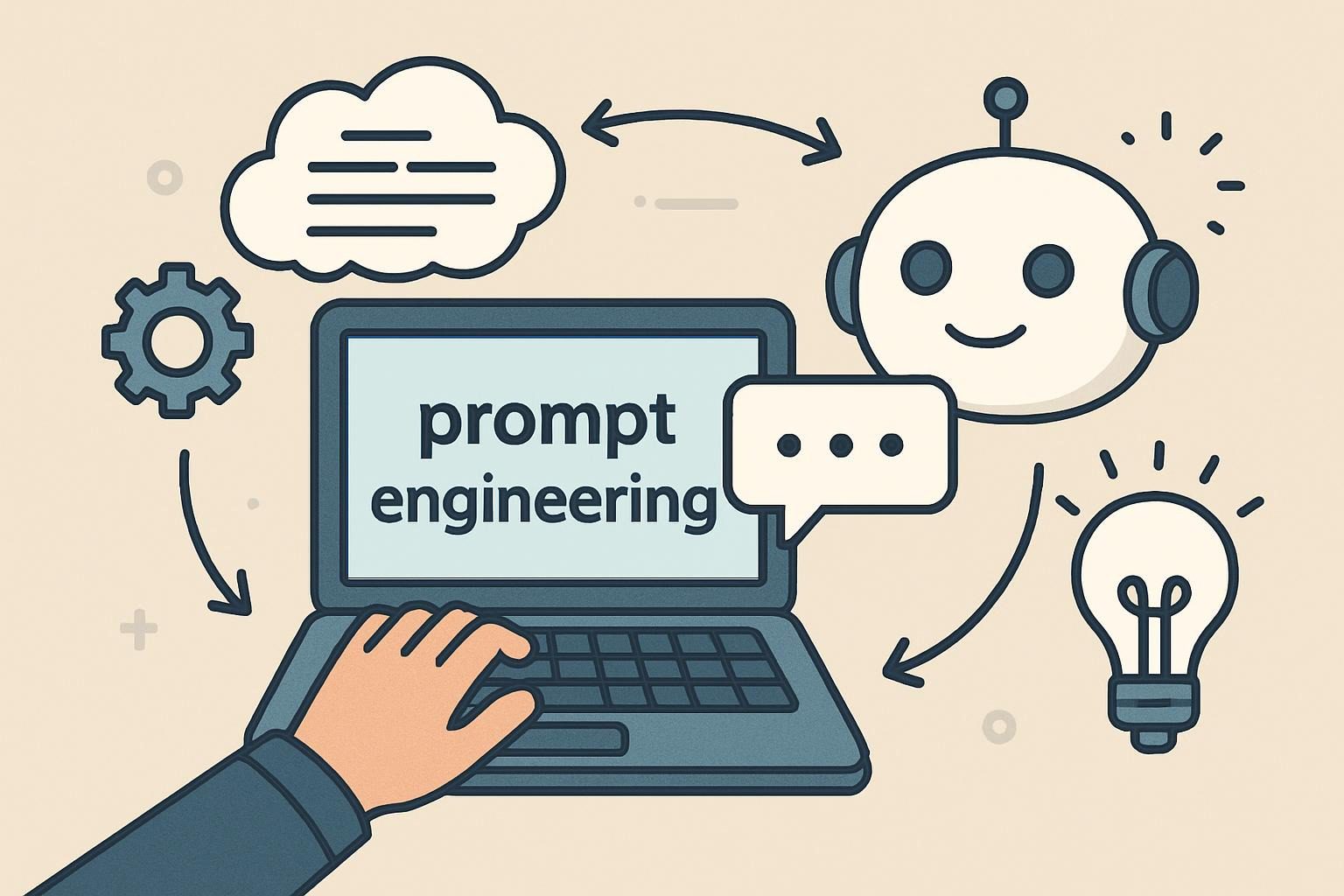
At its core, prompt engineering combines elements of linguistics, psychology, and technical understanding of how AI models process information. It’s both an art and a science – requiring creativity to craft engaging prompts while adhering to systematic principles that consistently produce quality results.
The importance of prompt engineering has grown exponentially as AI models have become more powerful and accessible. OpenAI’s latest models, such as GPT-5 for superior coding and debugging, and o1 for reasoning with images, can handle an enormous range of tasks from creative writing to complex analysis, but their effectiveness largely depends on how well users can communicate their intentions through prompts.
The Science Behind Effective Prompts
Modern AI language models work by predicting the most likely next words based on patterns learned from vast amounts of text data. When you provide a prompt, the model uses this information to generate responses that statistically align with similar contexts it encountered during training.
Understanding this process helps explain why certain prompt structures work better than others. Clear, specific prompts with relevant context give the model more accurate signals about what type of response you’re seeking. Ambiguous or vague prompts often result in generic or off-target responses because the model lacks sufficient guidance.
Research from leading AI institutions, such as a 2025 review on LLMs, reveals that well-engineered prompts can improve task performance by 40-60% across various applications, from customer service automation to content creation and data analysis.
Core Principles of Effective Prompt Engineering
- Clarity and Specificity
The foundation of successful prompt engineering lies in clear, specific communication. Vague prompts like “help me with marketing” will generate generic responses, while specific prompts such as “create a 7-day social media content calendar for a sustainable fashion brand targeting millennials, focusing on Instagram and TikTok” produce targeted, actionable results.
Specificity should extend to:
- Format requirements (e.g., bullet points, paragraphs, tables)
- Length constraints
- Tone and style
- Context details
- Context Setting
Providing adequate context is crucial for obtaining relevant responses. AI models perform significantly better when they understand the situation, audience, and objectives. Include background information, audience definitions, goals, and constraints. - Role Assignment
Assign specific roles to the AI, such as “Act as a financial advisor with 20 years of experience…” This leverages the model’s learned patterns to adjust expertise and approach. - Step-by-Step Instructions
Break down complex tasks into sequential steps to reduce oversights and improve systematic reasoning. - Examples and Templates
Use few-shot prompting by including 1-2 examples to pattern-match and ensure consistency.
Advanced Prompt Engineering Techniques
Chain-of-Thought Prompting
Chain-of-thought (CoT) prompting encourages the AI to show its reasoning process, leading to more accurate responses. This is particularly valuable for complex problem-solving.
Example: “Let’s work through this step by step. First, identify the key factors involved. Then, analyze each factor’s impact. Finally, provide your recommendation.”
A 2025 review indicates CoT can improve reasoning tasks by up to 85%.
Temperature and Token Control
Adjust temperature for creativity: low (0.1-0.3) for factual tasks, high (0.8-1.0) for brainstorming. Manage tokens to avoid cutoffs, especially with larger context windows in models like GPT-5 (up to 1M+ tokens).
Multi-Turn Conversations
Design iterative flows for refinement, building context over exchanges. This is ideal for models with long context like o1 (128K tokens).
Negative Prompting
Specify what to avoid, e.g., “Don’t include generic advice or clichés.”
Additional 2025 Techniques
- Zero-Shot Prompting: Direct instructions without examples for simple tasks.
- Self-Consistency: Generate multiple responses and select the most consistent.
- Meta-Prompting: Use prompts to generate better prompts automatically.
Industry-Specific Prompt Engineering Applications
- Content Marketing and SEO: Include keywords, personas, and goals for optimized content. Testimonial from Sarah Chen, Digital Marketing Manager: “Our content production increased by 400% with quality maintenance.”
- Software Development: Specify languages, frameworks, and edge cases for production-ready code. Testimonial from Marcus Rodriguez, Senior Software Engineer: “Prompt engineering has revolutionized coding challenges, getting production-ready suggestions in minutes.”
- Business Analysis and Strategy: Use frameworks like SWOT with industry context for market research.
- Education and Training: Create personalized learning paths; employee engagement scores improved by 65% in studies.

OpenAI Model Comparison and Optimization
Updated for October 2025, here’s a comparison of key OpenAI models based on official specs and recent releases:
| Feature | GPT-5 Pro | o1-preview | GPT-4o | GPT-3.5 Turbo |
|---|---|---|---|---|
| Context Window | 1M+ tokens | 128K tokens | 128K tokens | 16K tokens |
| Reasoning Ability | Superior in coding/debugging | Advanced with images/math | Strong multimodal | Basic pattern recognition |
| Creative Writing | Highly nuanced | Balanced | Superior | Strong |
| Code Generation | Excellent for large repos | Good for science/coding | Excellent | Good |
| Factual Accuracy | Highest, minimal hallucination | High in reasoning | High | Good with errors |
| Processing Speed | Fast responses | Moderate | Fast | Very fast |
| Cost per Token | Higher (Input: $15/1M, Output: $60/1M) | Medium (Input: $15/1M, Output: $60/1M) | Medium (Input: $2.50/1M, Output: $10/1M) | Low (Input: $0.50/1M, Output: $1.50/1M) |
| Multimodal Support | Full (text, image, video) | Images/reasoning | Image/text | Text-only |
Model Selection Guidelines: Choose GPT-5 Pro for complex, high-stakes tasks like large-scale coding; o1-preview for visual and mathematical reasoning; GPT-4o for balanced multimodal applications; GPT-3.5 Turbo for cost-sensitive, high-volume queries.
Optimization Strategies by Model
- GPT-5 Pro Optimization: Leverage massive context for comprehensive inputs; use multi-step reasoning.
- o1-preview Optimization: Focus on chain-of-thought for reasoning; incorporate image descriptions.
- GPT-4o Optimization: Use for iterative refinement in multimodal tasks.
- GPT-3.5 Turbo Optimization: Keep prompts concise for speed and cost efficiency.
Common Prompt Engineering Mistakes and How to Avoid Them
- Vague or Ambiguous Instructions
Problem: Leads to unfocused responses.
Solution: Specify format, length, audience, and purpose upfront. - Overwhelming the Model with Information
Problem: Confuses the model.
Solution: Use hierarchical structuring to organize info. - Failing to Iterate and Refine
Problem: Suboptimal first-try results.
Solution: Treat as an iterative process; analyze and adjust. - Ignoring Output Format Requirements
Problem: Unusable structure.
Solution: Always define formats (e.g., lists, tables). - Inconsistent Prompting Across Team Members
Problem: Variable quality.
Solution: Standardize templates and train teams.
Building Your Prompt Library: Templates and Frameworks
Content Creation Templates
Blog Post Generation Template:
Act as an expert content writer specializing in [INDUSTRY]. Write a comprehensive blog post about [TOPIC] for [TARGET AUDIENCE].
Requirements:
- Length: [WORD COUNT] words
- Tone: [PROFESSIONAL/CASUAL/CONVERSATIONAL]
- Include: [SPECIFIC ELEMENTS]
- SEO focus: [PRIMARY KEYWORDS]
- Call-to-action: [DESIRED ACTION]
Structure with headings, actionable insights, and examples. Optimize for search engines.
Analysis Framework Template
Strategic Analysis Template:
You are a senior business analyst with expertise in [INDUSTRY]. Conduct a comprehensive analysis of [SITUATION/PROBLEM].
Framework:
- Current State Assessment
- Key Challenges and Opportunities
- Stakeholder Impact Analysis
- Risk Assessment
- Strategic Recommendations
- Implementation Considerations
Provide data-driven conclusions and actionable recommendations.
Creative Brainstorming Template
Idea Generation Template:
Act as a creative strategist for [PROJECT TYPE] in [INDUSTRY]. Generate [NUMBER] innovative ideas for [CHALLENGE].
Parameters:
- Budget: [RANGE]
- Timeline: [TIMEFRAME]
- Audience: [DESCRIPTION]
- Metrics: [KEY METRICS]
- Constraints: [LIMITATIONS]
For each idea: Description, impact, resources, timeline. Prioritize by feasibility and ROI.
Technical Documentation Template
Code Documentation Template:
You are a senior software engineer in [LANGUAGE/FRAMEWORK]. Document [CODE/FEATURE].
Include:
- Overview and purpose
- Prerequisites/dependencies
- Installation/setup
- Usage examples
- Configuration options
- Troubleshooting
- Performance considerations
- Security best practices
Write for [SKILL LEVEL] developers with clear examples.
Multimodal Template (New for 2025)
Image Analysis Template:
Analyze this image [DESCRIPTION or URL] step-by-step, focusing on [ELEMENTS]. Act as a [ROLE, e.g., data scientist]. Output in [FORMAT], avoiding [NEGATIVES].
Measuring and Improving Prompt Performance
Key Performance Indicators for Prompts
- Quality Metrics: Relevance score (1-10), accuracy percentage, completeness ratio, consistency score.
- Efficiency Metrics: Time to output, token usage, revision frequency, and user satisfaction.
- Business Impact Metrics: Task time reduction, production volume increase, error rate decrease, and cost per output.
A/B Testing Prompt Variations
Test one variable at a time (e.g., tone, structure). Use baseline prompts, measure with criteria, and adopt winners.
Continuous Improvement Process
- Weekly Review: Analyze data, test variations, update libraries.
- Monthly Assessment: Evaluate effectiveness, identify training needs, and incorporate new techniques.
Future of Prompt Engineering: Trends and Predictions
Emerging Techniques and Technologies
The field evolves rapidly in 2025-2030:
- Multi-Modal Prompting: Integrate text, images, audio, and video for richer interactions.
- Automated Prompt Optimization: AI systems test variations to refine prompts automatically.
- Domain-Specific Libraries: Tailored for industries, ensuring compliance and quality.
- Adaptive Prompting: AI adapts to user styles in real-time.
- Human-AI Collaboration: Enhances creativity and decision-making.
Industry Adoption Patterns
Enterprises establish prompt engineering roles, with 200-400% productivity gains reported. Universities add courses, and standardization efforts create certifications.
Predictions for 2025-2030
- Natural language programming blurs with coding.
- Personalized assistants learn user preferences, reducing manual effort.
- Regulatory frameworks emerge for sensitive sectors like healthcare and finance.
Ethical Considerations in Prompt Engineering
Responsible AI interaction is paramount. Ethical prompt engineering involves:
- Bias Mitigation: Craft prompts to avoid stereotypes; test across diverse scenarios. Real-world example: In healthcare, poorly prompted AI might perpetuate gender biases in diagnoses (e.g., overlooking symptoms in women). Counter by including inclusive language like “Consider diverse demographics, including gender, age, and ethnicity.”
- Transparency and Disclosure: Always note AI-generated content to build trust.
- Privacy Protection: Avoid prompts with sensitive data; use anonymized examples.
- Human Oversight: Review outputs for high-stakes applications to prevent harm.
Best Practices for Ethical Prompt Engineering
- Use inclusive language to promote diversity.
- Implement fact-checking for claims.
- Maintain audits for unintended biases.
- Consider stakeholder impacts.
- Ensure compliance with emerging regulations.
Frequently Asked Questions (FAQ)
What is the difference between prompt engineering and regular AI usage?
How long does it take to learn effective prompt engineering?
Can prompt engineering replace human creativity and expertise?
What are the most common mistakes beginners make?
How do I know if my prompts are working effectively?
Is prompt engineering worth learning for non-technical professionals?
What’s the future career outlook for prompt engineering specialists?
How do 2025 models like GPT-5 change prompt engineering?
Conclusion: Mastering the Art and Science of AI Communication
Prompt engineering represents a fundamental shift in human-AI interaction, turning AI into an intelligent collaborator. This guide covers principles, techniques, applications, and future trends, with updates on 2025 advancements, such as GPT-5.
Key takeaways: Prioritize clarity, context, and iteration; leverage model strengths; measure performance; uphold ethics.
Your Next Steps: Start with one template aligned to your needs. Experiment daily, track results, and join communities like
Transform from basic user to skilled practitioner—unlock AI’s potential today for personal and professional success.