The Complete AI Marketing Stack for Modern Businesses
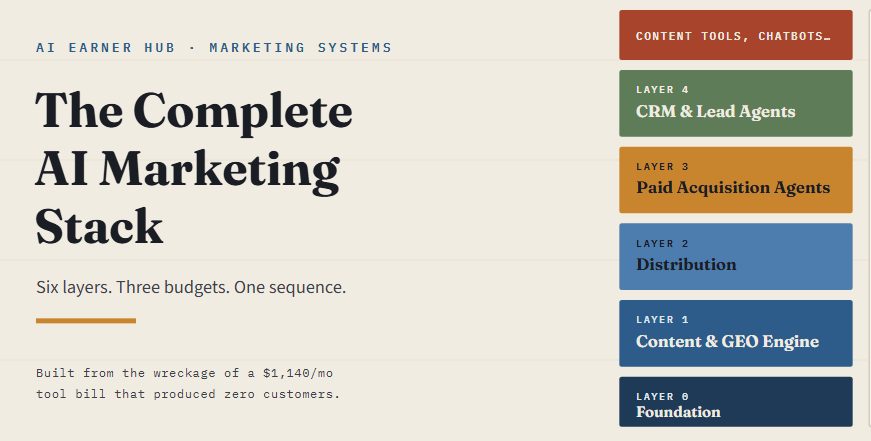
Six layers, three budgets, one sequence — built from the wreckage of a $1,140-a-month tool bill that produced exactly zero new customers, and rebuilt to survive a search landscape where over half of Google’s results pages no longer send a click anywhere.
In March, I sat down with a client’s accounting software and pulled every line item tagged with the word “AI.” Fourteen tools. $1,140 a month, charged automatically for eleven straight months. When I asked the owner which one had brought in a customer she could point to, she thought about it for a good ten seconds and said, “Maybe the chatbot?” It wasn’t the chatbot. The chatbot had handled four conversations that month, and three of them were me, testing it.
Here’s what the fourteen tools actually were, because the list matters more than the total: three overlapping “AI SEO” subscriptions doing the same keyword research in slightly different dashboards, an AI writer producing blog drafts that sat in a Google Doc folder nobody opened, a social caption generator feeding an Instagram account that hadn’t posted in six weeks, an AI image tool, an email subject-line tester running against a list of 340 people, the chatbot, an “AI marketing team in a box” platform that promised to replace a CMO for $297 a month, and two separate analytics dashboards that neither of us had logged into since onboarding.
None of these were bad products. I’ve used versions of half of them myself and would recommend several with a clear conscience. The problem wasn’t quality. The problem was that they were fourteen separate bets, placed in whatever order a SaaS company’s retargeting ad happened to reach the owner’s feed, with no relationship to each other and no shared idea of what “working” would even look like.
I’ve built a version of this exact mess myself — for my own business, in 2024, before I had any business telling other people how to do this. The fix isn’t a better tool. It’s an order.
A Stack Is an Order, Not a Shopping List
Borrow the word “stack” from how engineers actually use it and the fix becomes obvious. A stack is layers that depend on the layer below them. The database doesn’t care how nice your app’s interface looks; if the database is wrong, the interface is just a pretty window onto wrong data. Marketing software gets sold as if every tool sits on its own ground floor — buy it, plug it in, results. In practice, an AI writing tool sitting on top of no content strategy produces drafts nobody publishes. A CRM “agent” sitting on top of messy contact data automates the wrong outreach, faster. An ad-optimization AI sitting on top of a landing page that doesn’t convert just finds more efficient ways to spend your money on a page that doesn’t work.
The fourteen-tool client had bought almost exclusively from the top of the stack — content generation, social automation, a chatbot — while the foundation underneath (a working LLM workflow, clean customer data, one piece of content that actually mattered to her actual buyers) didn’t exist yet. Every tool she’d bought was a roof with no walls.
The Floor Moved While Everyone Was Shopping for Furniture
There’s a second reason “buy tools in a sensible order” isn’t quite enough advice anymore, and it’s bigger than any single client’s spreadsheet. Sometime between early 2025 and now, the ground that all of this marketing activity stands on — Google search results — changed shape, and most small-business stacks haven’t caught up.
By February 2026, AI Overviews were appearing on roughly 48% of tracked Google queries, up from about 31% a year earlier, according to BrightEdge’s tracking. By April, some trackers — Advanced Web Ranking among them — put the figure past 60% of US queries for the first time, with the feature now live across more than 200 countries in 40-plus languages. Semrush’s run through 10 million keywords over 2025 showed the same story with more texture: AI Overview prevalence climbed from about 6.5% in January to a peak near 24.6% in July, dipped to roughly 15.7% by November, then resumed climbing hard into 2026. It isn’t a smooth ramp. It’s a ramp with air pockets, and the overall direction is up.
What that means for clicks is the part that should change your stack. Pew Research’s controlled study of 68,000 queries found a 46.7% relative drop in clicks when an AI Overview appears. Position-1 rankings — the spot every SEO tool in that fourteen-tool stack was chasing — saw the sharpest click-through declines of any position, around 34.5%. Meanwhile, Seer Interactive’s 2026 analysis of roughly 5.47 million queries across 53 brands found that being cited inside an AI Overview is worth something real: cited brands earn about 120% more organic clicks per impression than uncited brands on the same query. Citation, not ranking, is becoming the prize. And citation has its own rules — Ahrefs’ 2026 data found external brand mentions correlate at 0.664 with AI Overview citation, and a page ranking #1 has roughly a 58% chance of being cited versus 14% by position 10.
Then there’s the part nobody’s stack has a line item for yet: AI-mediated shopping. A Drapers/Athos Commerce survey of 2,000 UK consumers in mid-2026 found 60% now use tools like ChatGPT, Claude, or Gemini while researching fashion purchases, and 39% said they’d be comfortable buying directly through an AI assistant. Google’s own AI Mode passed one billion monthly users by its May 2026 developer event, where the company also previewed an agentic rebuild of its ads stack — the same event that saw the ad-tech industry coalesce around the new Ad Context Protocol (AdCP) for letting AI agents transact on ad inventory directly. Separately, Google Analytics began rolling out tools in June 2026 specifically to surface “AI referral” traffic — visits arriving from ChatGPT, Gemini, and other assistants — because until that update, this traffic was arriving in dashboards as direct or unattributed, invisible to anyone deciding what to fund next.
The Six Layers
None of this means throw away SEO, or that AI Overviews are the only thing that matters, or that your Tuesday newsletter is suddenly obsolete. It means the stack needs a layer that didn’t exist in most 2023-era marketing plans, and it means the layers that do exist need to talk to each other in a specific order. Here’s the order I rebuild toward now, for almost every business between one and fifty employees.
Layer 0: The One Relationship Everything Else Depends On
This is the layer the fourteen-tool client had completely skipped, and it costs the least of anything on this list — sometimes nothing at all. It’s two things: picking one or two large language models as your default working environment (ChatGPT, Claude, or Gemini — the specific choice matters less than picking one and getting fluent in it), and getting your customer data into a state where an AI tool acting on it won’t make things worse.
The data-hygiene half sounds boring enough to skip, and that’s the trap. Every layer above this one — content suggestions, ad targeting, CRM follow-ups — is an AI system reading your data and acting on it. If your contact list has 40% duplicate or dead entries, an email AI optimizing “send time” or a CRM agent scoring “lead quality” is optimizing against noise. One piece of research on agentic marketing tools from spring 2026 put it bluntly: poor CRM and analytics data leads agents to optimize toward the wrong outcomes entirely, which is why a data audit has to happen before any agent gets switched on, not after it starts misbehaving.
Layer 1: The Content Engine, Not the Drafting Tool
This is where most of the fourteen tools lived, and where most of the wasted money was. There’s a real distinction between a drafting tool and a content engine, and it’s the difference between “writes faster” and “runs the workflow.” Jasper, Copy.ai, and similar tools are genuinely good at producing a draft from a prompt. What they don’t do is decide what to write about, check it against what’s already ranking (or being cited), optimize it for both traditional SEO and the newer discipline of GEO — generative engine optimization, meaning structuring content so AI systems can extract and cite it — and then publish it without someone copying and pasting between five tabs.
If you’re starting from zero, an integrated content engine that handles strategy through publishing in one workflow saves real hours — one estimate from a small-business AI stack guide published in April 2026 put it at five to eight hours a week in coordination alone, at price points around $99 a month for a solo-tier plan. If you already have a writer, an SEO tool, and a CMS that work fine separately, a drafting tool layered on top of that existing setup is the more sensible buy. The mistake is buying both — which is what three of the fourteen overlapping subscriptions were doing.
I’ve covered the caption and hashtag side of this layer in more depth separately, including which AI caption tools actually save time versus which ones just rearrange your sentence — worth a read before you add a third content tool to a stack that probably only needs one.
Layer 2: Distribution — Where the Words Actually Go
Content that doesn’t go anywhere is the single most common waste I see, and it was true for this client’s six-weeks-dormant Instagram account and her untouched blog drafts both. This layer is deliberately unglamorous: a scheduler that pushes Layer 1’s output to email and social on a rhythm a real person can sustain.
On email, Mailchimp’s Intuit Assist and ActiveCampaign (entry plans start around $49 a month) both do reasonable jobs of AI-assisted send-time optimization and subject-line testing — but only after you’ve solved the actual problem, which increasingly isn’t “what should the subject line say.” It’s whether the email lands in the inbox at all. Gmail’s AI-driven inbox filtering has gotten meaningfully more aggressive, and I’ve written separately about what Gemini’s filtering changes mean for which AI email tools still reach the inbox — it’s a Layer 2 problem that no amount of Layer 1 content quality can fix on its own.
On social, the AI-assisted schedulers (Hootsuite, Buffer, Canva’s Magic Studio for the visual side) are mature enough now that the differentiator isn’t the tool, it’s whether your hashtag and posting-time strategy reflects how the algorithms actually behave today rather than two years ago — something I went into detail on in the breakdown of Instagram’s algorithm changes and what they did to hashtag strategy.
Layer 3: Paid Acquisition — The Agents Are Already Driving
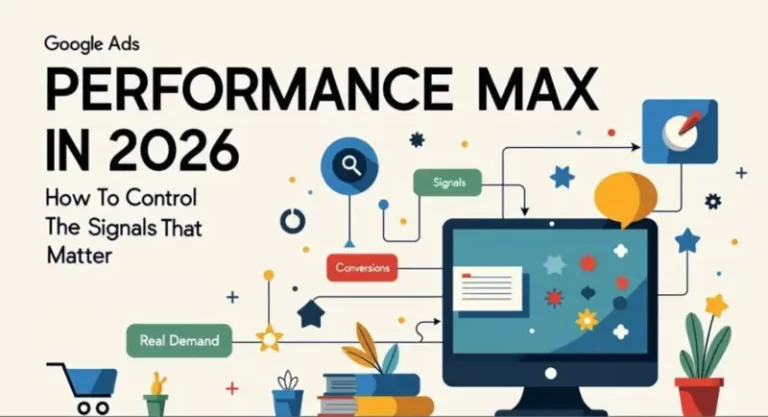
Here’s something worth sitting with: if you run Google or Meta ads at any meaningful scale, you are already using agentic AI, whether you opted in consciously or not. Performance Max handles bid, targeting, and creative-variant optimization across Google’s inventory; Meta’s Advantage+ does the equivalent across Facebook and Instagram. At Google Marketing Live in late May 2026, Google previewed a further rebuild of the ads stack around agentic AI, and the broader ad-tech industry has started coalescing around the new Ad Context Protocol (AdCP), a standard for letting AI agents transact on ad inventory directly rather than through a human buyer clicking through a dashboard.
The trade-off here is real and worth saying plainly: the more these systems automate, the less granular control you have, and the more they depend on Layer 0’s data being clean — feed Performance Max a conversion signal that’s actually measuring newsletter signups when you meant purchases, and it will efficiently buy you a lot of newsletter signups. The other thing worth knowing before Cannes Lions rolls around this June: 2026’s creative conversation in advertising has swung hard back toward “AI as tool, not AI as creator,” after visible backlash to fully AI-generated ad spots during the last Super Bowl. Automating the media buying is, at this point, mostly uncontroversial. Automating the creative that runs inside it is still something audiences notice — and not in a good way.
Layer 4: CRM and Lead Agents — Probably Not Yet
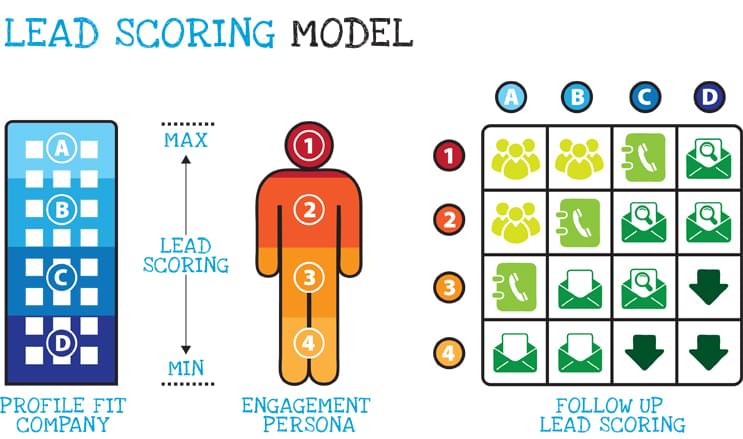
This is the layer everyone wants to talk about and almost nobody at small-business scale should be buying first. HubSpot’s Breeze AI agents — lead scoring, prospecting, email optimization — come bundled with Marketing Hub Professional at roughly $800 a month. Salesforce Agentforce ranges from a free Foundations tier with limited usage credits up to $550-plus per user per month for full access. Both are genuinely capable. Both are also overkill for a business whose Layer 0 data hygiene and Layer 1 content engine aren’t running yet, because an agent automating “follow up with this lead” on top of a CRM full of duplicates and dead contacts just automates the chasing of ghosts, faster and more confidently than a human would.
Here’s the context that should make any small-business owner feel better about waiting: Gartner’s 2026 CMO Spend Survey — of 401 marketing leaders, the large majority at companies with over $1 billion in annual revenue — found that while CMOs allocate an average of 15.3% of marketing budgets to AI, only about 30% report their organizations are actually ready to scale those capabilities. If companies with nine-figure marketing budgets and dedicated ops teams are mostly not ready for agentic CRM at scale, a five-person business absolutely should not feel behind for sequencing this layer last. The McKinsey estimate cited alongside this trend — 10 to 30% revenue uplift from this kind of always-on personalization — is real, but it’s an estimate for organizations where Layers 0 through 3 are already humming. Bolted onto a stack that isn’t, the same technology just personalizes the wrong message to the right person faster.
Layer 5: Measurement and the Governance Layer Underneath Everything
This is the layer that runs sideways through all the others rather than sitting on top, and it’s the one I’d actually argue is most urgent to get right in 2026 specifically — because of that AI-referral blind spot. Until Google Analytics’ June 2026 update started surfacing visits from ChatGPT, Gemini, and other AI assistants as their own category, this traffic landed in most dashboards as “direct” or simply vanished into “unattributed,” meaning a business could be getting real customers via AI search and have no way to see it, fund it, or replicate it.
The governance half of this layer is less a tool than a habit: a monthly thirty-minute review where someone actually looks at what each layer produced, against what it cost. Not a dashboard nobody opens — an actual habit, on a calendar, with a name attached. This is the layer the fourteen-tool client was missing most completely, and it’s the cheapest one to add. It’s also the one most likely to tell you, eventually, that one of your other thirteen tools should be cancelled.
Three Budgets, Three Stacks
The six layers are constant. What changes by business size is which specific tools fill each one, and how much of each layer you need running before moving up. Here’s how I’d actually allocate across three common stages — figures reflect publicly listed pricing as of mid-2026 and will drift, sometimes within months.
| Layer | Solo / Starter (<$150/mo) | Growth ($400–900/mo) | Scale ($1,500–5,000+/mo) |
|---|---|---|---|
| 0 — Foundation | ChatGPT Plus or Claude Pro~$20/mo | Team plan + data-cleanup pass~$25–30/seat | Enterprise LLM agreement + Microsoft Copilot across the team~$30/seat + base |
| 1 — Content & GEO | Solo-tier content engine (e.g. Averi Solo)~$99/mo | Content engine + Surfer/Semrush AI for SEO & GEO tracking~$150–300/mo | Full content engine + dedicated GEO/citation monitoring~$500–1,200/mo |
| 2 — Distribution | Mailchimp free/essentials + Canva Magic Studio~$15–30/mo | ActiveCampaign + Hootsuite or Buffer~$49–150/mo | Enterprise ESP + Canva/Adobe Firefly across teams~$300–800/mo |
| 3 — Paid acquisition | Native Performance Max / Advantage+ad spend only | Same, plus a reporting layer on topad spend + ~$100–300/mo | AdCP-aware agentic platforms + agency oversightad spend + ~$1,000+/mo |
| 4 — CRM & agents | HubSpot free CRM (agents off)$0 | HubSpot Breeze AI, Marketing Hub Pro~$800/mo | Salesforce Agentforce or equivalent$0–$550+/seat |
| 5 — Measurement | GA4 + monthly manual review$0 | GA4 + AI-referral tracking add-on~$30–80/mo | GA4 + dedicated MOps review against a governance checklistinternal time + ~$200/mo tooling |
The Sequence
Order matters as much as the table above. Layering everything on at once recreates the fourteen-tool problem with better individual tools. The sequence below is the one I now default to, adjusted up or down by a month or two depending on how much Layer 0 work is already done.
A trade reporter’s write-up in April 2026 described a US e-commerce business that went from sending three emails a month, manually, to fifteen AI-assisted ones over four weeks — and saw revenue rise around 35% while the effort involved dropped by roughly 60%. The detail that matters more than the percentages: that business already had Layer 0 and Layer 1 in reasonable shape. The email layer was the bottleneck being released, not the first thing bought.
Data audit done
Duplicate and dead contacts removed before any agent touches the list.
AI referral visible
Your analytics can show, by name, whether ChatGPT or Gemini sent you a visitor this week.
One layer cancelled
If the monthly review hasn’t told you to cut at least one tool by now, the review isn’t being done.
The Tool I Stopped Recommending
That sameness is becoming a measurable disadvantage, not just an aesthetic one. As AI search systems get better at citing sources, the sources that get cited are disproportionately the ones with something distinct to say — a specific number, a named source, an admitted failure. Generic brand voice doesn’t just read as forgettable to a human; it gives an AI Overview nothing distinguishable to extract and attribute.
What Won’t Survive This Article
Every dollar figure in the table above is accurate as of mid-2026 and will be wrong by the time some of you read this — not because the analysis is sloppy, but because the layer it’s describing is the one currently being rebuilt fastest. AdCP is months old. Agentic ad-buying previewed at Google Marketing Live hasn’t fully shipped. The AI-referral tracking in Analytics is brand new enough that most businesses haven’t turned it on yet, let alone built a habit of reading it.
What won’t be wrong is the order. Foundation before content, content before distribution, distribution before paid agents, paid agents before CRM agents, measurement running underneath all of it from day one. Specific tools will be swapped in and out of these six slots for years. The slots, and the sequence you fill them in, are the part of this stack actually worth building — the rest is furniture you can move later.
Sources & Further Reading
- → AI Overview prevalence & click impact: AI Overviews Statistics 2026: 80+ Data Points Decoded — compiles BrightEdge 12-month tracking, Pew Research (68,000 queries), Ahrefs, and Seer Interactive data.
- → Pew Research click-through study: Pew Research Demonstrates Sharp Impact of AI Overviews on Publisher Search Traffic — 900-user panel showing 15% → 8% click drop when AI Overviews appear.
- → Seer Interactive citation & CTR analysis: AI Overview CTR Fell 61%, But Clicks Didn’t Collapse — 2.43B impressions across 53 brands; cited brands earn ~120% more clicks per impression.
- → Ahrefs citation probability data: 2026 AI Citation Position & Revenue Report — position #1 = 33.07% citation probability; external brand mentions correlate at 0.664 with AI Overview citation.
- → Google AI Mode 1 billion users (May 2026): A new era for AI Search — Google Blog — official Google I/O 2026 announcement confirming AI Mode crossed 1 billion monthly users.
- → Ad Context Protocol (AdCP): AdCP — Introduction to the Protocol — official documentation for the agentic ad-buying standard.
- → Gartner 2026 CMO Spend Survey: Gartner 2026 CMO Spend Survey — 15.3% of budgets to AI; only 30% ready to scale (401 CMOs surveyed).
- → Drapers / Athos Commerce AI shopping survey: Connected Consumer 2026 Report — 60% of UK consumers use AI tools while shopping; 39% comfortable buying through AI assistants (2,000 respondents).
- → McKinsey AI personalization revenue estimates: 31 Personalized Shopping Experience Statistics — 5–15% revenue lift from personalization; 10–30% marketing efficiency improvement.
- → GA4 AI referral tracking setup: How to Track AI Search Traffic to Your Website (2026) — step-by-step guide for surfacing ChatGPT, Gemini, and Claude traffic in Google Analytics.