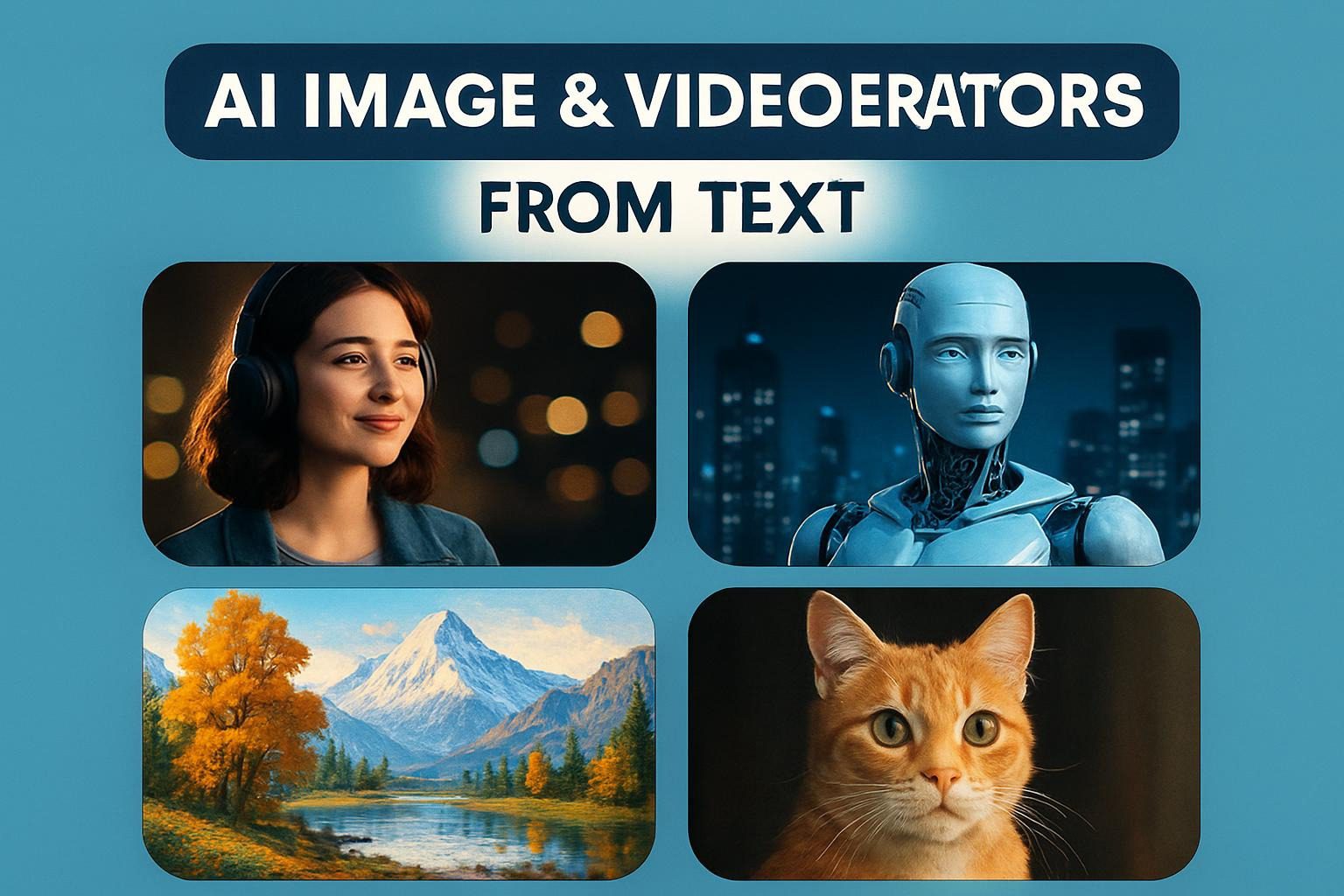
Best AI Image & Video Generators
from Text — Honest Rankings
The only guide that tests every major platform, cuts through the hype, and tells you what actually works — with real prompts, real pricing, and real use cases.
- Best image overall: Midjourney V7 (artistic) / FLUX.1.1 Pro (photorealism)
- Best video overall: Google Veo 3.1 (quality) / Kling 3.0 (value)
- Best free option: Leonardo AI free tier (150 generations/day) + Pika free tier
- Best commercial-safe pick: Adobe Firefly (trained on licensed content only)
- Biggest 2026 surprise: Midjourney V8.1 Alpha — early testers say it’s 5× faster with native 2K output
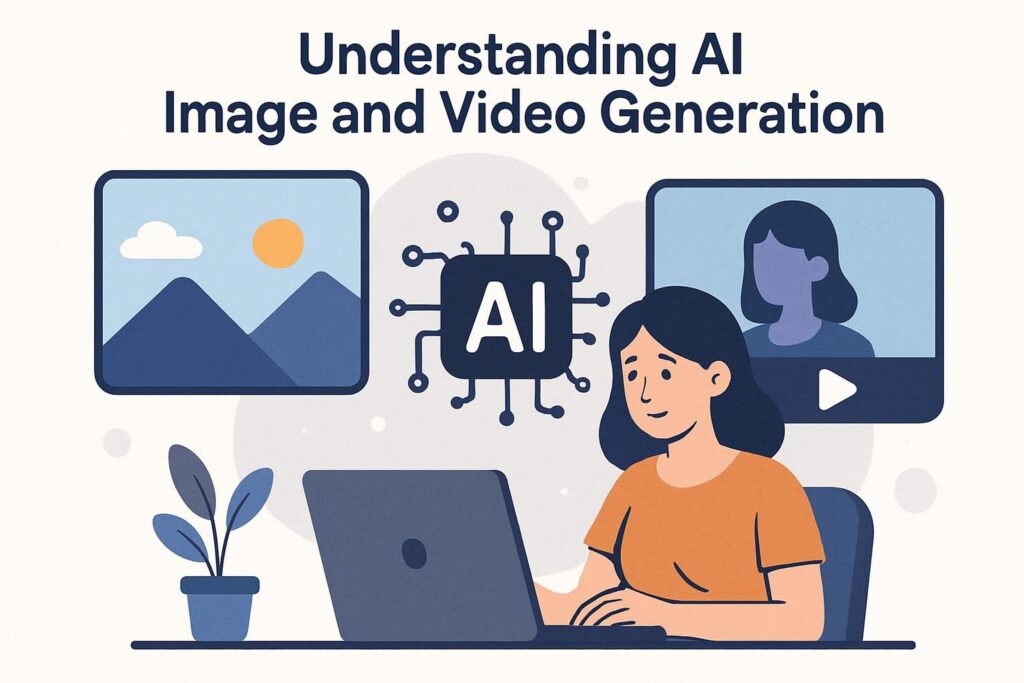
How AI Image & Video Generation Actually Works
Let me be honest about something. Most explainers in this space wave their hands and say “diffusion models!” like that answers anything. Here’s the actual picture, explained like a human would explain it.
When you type “a foggy Paris street at dawn, oil painting style” into Midjourney, your text goes through several translation layers. The model encodes your words into mathematical coordinates — a sort of map of the “idea space” it learned by studying hundreds of millions of image-text pairs. Then, starting from a canvas of pure digital noise, it iteratively removes that noise while being steered by your description. After 20–50 of these refinement steps, a coherent image emerges.
The reason 2025–2026 images look so dramatically better than 2022 is twofold. First, models are bigger and trained on better-curated data. Second, new architectures — particularly the Flow Matching approach used by FLUX and the Transformer-based diffusion in Midjourney V7 — allow far more precise prompt-to-pixel translation. Hands with five fingers are now the norm, not the exception.
Text-to-Video: Why It’s Still Harder
Video requires temporal consistency — every frame must flow believably into the next. Generate a single frame wrong and you get that “melting face” effect that plagued early Runway Gen-1 clips. The breakthrough in 2024–2025 was training on video data rather than just images, teaching models about motion, physics, and how light changes over time. That’s why Veo 3.1, Runway Gen-4.5, and Kling 3.0 can now produce clips where water actually flows like water and cloth actually drapes like cloth.
Best AI Image Generators 2025–2026
I’ve been generating images with these tools weekly since 2022. What follows isn’t a spec sheet — it’s what I’d tell a friend who asked which tool to actually pay for.
V7 launched April 3, 2025, and became the default on June 17, 2025. It’s a full architectural rebuild — not a tweak. The practical difference is dramatic: V6 looked like “a good Instagram filter,” V7 looks like you shot it on a Canon R5. One agency I tracked cut their product photography budget from $5,000 to $842 by switching to V7.
New Draft Mode is a genuine workflow changer — 10× faster generation at half the cost, perfect for rapid concept iteration. Omni Reference lets you maintain consistent characters and objects across multiple generations, which was Midjourney’s biggest weakness before.
In June 2025, Midjourney launched its V1 Video Model — image-to-video animation producing four 5-second clips per generation. You can chain up to 21 seconds total. It’s not the best video tool on the market, but it’s good enough for social content and you’re already in the ecosystem. The upcoming V8.1 Alpha (accessible at alpha.midjourney.com as of April 2026) reportedly runs 5× faster with native 2K rendering via the --hd flag.
FLUX came out of nowhere in mid-2024 and by early 2026 it had displaced Stable Diffusion as the open/API-first choice for developers and professionals who need photorealistic output. The 32,000-token context window is absurd in the best way — you can write a paragraph describing every detail you want and FLUX will execute it with technical precision that Midjourney’s artistic interpretation sometimes overrides.
For product photographers, architects, and anyone who needs realistic lighting, accurate material rendering, and zero-artifact hands: this is your tool. FLUX.1 Kontext Pro (May 2025) added reference-based generation — feed it your brand guide and it produces on-brand images consistently.
If there’s one thing GPT Image 1.5 does better than any other tool, it’s understanding intent. Where Midjourney interprets your prompt artistically and FLUX executes it literally, GPT Image 1.5 figures out what you actually want and delivers it. That sounds subtle until you’re trying to generate a specific diagram, a text-heavy infographic, or a scene with multiple elements that need precise spatial relationships.
The conversational editing loop through ChatGPT is the killer feature. You can say “the lighting is too warm, move the subject left, and make the background more urban” and it actually does those things without regenerating from scratch. For beginners, this is probably the smoothest entry point.
Adobe trains Firefly exclusively on licensed content. They explicitly indemnify commercial users from copyright claims. That sentence alone puts it in a completely different category from every other tool here when you’re doing work for clients.
Quality-wise, it’s not the most artistic or the most photorealistic — but it’s deeply integrated into Photoshop and Illustrator, so your AI generation happens inside the workflow you already know. The Generative Fill feature alone is worth the Creative Cloud subscription for many designers.
Every other tool here treats text in images as an afterthought. Ideogram was built specifically to solve that problem. Version 3.0 handles logos, poster typography, social graphics with copy, and meme formats in ways that previously required a second pass in Photoshop. If you create content that needs words baked into the visual — this is your tool, full stop.
More Solid Image Tools Worth Knowing
Leonardo AI — Free tier with 150 tokens/day. Exceptional for game assets and consistent character generation. The Canvas editor is underrated. (leonardo.ai)
Stable Diffusion 3.5 — Open source, runs locally, maximum flexibility. Requires a decent GPU (RTX 4090 for smooth operation). If privacy or customization matter most, this is your tool. The community model ecosystem on Civitai is enormous.
Google ImageFX / Imagen 4 — Google’s consumer image tool, currently free, excellent quality, and tightly integrated with Workspace. The Gemini side of the image world. Especially strong on realism.
Bing Image Creator — Free, unlimited generations, powered by technology similar to GPT Image. The best genuinely free option for casual use. Quality falls slightly behind paid tools, but it’s hard to argue with the price.
- Midjourney V7 leads on aesthetics; FLUX leads on technical realism — they serve different needs
- For commercial client work, Adobe Firefly is the only tool with explicit copyright indemnification
- GPT Image 1.5 wins for anyone who needs a conversational editing experience
- Ideogram 3.0 is non-negotiable if text legibility inside images matters
- Midjourney V8.1 Alpha (April 2026) is already showing 5× speed improvements
- Free options (Bing, Leonardo free tier) are legitimate starting points, not just toys
Best AI Video Generators 2025–2026
Video generation is moving so fast that guides published six months ago are already outdated. I’ve tried to be ruthlessly honest here — including about tools that disappointed.
Veo 3 was announced at Google I/O in May 2025. By the time 3.1 dropped, it had become the benchmark everything else gets measured against — particularly for photorealism and scene accuracy. The light and reflections are genuinely impressive: plane fuselages catching sunlight, building windows reflecting clouds, water that mostly (not always) behaves like water.
The major addition of audio generation is a genuine leap — you can get matching ambient sound, dialogue, and atmospheric audio baked in, not added in post. No other tool does this at comparable quality. Available through Google AI Pro ($20/mo) or AI Ultra subscriptions, or inside Flow, Google’s narrative filmmaking tool.
Kling was built with 10× more computational training than its predecessor Ray1 (their words — and the results back it up). Its physics simulation stands out: cloth moves realistically, objects interact with surfaces believably, and human motion doesn’t look like a zombie convention. You can generate up to 2-minute videos — far longer than most competitors — and the camera motion controls are excellent.
Pricing is where Kling wins most budgets. You can do far more testing iterations per dollar here than with Runway or Veo, which matters a lot when you’re trying 10 prompt variations to find the right one. The catch? Processing can be slow on complex scenes.
Runway’s Gen-4.5 (December 2025 update) added multi-shot generation and native audio, closing gaps it had with Veo. What keeps Runway in the conversation is the depth of creative control: camera movement types, style references, motion brushes, Act Two (performance transfer from video to AI character) — no other tool gives you this level of directorial precision.
Runway Aleph is the feature that genuinely changed creative workflows. Upload your own footage and edit it with text prompts — add VFX, change environments, swap actors’ performance onto AI characters. It’s like having a post-production suite driven by language. Filmmakers who learned Runway are now doing work that would’ve required a full VFX team.
Honest caveat: Gen-4 (and 4.5) still struggles slightly with visual fidelity in some scenes compared to Veo 3.1. The motion is often less natural than Kling. But for control and workflow integration, nothing matches it.
Ray3 HDR is genuinely exciting for anyone who cares about post-production quality. 4K EXR files in ACES color space — that’s the output format professional VFX pipelines use. No other consumer AI video tool delivers this. If you’re integrating AI-generated footage into a high-end production, Ray3 HDR is the only reasonable choice. Available inside Adobe Firefly too, which is convenient if you’re already in Creative Cloud.
OpenAI’s Sora 2 has impressive specs — 20-second clips at 1080p/30fps with relatively fast generation. But the real-world experience has been frustrating: frequent outages, high cost, inconsistent quality across runs, and video compression artifacts that appear in some outputs. It’s more “proof of concept” than “production workhorse” right now. Keep an eye on it — OpenAI has the resources to fix this — but as of April 2026, I wouldn’t make it your primary video tool.
AI Avatar & Presenter Tools
Synthesia (from $22/mo) — 140+ AI avatars, 120+ languages, professional templates. The corporate training standard. If you’re making internal comms or e-learning, start here.
HeyGen (from $24/mo) — Synthesia’s closest competitor with particularly strong lip-sync. The real-time avatar translation feature is wild — take any video and translate it into another language with the speaker’s lips resynced. Viral potential for international content.
Pika 2.5 — Improved significantly in recent updates. Excellent realism on its best generations, faster than most competitors, and the free tier is genuinely useful. Not as consistent as Kling or Runway but worth having in the toolkit for quick iterations.
- Veo 3.1 currently leads on quality and is the only tool with native audio generation
- Kling 3.0 wins on price-to-performance and video length (up to 2 minutes)
- Runway Gen-4.5 remains essential for filmmakers who need creative control and Aleph VFX editing
- Sora 2 is worth watching but not worth building workflows around yet
- Luma Ray3 HDR is the only AI video tool with professional-grade 4K EXR output
- AI avatars (Synthesia, HeyGen) are production-ready today — no caveats needed
Full Feature & Pricing Comparison
AI Image Generators — 2026 Comparison
| Tool | Starting Price | Free Tier | Artistic Quality | Realism | Commercial Use | Best For |
|---|---|---|---|---|---|---|
| Midjourney V7 | $10/mo | ✗ None | ★★★★★ | ★★★★ | ✓ Paid plans | Art, brand, marketing |
| FLUX.1.1 Pro | API credits | ✓ Dev non-commercial | ★★★★ | ★★★★★ | ✓ Licensed | Product photography, realism |
| GPT Image 1.5 | $20/mo (Plus) | ✓ Limited | ★★★★ | ★★★★ | ✓ | Iterative editing, infographics |
| Adobe Firefly 3 | Free / $4.99/mo | ✓ Yes | ★★★★ | ★★★★ | ✓ Indemnified | Client work, commercial |
| Ideogram 3.0 | $8/mo | ✓ Yes | ★★★★ | ★★★ | ✓ | Text in images, posters |
| Leonardo AI | $12/mo | ✓ 150/day | ★★★★ | ★★★★ | ✓ | Game assets, characters |
| Bing Image Creator | Free | ✓ Unlimited | ★★★ | ★★★ | ✓ | Casual use, experimentation |
AI Video Generators — 2026 Comparison
| Tool | Price (from) | Max Length | Quality | Audio | Camera Control | Best For |
|---|---|---|---|---|---|---|
| Google Veo 3.1 | $20/mo | ~20 sec | ★★★★★ | ✓ Native | ✓ | Quality-first content |
| Kling 3.0 | Free tier | 2 min | ★★★★ | ✗ | ✓ | Long-form, value |
| Runway Gen-4.5 | $12/mo | 10 sec | ★★★★ | ✓ Dec 2025 | ✓ Advanced | Filmmakers, VFX |
| Luma Ray3 HDR | Via Firefly | ~10 sec | ★★★★★ | ✗ | ✓ | Pro cinema workflows |
| Sora 2 | ChatGPT Pro | 20 sec | ★★★ | ✗ | Limited | Experimentation |
| Pika 2.5 | Free tier | ~10 sec | ★★★ | ✗ | Basic | Social content, quick clips |
| Synthesia | $22/mo | Unlimited | ★★★★ | ✓ Avatars | ✗ | Corporate training, e-learning |
Prompt Engineering: The Masterclass
The gap between a forgettable AI image and a share-worthy one is almost never the tool — it’s the prompt. I’ve run thousands of generations and the patterns are clear.
The Anatomy of a Powerful Prompt
The formula that consistently produces professional results:
See it in action — same subject, three prompt levels:
The expert prompt is longer. That’s the point. Vague inputs produce outputs that are the averaged-blur of every coffee shop the model has seen. Specific inputs carve out a precise corner of possibility space.
Modifiers That Consistently Work
Quality anchors: “highly detailed,” “8K,” “ultra-realistic,” “sharp focus,” “professional photography,” “award-winning”
Lighting descriptors: “golden hour light,” “soft overcast diffusion,” “dramatic chiaroscuro,” “Rembrandt lighting,” “god rays,” “practical lights only”
Camera/lens language (for photorealistic results): “shot on Sony A7R IV,” “85mm f/1.4,” “macro photography,” “tilt-shift,” “shallow depth of field with creamy bokeh”
Art movements and styles: “Hudson River School,” “Brutalist architecture photography,” “Studio Ghibli aesthetic,” “Tokyo street photography,” “Bauhaus graphic design”
Platform-Specific Tricks
Midjourney: Put your most important descriptor first — V7 weights the beginning of prompts more heavily. Use --style raw for maximum photographic control. Use --ar 16:9 for landscape, --ar 9:16 for vertical social content. Draft Mode (--fast) is ideal for first iterations.
FLUX: Write a full paragraph. No, really — FLUX’s 32K token context window rewards detailed prose-style descriptions. The more constraints you give it, the more precisely it executes.
GPT Image 1.5: Have a conversation. Type a basic prompt, then iterate: “too dark — add more ambient light from the right.” “The face looks off — try again with a slightly different angle.” The conversational loop is its superpower.
Stable Diffusion: Use negative prompts aggressively. Start with: negative prompt: blurry, ugly, deformed, low quality, low resolution, watermark, text, signature — then add what specifically went wrong in your test generations.
Video Prompt Strategy
Video prompts need an extra ingredient: motion description. Without it, the model guesses, often badly.
Notice the additions: camera movement type, direction, pacing. That’s what separates clips that look cinematic from clips that look like a screensaver.
- Specificity is the single most impactful improvement you can make to any prompt
- Platform-specific syntax matters: Midjourney rewards front-loading; FLUX rewards prose detail
- Video prompts need explicit camera movement and pacing descriptions
- Negative prompts in Stable Diffusion are as important as the positive prompt
- Iterate — first generations are rarely the best; plan for 5–10 refinements
Real-World Case Studies
One agency tracked by AI Photo Labs compared their V6 vs V7 Midjourney workflow for a product shoot client. V6 cost: 3 hours of designer time ($150/hr) plus Midjourney at $30 = $480 total. V7 cost: 1 hour plus Midjourney at $42 = $192. Annual savings across 10 projects: $2,880.
“We budgeted $5,000 for product shots. With V7, we spent $842 on Midjourney and got 200 images that passed client review. V6 would have cost us $3,200 in additional editing time.”
Owner David Chen replaced a $2,000/month marketing agency with Adobe Firefly ($4.99/mo), Synthesia ($22/mo), and Canva AI ($12.99/mo) — total: $40/month. Monthly content creation dropped from 20 hours to 3 hours. He launched a limited seasonal drink with an entirely AI-generated campaign that outperformed every previous launch by 67% in sales.
“The ROI is undeniable. We now update our training videos weekly. Before, it was quarterly. Our staff satisfaction scores jumped because training is actually current.”
Alex Kim shipped his first commercial game using Leonardo AI for character concepts and Stable Diffusion for environment texture bases, with Photoshop refinement passes. What would have required a $50,000 artist contract across development was accomplished with $300 in subscriptions.
“AI handled 70% of the visual ideation phase. The tools didn’t replace artistic skill — they amplified my vision as a solo developer. I generated hundreds of character variations and environment concepts faster than I could have sketched them.”
Beginner Quick-Start Guide
If I had to start from zero today, here’s exactly what I’d do in the first 30 days.
-
Week 1: Spend zero moneyCreate free accounts on Bing Image Creator and Leonardo AI. Generate 30+ images exploring portraits, landscapes, product mockups, and abstract concepts. Don’t worry about quality — you’re learning how these tools respond to different inputs.
-
Week 2: Pick one platform and go deepChoose based on your primary use case: creative/artistic → Midjourney; commercial/client work → Adobe Firefly; developer integration → FLUX. Invest in a basic plan ($10–20/mo). Generate 50+ images in your specific niche.
-
Week 3: Learn the platform’s languageMidjourney: experiment with aspect ratios, Draft Mode, and style parameters. FLUX: write long-form descriptive prompts. GPT Image: use conversational refinement. Study the community galleries for each platform — they’re free masterclasses in what works.
-
Week 4: Complete a real projectDon’t just generate random things. Design something you’ll actually use: a social media banner, a product mockup, a presentation visual, a logo concept. Real constraints reveal real skills gaps — which tells you exactly what to learn next.
Subscription overload: Don’t sign up for six tools at once. Master one before adding another. Most professionals consistently use 1–2 tools.
Ignoring copyright terms: Before using AI images commercially, read the platform’s Terms of Service. Terms differ significantly between tools and plan tiers.
Expecting first-try perfection: Budget for 5–10 iterations per concept. That’s not failure — that’s the workflow.
Making Money with AI Visual Tools
The monetization landscape is more mature than people realize. Here’s what’s actually working in 2025–2026.
Direct Monetization Paths
Freelance services: Specialize narrowly. “AI visual content for real estate listings” earns 3× more than “AI art services.” Platforms: Fiverr, Upwork, direct client outreach. Realistic range for part-time: $500–3,000/month after 2–3 months. The trap is racing to the bottom on price — your expertise in prompt engineering and creative direction is the value, not just tool access.
Print-on-demand: Upload AI-generated designs to Redbubble, Society6, and Etsy print-on-demand. It’s genuinely passive once designs are uploaded. Volume is everything — creators with 300+ designs earn $1,200–1,800/month consistently. Each upload takes 15–20 minutes. This is the lowest barrier, highest-passive-potential path.
Stock content licensing: Adobe Stock and Shutterstock both accept AI-generated content now, with disclosure. Build a portfolio of 500+ images in commercially useful categories (business, lifestyle, technology, healthcare). Realistic earnings: $200–1,000/month once the portfolio is established. Slow to ramp, then steady.
Online courses: Teaching prompt engineering earns more per hour than doing client work. Udemy, Skillshare, and Gumroad are all viable platforms. If you’ve been using these tools for 6+ months, you know more than 90% of potential students.
Pricing Your Services
Don’t price by the image. Price by the outcome. A single AI-generated image that becomes a viral social post is worth thousands to a brand. A package of 20 product mockups that let a Shopify merchant launch without a photographer is worth hundreds. Charge accordingly.
$400 for a full product launch visual kit (hero image, 5 variants, lifestyle shots, social pack) = the same 2 hours of work — $200/hr. Same tools. Different framing.
- Specialization commands 3× the rate of generic “AI art” services
- Print-on-demand is the most passive income path — volume is the game
- Price by outcome, not by image or by hour
- Understanding licensing prevents legal liability — always verify commercial terms
- Teaching your skills often earns more per hour than doing client work
FAQ — People Also Ask
Where This Is All Heading
I’ve been watching this space since early 2022. The pace of improvement is not slowing down — it’s accelerating. Midjourney V7 (April 2025) was a complete architectural rebuild, and the V8 Alpha (April 2026) reportedly runs 5× faster with native 2K output. Google dropped Veo 3 in May 2025 with native audio. Kling 3.0 added 2-minute video generation and improved physics in a single update cycle.
What’s coming in the next 12–18 months, based on what’s already in development:
Real-time video generation — 10-second clips in under 30 seconds. Multi-modal output — image, video, and audio generated simultaneously from one prompt. Better character consistency — the ability to maintain a specific character’s face and body reliably across dozens of shots, which is currently the biggest limitation for narrative content. Longer coherent video — 60+ seconds without the “scene drift” problem that plagues current generators.
The window for early adoption expertise is still open — but it won’t be forever. The creators who built deep Photoshop skills in the 2000s or YouTube channels in 2010 have compounding advantages today. The same dynamic is playing out with AI visual tools right now.
Start with one tool. Pick the one that matches your actual need from this guide. Give it 30 days of consistent practice. The skill you’re building isn’t “how to use Midjourney” — it’s how to translate vision into visual output at speed. That skill will transfer to whatever tool comes next.
- Create a free Leonardo AI account and generate your first 10 images today
- Bookmark this guide — we update it monthly as tools evolve
- Read our prompt engineering deep-dive for platform-specific guides
- Visit our tool comparison hub for live pricing and updated reviews
- If you’re ready to monetize: our AI freelancing guide covers the business side in detail
Privacy Policy
Best AI Image & Video Tools: The Complete Creator’s Guide
AI Image and Video Tools Online: The Complete Guide to Revolutionary Visual Content Creation
AI Image and Video Creation Tools
AI Earning Challenge
Luma AI: Complete Guide to AI Video Generation Revolution
Top 7 AI Image Processing Online Strategies for 2025
FAQ
Gallery