
Freelancing with AI in 2026:
What Reddit Gets Right (and What Gets You Stuck at $30/hr)
- The ceiling isn’t your tools — it’s your specialization. Every $100K+ AI freelancer I’ve seen got there by going deep on one niche, not by mastering more software.
- Reddit has good signal buried in bad noise. The r/freelance threads on positioning are worth reading. The “I made $10K in my first month!” posts are almost all either lies or outliers.
- Prompt engineering as a standalone service is dead. It’s now a skill you use inside a real service, not the service itself.
- Three services are actually paying well right now: AI workflow automation (Zapier/Make/n8n), AI-assisted technical writing, and AI research for B2B content. That’s it. Everything else is crowded.
I want to clear something up before we get into this
Most “AI freelancing” guides you’ll find — including the popular ones ranking on Google right now — are written by people who have never actually freelanced with AI. They recycle the same WEF 2020 job displacement numbers, invent Reddit usernames as fake case studies, and describe “prompt engineering” like it’s still a viable standalone career.
It’s not 2023. The market has moved.
I’ve been consulting on AI-enhanced content and workflow automation for 18 months. My clients are mostly B2B SaaS companies in the US and EU. I’m going to tell you what’s actually working right now — and I’ll tell you when I’m speculating vs. when I’m drawing from direct experience. That distinction matters.
Everything here reflects B2B SaaS and content/development work, English-language markets. If you’re targeting e-commerce, physical product brands, or non-English markets, the tool mix changes significantly and some of my rate estimates won’t hold.
Replace with AdSense code
The AI Freelance Positioning Matrix
Here’s the framework I use when someone asks me where to start. Two axes: how deep is your domain expertise, and how deep is your AI tool fluency. The quadrant you land in determines your realistic income ceiling — at least in the near term.
The hard truth: most people starting AI freelancing in 2026 land in the top-left quadrant — decent AI tool knowledge, shallow domain expertise, hitting a $30/hr ceiling and wondering why the Reddit success stories don’t apply to them.
The fix isn’t learning another AI tool. It’s going deeper on what you already know.
What’s actually paying well right now
I’m going to skip the exhaustive list of 47 “AI freelance niches” because that’s not useful. These three are the ones I’ve seen clients pay serious money for — in 2025 and into 2026.
| Service | Realistic Rate | What You Actually Need | Crowded? |
|---|---|---|---|
| AI Workflow Automation (Zapier / Make / n8n) | $80–150/hr or $3K–15K/project | Process mapping skills + API basics + one automation platform deeply | Low-medium |
| AI-Assisted Technical Writing (docs, API guides, SOPs) | $60–120/hr | Domain knowledge in the client’s tech stack — AI handles speed, you handle accuracy | Low |
| AI Research for B2B Content (analyst reports, whitepapers) | $2K–8K/project | Research methodology + editorial judgment — AI compresses the research phase by 50–60% | Medium |
| Generic AI Content Writing (blogs, social, email) | $20–45/hr | Basic prompting — and every platform has 500K people doing this now | Extremely |
Rates based on US/EU B2B market observations, 2025–2026. Probable
Notice what’s missing from the “paying well” list: prompt engineering as a standalone service. That window closed sometime in 2024. What’s left of it is now baked into other roles — AI trainers at companies, automation consultants, technical content leads. If someone’s still selling “prompt engineering packages” as the core offer, run.
Replace with AdSense code
A story about why specialization isn’t optional
I had a client — mid-market SaaS, wanted competitive analysis reports — who was paying an AI freelancer $25/hr. The work looked fine on the surface. Nice formatting, good length, proper citations. The problem: every report was missing the thing that actually mattered to the client’s sales team — an opinion. “Here’s what this competitor’s pricing page signals about where they’re heading.” That judgment requires knowing the SaaS pricing landscape cold, not just knowing how to prompt Perplexity. The AI freelancer wasn’t dumb. They were just in the wrong quadrant for the job. The replacement — someone with 4 years of SaaS product marketing experience who also used Claude aggressively — charged $95/hr and the client didn’t blink.
The rate difference wasn’t about AI skill. It was about domain knowledge creating irreplaceable judgment.
In 2026, the AI freelancers getting stuck aren’t using bad tools. They’re using good tools in a field they don’t understand deeply enough.
What Reddit actually gets right
I don’t want to be entirely negative about the Reddit signal here, because some of it is genuinely useful. The communities worth reading:
r/freelance — the rate negotiation threads are the most honest data you’ll find anywhere on what clients actually pay. The quality varies, but the raw experience reports from working freelancers are worth filtering through.
r/ChatGPT — good for finding edge-case prompting techniques and workflow ideas. Skip anything that starts with “I made $X in my first week.”
r/webdev — probably the most honest technical community on Reddit for understanding what Copilot, Cursor, and Claude actually do well vs. where they still fail in real codebases.
What Reddit doesn’t get right: survivorship bias is catastrophic on any earnings discussion. The person who made $10K in month one posts. The 300 people who tried the same strategy and made $800 don’t. Treat income reports as anecdotes, not benchmarks.
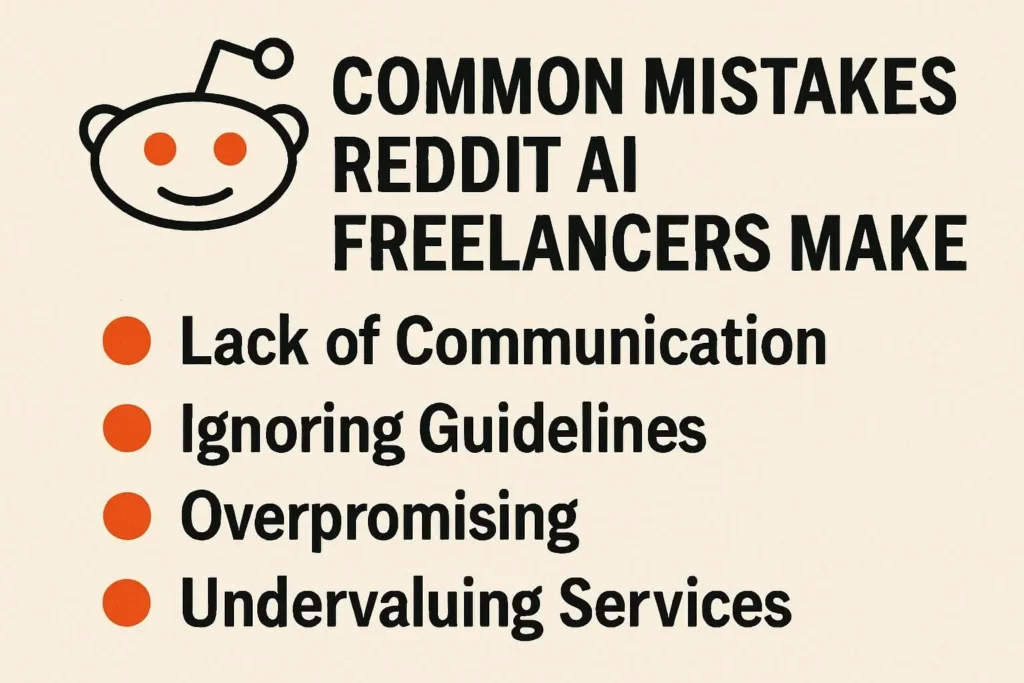
The 4 mistakes that keep AI freelancers at $30/hr
See also: how to build an AI content process with real editorial checkpoints.
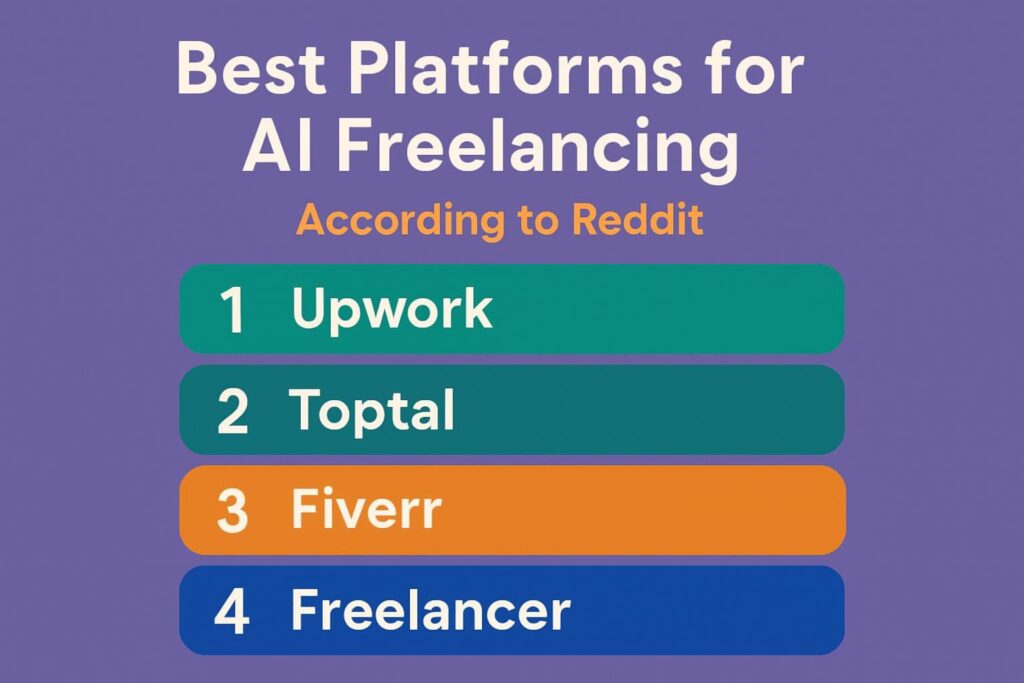
Platform reality check: where to actually find clients
The honest version, not the affiliate-optimized version:
Upwork Established — still the most reliable source of B2B AI clients if your profile is specialized. Generic AI writing profiles are invisible here. Technical or domain-specific AI services stand out. Expect to spend 4–6 weeks building initial reviews before inbound picks up.
Fiverr Established — works well for productized, fixed-scope AI services. If you can package something repeatable (“AI-powered competitor analysis report for SaaS, delivered in 72 hours”), Fiverr’s discovery works in your favour. Poor fit for bespoke high-value work.
LinkedIn direct outreach — underused and underrated. A short LinkedIn message to a Head of Content or VP Marketing, referencing a specific pain point and offering a pilot project, converts surprisingly well for mid-market clients. This is where the $5K+ project pipeline actually lives for most people I know.
Toptal Probable — elite tier, worth the screening process if you have a strong portfolio. Average rates are meaningfully higher, but competition is tighter and the vetting is real.
For a deeper platform comparison: our breakdown of AI freelance platforms, ranked by niche fit.
The honest income timeline
Not the “6 figures in 90 days” version. The real one.
Months 1–3: You’re building a portfolio, not making serious money. Expect $1,500–$3,000/month if you’re working at it consistently. This is normal. Don’t panic and pivot.
Months 4–8: If you stayed specialized and delivered quality, reviews accumulate and inbound starts. $4,000–$7,000/month is realistic for someone who picked a real niche and priced based on value. Probable
Year 2+: Retainer clients, referrals, increasing rates. $80K–$120K annual is achievable for someone with genuine domain expertise and good AI tool integration. Not guaranteed. Requires actually being good. Speculative
Anyone promising faster timelines than this is selling you something.
FAQ
Replace with AdSense code
AI freelance platforms ranked by niche: which one fits your service type
How to build an AI content workflow that doesn’t produce errors at scale
Getting your first AI automation client: a practical cold-outreach template
How to calculate and present ROI for AI freelance projects
The one thing I’d tell someone starting today
Don’t start by choosing your AI tools. Start by choosing the narrowest possible niche where you already have some knowledge advantage. Then learn exactly which two or three AI tools make you faster in that specific niche. Then go find one paying client and do excellent work for them.
That’s it. The rest is execution.
The AI freelancers who’ll still be here in three years aren’t the ones with the best tools — they’re the ones who got good at something before they got fast at it.
Ultimate AI Productivity Hacks from Reddit: Boost Your Efficiency