The Top AI Companies in India Advice That Sounds Right — But Is Quietly Holding You Back
Most people searching for India’s top AI companies are asking the wrong question. They want a ranked list when what they actually need is a decision framework — because the “best” company depends entirely on what you are trying to build, buy, or invest in.
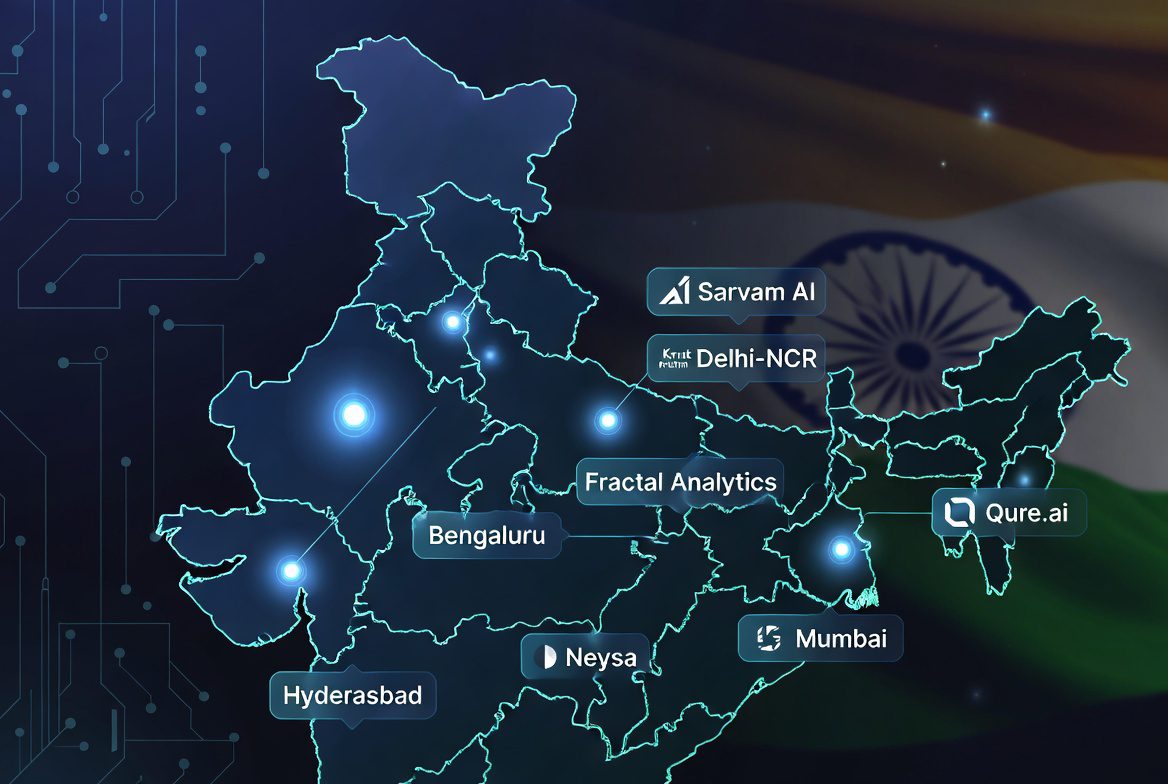
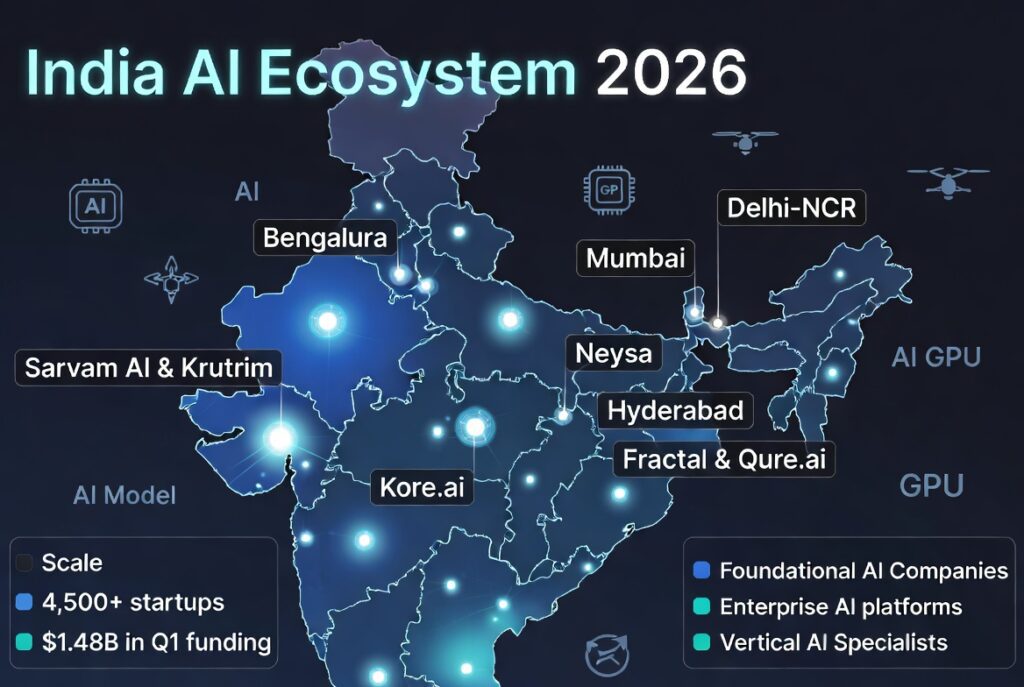
Alt text: “Top AI companies in India 2026 — ecosystem map showing Bengaluru, Hyderabad, Mumbai and Delhi-NCR AI hubs”
India’s AI ecosystem crossed 4,500 active startups in 2026. The country now accounts for 16% of the global AI talent pool. In Q1 2026 alone, Indian AI companies raised $1.48 billion — 38% of all Indian tech funding in that single quarter.
The scale is real. But the standard advice — “go with TCS or Infosys, they’re established” or “Krutrim is the hot startup to watch” — flattens critical distinctions that determine whether your engagement with any of these firms succeeds or stalls.
This guide corrects those distortions. You’ll get a practitioner-tested framework, current funding data, verified production benchmarks, and a specific 30-day action plan — whether you’re an enterprise buyer, an investor, or a talent strategist.
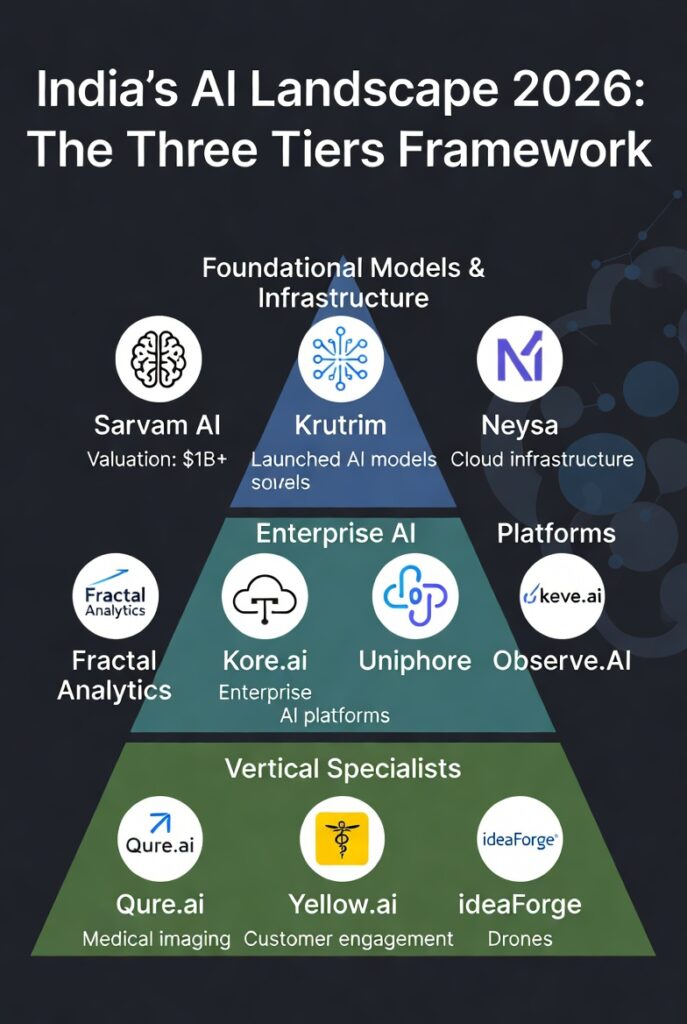
India’s AI landscape in 2026 is split into three fundamentally different tiers — sovereign/foundational model builders, enterprise AI platforms, and vertical specialists. Conflating them is the single most common error made by investors, enterprise buyers, and talent scouts. Every section of this guide returns to that argument.
What “Top AI Companies in India” Actually Means (And Why Most Definitions Miss the Point)
The phrase “top AI companies in India” has a surface definition and a functional one. On the surface, most rankings conflate three fundamentally different entity types into a single list: IT services giants who have added AI capabilities (TCS, Infosys, Wipro), pure-play AI product companies (Sarvam AI, Krutrim, Qure.ai), and AI-enabled SaaS platforms (Kore.ai, Observe.AI, Yellow.ai). Treating them as comparable leads to bad decisions.
The Working Definition Practitioners Actually Use
A practitioner defines “top AI company in India” relative to a use case. The question is never “who is ranked number one” — it is: Who has demonstrated production-grade AI capability at scale, in my vertical, at my budget, with the data sovereignty requirements I need?
Fractal Analytics, for instance, is unambiguously one of India’s elite AI firms across two decades and Fortune 500 clients. But it is the wrong choice if you need a multilingual voice interface for rural banking. For that, you need Sarvam AI or Gnani.ai. Context determines ranking, not a universal hierarchy.
Why the Textbook Version Creates Confusion
The textbook version lists companies by market cap or name recognition. That produces lists where Wipro appears alongside Krutrim — a ₹2.5 lakh crore IT services conglomerate next to a two-year-old foundation model startup. Both are legitimately “top AI companies in India.” They do not compete on any dimension that matters to an enterprise buyer or investor.
The core mechanism separating signal from noise: India’s AI ecosystem has bifurcated between technology exporters (companies using AI to deliver better outsourced services to Western clients) and technology builders (companies building foundational AI infrastructure for Indian and global markets). The first tier is mature and bankable. The second is younger, riskier, and where structural value creation is concentrated.
India’s AI market is projected to reach $126 billion by 2030, growing at approximately 30% CAGR. The government’s IndiaAI Mission has committed ₹10,300 crore ($1.25 billion) to compute infrastructure, startup funding, and sovereign AI capability. Sources: NASSCOM / IndiaAI Mission.
Alt text: “Three-tier model of top AI companies in India — from IT services exporters to foundational model builders”
How India’s AI Ecosystem Actually Works: The Real Three-Tier Framework
India’s AI company landscape operates across three distinct phases of value creation. Understanding the sequence explains why certain companies attract billion-dollar valuations despite minimal revenue, while others with decades of profitable delivery get little attention from the AI investment community.
Tier 1: Sovereign Infrastructure and Foundational Model Builders
This is the layer most people skip when evaluating top AI companies in India — and it is the layer that determines everything downstream. The companies here are building the models and compute infrastructure that India’s entire AI stack will eventually run on.
Selected by the Indian government under the IndiaAI Mission to build India’s first homegrown sovereign LLM. Sarvam-105B is a 105-billion-parameter model that, on independent benchmarks, outperforms Gemini Flash on Indian language tasks. Its Vision OCR scored 84.3% on the olmOCR-Bench — ahead of Gemini 3 Pro (80.2%) and ChatGPT (69.8%). FY25 revenue: ₹29.1 crore ($3.45M), with NVIDIA and HCLTech reportedly among investors in the upcoming round. Backed by Lightspeed, Peak XV Partners, and Khosla Ventures.
India’s first AI unicorn — reached $1 billion valuation in January 2024 within a single year of founding, the fastest in Indian startup history. Founded by Ola’s Bhavish Aggarwal. Thesis: full vertical integration from silicon to application. Krutrim-2 is an open-source 12-billion-parameter multilingual model. Kruti, its agentic AI assistant, supports 13 Indian languages. Indigenous AI chip Bodhi 1 expected later in 2026. 25,000+ developers on its cloud platform.
The dark horse of India’s AI infrastructure layer and the most underweighted company in most analyst lists. Positioned as India’s answer to CoreWeave, Neysa provides GPU-accelerated cloud infrastructure — the compute layer that enables every other Indian AI company to train and deploy models without routing workloads through AWS or Google Cloud. Deploying 20,000+ GPUs. Backed by Blackstone.
Tier 2: Enterprise AI Platforms — Where the Revenue Is
This tier contains the deepest current commercial revenue and serves most enterprise buyers. These are the companies with verifiable Fortune 500 references, multi-year delivery track records, and AI platforms with measurable ROI documentation.
Twenty-five years of enterprise AI and decision science for Fortune 500 organisations across CPG, financial services, and healthcare. In May 2025, Fractal launched Fathom-R1-14B — an open-source reasoning LLM that reportedly surpasses o1-mini on structured reasoning benchmarks at a post-training cost of just $499. Under the IndiaAI Mission, Fractal is developing India’s first large-scale reasoning model. Its healthcare AI subsidiary, Qure.ai, operates in 70+ countries.
Enterprise conversational AI and agentic workflow platform operating across banking, healthcare, and retail. Competes globally against ServiceNow and Salesforce on agentic AI workflows. NVIDIA’s direct investment signals technical validation at the infrastructure level — not just commercial partnership.
One of India’s best-funded AI companies. Specialises in emotion AI and real-time conversational analytics for global contact centers. Important caveat: Uniphore’s revenue and customer base are primarily US-based, making it an Indian-origin global company rather than a domestic-market player. This distinction matters for market-entry strategy and investment thesis.
Tier 3: Vertical Specialists with Proven Deployment at Scale
These companies are often underestimated because they operate in less glamorous verticals, but several have deployment reach that most Tier 1 and Tier 2 companies cannot match. They set the production evidence standard.
Applies deep learning to medical imaging — reading chest X-rays for tuberculosis, stroke, and other time-critical conditions. Backed by Gates Foundation grants. TB detection AI reduces diagnostic turnaround from several days to under 60 seconds per X-ray, in settings where trained radiologists are scarce. This is the production evidence standard against which every other “top AI company in India” claim should be measured.
Alt text: “India’s top AI companies organised by tier — foundational models, enterprise platforms, and vertical specialists 2026”
Master Comparison: Top AI Companies in India at a Glance
| Company | Tier | Valuation (2026) | Total Funding | Primary Strength | Best For |
|---|---|---|---|---|---|
| Sarvam AI | Tier 1 | ~$1.5B (target) | $53M+ → $320–350M round | Indic LLMs, sovereign AI | Govt / Indic-language products |
| Krutrim | Tier 1 | $1.5B+ | $50M+ committed | Full-stack: chips → cloud → apps | Strategic investors, developer infra |
| Neysa | Tier 1 | N/A (private) | $1.2B Series B | GPU cloud for Indian AI ecosystem | Infrastructure investors, AI builders |
| Fractal Analytics | Tier 2 | $1.6–2.4B | $170M+ | Decision intelligence, Fortune 500 | Enterprise buyers, regulated verticals |
| Kore.ai | Tier 2 | $1B+ | $150M | Agentic conversational AI | Banking, healthcare automation |
| Uniphore | Tier 2 | $2.5B | $985M+ | Emotion AI, global CX | Western enterprise contact centers |
| Observe.AI | Tier 2 | $1B+ | Undisclosed | Voice intelligence at scale | Western enterprise (US-primary) |
| Yellow.ai | Tier 3 | Undisclosed | Undisclosed | 135+ languages, CX automation | Multilingual customer-facing AI |
| Qure.ai | Tier 3 | Pre-unicorn | Gates Foundation grants | Medical imaging AI | Healthcare diagnostics, global deployment |
| ideaForge | Tier 3 | Undisclosed | Undisclosed | AI-powered UAVs, defence | Defence, surveillance, mapping |
Sources: Tracxn, IPOCentral, AIFundingTracker, company announcements. Data as of May 2026. Valuations are reported or estimated figures; treat with appropriate uncertainty.
The Top AI Companies in India Mistakes That Are Quietly Destroying Results
Mistake 1: Evaluating by Brand Name Instead of Deployment Evidence
The root cause is availability bias, not negligence. TCS and Infosys dominate name recognition in any discussion of Indian technology. So when a procurement team or investor needs to make a decision quickly, they default to known names.
The problem: TCS and Infosys are AI-enabled service providers, not AI product companies. Their AI capabilities exist primarily to deliver better outsourcing outcomes — not to build proprietary models or platforms with standalone intellectual property. For enterprise service delivery, they are excellent. For AI product investment or capability partnership, they are the wrong reference class.
This error is most damaging for investors. The companies building foundational AI value in India — Sarvam, Krutrim, Fractal, Neysa — are not the names that appear in most mainstream financial media. The opportunity premium sits precisely in that gap.
Mistake 2: Treating Market Size Projections as Company Quality Signals
Market projections circulate constantly: $35 billion by 2032 (Mordor Intelligence), $126 billion by 2030 (NASSCOM), $130 billion by 2032 (Fortune Business Insights). These numbers vary substantially — and more importantly, they tell you nothing about individual company quality.
This is a form of halo effect: a large market implies that all companies in it are valuable. It does not. India has 4,500+ AI startups, the majority of which are packaging third-party APIs as proprietary solutions. The signal-to-noise ratio in the Indian AI company landscape is genuinely poor.
The production evidence standard: Qure.ai’s TB detection AI in Southeast Asia reduced diagnostic turnaround from several days to under 60 seconds per X-ray, across settings where trained radiologists are scarce. That is a production result with a measurable clinical outcome. Most companies on “top AI in India” lists cannot provide anything comparable.
Mistake 3: Conflating Indian-Origin Global Companies with India-Market AI Builders
Uniphore ($985M raised, $2.5B valuation) and Observe.AI ($1B+ valuation) are frequently cited as top Indian AI companies. Both are legitimately impressive. Both operate primarily in the US enterprise market. If you are evaluating AI vendor options for India-market deployment — especially for multilingual, vernacular, or rural-reach applications — these companies are the wrong shortlist.
The “top AI companies in India” lists that rank TCS, Infosys, and Wipro at the top are not wrong — they are answering a different question than you are asking. Those rankings reflect IT services revenue. You need AI capability rankings. These are different taxonomies, and using one to answer the other produces unreliable results.
Proven Strategies for Engaging India’s Top AI Companies Right Now
What Has Changed in the Last 12 Months
Two structural shifts since mid-2025 have materially altered the evaluation calculus.
The IndiaAI Mission moved from policy to execution. The ₹10,300 crore government budget now has active disbursement pipelines. Sarvam AI has been selected as the sovereign LLM developer. The government earmarked an additional $1.1 billion for an AI venture capital fund at the India AI Impact Summit in early 2026. Government-aligned AI companies now have access to subsidised compute and preferential procurement — an advantage that was absent 18 months ago.
The compute bottleneck is being addressed domestically. Neysa’s $1.2 billion raise and Tata Communications’ large-scale GPU deployment mean Indian AI companies no longer need to route training workloads through expensive US cloud providers. This directly reduces operational costs and improves data sovereignty compliance for regulated industries — banking, healthcare, and government specifically.
Alt text: “Key milestones in India’s AI ecosystem development 2024 to 2026 — from first AI unicorn to sovereign LLM”
The Approaches With the Strongest Evidence
For enterprise buyers: The most underused evaluation filter is independent benchmark performance rather than vendor-supplied case studies. Sarvam’s Vision OCR results on the olmOCR-Bench are independently verifiable. Qure.ai has Gates Foundation-backed clinical validation. Fractal’s Fathom-R1-14B can be tested against public reasoning benchmarks. These evidence points distinguish genuine AI capability from marketing.
For investors: The structural opportunity is at the infrastructure and foundational model layer, not the application layer. Neysa is the clearest infrastructure play. Sarvam AI represents the foundational model bet with the highest sovereign alignment (which matters for regulatory and policy risk). Krutrim is the highest-risk, highest-optionality bet — if Bodhi 1 delivers as a competitive indigenous AI chip, full-stack vertical integration becomes defensible at global scale.
For talent professionals: Meaningful AI research talent concentrates in Bengaluru first (IISc, IIT ecosystem), then Hyderabad, then Mumbai. The institutions producing the highest-calibre AI researchers are IIT Bombay, IIT Delhi, IISc Bengaluru, and IIT Madras. Sarvam AI’s founding team came directly from this alumni network. Any talent pipeline that doesn’t start with these four institutions is starting in the wrong place.
What No Longer Works
Evaluating Indian AI companies by proximity to Silicon Valley clients or US revenue. In 2023, US revenue was a reliable proxy for technical sophistication. Today, with sovereign AI becoming a strategic priority and domestic demand accelerating — AI accounted for 38% of Q1 2026 Indian tech funding — the companies with the highest future value are building for India-first deployment at India-first economics.
The most underused quality filter: Go to IndiaAI.gov.in and read the technical selection criteria for the sovereign LLM program. That document contains the most rigorous publicly available framework for evaluating genuine AI capability in the Indian context — and it is almost never cited in standard “top AI companies in India” articles. Read it before your next vendor conversation.
What Changed: 2024 vs 2026 Evaluation Landscape
| Dimension | 2024 (Still Common Assumption) | 2026 (Current Reality) |
|---|---|---|
| Compute access | Route through AWS / Google Cloud | Neysa / Tata GPU cloud available domestically |
| Foundational models | OpenAI / Anthropic only viable options | Sarvam-105B, Krutrim-2 viable for Indic tasks |
| Government role | Policy statements, no active funding | ₹10,300 crore disbursing; sovereign LLM contracted |
| Quality signal | US revenue and Silicon Valley validation | IndiaAI Mission selection + independent benchmarks |
| Best indicator of top-tier status | Brand recognition, headcount, US clients | Production deployments with measurable outcomes |
| Data sovereignty | Aspirational / optional | Contractually required for banking, health, govt |
Tools, Resources, and What to Actually Trust for India AI Research
Essential Tools (Free and Paid)
| Tool / Source | Best Used For | Reliability | Cost |
|---|---|---|---|
| Tracxn | Funding rounds, investor lists, valuation data | High — primary data sourced | Paid (free tier limited) |
| IndiaAI.gov.in | Mission-selected companies, compute resources, open datasets | High — primary government source | Free |
| NASSCOM AI Research | Market sizing, employment data, sector revenue | High — conservative and consistent | Mixed (reports paid) |
| Hugging Face Open LLM Leaderboard | Verifying model benchmark claims independently | High — community-validated | Free |
| AIFundingTracker | Early-stage Indian AI deals below $50M | Medium — less curated than Tracxn | Free |
| The Ken | Investigative journalism on Indian AI companies | High — original reporting, named sources | Paid |
| Blume Ventures — India Tech Thesis | Annual ecosystem synthesis; investor perspective | High — practitioners with portfolio stakes | Free (annual report) |
Sources With Known Accuracy Problems — Avoid These
Listicle sites and content-mill “Top AI Companies in India” articles — including those ranking Appinventiv, DRC Systems, or similar app-development shops alongside Sarvam AI and Krutrim — are using marketing criteria (self-reported client counts, years in business, awards). They are not using AI capability criteria. Discard these for substantive research.
Government AIRAWAT platform data lags by 6–12 months on actual deployment numbers. Cross-reference with Neysa’s and Tata Communications’ publicly stated GPU figures for a current picture.
Fortune Business Insights / Grand View Research market projections vary wildly from NASSCOM figures for the same market. NASSCOM’s numbers are more conservative and more defensible for professional use.
Alt text: “IndiaAI Mission portal showing selected companies and sovereign LLM program criteria — essential resource for evaluating top AI companies in India”
Your 30-Day Action Plan for Evaluating India’s Top AI Companies
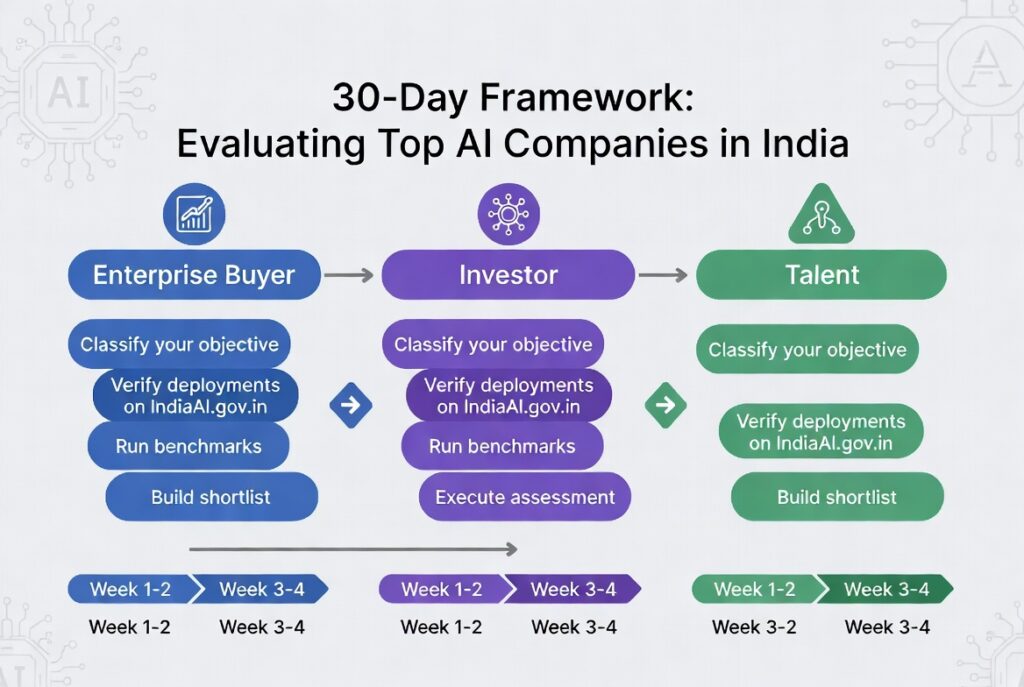
The framework below is structured for three audiences simultaneously: enterprise buyers (procurement and vendor evaluation), investors (due diligence and portfolio exposure), and talent professionals (hiring and partnership). Each day’s action is specific and time-bounded — not a vague directive.
Alt text: “30-day action plan flowchart for evaluating top AI companies in India — enterprise buyer, investor, and talent professional pathways”
Week 1–2: Get the Foundation Right
- Classify your objective into one of three buckets: (a) enterprise AI services and outsourcing delivery, (b) foundational model or infrastructure exposure, or (c) vertical AI product evaluation for a specific domain.
- Write this classification as one sentence before opening any browser tab. This decision determines which 10 companies are relevant and which 4,490 are not.
- If you are an investor, add a fourth filter: domestic-market focus vs. Indian-origin global company. These have different risk profiles, growth drivers, and exit paths.
- For each company on your initial longlist: check Tracxn for current funding status and investor list. Check IndiaAI.gov.in for Mission participation. Check Hugging Face for any model benchmark claims.
- Remove any company that fails all three checks — no verified funding, no government alignment signal, and no independently verifiable AI benchmark. This step alone removes 80% of the “top AI companies in India” lists you’ll encounter.
- Note whether the company’s primary commercial traction is India-market or US-market. Record this against every company on your list — it will matter in Week 3.
- Contact each company on your longlist with one specific technical question: “Walk me through the architecture of your most recent production deployment — model size, training data provenance, inference latency at scale, and the business metric it improved.”
- This single question separates companies with genuine AI capability from those wrapping commercial APIs. Most will deflect or send marketing material. The ones that answer directly with specific numbers are worth pursuing.
- By Day 14 you should have a shortlist of 3–5 companies with verified production credentials, classified by tier, with funding and benchmark data on file.
Week 3–4: Execute, Measure, and Decide
- Score your shortlist on three criteria: Technical depth (independent benchmarks, model architecture transparency) / Delivery evidence (named Fortune 500 or government references, multi-year track record) / Strategic alignment (IndiaAI Mission selection, sovereign compute access, multilingual capability).
- Weight these 40/40/20 for enterprise buyers. For investors focused on policy tailwinds and long-term structural value, flip to 30/30/40.
- For any Tier 1 company (Sarvam, Krutrim, Neysa): acknowledge explicitly that their strategic value is currently ahead of their commercial revenue. This is not a red flag — it is the correct risk profile for infrastructure plays. Evaluate accordingly.
- Before selecting a vendor: run an internal AI readiness assessment across five dimensions — data availability, infrastructure maturity, talent depth, process integration readiness, and strategic alignment. Most enterprise AI projects stall not because the vendor failed, but because the buyer overestimated their own readiness.
- Fractal Analytics and several other Indian AI practitioners have published readiness frameworks. Find and complete one of these frameworks before your final vendor conversations.
- The decision most people face by Day 14 and navigate incorrectly: the temptation to expand the shortlist after initial research. The correct move is the opposite — reduce to 3 companies with the clearest production evidence in your specific use case. Breadth of options is not the problem. Depth of evaluation is.
- Are you operating in the enterprise services tier (TCS, Infosys, Wipro AI practice — correct for large-scale outsourced AI delivery)? The platform tier (Fractal, Kore.ai, Yellow.ai — correct for production AI platforms with verified ROI)? Or the foundational infrastructure tier (Sarvam, Krutrim, Neysa — correct for strategic investment, sovereign compute, or India-first model access)?
- These are not interchangeable. The decision made here determines every subsequent engagement, budget allocation, and success metric. Make it explicit before the first contract conversation.
The Three Highest-Leverage Moves in Week 1
- Classify your objective by tier — services delivery, enterprise platform, or foundational infrastructure — before evaluating a single company name. This filters 95% of irrelevant options immediately.
- Verify one production deployment with a measurable business outcome for every company on your longlist. Not a client logo. Not a press release. A named customer, a stated metric, and a before/after comparison.
- Check IndiaAI.gov.in for Mission-selected companies. Government technical validation is imperfect but non-trivial — it is the only independently conducted capability assessment publicly available for Indian foundational AI companies.
Start With the Framework, Not the Shortlist
The 30-day plan above gives you the mechanics. The tier classification gives you the strategic map. Your immediate next step: go to IndiaAI.gov.in, read the sovereign LLM selection criteria, then return to your shortlist with that filter applied. Most of the names will drop off. The ones that remain are worth your time.
Read the IndiaAI Mission Criteria →Frequently Asked Questions: Top AI Companies in India
What is the most important first step when evaluating top AI companies in India?
Classify your objective before you evaluate any company name. India’s AI landscape contains IT services firms, foundational model builders, enterprise platforms, and vertical specialists — these are not substitutable. An investor looking for infrastructure exposure should evaluate Neysa and Krutrim, not TCS. An enterprise buyer needing healthcare AI should start with Qure.ai, not Sarvam. One wrong classification at the outset wastes weeks of due diligence on companies that were never relevant to your actual goal. Write the classification in one sentence first, then open your research.
Which is the number one AI company in India in 2026?
There is no single number-one answer — the leading company depends on the use case. For sovereign foundational AI and Indic language models, Sarvam AI leads with government selection and the Sarvam-105B model. For full-stack AI from chips to applications, Krutrim leads by valuation ($1.5B+) and vertical ambition. For AI infrastructure, Neysa leads with $1.2B in Series B funding. For enterprise decision intelligence with 25 years of delivery evidence, Fractal Analytics leads. Choosing a “number one” without specifying a category produces a misleading answer.
Is Krutrim better than Sarvam AI?
They are solving different problems at different risk profiles. Sarvam AI is laser-focused on Indic language models and sovereign AI infrastructure — its Sarvam-105B model has independently verifiable benchmark performance, and it holds the government contract for India’s first sovereign LLM. Krutrim is building full vertical integration from chip to cloud to application — broader scope, higher optionality, higher execution risk. If you need production-grade Indic language AI today, Sarvam is further along. If you are making a long-term platform bet, Krutrim’s full-stack thesis is more ambitious and potentially more valuable if Bodhi 1 delivers.
How long does it take to see results when working with an Indian AI company?
It depends heavily on the tier. Enterprise service engagements with Fractal Analytics or Wipro’s AI practice typically require 6–12 months from contract to measurable production output — assuming internal data and process readiness. Product evaluations with Kore.ai or Yellow.ai run 4–8 weeks for a proof-of-concept phase. Foundational model partnerships with Sarvam or Krutrim are longer-horizon: both are still in active R&D for their most ambitious capabilities. Set timeline expectations by tier before scoping any project, or you will consistently misalign on delivery milestones.
What is the most common mistake when evaluating top AI companies in India?
Conflating brand recognition with AI capability. TCS and Infosys are globally recognised names in Indian technology with substantial AI practices. Neither is building proprietary foundational AI models with independent intellectual property. When procurement teams default to these names as “safe” AI choices, they are optimising for reputational safety, not AI outcomes. The companies with the strongest AI-specific credentials — Sarvam, Krutrim, Fractal, Qure.ai — require more diligence but deliver materially different results for AI-specific goals.
Is the Indian AI ecosystem suitable for international enterprise buyers?
Yes, with the right entry point. For first-time international buyers, enterprise-tier companies — Fractal Analytics, Kore.ai, Wipro AI practice — offer the most de-risked engagement model: established delivery infrastructure, Western client references, and English-language contracting. The foundational model tier (Sarvam, Krutrim) is more appropriate for strategic investors or technology partners than for buyers needing production deployments in the near term. Start in the enterprise tier; the foundational tier becomes accessible as your understanding of the ecosystem deepens over 12–24 months.
How do I know if my engagement with an Indian AI company is actually working?
Define one production business outcome metric before the engagement starts — not a delivery milestone, a business result. Qure.ai’s correct metric is diagnostic accuracy versus a radiologist baseline. Fractal’s correct metric is decision quality improvement against a pre-AI baseline. Observe.AI’s correct metric is call resolution rate or handling time reduction. If a company cannot help you define a measurable business outcome in your first scoping conversation, that is a red flag regardless of their brand or valuation. Any genuine production-scale AI company has outcome data. Ask for it before you sign.
What is the IndiaAI Mission and why does it matter for evaluating AI companies?
The IndiaAI Mission is a government program with a ₹10,300 crore ($1.25 billion) budget structured around seven pillars: compute infrastructure, data platforms, startup funding, AI education, application development, safety, and innovation sandboxes. It matters for company evaluation because Mission selection is the only independent technical vetting process publicly available for Indian foundational AI companies. Companies selected under the Mission — Sarvam AI being the most prominent — have passed a government-conducted capability assessment. This is an imperfect but non-trivial quality signal.
Which Indian AI companies are most likely to IPO in 2026–2027?
Fractal Analytics is the most frequently cited IPO candidate, with reports of a 2026 listing and a valuation of $1.6–2.4 billion. Whatfix, an AI-powered digital adoption platform, is reportedly in advanced talks with advisors for a 2026 listing. Atlan, a data intelligence platform, is near $850 million in valuation with revenue crossing $35 million — a strong IPO candidate for 2026–2027. Krutrim and Sarvam AI are earlier-stage and more likely to remain private through 2027 while they prove commercial revenue at scale.
How does India’s AI ecosystem compare to China’s and the US’s?
India is the third-largest AI startup ecosystem globally after the US and China as of 2026. The US leads on foundational model capability (OpenAI, Anthropic, Google DeepMind) and venture capital scale. China leads on AI deployment at population scale and state-integrated industrial AI. India’s differentiated position is in three areas: frugal innovation economics (Fractal’s Fathom-R1-14B trained for $499), multilingual AI for 22+ official languages at population scale, and a democratic data governance model that makes Indian AI more trusted in Global South markets than Chinese alternatives.
What is “sovereign AI” in the Indian context and which companies are leading it?
Sovereign AI refers to AI infrastructure — models, compute, and data — that is owned, operated, and governed domestically rather than rented from foreign cloud providers. In India’s context, it means foundational LLMs trained on Indian data, running on Indian compute, under Indian regulatory oversight. Sarvam AI is the designated sovereign LLM developer under the IndiaAI Mission. Neysa provides the sovereign compute layer. Krutrim is pursuing sovereign silicon (Bodhi 1 chip). The strategic driver is reducing India’s dependency on US cloud infrastructure for AI that touches regulated sectors like banking, healthcare, and government services.
What AI companies in India are best for healthcare applications?
Qure.ai leads for medical imaging diagnostics — 3,000+ deployed clinical sites across 90+ countries, Gates Foundation validation, sub-60-second TB detection from X-rays. For hospital operations and patient flow AI, Practo’s AI features and Niramai (breast cancer screening) are worth evaluating. For drug discovery and genomics, companies in the Fractal Analytics orbit and Bangalore-based deep-tech startups in the IndiaBioscience ecosystem are most active. Any healthcare AI engagement in India should require regulatory pathway documentation — India’s CDSCO has specific guidance on AI/ML-based medical devices that many vendors do not address proactively.
Are there risks to working with early-stage Indian AI startups like Sarvam or Krutrim?
Yes — and being honest about them is more useful than glossing over them. Both Sarvam and Krutrim are pre-profitability with high burn rates. Sarvam’s FY25 revenue was ₹29.1 crore ($3.45M) against estimated monthly burn of $1.5–2.5M. Performance claims for both companies are largely self-reported and not yet independently replicated on major public leaderboards. The compute-intensive nature of training large models creates ongoing capital dependency. For enterprise production deployments, these risks are significant. For strategic partnerships, long-term investment, or pilot programs with clear off-ramps, the risk profile is more manageable.
Scale AI: The Complete Guide to Enterprise AI Data Transformation
The Fastest-Growing AI Companies: Revenue, Valuations & What’s Really Driving the Boom
AI INFRASTRUCTURE: INVESTMENT THESIS 2.0
15 Proven AI Startups to Invest In: Techniques Most Experts Won’t Tell You
88% of Companies Say They Use AI—Only 7% Actually Produce Anything With It: The $47B Governance Arbitrage of 2026
The Multi-Vendor AI Imperative: How to Build a Marketplace That Survives the 2026 Consolidation Wave