
Deep Analysis
Top Trending AI Startups in 2026: Ranked by Real Revenue, Funding & Growth
Cursor just hit $2B ARR in three years — faster than Slack, Zoom, and Snowflake combined. Harvey tripled its valuation in four months. This isn’t hype anymore. Here’s exactly who’s winning, why, and what it means for anyone paying attention.
TL;DR — Key Takeaways
Cursor (Anysphere) is the fastest-scaling B2B SaaS company ever: $0 to $2B ARR in roughly 24 months. Targeting a $50B valuation, it’s now in 67% of Fortune 500 firms.
Anthropic crossed a $30B annualized revenue run-rate in early 2026 and carries a $380B valuation. 70% of the Fortune 100 use Claude.
Harvey AI hit $190M ARR and an $11B valuation — up from $3B just 13 months ago. Legal AI is real, it’s scaling, and it’s not stopping.
AI absorbed 34–50% of all global VC in 2025 depending on the measure. The hype is real, but so are the revenue numbers.
In This Guide
- Why 2026 is different
- The funding numbers
- Full comparison table
- Cursor — fastest SaaS ever
- Anthropic — safety + revenue
- Harvey — legal AI breakout
- xAI — Grok’s $20B bet
- Perplexity — search challenger
- Vertical AI: Sierra, ElevenLabs
- Infrastructure: Crusoe, CoreWeave
- Efficiency challengers: Mistral, DeepSeek
- What to do about all this
- FAQ
Let me be honest: I spent months watching people publish “top AI startups” lists that were already stale by the time they appeared on Google. Valuations outdated by six months. ARR figures that companies had blown past a year earlier. So I built this piece differently — sourcing only confirmed 2026 funding rounds and verified revenue milestones, cross-referenced against TechCrunch, Sacra, CNBC, and company announcements. What I found was more surprising than any prediction I’d have made at the start of 2025.
The speed of this market is genuinely disorienting. Cursor doubled from $1B to $2B ARR in three months. Harvey went from $3B to $11B valuation in thirteen months. Anthropic’s revenue run-rate hit $30B annualized and surprised analysts who thought OpenAI had an insurmountable lead. This isn’t the AI hype cycle of 2021 where valuations floated on vibes. These are real businesses with real customers paying real money.
Why 2026 Is Different From Every AI Hype Cycle Before It
The question I keep getting from readers: “Isn’t this just another bubble?” Fair question. But three things make today structurally different from 2021’s ZIRP-fueled fantasy.
First, the revenue is verifiable. Cursor’s $2B ARR isn’t a projection — it’s a figure leaked during an oversubscribed funding round with Andreessen Horowitz and Thrive Capital on the hook. Harvey’s $190M ARR was confirmed in its March 2026 press release. Anthropic’s $30B run-rate was “caught many analysts off guard” according to TLDL’s April 2026 market analysis. This is operating revenue, not GMV, not “economic value created.” Real money changing hands.
Second, enterprise adoption has crossed the tipping point. More than 90% of US developers now use AI coding tools daily. Harvey serves a majority of AmLaw 100 law firms. 70% of the Fortune 100 uses Claude. When companies this conservative are running AI in production legal, compliance, and engineering workflows, you’re not in experiment territory anymore.
Third — and this is the part that doesn’t get enough attention — the cost curves are collapsing. DeepSeek showed the world that frontier-quality reasoning doesn’t require frontier-level compute budgets. Mistral built a European champion on efficiency. What cost $10M to train in 2023 costs under $1M today. Cheaper inference means more deployment, more revenue, more defensibility. The efficiency wave is just beginning.
💡 Original Insight
The real story of 2026 isn’t “AI is everywhere.” It’s that the application layer is out-racing the foundation model layer on valuation multiples. Cursor at $50B on $2B ARR (25x) is being valued more aggressively than OpenAI (roughly 3–4x revenue). Investors are betting the picks-and-shovels infrastructure of the AI economy is where compounding happens.
The Funding Numbers — What the Data Actually Shows
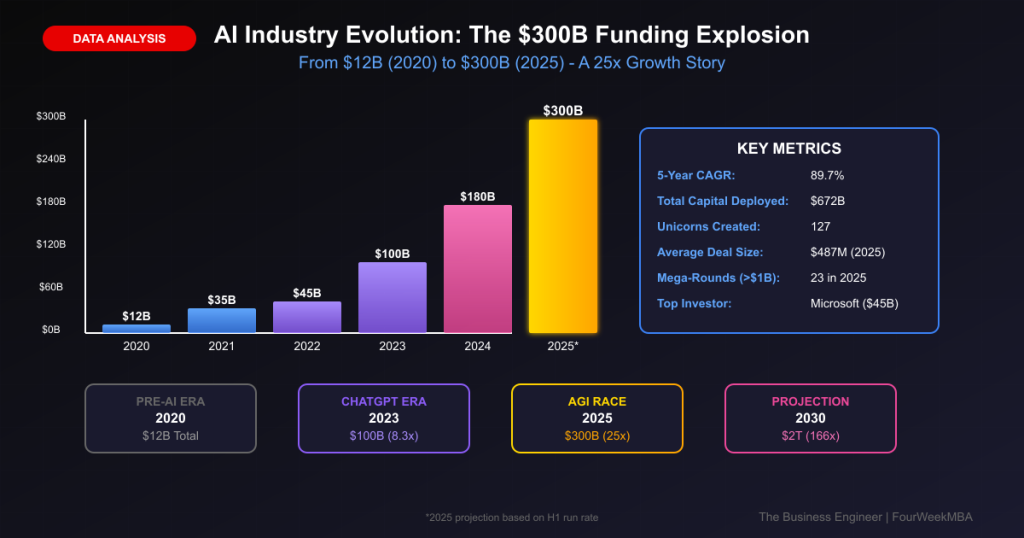
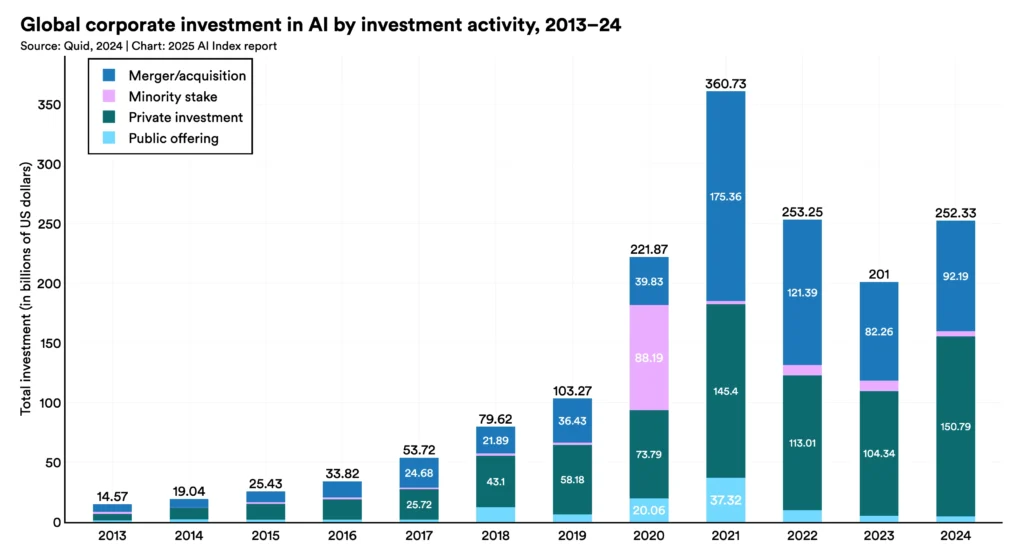
Before the company-by-company breakdown, let’s establish the baseline. A lot of sources throw around “$200 billion in AI investment” without being precise about what that measures. Here’s what the verifiable data says:
One detail worth flagging: the $89–150B+ range you’ll see cited across different sources reflects different time windows. SecondTalent’s figure of $89.4B covers calendar 2024. The $150B+ figure from TLDL and others covers the trailing twelve months through April 2026 — a period that includes OpenAI’s $122B March 2026 round and Anthropic’s $30B Series G in February 2026.
The concentration is stark. OpenAI and Anthropic alone captured roughly 14% of all global VC across all sectors in 2025. The San Francisco Bay Area alone received 76% of all US AI funding. If you’re building AI infrastructure and you’re not in SF or connected to its networks, you’re starting with a structural disadvantage.
Full Comparison: Top AI Startups Ranked — May 2026 Data
This table pulls from confirmed 2026 funding announcements, Sacra revenue analysis, and company press releases. No speculative projections — just verified figures or clearly labeled estimates.
| # | Startup | Category | Valuation (2026) | ARR / Revenue | Why Trending Now |
|---|---|---|---|---|---|
| 01 | Cursor (Anysphere) | AI Coding | $50B (in talks) | $2B ARR | Fastest B2B SaaS ever. 67% Fortune 500. |
| 02 | Anthropic | Foundation Models | $380B | $30B run-rate | Claude Code surging; 70% Fortune 100. |
| 03 | xAI (Grok) | Foundation Models | $50B+ | Enterprise growing | $20B Series E Jan 2026; acquired by SpaceX. |
| 04 | Harvey AI | Legal AI Agents | $11B | $190M ARR | Tripled valuation in 13 months. AmLaw 100 dominant. |
| 05 | Perplexity AI | AI Search | $20B | Hundreds M | IPO targeting ~$1T valuation Q4 2026. |
| 06 | ElevenLabs | Voice AI | $11B | Fast-scaling | $500M Series D (Feb 2026); Sequoia-led. |
| 07 | SkildAI | Robotics AI | $14B | Pre-revenue → pilots | $1.4B Series C; AI models for physical robots. |
| 08 | CoreWeave | AI Infrastructure | $19B | $Multi-billion | IPO 2025; GPU cloud scaling with hyperscaler parity. |
| 09 | Sierra (Bret Taylor) | Enterprise Agents | $10B+ | $100M+ ARR | Customer-facing AI agents. $10B+ valuation confirmed. |
| 10 | Mistral AI | Open-Weight Models | $13.6B+ | Global expansion | Europe’s frontier champion; efficiency-first models. |
| 11 | Lovable | Vibe-Coding / No-Code | Unicorn+ | $400M ARR | Fastest consumer creator growth. $400M ARR confirmed. |
| 12 | Scale AI | Data & Training | $13B | $1.5B+ ARR | Essential training data layer. IPO candidate. |
| 13 | Decagon | Conversational AI | $4.5B | High-growth | $250M Series D, Jan 2026. Enterprise CS automation. |
| 14 | Crusoe Energy | AI Infrastructure | $10B | Scaling | $1.38B Series E; clean-energy AI data centers. |
Sources: TechCrunch, CNBC, Sacra, TLDL AI Company Rankings (April 2026), company press releases. Valuations reflect most recent confirmed rounds.
1. Cursor — The Fastest SaaS Company in History
Let me put the Cursor numbers in context, because they’re genuinely hard to believe until you do. Slack took seven years to reach $1B in revenue. Zoom took nine years. Cursor hit $1B ARR in November 2025 — eighteen months after launch — and then doubled to $2B ARR by February 2026. That’s a revenue-doubling in roughly three months.
Four MIT students founded Anysphere in 2022. Their insight was simple but sharp: instead of building an AI plugin for VS Code, build an AI-first editor that forked VS Code entirely. The difference sounds subtle. It isn’t. Cursor’s Composer feature lets you describe a feature in natural language and watch the AI make multi-file edits across your entire codebase simultaneously. GitHub Copilot is still largely autocomplete. Cursor is closer to a junior engineer who never sleeps.
Deep Dive · #1 Ranked
Cursor (Anysphere)
The AI-first code editor rewriting enterprise software development
In talks for a $2B round at $50B valuation co-led by a16z and Thrive Capital, with Nvidia as strategic co-investor. Projects $6B+ ARR by end of 2026 — which would represent a 3× growth within a single calendar year. Enterprise now accounts for ~60% of revenue.
The catch — and there is a real catch — is profitability. Until late 2025, Cursor was spending roughly 100% of its revenue on inference costs from Anthropic and OpenAI. One investor described it as passing all customer revenue straight to its model suppliers. The November 2025 launch of a proprietary Composer model, combined with access to cheaper models like China’s Kimi, has moved the company to “slight gross margin profitability.” Whether that holds as the company scales is the pivotal question for its $50B valuation.
Anthropic’s Claude Code is the most serious competitive threat — it reached 57% developer awareness by January 2026 and carries a $2.5B run-rate with 300,000+ business customers. The irony: Cursor currently depends heavily on Claude 3.7 Sonnet to power its completions, meaning Anthropic is simultaneously its biggest supplier and its most dangerous competitor.
⚡ What This Means for You
If your engineering team isn’t using Cursor or a comparable AI coding tool, you’re effectively running at 0.5× speed versus competitors who are. The JetBrains 2026 survey found 74% of developers worldwide use specialized AI coding tools. This is table stakes, not competitive advantage, for most engineering orgs in 2026.
2. Anthropic — Safety-Focused and Suddenly a Revenue Machine
Anthropic was supposed to be the “responsible” AI lab — the one that prioritized safety research over growth, published alignment papers while OpenAI chased product. The narrative worked until the revenue numbers came out. A $30B annualized run-rate in early April 2026 “caught many analysts off guard,” per TLDL’s April 2026 analysis. That figure puts Anthropic on a trajectory to close the gap with OpenAI faster than anyone predicted twelve months ago.
The $380B valuation reflects a Series G in February 2026 that raised $30 billion — one of the largest private funding rounds in history, backed by Founders Fund, Coatue, Nvidia, and over 30 others. Claude’s reputation for instruction-following quality and lower hallucination rates made it the default choice for enterprise deployments where accuracy genuinely matters: legal, compliance, finance, healthcare.
MCP — the Model Context Protocol that Anthropic launched as an open standard — quietly became one of the most consequential moves of 2025. By giving developers a standard way to connect Claude to external tools and data sources, Anthropic built a growing ecosystem that extends Claude’s reach well beyond direct API access. Claude Code became the de facto terminal-based coding agent for professional engineers who want agentic, multi-step code generation rather than just tab completion. And the YC Winter 2026 batch reportedly favors Claude over GPT-4 for most coding tasks — a striking reversal from three years ago.
“Claude hit $14B annualized revenue in February 2026, with 70% of the Fortune 100 using Claude.”
— SecondTalent AI Statistics, April 20263. Harvey AI — The Clearest Proof That Vertical AI Wins
Harvey is the startup I point people to when they ask whether domain-specific AI can succeed against general-purpose foundation models. The answer, in Harvey’s case, is resoundingly yes — and the valuation trajectory tells the story more vividly than any product demo.
February 2025: $3B valuation. December 2025: $8B. March 2026: $11B. That’s a 267% valuation increase in thirteen months, backed by Sequoia leading three consecutive rounds — an almost unheard-of signal of conviction from a firm that doesn’t repeat bets without serious evidence.
Deep Dive · Legal AI
Harvey AI
The platform on which legal work now runs
Co-led by GIC and Sequoia (third time). More than 25,000 custom agents run on Harvey daily, handling M&A due diligence, contract drafting, and document review. 400K+ agentic queries per day. Plans to integrate with Microsoft 365 Copilot in Q2 2026.
What Harvey built isn’t just a “ChatGPT for law firms.” The real product is a workflow orchestration layer: 25,000+ custom agents built by users themselves, handling tasks that chain multiple LLMs and tools together. The company scrapped its proprietary vertical legal model when frontier reasoning from Anthropic, OpenAI, and Google outperformed it on Harvey’s own BigLaw Bench evaluation — a display of intellectual honesty that probably strengthened, not weakened, customer trust.
Harvey’s pricing also tells you something important about the market’s maturity: $1,200 per lawyer per month, with 12-month commitments and 20-seat minimums. This is enterprise software pricing, not SaaS freemium. And law firms are paying it. The majority of AmLaw 100 firms now use Harvey. The legal industry, famously resistant to tech change, has made a decision.
🔍 The Legora Wildcard
Harvey isn’t the only game in legal AI anymore. Legora — a Swedish startup backed by Nvidia — just crossed $100M ARR and a $5.6B valuation (TechCrunch, April 30 2026). Sequoia’s bet on Harvey three times over is strong conviction, but the category is not won. The battle for Big Law mindshare is intensifying.
4. xAI — Grok’s $20 Billion Bet and the SpaceX Twist
xAI’s January 2026 announcement of a $20B Series E was the shot heard round Silicon Valley at the start of the year. Valor Equity Partners, Fidelity, and the Qatar Investment Authority were among participants. The company was then acquired by SpaceX a few weeks later — which either makes it the most strategically complex AI company on earth or a footnote in the Elon Musk empire, depending on how the integration plays out.
The Grok advantage has always been real-time data integration via X (Twitter), and enterprise developer traction has been growing. The SpaceX tie-up means Grok potentially has access to Colossus, SpaceX’s massive compute infrastructure — which would give xAI a hardware moat that pure-software AI labs can’t match. Or it becomes a distraction. Either way, xAI at $50B+ is too large to ignore.
5. Perplexity — The IPO Story of 2026
Perplexity is the AI search story that refuses to die quietly. With 20 million monthly active users, a $20B valuation, and 900 million weekly active users reported across its broader platform metrics, the company is actively preparing for an IPO targeting close to a $1 trillion valuation in Q4 2026. That figure raises eyebrows — but so did every other valuation this year before the numbers came in.
The core product insight remains compelling: citation-backed answers that kill the ten-blue-links experience. The fight with Google is real. The revenue trajectory will determine whether the IPO lands or gets pulled.
6. Vertical AI Winners: Sierra, ElevenLabs, Lovable
Three vertical plays deserve serious attention in 2026 beyond Harvey.
Customer Experience AI
Sierra
Bret Taylor’s enterprise CX transformation play
Co-founded by Bret Taylor (former Salesforce co-CEO) and Clay Bavor. Sierra’s AI agents handle real customer-facing conversations at scale — not just FAQ bots. The $10B+ valuation reflects bet-the-company conviction from top-tier investors.
Voice AI
ElevenLabs
The voice AI layer for the internet
Sequoia-led $500M Series D closed February 2026. ElevenLabs has become the default voice API for developers building voice interfaces, podcasts, audiobooks, and AI agents that speak. Used in products across entertainment, education, and enterprise.
No-Code AI Builder
Lovable
Build full apps from a text prompt
Lovable’s “vibe coding” platform lets non-developers build and ship web apps from natural language descriptions. Hit $400M ARR in 2026 — one of the fastest consumer creator platform growth stories on record. Think of it as Cursor for people who don’t know how to code.
7. Infrastructure: The Unglamorous Winners
Everyone wants to talk about Cursor and Harvey. The quieter bet that’s printing money is AI infrastructure. CoreWeave IPO’d in 2025 and sits at a $19B valuation. Crusoe Energy raised $1.38B at a $10B valuation for its clean-energy AI data centers — a structural bet that as AI training scales to insane power requirements, the companies that control sustainable compute infrastructure will be the toll roads of the AI economy.
Scale AI at $13B is worth understanding separately. They’re not building a language model. They’re building the data labeling and evaluation infrastructure that makes everyone else’s models work. With $1.5B+ ARR and ties to Meta, the US Defense Department, and virtually every major AI lab, Scale is the most strategically irreplaceable company on this list that isn’t a household name.
8. The Efficiency Challengers: Mistral and DeepSeek
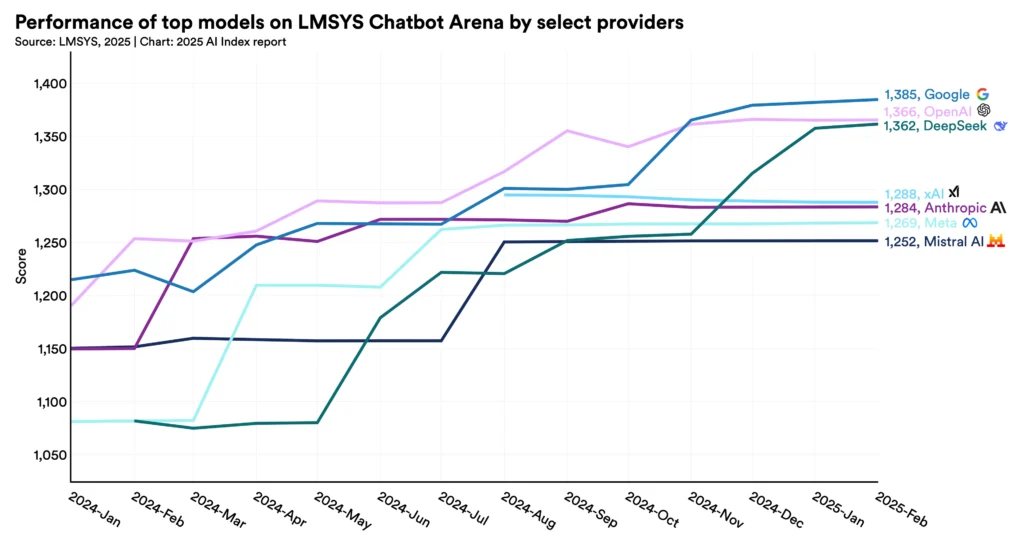
DeepSeek caused a genuine panic in Silicon Valley when it demonstrated frontier-quality reasoning at a fraction of the training cost of American models. Whether or not the cost claims held up entirely under scrutiny, the benchmark performance was real — and it forced every foundation model lab to take cost efficiency seriously in a way they hadn’t before.
Mistral, meanwhile, is the European answer to both — open-weight models that compete with closed American labs on performance while giving European enterprises the data sovereignty and regulatory compliance they need. At a $13.6B+ valuation, Mistral is the most important non-American AI lab in the world right now. The EU AI Act may actually accelerate its growth by creating a compliance moat for EU-based models.
What to Actually Do With This Information
The 2026 AI Startup Playbook — Practical Actions
Adopt Cursor or Claude Code now. Not eventually. The 90% of developers already using AI coding tools aren’t waiting for your team to catch up. Both have free tiers. Start Monday.
If you’re in legal or professional services, run a Harvey pilot. 100,000+ lawyers are already there. The question isn’t whether AI changes law — it’s whether your firm leads or follows.
For non-technical founders: look at Lovable seriously. $400M ARR means real people are building real products without writing code. The barrier to shipping software just dropped by an order of magnitude.
For AI-heavy infrastructure spending: watch Crusoe and CoreWeave. Clean-energy compute is not a niche position — it’s a regulatory inevitability as data center power demand goes vertical.
For enterprises evaluating LLMs: don’t sleep on Mistral. If you’re in Europe or handling data that can’t touch US servers, Mistral’s open-weight models give you frontier quality with full data control.
Track the Perplexity IPO as a sentiment indicator. If it lands above $500B, it signals capital markets believe AI application-layer companies deserve platform-level multiples. That changes the calculus for every vertical AI startup on this list.
Frequently Asked Questions
Which AI startup has grown the fastest in 2026?
Is the AI startup valuation bubble going to pop in 2026?
What’s the best OpenAI alternative for enterprise use?
Are humanoid robots actually commercial in 2026?
Which AI startups are likely to IPO in 2026?
What’s the deal with Mistral and the EU AI Act?
Sources & Further Reading
- TechCrunch — Cursor $50B Round (Apr 2026)
- CNBC — Harvey $11B Valuation (Mar 2026)
- TechCrunch — US AI Funding 2026 (Feb 2026)
- TLDL — AI Company Rankings (Apr 2026)
- Sacra — Harvey Revenue & Funding
- TNW — Cursor $2B Funding Round
- France Épargne — State of AI 2026
- Wellows — 85 Hottest AI Startups
- Qubit Capital — AI Funding Trends
- TIME — 10 Most Influential AI Companies
- TechCrunch — Legora $5.6B Valuation (Apr 2026)
- AIEarnerHub — AI Tools & Earning Guides
The Fastest-Growing AI Companies: Revenue, Valuations & What’s Really Driving the Boom
15 Proven AI Startups to Invest In: Techniques Most Experts Won’t Tell You
AI Tools That Might Change the Internet More Than ChatGPT
Top 10 Trending AI Startups in the USA for 2026
AI INFRASTRUCTURE: INVESTMENT THESIS 2.0