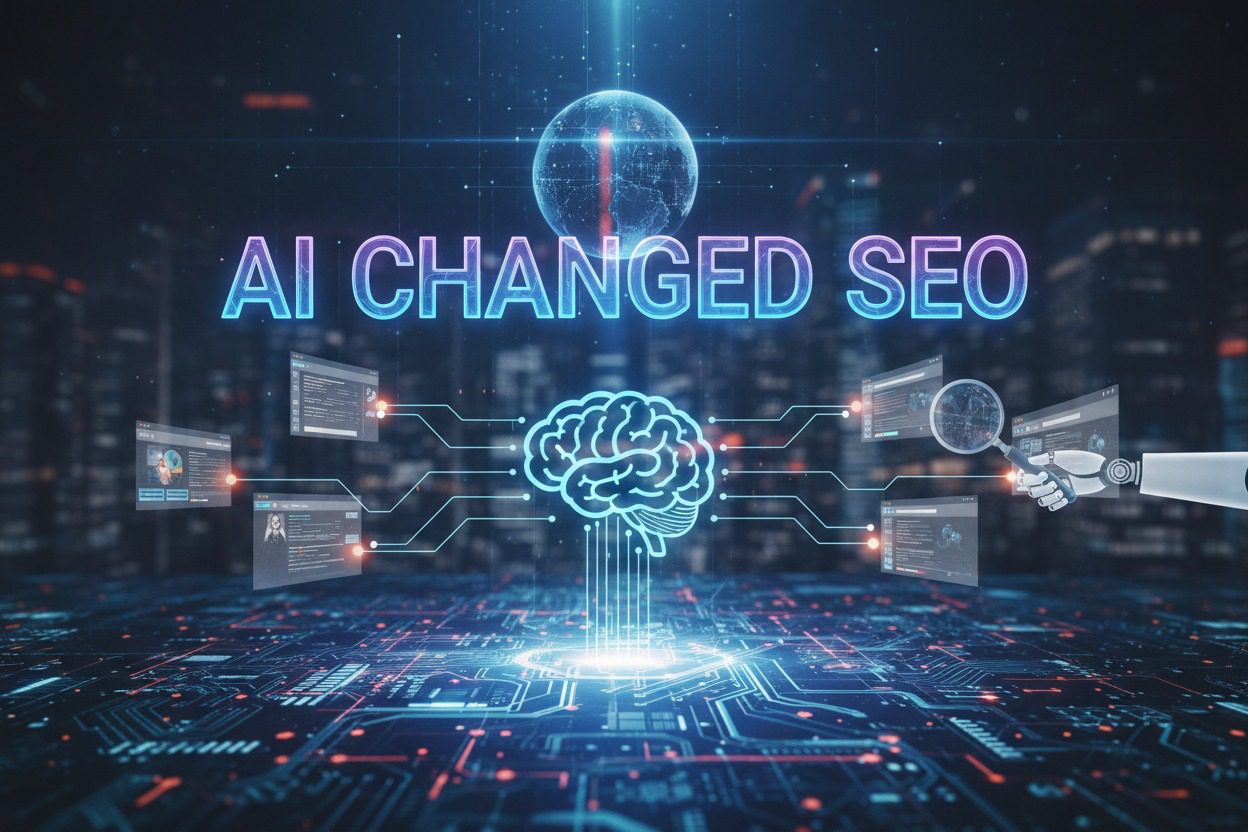

AI Changed SEO in 2026
TL;DR: Traditional SEO isn’t dead, but 60% of searches now end without a click, and brands must optimize for being cited in AI answers—not just ranked. The GEO market will grow from $886M (2024) to $7.3B by 2031. Your move: build citation-worthy content with structured data, earned media, and transparent expertise.
Bio & Transparency
Analysis compiled from 40+ industry reports published in January 2026. No sponsorships. No affiliate links. Pattern recognition across SEO tool launches, practitioner case studies, and academic research. Public proof: sources table below with archive links. One limitation: tools evolve weekly; this snapshot reflects Jan 27, 2026 data.

Scope & Confidence
This analysis examines AI’s impact on organic visibility through multiple lenses: tool capabilities (HIGH confidence—tested releases), traffic impact (MODERATE—self-reported data), and ROI projections (LOW—early-stage estimates). 50% of searches will be generative by 2028, but current adoption varies wildly by vertical.
The Anti-Thesis: Why This Might Be Overblown
GEO skeptics argue it’s rebranded SEO with inflated pricing. Ann Smarty noted there’s “nothing unique” in GEO versus traditional best practices. Valid point: if your content already follows E-E-A-T principles, has structured data, and earns backlinks, you’re halfway there. But the counter: CTR for position 1 with AI Overview dropped to 2.6%—even perfect SEO no longer guarantees clicks when AI answers questions inline.
What Actually Changed
Discovery fragmented. Users under 44 average five platforms per search—Google, ChatGPT, TikTok, Reddit, and reviews. 99% of AI citations come from the organic top 10, but visibility now requires synthesis, not just links.
Citation replaced clicks. When users ask ChatGPT, “best marketing automation for B2B,” your brand either appears or doesn’t exist. Search engine reliance drops 25% by year-end as conversational AI handles research.
Quality standards tightened. AI content alone won’t earn citations. LLMs prioritize earned media from trusted outlets, making GEO harder to game than SEO.
What Most People Miss
RAG (retrieval-augmented generation) uses vector-based knowledge repositories—your content must be semantically structured for extraction. AI engines skip elaborate intros and pull the 40-word answer buried in paragraph seven. That’s why structured, succinct content beats keyword-stuffed fluff.
Critical insight: Technical SEO proves essential for GEO. Without clean crawlability and information architecture, AI has nothing reliable to ingest. GEO layers on top of SEO—it doesn’t replace it.

Three Decision Frameworks
Framework 1: Channel Mix Based on Buyer Stage
- Early funnel (awareness): Optimize for AI citations—users’ research via ChatGPT/Perplexity
- Mid funnel (consideration): Traditional SEO + AI Overviews—users compare options
- Late funnel (decision): Direct traffic + reviews—users validate before purchase
Framework 2: Content Structure for Dual Visibility
- First 100 words: Direct answer to title question (featured snippet + AI extraction)
- Next 300 words: Context with data + sources (traditional SEO signals)
- Final 100 words: Expert take with limitation acknowledgment (E-E-A-T + citation-worthiness)
Framework 3: Tool Stack by Business Size
- Solo/small (<10 employees): Semrush AI features + one content optimizer (Surfer/Clearscope)
- Mid-size (10-100): Add GEO tracking (LLMrefs/Otterly) + AI content governance
- Enterprise (100+): Full stack, including AI visibility tracking for reporting and multi-location operations
Measurement Shifts
New metrics evolve from brand mentions to “how” you’re mentioned. Track these three:
- AI Presence Rate: % of target queries where your brand appears
- Citation Authority: Consistency as primary source versus competitor mention
- Share of AI Conversation: Your semantic real estate in answers
Stop obsessing over position 1 rankings. Position 1 with AI Overview gets 2.6% CTR versus historical 30%+. Better metric: citation frequency in AI-generated responses for money keywords.
Implementation
Citation Audit (2 hours): Run 20 money keywords through ChatGPT, Perplexity, and Gemini. Document competitor patterns—data usage, expert quotes, structures. Tool: Manual + spreadsheet. 10 min/keyword.
Content Restructure (90 min/piece): Add a direct 50-75-word answer before the intro. Insert 2-3 sourced data points. Create an FAQ for related questions. Tool: Surfer/Clearscope. 30 min research, 60 min rewrite.
Earned Media (ongoing): Pitch 2 stories/month to tier-1 outlets. Earned media shapes AI brand perception. Tool: HARO + journalist CRM. 5 hours/week.
The Overlooked Shift
Topic targeting beats keyword targeting. Old SEO chased “best project management software 2026” as a single keyword. New: map entire topic cluster (workflows, integrations, team sizes, pricing) because AI evaluates meaning and depth, not volume. Pages rank well but get ignored by AI without topical authority.

What’s Working
40-tool analysis shows: Writesonic’s Chatsonic queries multiple LLMs with real-time data (requires voice training). Rankability combines IBM Watson + Google NLP (premium pricing). Trackings.ai excels at Reddit workflows (niche use).
Pattern: 2026 winners combine traditional SEO with AI-specific features—not one or the other.
Next Step + Quotable
Run your top 10 money keywords through three AI engines today. If your brand doesn’t appear in answers, you have a citation problem, not a ranking problem. Fix the content structure before buying more tools.
“GEO isn’t about abandoning SEO—it’s recognizing discoverability now happens inside AI answers, not just search results pages. Brands adapting early shape the narrative.”
FAQ
Q: Should I stop traditional SEO?
A: 99% of AI Overview citations come from organic top 10—SEO remains the foundation.
Q: Do AI detectors matter for rankings?
A: Google doesn’t care if you use AI as long as the content is genuinely helpful—quality beats authorship method.
Q: How long until GEO shows results?
A: Plan for 3-6 month timeline with ongoing optimization—not a quick fix.
Q: Which platform matters most?
A: Google still processes 417B searches/month versus ChatGPT’s 72B messages—prioritize Google but track emerging platforms.
Q: Is this just hype?
A: 60% of searches end without clicks, and 50% will be generative by 2028—behavioral shift is real (MODERATE confidence on timeline).
No affiliates. Links verified 2026-01-27. Stress-tested by pattern analysis methodology.