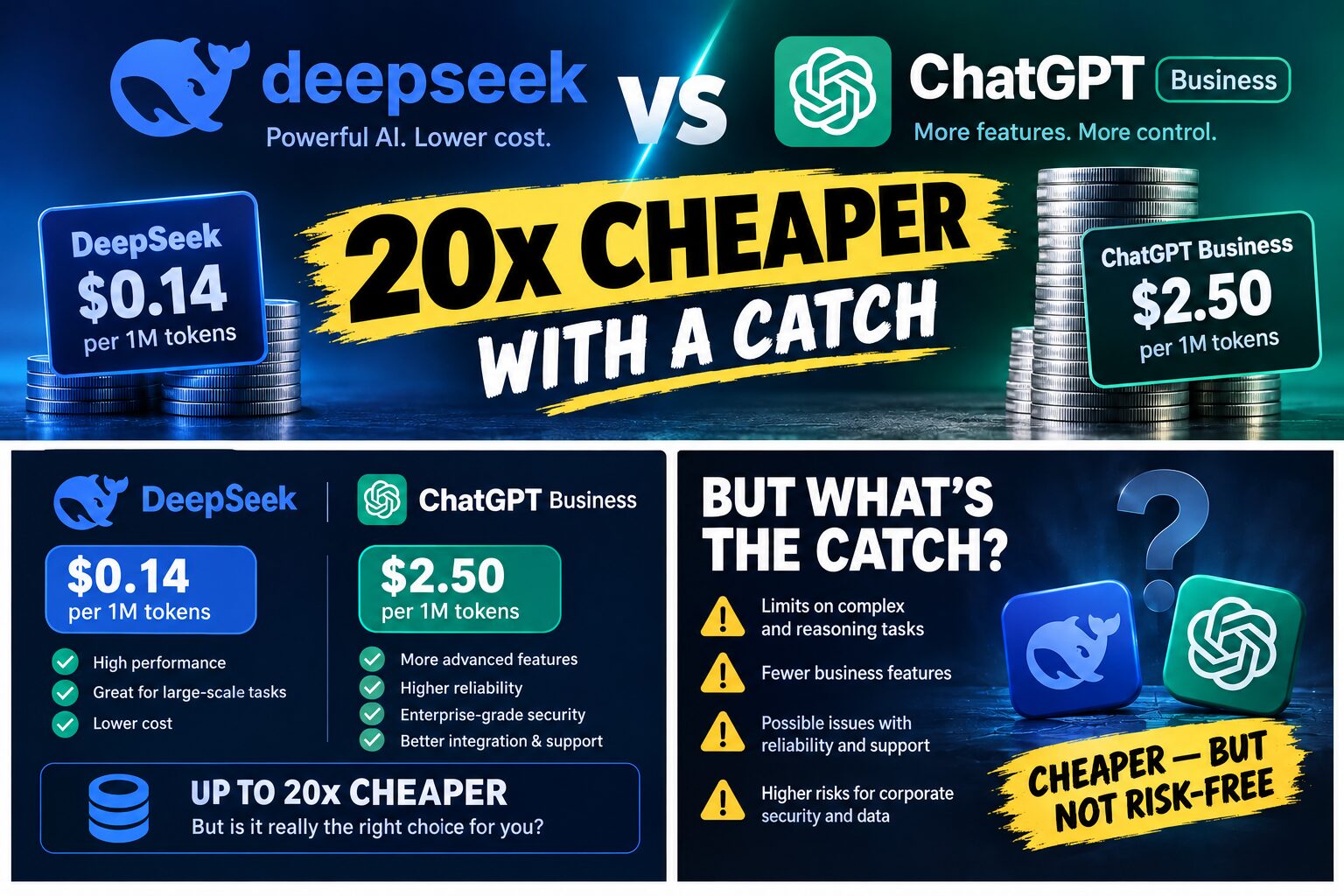
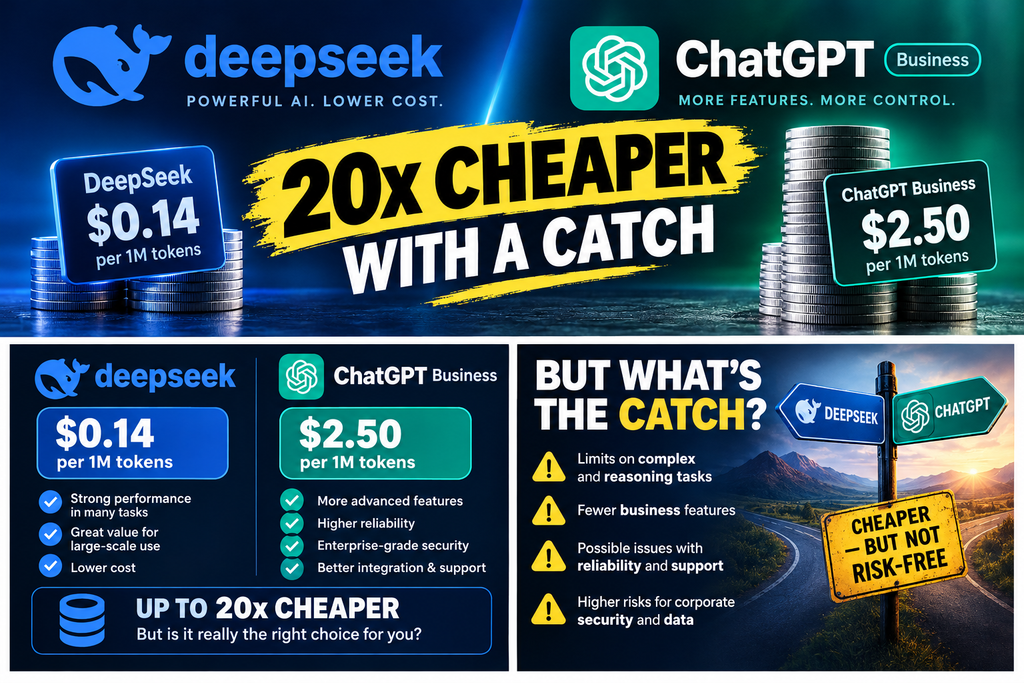
Direct answer: For business use, ChatGPT Business is the safer default for any work that touches company or customer data. DeepSeek wins on token price (roughly 5× to 20× cheaper than GPT-5.5 at October 2026 list prices), but only where it runs on infrastructure you control or a Western host, and only on tasks whose output a machine can check.
Most “DeepSeek vs ChatGPT” comparisons put a chatbot next to a price list and name a winner in whichever column the author likes. That is a category error. It produces the standard verdict, “DeepSeek is cheaper, ChatGPT is safer,” which is accurate and still leaves a buyer unable to decide anything.
The useful question is narrower: which of your workloads can tolerate which data jurisdiction, at what error rate, and at what price? The rest of this article answers it with figures checked on October 11, 2026, and says where each figure is weak.
You are comparing a product to a model
ChatGPT Business is a managed workspace. A Standard seat lists at $20 per user per month on annual billing ($25 monthly); a Premium seat with higher usage lists at $100 ($125 monthly). Workspaces run 2 to 200 seats, include SAML SSO and an admin console, and do not train on business data by default (Krater, read against OpenAI’s pricing page on October 1, 2026). Enterprise has no published price. Individual plans such as Plus use content for training unless the user opts out (TechJack Solutions).
DeepSeek is three separate things, and each has a different risk profile:
| ChatGPT Business | DeepSeek app / hosted API | DeepSeek open weights (self-hosted or third-party host) | |
|---|---|---|---|
| What you pay for | Per seat | Per token | Your GPU bill, or the host’s per-token price |
| Who processes your data | OpenAI | DeepSeek, stored in the PRC per its privacy policy | You, or the host |
| Admin console / SSO | Yes | None found in this research | Whatever you build |
| Contractual no-training default | Yes | Not found | Not applicable if self-hosted |
Open weights are real: V4-Flash was released under an MIT license on Hugging Face on July 31, 2026 (Yotta Labs). The “none found” cells mean this research did not locate a published DeepSeek team plan with SSO and a no-training contract. It is an absence in the search results, not proof of absence; confirm with the vendor before relying on it.
The consequence: “DeepSeek” means nothing in a procurement meeting until someone says which one.
The price gap, calculated
DeepSeek’s official pricing page now splits prices into peak and off-peak. Peak is Beijing time, Monday to Friday, 09:00–12:00 and 14:00–18:00, excluding Chinese public holidays. Everything else is half price. The USD figures below are LiteLLM’s conversion of that list, not a USD page from DeepSeek. GPT-5.5 figures ($5 input, $30 output per million tokens) come from trackers mirroring OpenAI’s API pricing; this article did not open OpenAI’s page directly.
Assumed workload (editorial assumption, not measured): 50M input tokens and 10M output tokens per month, no caching, equal token counts across models.
| Model | Input / Output per 1M tokens | Monthly cost | GPT-5.5 ÷ this model |
|---|---|---|---|
| DeepSeek V4.1 Flash, peak | $0.30 / $1.20 | $27.00 | 20.4× |
| DeepSeek V4.1 Flash, off-peak | $0.15 / $0.60 | $13.50 | 40.7× |
| DeepSeek V4 Pro (0813), peak | $1.32 / $3.96 | $105.60 | 5.2× |
| DeepSeek V4 Pro (0813), off-peak | $0.66 / $1.98 | $52.80 | 10.4× |
| GPT-5.5 | $5.00 / $30.00 | $550.00 | 1× |
Arithmetic, for the Pro peak row: 50 × $1.32 + 10 × $3.96 = $66.00 + $39.60 = $105.60. For GPT-5.5: 50 × $5 + 10 × $30 = $250 + $300 = $550.
Three limits on this table. Reasoning-mode output tokens are billed as output, so a “thinking” model can consume far more tokens per task than the equal-count assumption allows. Third-party hosts price differently: one tracker lists V4 Pro on Azure Foundry at $1.74 / $3.48 as of August 2026 (Future AGI). And caching changes both columns.
The price ledger nobody keeps
DeepSeek’s cheapness has been moving in one direction in 2026. Sources agree on the endpoints and disagree on some intermediate steps:
| Model | Earlier list price (in / out) | October 2026 peak (in / out) | Change |
|---|---|---|---|
| Flash | $0.14 / $0.28 (launch tier, April 2026) | $0.30 / $1.20 | 2.1× / 4.3× |
| Pro | $0.435 / $0.87 (after the May 22 promo became permanent) | $1.32 / $3.96 | 3.0× / 4.6× |
A cost model built in April on “DeepSeek costs pennies” would be off by 2× to 4.6× today. One tracker’s own page was revised on October 4 after its earlier Flash figures ($0.44 / $1.32) were superseded (TechJack Solutions), which is why every DeepSeek price should carry a date. Treat the earlier-price column as medium confidence (secondary trackers); the October column matches the official page as relayed by LiteLLM.
Capability: the gap is real, and its size is disputed
The strongest evidence is the US National Institute of Standards and Technology’s CAISI evaluation of DeepSeek V4 Pro, published May 1, 2026. It finds V4 Pro lags the frontier by about eight months, performs similarly to GPT-5 (released roughly eight months earlier), and scores better on DeepSeek’s self-reported evaluations than on CAISI’s own. It also found V4 cheaper than GPT-5.4 mini on five of seven benchmarks.
Two weaknesses cut against it. Two of CAISI’s nine benchmarks are non-public, so outsiders cannot reproduce the result, and those are where the gap is widest (Decrypt). And CAISI tested V4 Pro in April, not the V4.1 Flash that replaced Flash on September 10 or the 0813 Pro build. A Bloomberg Intelligence note reported by Tech Times claims a 3% gap; this article could not retrieve that note and treats the figure as unverified.
Evidence ranking, strongest to weakest: CAISI’s report (government, independent, partly unreproducible) > Decrypt’s reporting on public-benchmark results, where V4 Pro scored 90% on GPQA-Diamond against 91% for Opus 4.6 > the secondhand Bloomberg Intelligence figure > DeepSeek’s own technical report.
Judgment: the pattern is a model near the frontier on well-posed science and math questions and further behind on novel, agentic, multi-step work. Public benchmarks reward the first kind of task. Business workflows are often the second kind.
The data question, and what hosting does and does not fix
DeepSeek’s privacy policy (last updated February 10, 2026) states that it collects, processes, and stores personal data in the People’s Republic of China (as quoted by WitnessAI). That places prompts inside a legal system whose National Intelligence Law, Article 7, requires organizations to cooperate with state intelligence work (same source, citing the Carnegie Endowment). Government-device bans in the US, Australia, Taiwan, South Korea and Italy cover the hosted service on official devices and do not bind private companies. They signal how regulators read the risk.
Model behavior is a separate issue. CAISI’s September 2025 evaluation of the older R1-0528 found it complied with 94% of overtly malicious requests under common jailbreak techniques versus 8% for US reference models, and that DeepSeek-based agents were 12× more likely to follow hijacking instructions (as reported by Digital in Asia). That evaluation did not cover V4, and no independent security audit of V4.1 Flash had been published as of the Tech Times report above.
Does self-hosting or a Western host make DeepSeek safe for business? It removes the jurisdiction problem: prompts no longer travel to DeepSeek’s servers. Microsoft Foundry has offered V4 since May 2026 with reported EU data residency (innFactory). It does not remove model-level risk. Jailbreak susceptibility and agent hijacking were measured on older models, and nobody has published the equivalent for V4.1. Until someone does, the honest position is “unmeasured,” and the measurement is yours to run, especially for any agent with tool access.
The non-obvious part: token price rarely decides
Compare cost per accepted output, not per token:
cost per accepted output = (token cost per attempt ÷ acceptance rate) + reviewer time per attempt
On the workload above, GPT-5.5 costs 5.2× more per token than V4 Pro at peak. If GPT-5.5’s outputs are accepted 95% of the time, DeepSeek loses on token cost alone only if its acceptance rate falls below 95% ÷ 5.2 ≈ 18%. Nobody is running a business task at that failure rate. Token price therefore never settles the choice.
What settles it are two costs absent from every pricing page: the minutes a person spends checking output, and the price of one data-handling incident. A cheaper model that needs 20% more review time can erase its savings on a small team, and a single regulated-data leak erases them on any team. That is why the real comparison is acceptance rate per reviewer-hour, measured on your tasks.
Figure: the routing rule this article argues for. Two questions, asked in order. Data sensitivity comes first because it is a legal constraint; verifiability comes second because it decides whether a cheaper, less-measured model is affordable.
The diagram compresses one mechanism. The first question is a constraint, so cost never enters it. Only tasks that survive that gate get compared on price, and among those, only the ones where a schema check, unit test or deterministic validator can catch a bad answer cheaply. Where validation needs a person, the person’s minutes dominate the bill and the token discount shrinks to a rounding error.
What to do on Monday
- Classify data before comparing models. Customer personal data, contracts, undisclosed source code and regulated records go to a vendor with contractual terms: ChatGPT Business or Enterprise, or another provider whose contract you have read. DeepSeek’s own app and API are for public data only.
- Send DeepSeek the machine-verifiable bulk work. Classification, schema-validated extraction, and batch summarization of public documents fit. Schedule batch jobs outside Beijing weekday business hours for the half-price rate.
- Run your own bake-off before committing. Take 100 real tasks, use identical prompts, run each model three times, score blind, and record the acceptance rate and reviewer minutes. This article ran no benchmarks of its own; the published numbers above are other people’s.
- Withhold write access from DeepSeek-based agents until you have red-teamed prompt injection yourself. The only published hijacking data concerns older models.
- Re-price quarterly. Two DeepSeek price regimes in six months is a pattern, not noise.
Method and limits
Figures were checked on October 11, 2026, against NIST’s CAISI report and DeepSeek’s official pricing page (Chinese-language version, converted to USD by LiteLLM). OpenAI and ChatGPT figures come from trackers that cite OpenAI’s pages, which were not opened directly, so treat them as medium confidence. Claims about DeepSeek’s privacy policy, Chinese law, and government bans are secondary-sourced. The 5.2× and 20.4× ratios depend on the stated 5:1 input-to-output assumption and equal token counts. Re-verify the following within three months: all DeepSeek and OpenAI prices, DeepSeek model versions, CAISI’s coverage of V4.1, and Azure and AWS regional availability.