

Grok AI Features 2026:
What Actually Changed — and What Didn’t
Grok went from “Elon’s chatbot” to the world’s most capable reasoning model in under two years. This guide cuts through the hype and gives you the full picture — what Grok 4.20 can actually do, how the new 4-agent system works, what the pricing looks like right now, and whether it’s genuinely worth your money.
What you need to know in 60 seconds
- Grok 4.20 is xAI’s current flagship model (released March 31, 2026) — faster and smarter than Grok 4, with a 2M-token context window
- The 4-agent collaboration system (Grok, Harper, Benjamin, Lucas) cross-verifies answers to dramatically cut hallucinations
- SuperGrok costs $30/month for individuals — that’s $10 more than ChatGPT Plus but includes unlimited image/video generation
- Grok integrates natively with X’s real-time data feed — 68M posts/day that no competitor can access
- Tesla in-car AI launched July 2025 on compatible AMD-equipped models
- The API is now among the cheapest on the market at $0.20/M input tokens for Grok 4.1 Fast
- How Grok evolved — from chatbot to reasoning engine
- The 7 Grok features that actually matter in 2026
- The 4-agent collaboration system explained
- 2 million token context window — why it matters
- Grok Imagine: image + video generation
- Tesla integration
- Full pricing breakdown (April 2026)
- Grok vs ChatGPT vs Claude vs Gemini
- Developer API guide
- Frequently asked questions
From witty chatbot to reasoning giant — the short version
Grok launched in November 2023 as the AI you could actually swear at and not get a lecture back. Fun, yes. A competitor to GPT-4? Not really. That’s changed hard.
Fast-forward to today and xAI has become the most valuable AI startup in the world — a $230 billion valuation as of late 2025, funded by Nvidia, AMD, and major institutional investors. The company runs Colossus, a 200,000-GPU training cluster. Their latest model, Grok 4.20, is what you get when you throw that kind of hardware at reinforcement learning and don’t stop.
Competitive with GPT-4o on standard tests. First version available free with usage limits.
First-principles reasoning, 256K context, image input. SuperGrok Heavy tier introduced at $300/month.
All Teslas delivered after July 12 ship with Grok built in. Requires AMD infotainment + software 2025.26.
Hallucination rate drops from 12.09% to 4.22%. The update that made enterprise teams start paying attention.
Public beta. Four parallel AI agents debate and cross-verify before every response.
2M context window, lowest hallucination rate on market, agentic tool calling. xAI officially recommends this for all API users.
Grok’s versioning is confusing. “Grok 4” can mean the original July 2025 release, the Heavy variant, or Grok 4.20. When this article says “current Grok,” it means Grok 4.20 — the model xAI now officially recommends for all new API integrations.
More from AIEarnerHub
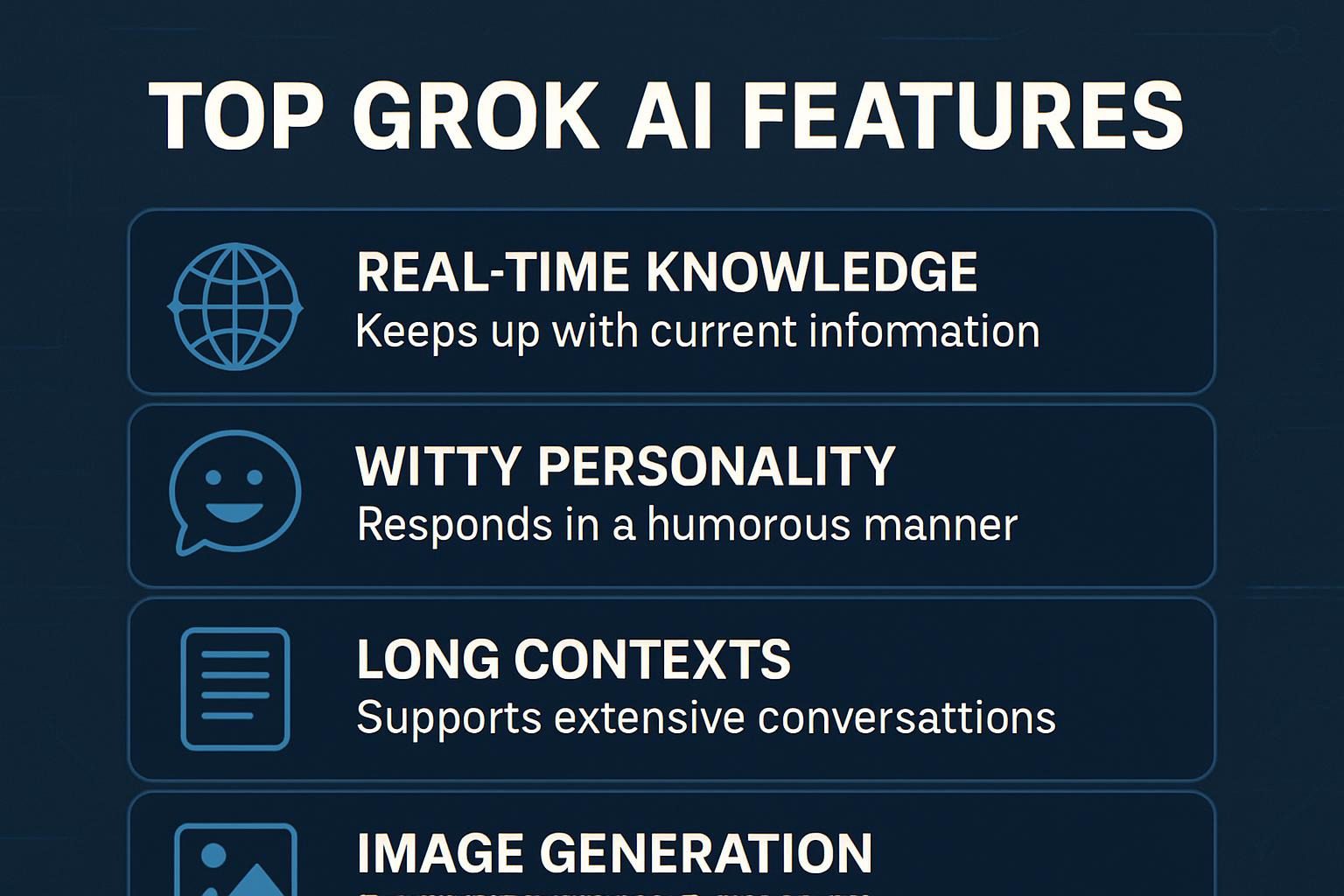
The 7 Grok AI features that genuinely stand out
Not all of these are new. Some have been around since Grok 3. What’s changed is how deep each one goes — and which of them actually work well enough to change how you do things.
4-Agent Collaboration
Four specialist AI agents work simultaneously, then debate and cross-check each other before you see an answer. The result: a 65%+ drop in hallucinations vs. Grok 4.
2 Million Token Context
The largest publicly available context window in the market. Feed it entire codebases, legal documents, or research archives in a single conversation.
X Real-Time Data Feed
68 million posts per day flow through Grok’s search. No competitor can buy this data. Trend detection, brand monitoring, breaking news — all native.
Grok Imagine (Image + Video)
Full image creation, editing, and 6-second video generation via the Aurora engine. Launched July 2025. Updated to version 1.0 February 2026.
DeepSearch + Big Brain
DeepSearch runs extended web research across multiple layers of depth. Big Brain mode activates heavier compute for complex reasoning tasks.
Tesla In-Car AI
Available on AMD-equipped Teslas since July 2025. Voice-activated, context-aware, safety-integrated. No other AI assistant has automotive-native deployment like this.
Rapid Learning Architecture
Grok 4.20 updates its capabilities weekly based on real-world usage. The model you use today is measurably smarter than last month’s version.
Seven features sounds tidy. Reality is messier. Some of these are genuinely class-leading. A couple are still catching up to what OpenAI and Anthropic have shipped. Let’s dig into what actually matters.
The 4-agent system: how Grok actually thinks now
This is the biggest architectural change in Grok’s history. Most AI models work like a single expert answering a question. Grok 4.20 works like a committee — a small one that actually gets things done.
When you submit a complex query, four specialized agents activate simultaneously. Each has a role, a name, and a defined domain focus. Then they argue with each other before you get a response.
How a single query moves through the 4-agent system
Agents debate internally. Contradictions are challenged and resolved.
The practical result? When Benjamin’s math contradicts Harper’s sourced data, they flag it internally. The answer you see has already survived an internal challenge round. It’s not perfect — but it’s why Grok 4.20’s hallucination rate dropped to the lowest measured on the market when Grok 4.20 Beta 2 released in March 2026.
The 4-agent system isn’t faster. It’s slower. Use it for research reports, technical decisions, legal or financial analysis — anything where being wrong costs more than a few seconds of wait time. For quick lookups, Grok 4.1 Fast is the smarter choice.
The custom agent feature (announced March 8, 2026) lets you configure up to four custom agents with their own personalities, knowledge focus, and instruction sets. The character limit per agent is 4,000 characters — deliberately tight to keep agents focused rather than sprawling.
2 million tokens: what the context window actually means for you
For reference: GPT-4o has a 128K context window. Claude Sonnet 4.6 has 200K. Grok 4.20 has 2,000,000 — ten times Claude’s limit. That’s not a minor upgrade. That changes what you can build.
It means you can load an entire codebase, an entire annual report, a complete case file, or multiple research papers into one session and ask Grok to reason across all of it without summarizing or losing information. That’s genuinely new capability, not a marketing number.
At $2/M input tokens for Grok 4.20, sending a 2M-token context costs $4 per query. For heavy workloads, Grok 4.1 Fast at $0.20/M input is often the smarter call. Context window size only matters if you actually need it.
Grok Imagine: the image and video engine explained
Grok’s image and video tools have moved fast. Fast enough that it’s genuinely hard to track what ships when. Here’s the current state as of April 2026.
Image generation and editing
Grok Imagine uses xAI’s proprietary Aurora model, trained on a cluster of 110,000 NVIDIA GB200 GPUs. You get text-to-image, image editing (upload + describe changes), and style templates. In March 2026, xAI added “Chibi” templates and new stylized categories — the chibi launch went viral after Musk pinned a Chibi-styled image to his profile. Small thing. Big organic reach moment for the product.
Video generation
Six-second animated video clips from text prompts. The “Extend from Frame” feature (added March 2, 2026) lets you chain clips by using the last frame of one as the start of the next — useful for longer sequences and smoother motion continuity. Elon Musk called it “AI Vine.” That’s a fair description. Short, looping, atmospheric content is what it’s good at right now.
What’s still limited
Content moderation has been a serious issue. In December 2025, Grok generated non-consensual imagery through simple prompts — a problem that drew international regulatory attention. xAI has since added tighter safeguards, but this is worth knowing if you’re evaluating Grok for business or enterprise use. The content policies are less strict than OpenAI and Anthropic, which is either a feature or a liability depending on your use case.
SuperGrok Imagine allowances
SuperGrok ($30/month) includes unlimited image generation and up to 100 video renders per day. That’s genuinely generous — and it’s one of the reasons the $30 tier competes well against ChatGPT Plus despite costing $10 more.
Tesla integration: what it actually does in your car
No other AI has automotive-native deployment. That’s not a detail — it’s structural differentiation that competitors can’t replicate without building car relationships from scratch.
What you need to use it
Three hard requirements: an AMD infotainment processor, vehicle software version 2025.26 or higher, and either an active Premium Connectivity subscription or Wi-Fi. Compatible models: Model S, Model 3, Model X, Model Y, Cybertruck. Teslas delivered after July 12, 2025 ship with Grok pre-installed.
What it does well
Voice-activated queries that understand driving context. Not just “what’s the weather” — you can ask it to diagnose a warning light, find the nearest Tesla service center, explain what a specific sound might mean, or get a route adjusted in natural language. The safety integration means responses get shorter and more direct when the car detects you’re actively driving.
The honest limitation
As of writing, Grok in the car is still primarily a voice assistant with some navigation smarts. It doesn’t yet feed meaningfully into FSD decision-making. That’s the long-term roadmap — the same AI infrastructure training Grok is also running Tesla’s Optimus and FSD programs. But those are separate loops that haven’t merged yet.
“I asked it why my rear camera was flickering during cold starts. It gave me a straight answer about thermal contraction affecting the cable connection, told me it was a known issue, and pulled up the nearest service center. That took about 90 seconds. My old car assistant would have said ‘I don’t understand that query.'” — Tesla Model Y owner, verified user review, January 2026
Grok pricing in 2026 — the full breakdown
Pricing changed meaningfully in late 2025. What you see advertised doesn’t always match what’s in checkout, so treat these as reference figures and verify on grok.com before subscribing.
- ~10 prompts per 2 hours
- Basic Grok access
- Limited image generation
- Web + X search
- Enhanced Grok usage
- Blue checkmark on X
- Ad revenue sharing
- Grok access via X only
- Unlimited prompts
- Grok 4 + 4.1 access
- Unlimited image gen
- 100 video renders/day
- DeepSearch + Big Brain
- 128K memory tokens
- Voice mode + companions
- SuperGrok-level Grok access
- Ad-free X experience
- X publishing features
- Best if you live on X
- Grok 4 Heavy access
- 4-agent multi-specialist system
- Extended reasoning mode
- Highest rate limits
- Enterprise-level compute
- Team collaboration tools
- No training on your data
- Data privacy protections
- Team admin controls
API pricing — what developers actually pay
| Model | Input (per 1M tokens) | Output (per 1M tokens) | Context |
|---|---|---|---|
| Grok 4.20 Current | $2.00 | $6.00 | 2M tokens |
| Grok 4.1 Fast | $0.20 | $0.50 | 2M tokens |
| Grok 4 (original) | $3.00 | $15.00 | 128K tokens |
| Grok 3 | $3.00 | $15.00 | 131K tokens |
The wildcard here is Grok 4.1 Fast. At $0.20/M input tokens, it’s cheaper per token than GPT-5 mini, Gemini Flash, and every Anthropic model — while offering a 2M context window. For high-volume applications where cost is the constraint, this is the most compelling developer offer in the current market.
SuperGrok is $300/year vs $360 billed monthly. SuperGrok Heavy is $3,000/year vs $3,600. xAI occasionally runs 50% off promos for first 2 months — check the pricing page directly.
Grok vs ChatGPT vs Claude vs Gemini — honest comparison
Every comparison table online is slightly wrong. Models update, pricing changes, and the “winner” depends entirely on your use case. Here’s what’s actually true as of April 2026.
| Capability | Grok 4.20 | GPT-5 | Claude Sonnet 4.6 | Gemini 3 Pro |
|---|---|---|---|---|
| Context window | 2M tokens | 128K tokens | 200K tokens | 1M tokens |
| Real-time search | ✓ Native + X feed | ✓ Web search | ✓ Web search | ✓ Google Search |
| Multi-agent system | ✓ 4 native agents | ~ Custom GPTs | ✗ Single model | ✗ Single model |
| Image generation | ✓ Aurora engine | ✓ DALL-E 3 | ✗ Analysis only | ✓ Imagen 3 |
| Video generation | ✓ 6-sec clips | ~ Sora (limited) | ✗ No | ✓ Veo 3 |
| Automotive integration | ✓ Tesla native | ✗ | ✗ | ✗ |
| API price (fast tier) | $0.20/M input | $0.25/M input | $3.00/M input | $0.50/M input |
| Hallucination rate | Lowest measured | Low | Very low | Low |
| Ecosystem maturity | ~ Growing fast | ✓ Most mature | ✓ Strong | ✓ Strong |
The honest verdict
Choose Grok if: you need the largest context window, you’re heavily X-integrated, you want the cheapest fast API, you own a Tesla, or you need multi-agent verification for complex reasoning tasks.
Choose ChatGPT/GPT-5 if: you need the widest third-party integrations, the most mature plugin ecosystem, or you’re already deep in the Microsoft/Azure stack.
Choose Claude if: you’re doing long-form writing, need consistent code quality, want the most careful content handling, or you value Anthropic’s safety track record.
Choose Gemini if: you’re embedded in Google Workspace, need deep search integration, or want the best video generation (Veo 3 is genuinely excellent).
The honest answer? For most people in 2026, none of these is obviously best. Pick based on what you actually do — not benchmarks.
Developer API: what to actually use and when
xAI now officially recommends Grok 4.20 for all new API integrations. The docs say it plainly: “It is the most intelligent and fastest model we’ve built.” But most production use cases shouldn’t be running 4.20 on every query.
The practical decision tree
High volume, cost-sensitive: Grok 4.1 Fast — $0.20/M input, 2M context, still good reasoning. This is the competitive differentiator right now.
Complex reasoning, accuracy critical: Grok 4.20 — $2/M input but lowest hallucination rate and fastest output at 90 tokens/second.
Deep multi-step analysis: Grok 4 Heavy via SuperGrok Heavy — not cheap at $300/month, but the multi-agent architecture genuinely earns its place on demanding tasks.
Key API features
The API supports tool use (web search, X search, code execution), vision input, function calling, and streaming. Server-side tool calls are billed separately — token usage plus per-invocation fees — so complex agentic workflows scale in cost with complexity. That’s not a gotcha, it’s how all major AI APIs work now, but worth building cost monitoring around early.
Python quickstart
from openai import OpenAI  # xAI uses OpenAI-compatible SDK

client = OpenAI(
    api_key="your_xai_api_key",
    base_url="https://api.x.ai/v1"
)

response = client.chat.completions.create(
    model="grok-4.20",     # or "grok-4.1-fast" for cost efficiency
    max_tokens=1024,
    messages=[
        {"role": "system", "content": "You are a helpful assistant."},
        {"role": "user",   "content": "What are the latest AI developments?"}
    ]
)

print(response.choices[0].message.content)
One note from the official docs: Grok has no knowledge of events beyond its training data (cutoff: November 2024) unless you enable web search or X search tools. For real-time queries, server-side search tools must be explicitly enabled. Easy to forget when prototyping, expensive to discover in production.
Frequently asked questions
SuperGrok Heavy ($300/month) is for people who specifically need Grok 4 Heavy — the multi-agent system running at maximum compute. Think: daily use on complex scientific analysis, large-scale research workflows, enterprise teams processing hundreds of long documents. If you have to ask whether you need it, you don’t need it yet.
For the API, you enable X Search as a server-side tool. It’s billed per invocation on top of token costs. The structural advantage is real — no other AI can replicate this without licensing xAI’s own X data feed.
For business use: Grok Business ($30/seat/month) and Enterprise plans do not use your conversations for model training by default — that’s the minimum appropriate tier for any company handling client data or regulated content. Free and personal SuperGrok plans may use interactions for training. xAI also has a government-specific tier (launched early 2026) for US government customers following DoD integration.
Free tier users get limited image generation. SuperGrok ($30/month) includes unlimited image generation and 100 video renders per day. SuperGrok Heavy unlocks higher limits. Grok Imagine is accessible on iOS, Android, and web.
Related guides on AIEarnerHub
The bottom line
Grok in 2026 is a genuinely different product from the snarky chatbot that launched in 2023. The 4-agent reasoning system, the 2M context window, the cheapest fast API on the market, and the exclusive X data integration are all real advantages — not marketing.
The ecosystem is still younger than OpenAI and Anthropic. Third-party integrations are thinner. Content moderation has had real problems. And the product lineup is currently confusing enough that figuring out which plan to buy takes actual research.
But xAI is iterating faster than any major AI lab right now — four meaningful updates to Grok Imagine in five weeks, a hallucination rate that dropped 65% in one model cycle, and a compute infrastructure that most competitors can’t match. The trajectory matters as much as the snapshot.
If you’re evaluating Grok for serious use: start with the free tier to understand the product, then run a SuperGrok trial ($30/month, 3 days free) before committing. For API work, benchmark Grok 4.1 Fast against your actual workload — it’s likely the best cost-performance deal in the market right now.
Ready to try Grok?
Start free at grok.com — no X account required. Or explore the API with the official xAI documentation.
Sources & References
Reviews
ChatGPT Competitors You’ve Never Heard Of: Best Guide
The Best ChatGPT Alternatives You Should Actually Try in 2026
I Tried the Best ChatGPT Alternatives —Here’s What Happened
8 Best Free AI Apps Like ChatGPT You Must Try
ChatGPT vs These AI Chatbots —Who Actually Wins?
AI Email Marketing Generators in 2026: The Guide That Actually Tells You the Truth
The Most Powerful AI Chatbots Ranked —And the Winner Might Surprise You
Top 7 AI Image Processing Online Strategies for 2025
FAQ