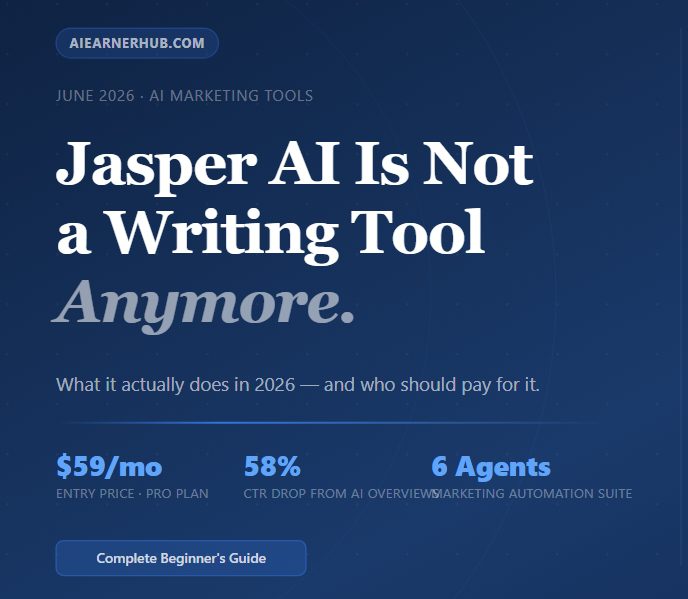

Jasper AI Is Not a Writing Tool Anymore.
That’s the Part Most Reviews Miss.
The platform most people think of as “the AI that writes blogs faster” has quietly become something far harder to explain — and far more consequential for marketing teams. Here’s what it actually does in 2026, who should pay for it, and what the $59/month entry point actually buys.
Jasper AI is often described as “an AI writing assistant for marketing teams.” That’s the consumer definition. The operational definition, as of 2026, is something closer to: a brand governance layer that sits above your content production and enforces consistency at scale — with a set of autonomous agents that can execute research, optimize for AI search engines, and surface where your brand is being misrepresented by tools like ChatGPT before your customers notice it.
Those two definitions look the same in a demo. They look completely different in a contract negotiation and in your quarterly content budget. Most beginners walk away from their Jasper trial thinking they’ve tested a faster way to draft blog posts. What they actually tested was a thin slice of a platform that has been deliberately repositioning itself for eighteen months away from individual content creation and toward enterprise marketing infrastructure.
This matters because the advice you’ll find about Jasper is almost entirely calibrated to the old version of the product. “Great for blog outlines.” “Slower than ChatGPT.” “Not worth it for freelancers.” Some of that is still true. But if you’re a marketing manager or a solo operator trying to decide whether Jasper earns a line on your 2026 budget, you need to understand what actually changed — and whether those changes are relevant to you at all.
The Pivot Most People Missed
In January 2026, Jasper shipped what it called a “Marketing Hub” repositioning: a set of features that moved the product away from being a template library and toward being what the company now describes as a “content operating system.” The phrase sounds like marketing copy. Under it are three structural changes that are more specific.
First, Jasper IQ — the platform’s proprietary context engine — was upgraded to support multimodal knowledge assets. Previously, you could feed Jasper text documents (brand guidelines, style guides, product specs) and it would use those to write on-brand content. In 2026, it ingests video and audio alongside text. A 40-minute brand positioning presentation recorded in a meeting can now become part of what Jasper knows when it writes your next product launch email. That sounds incremental. In practice, it closes the gap between “what our agency knows about us” and “what the AI generates when we’re in a hurry.”
Second, autonomous Marketing Agents were promoted from beta to production. These aren’t AI writing templates; they’re task-executing systems. The Optimization Agent, for instance, connects directly to your SEMrush data, pulls keyword gaps, analyzes your existing page against Google’s Search Quality Rater Guidelines, and produces a rewritten draft — all without you manually exporting a CSV and pasting it into a prompt. The Research Agent builds competitive intelligence reports from public content before you begin writing, identifying topic gaps and saturated areas. A February 2026 update also added MCP and API agent support, meaning technical teams can embed these agents inside their own internal tools.
Third — and this is the piece that most newcomers haven’t registered yet — Jasper began addressing what it now calls the GEO problem. GEO stands for Generative Engine Optimization, the emerging discipline of structuring content so that systems like ChatGPT, Perplexity, and Google AI Overviews represent your brand accurately when someone asks about you.
What “Brand Voice” Actually Means in This Context
The most-used feature on the platform, according to the company’s product documentation, is Brand Voice configuration. It’s also the feature most often described in a way that undersells its actual function.
The standard explanation: you paste in some sample content, Jasper analyzes the tone and style, and future outputs match your voice. Accurate, but incomplete. In 2026, the Brand Voice system — part of the broader Jasper IQ framework — is a governed repository of brand intelligence that persists across every piece of content, every team member, and every agent-executed task. The Pro plan allows for two distinct Brand Voices and five Knowledge Assets. The Business plan removes those caps entirely.
The difference matters practically when you’re managing multiple product lines, serving agency clients, or dealing with the common scenario where your best writer leaves and the next person inherits an AI system that has “learned” how your brand talks. Without that governance layer, the new person’s output starts drifting within weeks. With it, the drift is constrained — not eliminated, but constrained.
“The Brand Voice system isn’t about making AI sound like you. It’s about making AI not sound like everyone else.” — Operational framing worth keeping when evaluating whether the feature earns its cost
Visibility Controls, added in March 2026, extended this further: admins can now designate which Brand Voices and Knowledge Assets are official (shared and enforced across the team), which are personal (for individual experimentation), and which are shared but not mandatory. For a team of five or more, this matters a lot. It’s the difference between AI governance and AI chaos.
The Agents: What They Can and Can’t Do
The agent vocabulary has inflated significantly in the AI industry over the past year — almost everything is an “agent” now, including some systems that are just conditional logic wrapped in a chat interface. Jasper’s agents are meaningfully more capable than that, and meaningfully less capable than the term implies in its most ambitious usage.
Here’s what they actually do, in plain terms:
What they can’t do: they can’t publish autonomously, they can’t make strategic decisions about what to write, and they don’t replace the judgment required to know whether a given piece of content should exist at all. They’re very good at the middle section of content production — the gap between “we know what we want to say” and “it’s live and optimized.” They’re not good at the brief itself or at the post-publication performance analysis (though reporting features improved in March 2026 and are now more useful than before).
The SEMrush integration deserves a specific note. The Optimization Agent’s direct connection to SEMrush data means that for teams already paying for SEMrush, a significant part of the manual workflow — export keyword data, import to your writing tool, run your optimization pass, check against SEO guidelines — collapses into a single step. For teams not using SEMrush, it’s a feature that exists on paper more than in practice.
The Search Landscape Jasper Is Responding To
It’s worth spending a moment on why Jasper has pivoted so hard toward GEO and AEO, because the pivot tells you something about where the platform sees content marketing going over the next 24 months.
For the first time since the early 2000s, Google’s market share has dropped below 90%. The shift isn’t dramatic in absolute terms, but the direction is consistent. People are asking ChatGPT questions they would previously have Googled. Perplexity is processing research queries that used to generate clicks. Google’s own AI Overviews are providing answers that make clicking through to source pages optional.
The consequence for content teams is that optimizing for Google ranking is necessary but no longer sufficient. Your content also needs to be structured in a way that makes it easy for AI systems to summarize accurately, attribute clearly, and cite when someone asks a question in your category. That’s AEO (Answer Engine Optimization) — formatting that prioritizes direct, quotable answers — and GEO, which is broader, encompassing everything about how AI systems represent your brand in context.
Jasper is one of the few platforms that has built specific tooling around this problem. Its GEO Diagnostic tool, launched in 2026, scans your site pages and shows you where AI engines are likely misrepresenting your brand versus competitors. Whether that tooling actually moves the needle is still being determined — it’s early days for the category. But the problem it’s trying to solve is genuinely real, and it’s the kind of problem that content teams with no enterprise tooling budget are completely unprepared for.
Pricing in 2026: The Honest Version
The pricing story for Jasper is more complicated than the website suggests. Here’s the breakdown as of May 2026:
One seat. Built for a single person managing one or two brands. Good entry point; hits limits fast for agencies.
- 1 seat
- 2 Brand Voices
- 5 Knowledge Assets
- 3 Audiences
- Essential Agents
- Canvas editor + Chrome extension
- Image generation tools
- No API access
- No AI App Builder
- Single seat only
Starts around $62/seat/month per third-party reports. No published floor. Enterprise terms, dedicated CSM, custom contracts.
- Unlimited Brand Voices
- Unlimited Knowledge Assets
- Advanced Agents (full suite)
- AI App Builder (Studio)
- Jasper Grid (bulk execution)
- API access + MCP support
- SSO + role-based permissions
- Dedicated Customer Success Manager
A 7-day free trial is available on the Pro plan — the clearest way to test whether Jasper’s Brand Voice capabilities add real value to your workflow before committing. The trial does not include the advanced agent features or the Business-tier governance tools.
Who Should Actually Use Jasper
The honest answer here is narrower than Jasper’s marketing implies, and broader than its critics allow.
| User Type | Verdict | Reason |
|---|---|---|
| Solo blogger / freelancer | Marginal | $59/month is steep for a single seat when ChatGPT Plus does 80% of the same writing work at $20/month. The Brand Voice system adds little value when you’re the only voice. |
| Solo operator, multiple brands | Conditional yes | Two Brand Voices and five Knowledge Assets on the Pro plan handle two distinct clients or product lines. If you’re switching context frequently, the governance layer pays back in saved mental overhead. |
| Small marketing team (3–8 people) | Strong case | This is the clearest value zone. Brand consistency across team members, shared Knowledge Assets, agent-assisted content pipelines. The jump to Business pricing is painful but often justified by time savings. |
| Agency managing multiple clients | Evaluate carefully | Unlimited Brand Voices and Knowledge Assets on Business make the per-client economics work. The ROI depends entirely on volume — agencies producing 50+ pieces per client per month have clear cases; smaller operations may not. |
| Enterprise marketing team (15+ people) | Purpose-built | This is who Jasper is now being designed for. SSO, role-based permissions, compliance guardrails, audit trails, dedicated support. The platform is genuinely differentiated at this tier from cheaper alternatives. |
| Technical teams wanting custom workflows | Business required | API access and MCP/API agent support are Business-only. If you want to embed Jasper’s agents in your own tools and workflows, that conversation starts with the sales team, not the pricing page. |
What Jasper Doesn’t Do Well (As of June 2026)
No platform review that skips this section is honest. Here are the limitations worth knowing before you sign:
It doesn’t think strategically. The agents are execution systems. They optimize what exists; they don’t question whether the underlying strategy is correct. You can run the Optimization Agent on a blog post targeting the wrong keyword and get a very well-optimized blog post targeting the wrong keyword. Strategy still lives with humans.
The pricing structure punishes growth. The cliff between Pro and Business has no middle ground. Teams between one and roughly fifteen people often find they need Business-tier features (more Brand Voices, more agents, team governance) but struggle to justify the custom-contract pricing. This is a product decision Jasper has made deliberately — it is positioning for enterprise — but it creates a frustrating gap for mid-market teams.
GEO outcomes are still being proven. The GEO Diagnostic and the AEO/GEO optimization features are among the most interesting things Jasper shipped in 2026. They’re also the least proven in terms of measurable traffic impact. The discipline itself — getting AI engines to represent your brand accurately — is real and growing. But “Jasper’s GEO tools move the needle by X%” is a claim that nobody, including Jasper, has strong third-party evidence for yet.
Billing has had documented complaints. This is worth mentioning plainly: TrustPilot reviews as of mid-2026 include credible reports of billing disputes after cancellation attempts. These are not universal, but they’re consistent enough to warrant careful reading of cancellation terms before you enter a subscription.
The Tool You Should Compare It Against
The most useful comparison in 2026 isn’t Jasper versus ChatGPT. That’s a different category of tool. The useful comparisons are Jasper versus Writer, Jasper versus Copy.ai, and — for enterprise teams thinking about AI governance specifically — Jasper versus building internal workflows on top of the Anthropic or OpenAI API directly.
| Platform | Best for | Team pricing (annual) | Key differentiator vs. Jasper |
|---|---|---|---|
| Jasper Business | Enterprise brand governance + content operations | Custom (typically several hundred–thousands/month) | GEO tooling, multimodal Brand IQ, agent ecosystem |
| Copy.ai | Team content with lighter governance needs | ~$1,440/year (5-person team) | Lower cost; less brand governance depth |
| Writer | Enterprise tone/style enforcement + compliance | Custom (comparable enterprise tier) | Stronger compliance features for regulated industries |
| ChatGPT Team | General writing assistance | $300/year (5 users at $25/month) | Significantly lower cost; no brand governance or agent pipeline |
If you’re a solo operator or a small team without a genuine brand consistency problem, the price difference between ChatGPT Team and Jasper Pro is hard to justify on writing quality alone. The writing outputs are comparable. Where Jasper separates itself is in what happens when you need the same AI to write as your brand — not as itself.
Jasper is a brand operations platform that produces content — not a content platform that does brand operations. That distinction determines whether it’s worth the price.
For enterprise teams and growing agencies where brand consistency, multi-user governance, and AI search visibility are operational problems, Jasper in 2026 is purpose-built in ways that cheaper alternatives genuinely aren’t. The SEMrush-connected Optimization Agent alone is worth evaluating if your team currently handles that workflow manually.
For individuals and small teams primarily looking to write faster, the $59 Pro plan is overpriced relative to alternatives unless you’re managing multiple brands or have a specific Brand Voice problem that free or cheaper tools can’t solve.
- Multimodal brand intelligence (text, video, audio)
- Autonomous agents for research and optimization
- SEMrush-native Optimization Agent
- GEO/AEO tooling (early but serious)
- Governance controls for large teams
- MCP/API integration for technical teams
- No mid-market pricing between Pro and Business
- GEO outcomes not yet independently proven
- Strategic judgment still requires humans
- Billing complaints documented on review platforms
- 5-person team costs 2.5× Copy.ai equivalent
- Trial doesn’t include Business-tier agent features
Starting with Jasper: The Shortest Useful Path
If you’ve decided the Pro plan is worth a trial, the setup that actually tests whether it adds value to your workflow looks like this — not the onboarding flow Jasper suggests, which optimizes for first-week “wow” moments rather than real workday utility:
Day one: don’t write anything. Spend the first hour uploading your best existing content into a Brand Voice — three to five pieces that represent how you actually communicate, not aspirationally but actually. Then upload your core brand document or product brief as a Knowledge Asset. If you don’t have those documents in usable form, that’s the real barrier to using Jasper effectively, and no amount of AI will fix it.
Day two: use Canvas to write one piece you would normally write anyway. Not a test piece. A real deliverable. The question isn’t whether Jasper can write — it can. The question is whether the output requires less revision than your current process, and whether it sounds like your brand without you manually correcting it back.
By the end of week one, you’ll have a real answer about whether the Brand Voice system solves a problem you actually have. If it does, the case for the subscription becomes straightforward. If it doesn’t — if you find yourself rewriting the brand voice back in every time — that’s your answer, and you’ve spent $0 on an annual commitment to find it out.
The Part That Will Be Outdated Soonest
Everything above on GEO tooling — the Optimization Agent’s effectiveness at AI search citation, the practical impact of AEO formatting on LLM mention rates — is the section of this piece most likely to need revision in six months. The discipline is real; the measurement infrastructure for it is still catching up. By late 2026 or early 2027, there will be clearer third-party evidence about which platforms’ GEO tooling actually delivers citable outcomes and which deliver dashboards that show you metrics you can’t validate.
The core product question won’t change: does your team have a genuine brand governance problem, and are you operating at a scale where that problem has a measurable cost? If yes, Jasper 2026 is worth a serious evaluation. If no, you’re paying for infrastructure you don’t need.
Pricing figures reflect data available as of May–June 2026 from published Jasper materials and third-party procurement reporting (Vendr, HyperWrite). Seat costs at enterprise tier vary by negotiation; figures cited are directional. All capability descriptions based on Jasper’s public product updates through March 2026. GEO effectiveness data referenced from Jasper’s own published research and the Ahrefs studies cited therein — independent verification of GEO outcomes is, as noted, still limited. This article does not contain affiliate links to Jasper.
Sources: Jasper January 2026 update · March 2026 update · Jasper on GEO/AEO · HyperWrite pricing analysis · eesel AI 2026 review