
AI for Social Media Marketing:
The 2026 Playbook That Actually Works
$277 billion in global social ad spend. 94% of marketers using AI for content this year. And a 12% engagement penalty if your audience catches you over-automating. Here’s how to land on the right side of that line.
Let me tell you something that surprised me on a client call last month. Their engagement had dropped after they fully switched to AI-generated posts. Not by a little — by about 18% over 8 weeks. They’d done everything “right”: prompt templates, scheduled posting, A/B tested headlines. And their audience had quietly started ignoring them.
This is the AI social media paradox of 2026. The tools have never been more powerful. The trap has never been more tempting. And the brands winning right now aren’t necessarily the ones using the most AI — they’re the ones using it the most intelligently.
This guide is what I wish existed when I started implementing AI into social strategies in 2023. It’s built on current data, real campaign results, and a few hard lessons. No vague frameworks. No “AI is the future” throat-clearing. Just what works, what doesn’t, and why.
The 2026 Reality Check
The numbers are genuinely staggering. 5.66 billion people now use social media — essentially 70% of the entire planet. Global social ad spend cleared $277 billion in 2025. And for the first time in history, AI-generated content surpassed human-written content online.
That last one should give you pause, not excitement. When AI-generated content becomes the norm, audiences develop a feel for it. Research tracking content performance across major platforms in 2026 found that content audiences perceive as AI-generated sees a 12% engagement penalty on average. AI-augmented content — where AI assists but the output still feels human — shows no measurable negative impact. That distinction is going to define winners and losers for the next few years.
Algorithm shifts on every major platform in 2025–2026 moved from social-graph distribution (who follows you) to interest-graph distribution (what people engage with). Your follower count matters less now. Content velocity and engagement within the first 30–60 minutes matters enormously. AI can help with both — or hurt both if misused.
Instagram now penalizes accounts that post fewer than 4 Reels per week with 23% lower overall reach. TikTok crossed 2 billion monthly active users. Threads — yes, Threads — surpassed X in daily mobile usage as of January 2026. The platforms you’d written off may deserve another look.
What Actually Changed in 12 Months
A year ago, the conversation was “should we use AI?” That question is dead. 94% of marketers plan to use AI for content creation in 2026. The conversation now is about how — and where the line sits between augmentation and over-automation.
Here’s what’s genuinely new compared to the 2025 landscape:
| Dimension | 2025 State | 2026 Reality |
|---|---|---|
| Content Discovery | Mostly follow-based feeds | AI interest-graph dominates all major platforms |
| AI Content Volume | Human content still majority online | AI-generated content surpassed human content (first time ever) |
| Audience Tolerance for AI | Mostly unaware or indifferent | Noticeably more skeptical — 31% less likely to choose brands using AI ads |
| Social Commerce | Growing but fragmented | 17% of ALL online sales now happen through social platforms |
| Video Requirement | Strong advantage | Non-negotiable — 92% of marketers maintaining or increasing video spend |
| First-Party Data | Nice to have | Essential as third-party signals continue degrading |
One thing I keep pointing out to clients: Gen Z now uses social media as a search engine more than Google for certain queries. 41% of Gen Z go to social media first when they need information. Your SEO-first strategy needs a social-search dimension in 2026. AI can help enormously with social search optimization — if you know what you’re optimizing for.
The AI Engagement Penalty — and How to Avoid It
Here’s the uncomfortable truth that almost nobody in the AI tools space wants to tell you. Hootsuite’s 2026 Social Trends report found that nearly a third of consumers say they’re less likely to choose a brand that uses AI ads. Not AI assistance — AI ads, the kind that feel generated rather than crafted.
So why are winning brands still heavily using AI? Because there’s a meaningful difference between:
- ✗ AI-generated content — Published directly from the AI output with minimal human involvement. Readers notice the flatness, the uniform rhythm, the absence of personality.
- ✓ AI-augmented content — Human insight, story, or angle drives the content; AI handles drafting, variation, optimization. The human fingerprint is genuinely there.
“Winning brands are intentionally moving away from overly polished social content. Imperfections, natural pacing — even typos — signal authenticity, even when AI is at work behind the scenes.” — Hootsuite Social Trends 2026
The practical takeaway: use AI to do the heavy lifting on structure, variation, and distribution. Keep humans in the room for the angle, the voice, and the final edit. Your audience doesn’t care about efficiency. They care about whether the post sounds like someone who actually knows something.
The accounts I’ve seen maintain or grow engagement through an AI transition all have one thing in common: a clear “voice owner” — one person whose perspective, opinions, and idiosyncrasies shape every post, even when AI drafts the words. The AI becomes the keyboard. The human remains the brain.
Platform-by-Platform AI Breakdown
Different platforms have radically different dynamics right now. Here’s where AI is most and least useful in 2026, based on current platform data:
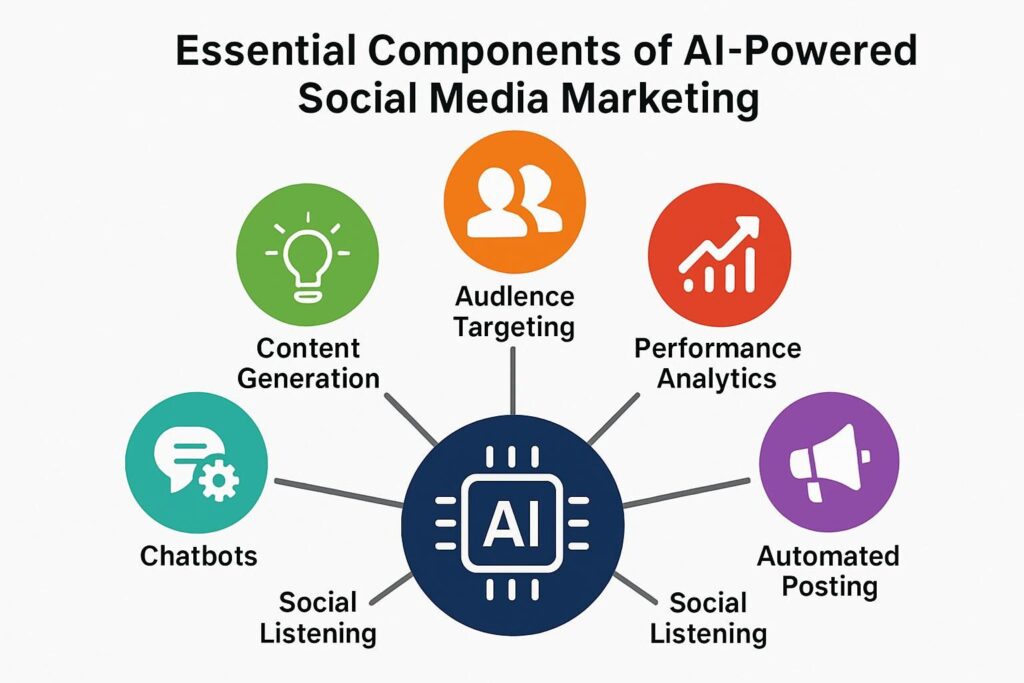
The 5 Core AI Applications That Actually Pay Off
Most “AI for social media” articles list 15 use cases. Honestly, most of them are marginal. These five are where the measurable returns concentrate — I’ve seen this across enough campaigns to call it a pattern.
1. Content Variation at Scale
Creating one strong piece of content is hard. Creating 12 variations of it for different platforms, formats, and audience segments used to be impossible for small teams. AI makes it routine. The catch: you still need one genuinely strong original. AI is an amplifier, not a creator.
73% of social media marketers now use AI editing tools to refine and fine-tune social posts. The ones seeing ROI are using AI to multiply quality content — not to replace the process of creating quality content in the first place.
2. Predictive Posting Optimization
Forget fixed posting schedules. AI tools that analyze your audience’s engagement patterns and dynamically optimize posting times can make a meaningful difference — especially on platforms like Instagram and LinkedIn where engagement velocity in the first hour matters for algorithmic distribution.
If you’re not already doing this: pull 90 days of your engagement data by hour-of-day and day-of-week. Most social analytics platforms display this for free. That alone will beat whatever “best time to post” article you last read — because it’s your audience, not the average.
3. AI-Powered Social Listening
This is the underrated one. 62% of marketers use social listening tools to spot trends in real time, and 71% of organizations use AI for social listening in PR contexts. The brands catching trend windows early and adapting messaging on the fly are running AI-powered listening stacks, not checking Twitter manually.
The most sophisticated operators aren’t just monitoring brand mentions. They’re using AI to surface micro-shifts in audience sentiment — catching a problem before it becomes a crisis, or a trend before it peaks.
4. Social Commerce Optimization
Social commerce generated 17% of all online sales in 2025. That number will be higher by the time you read this. AI’s role here is specifically valuable in three places: product recommendation logic within native shops, pricing signal monitoring, and retargeting sequencing across platforms.
A quick stat that should focus priorities: 81% of consumers say social media compels them to make spontaneous purchases multiple times per year. You’re not selling — you’re creating conditions for impulse. AI helps you identify and amplify those conditions at the right moment.
5. Chatbot and DM Automation (With Guardrails)
Response speed matters more than most marketers realize. Brands that respond to customer queries within 24 hours reduce reputation damage by 30%. More pointedly: 73% of social users say if a brand doesn’t respond on social, they’ll buy from a competitor.
AI chatbots and DM automation can close that gap — but the failure mode here is brutal. Nobody has ever felt good about getting an obviously wrong or robotic response to a genuine problem. Build the escalation path carefully before you flip the switch.
Real Case Studies with Real Numbers
They were posting the same content across all 15 locations — a chain problem that made every location feel corporate. The AI implementation layered local event data, weather signals, and community news into location-specific content templates. User-generated content got automatically tagged and categorized via image recognition. Chatbots handled reservation inquiries.
Predictive analytics identified trending products before they peaked in search. AI-powered social listening surfaced customer pain points and desires that weren’t appearing in explicit reviews. Dynamic ad optimization ran continuously rather than weekly — the difference was measurable within days. AI-generated product videos were auto-formatted for each platform.
AI-generated thought leadership articles + distribution timing optimization across LinkedIn. AI chatbots qualified leads and booked consultations autonomously. Automated social listening flagged conversations where expertise was relevant, prompting timely, human-written responses from consultants.
Your 90-Day Implementation Roadmap
Most implementation guides skip the honest part: the first 30 days almost always feel worse, not better. You’re building systems while simultaneously running your actual marketing. Plan for that friction. It’s normal.
Foundation & Audit
Audit current performance. Define clear KPIs. Assess your data quality — bad data makes AI worse, not better. Pick one tool and learn it properly.
Pilot Launch
Integrate your chosen tool. Create brand voice guidelines for AI to reference. Small-scale testing on 2–3 content types only. Build your review process now.
Optimization
Analyze what’s working. Expand to additional platforms or content types. Add predictive features. Document your SOPs — this is what lets you scale.
Scale & Govern
Layer in additional tools. Build your AI ethics framework. Establish first-party data collection flows. Start planning for what’s coming in 2027.
Implementation Checklist
- Audit 90 days of social data before implementing any AI tool
- Define at least 3 concrete KPIs that AI implementation should move
- Create a brand voice document with at least 5 “sounds like us / doesn’t sound like us” examples
- Establish a human review step for every AI output before publication
- Set a budget for the first 6 months — expect $50–200/month for small business, scaling up
- Start building first-party data collection now (email, DMs, lead forms)
- Assign a “voice owner” — one person whose perspective shapes AI outputs
- Schedule a monthly performance review — the AI landscape shifts fast enough to warrant it
Ethics, Privacy, and the Authenticity Problem
This section matters more in 2026 than it did a year ago. Regulatory environments are tightening. Audiences are more discerning. And the cost of getting it wrong — a viral post exposing AI-generated content as deceptive — has gone up significantly.
| Risk Area | What Can Go Wrong | Mitigation |
|---|---|---|
| Algorithmic Bias | AI trained on biased data produces biased targeting or messaging — excluding or stereotyping groups | Review Audit AI outputs monthly for patterns. Diversify training inputs. |
| Privacy Violations | Over-collecting user data to feed AI personalization tools creates GDPR/CCPA exposure | Govern Data minimization policy. Clear consent flows. Legal review. |
| Authenticity Loss | Fully automated social presence erodes brand trust — audiences feel the absence of a real human | Balance Keep human voice owner. Review all public-facing outputs. |
| AI Hallucinations | AI invents product facts, misattributes quotes, or generates factually wrong claims at scale | High Risk Never publish AI content about products/services without fact-checking. |
| Vendor Dependency | Heavy reliance on one AI vendor exposes you to pricing changes, API shifts, or service shutdown | Diversify Build processes around outputs, not specific tools. Document everything. |
Any AI output that makes a factual claim about your product, service, pricing, or customer outcomes gets human verification before it goes anywhere near the publish button. That’s not being conservative — that’s being sane. One wrong AI-generated claim that goes viral will cost more than a year of AI savings.
What’s Coming in 2026–2027
The trends worth actually tracking, not the ones that will be on slide decks but irrelevant to most businesses:
Agentic AI Systems Moving Into Social
The next evolution isn’t AI that drafts posts — it’s AI that plans, publishes, monitors, and adjusts campaigns with minimal human involvement. Meta has announced plans to automate ad creation and management entirely by end of 2026. The marketers who will be valuable aren’t those who can run these tools — it’s those who can set strategy, interpret outcomes, and catch errors.
AI-Only Social Platforms
Meta’s Vibes and OpenAI’s Sora-powered experiences are early signals of a genuinely strange future: social environments where you’re not sure if you’re engaging with humans or AI. How this shapes brand strategy is still genuinely unclear, but it’s worth watching closely.
First-Party Data as the New Ad Budget
As third-party signals degrade and privacy regulations tighten, AI needs first-party data to work well. The brands investing now in building direct relationships — email lists, SMS opt-ins, DM conversations, loyalty programs — will have an insurmountable AI advantage in 2 years. This isn’t a future-proofing play. It’s a present-tense priority.
Emotional AI in Content Optimization
Tools are emerging that predict audience emotional response to content before publishing. Sentiment forecasting — not just post-publication analysis — could fundamentally shift how content approval decisions get made. The research on emotional marketing is already clear: campaigns that connect emotionally outperform rational campaigns by 31% in long-term memory encoding.
Research & Data Sources
All statistics in this article are drawn from primary research published in 2025–2026. Click any source to read the underlying report.
Frequently Asked Questions
Continue building your AI marketing stack with these related guides:
- → Best AI Content Tools for Small Business in 2026
- → Social Commerce Strategy: From Shoppable Posts to Checkout
- → Building a First-Party Data Strategy Before It’s Too Late
- → AI Chatbots for Customer Service: Setup, Scripts, and Guardrails
- → TikTok + AI: How to Hit the 3.70% Engagement Rate Benchmark
Best AI Social Media Apps: The 2026 Revolution in Digital Connections
Best AI Social Media Manager Tools: Transform Your Strategy
Social Media AI Automation Tutorial 2026: The Only Setup Guide That Won’t Get You Shadowbanned
AI Social Media Managers: The Ultimate Guide
https://www.aiearnerhub.com/blog/
Gallery