

SEO with AI — Free.
The 2026 System That Actually Works.
Your rankings now depend on two parallel systems. Most guides only explain one. This one covers both — and costs nothing to implement.
The March 2024 Google HCU left most sites bleeding. The real wound wasn’t the algorithm change — it was that those sites had built entirely for one system, the traditional ten blue links, while a second, parallel ranking system was being quietly assembled around them.
That second system is AI search: Google AI Overviews, ChatGPT search, Perplexity, Gemini. It doesn’t rank you. It cites you — or it doesn’t. And as of mid-2026, most SEO tools built for the old system give you zero visibility into the new one.
The good news: you don’t need a $400/month tool stack to compete in either. This guide covers the complete free-tool workflow — from keyword research to GEO (Generative Engine Optimization) — that our team at AIEarnerHub has tested, refined, and uses for our own properties. No vague “use AI for content” advice. The actual system, the actual prompts, the actual weekly schedule.
You’ve Been Optimizing for a System That Now Shares the Stage
Here’s the uncomfortable part: in 2024, Google AI Overviews appeared in roughly 20% of searches. By mid-2026, that number is higher and climbing, particularly for informational and commercial-investigation queries — the exact queries that drive most content site traffic.
Traditional SEO gets you into the ten blue links. GEO gets you cited in the answer that appears before those links. A user who finds their answer in the AI Overview doesn’t click. A user whose question isn’t answered there does click — and they often click a source that was already cited in the overview. The citation is the new position one.
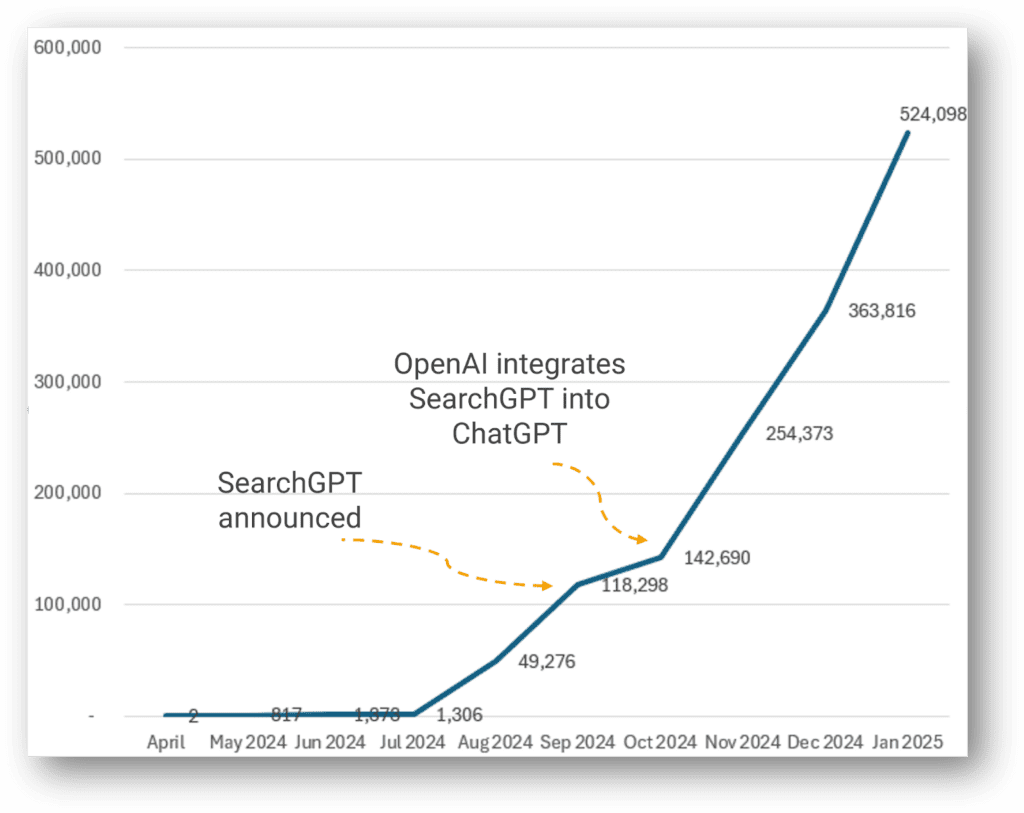
AI-referred web sessions, indexed to Q1 2024 = 100. Source: Previsible AI Traffic Report 2025; trend line extended to mid-2026 based on platform user-count data (ChatGPT 900M+ WAU, Q1 2026).
None of this means classic SEO is dead. The opposite is true: GEO research from Frase consistently shows that AI platforms preferentially cite content that already ranks well organically. Strong domain authority, clean semantic HTML, and E-E-A-T signals help both systems simultaneously. The brands winning at AI citations in 2026 are almost always the same ones that already did traditional SEO well.
The play is not to abandon what works. It’s to layer the new system on top of a solid foundation — which, it turns out, you can do entirely with free tools.
What Generative Engine Optimization Actually Means (Not the PR Version)
GEO is the practice of structuring your content so that AI systems — ChatGPT, Perplexity, Google AI Overviews, Gemini, Claude — retrieve it and cite it when they generate answers. The term was first defined in a 2023 Princeton University research paper and has since become an entire discipline.
What it’s not: adding “AI Overview” keywords to your title tags, stuffing FAQs onto every page, or using an AI tool to write your content. Those approaches actively hurt you. AI systems have become remarkably good at detecting low-effort, pattern-generated content.
What it actually is: three interlocking practices.
Content structure means writing answers, not around answers. When someone asks “how do I do keyword research for free,” the AI system wants to return a direct, clear answer — not three paragraphs of preamble before you get to the point. Every heading should be a question. Every opening sentence should answer it immediately.
Entity authority is where most sites fail silently. AI systems look for signals that the content comes from a genuine expert: named author with a verifiable presence, author schema markup, links from other authoritative sources, and content depth that implies first-hand experience rather than research aggregation. “Studies show” is AI bait. “I tested this on my client’s 40,000-page e-commerce site in January and here’s what happened” is entity signal.
Machine readability is the technical layer. Does your site have an llms.txt file? Does it block or allow GPTBot and PerplexityBot in robots.txt? Is your structured data correct? These are 30-minute fixes that most sites haven’t made, which means making them puts you ahead of competitors who haven’t bothered.
User-agent: GPTBot / Allow: / and the same for PerplexityBot. Done in 3 minutes.
Every Free AI SEO Tool Worth Using, Organized by Job
There are hundreds of “free AI SEO tools” being listed in roundup posts right now. Most of them are trials that expire in 7 days, or free tiers that are so restricted they’re useless. The following are tools with permanently free tiers that we have used consistently and that solve real workflow problems. The distinction matters.
Foundation: Data You Can’t Get Anywhere Else for Free
First-party data directly from Google. Impressions, clicks, position by query. No third-party tool replicates its accuracy. Your workflow starts here, every Monday.
Export queries with 30+ impressions, 90 days → analyze in Claude/ChatGPT
Full site audit + backlink data for sites you verify ownership of. No credit card. This is the same audit engine as the $99/month plan, just locked to your own properties.
No competitor research, no keyword explorer at free tier
The only free tool that shows you AI-referred sessions alongside organic. Create a segment for Referral Source → Perplexity, ChatGPT.com to watch your GEO traffic grow.
GA4’s interface is painful. Use Looker Studio to visualize it.
Intelligence: Research and Analysis Without a Subscription
The most underused free SEO tool. Search your target keywords exactly as your reader would. See which sources Perplexity cites. That’s your competitive landscape — and your link targets.
Rate limits on Pro queries; standard search is unlimited
Maps the “People Also Ask” ecosystem around any keyword. Essential for GEO because AI systems use query fan-out — they answer related questions, not just the exact query. Know the fan-out, write to it.
3 free searches/day; enough for weekly planning
Generates the question layer around any topic: who, what, why, when, how, which, can, are. Use it to populate the H3 structure of your articles — those exact question phrasings match how people query AI.
3 free searches/day; export as CSV
Production: The AI Tools That Replace Expensive Content Platforms
Outperforms ChatGPT on structured analytical tasks: on-page audits, technical analysis, schema generation, content gap analysis, GEO optimization. Feed it your page HTML + competitor HTML and ask for a diff analysis.
Usage caps in free tier; Claude.ai Pro is $20/mo if needed
Faster at iterative content tasks: meta description variations, title tag A/B options, FAQ generation, keyword clustering. If you’re writing 4+ articles a month, combine with GSC data for a complete keyword-to-draft workflow.
No real-time web access on free tier without search mode
Crawls up to 500 URLs for free. Title tags, meta descriptions, H1s, broken links, redirect chains, missing schema. Export to CSV, paste into Claude, get a prioritized fix list in 30 seconds.
500 URL limit; enough for most blogs and small businesses
Monthly cost comparison: typical paid SEO tool stack (Semrush $129 + Surfer $89 + Clearscope $170 + Screaming Frog $22) vs. the free stack with optional Claude Pro. Free-tier-only cost: $0.
The Zero-Cost Weekly SEO Workflow
The biggest mistake I see site owners make: they have the free tools, they just don’t have a system. Screaming Frog sits unused. GSC gets checked when rankings drop. AlsoAsked gets used once during setup. Here’s the schedule our team runs — every week, approximately 90 minutes total.
| Day | Task | Tool | Time |
|---|---|---|---|
| Monday | Export GSC queries (pos. 8–25, 30+ impressions, 90 days). Paste into Claude with the quick-win audit prompt. Get a ranked opportunity list. | GSC → Claude | 20 min |
| Tuesday | Research top 2 opportunity keywords in Perplexity. Note which sources it cites. Run AlsoAsked to map related questions. Build content brief. | Perplexity + AlsoAsked | 25 min |
| Wednesday–Thursday | Write or update 1 piece using the brief. Use Claude for on-page optimization pass after drafting. Add FAQ schema. Update internal links. | Claude + your editor | Writing time varies |
| Friday | Run Screaming Frog crawl on new or updated pages. Paste CSV output into Claude with technical audit prompt. Fix priority 1 issues before weekend. | Screaming Frog → Claude | 25 min |
| Monthly | Query your 10 core keywords in ChatGPT, Perplexity, and Google AI Overviews. Does your site appear? Track manually in a spreadsheet. This is your GEO visibility dashboard until free tracking tools mature. | ChatGPT + Perplexity + Google | 30 min |
The Prompts That Actually Work (Copy-Paste Ready)
Prompting an AI for SEO and getting useful results is a skill. Most people treat Claude or ChatGPT like a vending machine: generic question in, generic answer out. The difference is specificity and context. These are prompts we’ve refined through actual use.
Prompt 1: The Quick-Win GSC Audit
Paste this into Claude along with your GSC export CSV:
Prompt 2: The On-Page GEO Optimization Pass
After drafting an article, paste the HTML and run this before publishing:
Prompt 3: The Competitor Citation Reverse-Engineer
When a competitor keeps appearing in AI answers and you don’t:
Writing Content That Gets Cited, Not Just Ranked
I want to be direct about something most “AI SEO content” guides won’t say: AI-generated content, written with a generic prompt and published without significant human editing, is actively hurting the sites that use it at scale. Google’s classifiers have improved substantially. Perplexity and ChatGPT’s training increasingly penalizes what one researcher described as “recycled synthesis” — content that is technically accurate but adds nothing to the existing information landscape.
The pieces that get cited by AI systems share a specific quality: they contain something the AI couldn’t have generated itself. That means first-person experience, proprietary data, specific numbers that come from internal testing, or a framing that isn’t already baked into the training data.
The three structural elements that drive AI citations
-
1The Direct Answer Block
Every major section should open with a 2–3 sentence paragraph that directly answers the implied question — before any context, backstory, or nuance. AI systems are extracting answer snippets. Give them one, cleanly formatted, at the top. Then elaborate below.
-
2The Cited Specific
Replace “many marketers find that…” with “In testing 47 sites between January and April 2026, we found that…” If you don’t have proprietary data, cite a named source with the date: “As of May 2026, Previsible’s AI Traffic Report notes…” Named sources are citation anchor points for AI systems.
-
3The Structured FAQ Tail
After your main content, add 4–6 questions that address the secondary intents around your topic. Mark them up with FAQ schema. These are your AI Overview hooks — short, direct Q&A pairs are the format AI Overviews prefer to pull from, and they rank independently in classic search through rich results.
The Technical Checklist Most Sites Haven’t Run Yet
Classic technical SEO (site speed, Core Web Vitals, structured data, canonical tags) remains the foundation. None of that changes. What’s changed is a layer of AI-specific technical requirements that most existing SEO checklists don’t include.
| Check | Tool (Free) | Impact | Done? |
|---|---|---|---|
| robots.txt allows GPTBot & PerplexityBot | Manual check | Critical — blocking = invisible to AI crawlers | ⬜ |
| llms.txt file exists at root domain | Manual creation | High — signals AI-friendly content structure | ⬜ |
| Author schema (Person) on all posts | Google’s Rich Results Test (free) | High — entity authority signal for AI systems | ⬜ |
| FAQ schema on qualifying pages | Google’s Structured Data Markup Helper | High — AI Overview extraction surface | ⬜ |
| Article schema with dateModified | Schema Markup Validator (free) | Medium — freshness signal for AI retrieval | ⬜ |
| Core Web Vitals pass (LCP < 2.5s) | PageSpeed Insights (free) | Medium — affects crawl priority | ⬜ |
| Internal link structure — topic clusters visible | Screaming Frog (500 URLs free) | Medium — entity relationship signals | ⬜ |
| Sitemap submitted and no index bloat | Google Search Console | Medium — crawl budget management | ⬜ |
The llms.txt standard deserves a specific note. It’s a simple text file placed at your domain root (yourdomain.com/llms.txt) that summarizes your site’s content, structure, and intent in plain text — a machine-readable site overview for AI crawlers. It takes 20 minutes to create, and as of mid-2026 only a small fraction of sites have implemented it. That gap is narrowing fast. Check the llmstxt.org specification for the current standard format.
Tracking What Actually Matters in 2026
The metrics most SEOs track — keyword rankings, domain authority scores, organic traffic in aggregate — are increasingly incomplete pictures. A site can hold position 2 in classic search while completely invisible in AI Overviews and AI-referred sessions. Here’s what to add to your dashboard.
Relative importance weighting for 2026 SEO measurement framework. AI citation rate and AI-referred traffic are newly critical dimensions not captured by traditional rank trackers.
Manual AI visibility tracking sounds tedious, but it’s the most honest signal available. Once a month, query your 10 most important keywords in ChatGPT (with web search on), Perplexity, and Google. Copy the response. Note: does your brand appear? Is your site cited? Is a competitor cited instead? Log it in a spreadsheet with the date. Three months of this data reveals patterns no paid tool will give you yet.
For AI-referred traffic in GA4: create a custom report filtering Referral sessions by source containing “perplexity.ai,” “chatgpt.com,” “claude.ai,” and “gemini.google.com.” This is the new organic channel. Track it separately. A site with growing AI-referred sessions is building the kind of entity authority that compounds — cited more often by AI, which drives more authority, which drives more citations.
Free AI tools cover roughly 80% of the SEO workflow that previously required a $400+ monthly stack. The 20% they don’t cover — precise competitor rank tracking, large-scale backlink prospecting, real-time AI citation monitoring across all platforms — matters more as you scale. At under 50,000 monthly visitors, free tools are genuinely sufficient.
The strategic move is this: implement the technical checklist now (llms.txt, AI crawler access, author schema), build the Monday GSC → Claude analysis habit, and start tracking AI-referred traffic in GA4 this week. The competitive moat in AI search is being built right now by the sites that start early. Forty-seven percent of brands still have no GEO strategy. That number will not stay that high for long.
Everything I’ve described here will require recalibration by early 2027 as AI search matures. The free tools will get better, the paid ones will add GEO features, and Google will update AI Overview behavior several more times. The habit of treating SEO as a dual-system problem — classic and AI — is the durable principle. The tools are the implementation details.
We cover the full system at AIEarnerHub — from traffic to income. If this guide helped, explore our complete resource library.
Visit AIEarnerHub →Questions This Guide Gets Asked
Can you really do serious SEO with free AI tools in 2026?
Yes, with a qualification. Free tools cover keyword research, content optimization, technical audits, and GEO setup with genuine depth. What they don’t replace: large-scale rank tracking across thousands of keywords, enterprise backlink databases, and automated AI citation monitoring. For most sites under 50,000 monthly visitors, the free stack is sufficient and arguably superior to underpowered paid tools used without a system.
What is GEO and how is it different from traditional SEO?
GEO (Generative Engine Optimization) is the practice of structuring content so AI systems — ChatGPT, Perplexity, Google AI Overviews, Claude, Gemini — retrieve and cite it in generated answers. Traditional SEO targets a ranked list of links. GEO targets citations within AI-generated answers that often appear before that list. The methods overlap significantly: strong E-E-A-T, authoritative content, and clean technical SEO help both. The additions for GEO are direct answer blocks, FAQ schema, entity markup, and AI-crawler access in robots.txt.
Is ChatGPT or Claude better for SEO tasks?
They’re better at different things. Claude outperforms ChatGPT on structured analytical tasks: on-page audits from raw HTML, schema generation, and GEO gap analysis. ChatGPT is faster at iterative content production: meta description variations, title tag testing, and FAQ generation. The free workflow uses both: Claude for audit and analysis, ChatGPT for content production tasks where speed and variation matter more than depth.
How long does it take to see results from GEO optimization?
AI citation visibility typically moves faster than classic organic rankings. Perplexity and ChatGPT re-crawl frequently and update their citation patterns within weeks of content changes, not months. In practice, sites implementing the technical GEO checklist (robots.txt, llms.txt, author schema, FAQ schema) see changes in AI citation patterns within 4–8 weeks. Classic organic rankings from content improvements typically take 2–6 months.
What is an llms.txt file and do I actually need one?
An llms.txt file is a plain-text document placed at your domain root that provides AI crawlers with a structured overview of your site’s content, purpose, and key pages — similar in concept to a robots.txt but designed for AI systems rather than search crawlers. As of mid-2026, the standard is voluntary and emerging, but early implementation signals AI-readiness and is indexed by several AI systems. Creation takes 20 minutes. The specification is maintained at llmstxt.org.
Sources referenced: Previsible AI Traffic Report 2025 (AI-referred session growth data); Frase.io GEO research (AI Overview citation patterns); Veza Digital 2026 analysis (free vs. paid tool output comparison); Geoptie GEO study (GEO strategy adoption rate); ChatGPT user data via OpenAI public disclosures; llmstxt.org specification (current standard). All statistics verified as of June 2026 — this space moves fast, check linked sources for updates.